
Atarax
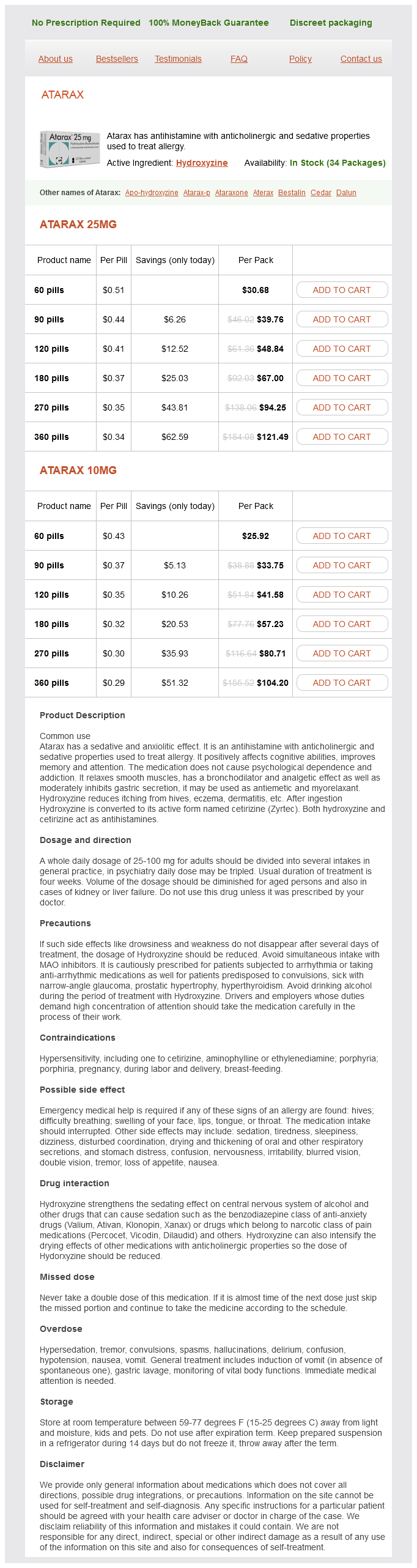
Atarax 25mg
- 60 pills - $30.68
- 90 pills - $39.76
- 120 pills - $48.84
- 180 pills - $67.00
- 270 pills - $94.25
- 360 pills - $121.49
Atarax 10mg
- 60 pills - $25.92
- 90 pills - $33.75
- 120 pills - $41.58
- 180 pills - $57.23
- 270 pills - $80.71
- 360 pills - $104.20
Atarax dosages: 25 mg, 10 mg
Atarax packs: 60 pills, 90 pills, 120 pills, 180 pills, 270 pills, 360 pills
In stock: 964
Only $0,31 per item
Description
Randomised trial of irinotecan plus supportive care versus supportive care alone after fluorouracil failure for sufferers with metastatic colorectal most cancers anxiety symptoms help buy atarax 10 mg amex. Oxaliplatin plus irinotecan compared with irinotecan alone as second-line treatment after single-agent fluoropyrimidine remedy for metastatic colorectal carcinoma anxiety symptoms natural remedies atarax 10 mg on line. Capecitabine plus oxaliplatin compared with 5-fluorouracil plus oxaliplatin in metastatic colorectal cancer: Meta-analysis of randomized managed trials anxiety symptoms treatment and prevention buy discount atarax 25 mg. The role of upkeep strategies in metastatic colorectal cancer: a scientific review and network meta-analysis of randomized medical trials anxiety symptoms unreal order atarax 10 mg visa. Oxaliplatin together with protracted-infusion fluorouracil and radiation: report of a scientific trial for sufferers with esophageal most cancers. Concurrent cisplatin, paclitaxel, and radiotherapy as preoperative remedy for patients with locoregional esophageal carcinoma. Definitive concomitant chemoradiotherapy with docetaxel and cisplatin in squamous esophageal carcinoma. Phase I trial of docetaxel, cisplatin and concurrent radical radiotherapy in regionally advanced oesophageal cancer. First-line nivolumab plus chemotherapy versus chemotherapy alone for superior gastric, gastrooesophageal junction, and oesophageal adenocarcinoma (CheckMate 649): a randomised, open-label, section 3 trial. Chemotherapy with cisplatin and paclitaxel in patients with domestically superior, recurrent or metastatic oesophageal cancer. Activity of taxol in sufferers with squamous cell carcinoma and adenocarcinoma of the esophagus. Quality of life throughout palliative systemic remedy for esophagogastric cancer: systematic evaluation and meta-analysis. Salvage chemotherapy with biweekly irinotecan, plus 5-fluorouracil and leucovorin in sufferers with superior gastric most cancers beforehand treated with fluoropyrimidine, platinum, and taxane. Combined postoperative radiotherapy and weekly cisplatin infusion for regionally advanced head and neck carcinoma: last report of a randomized trial. CheckMate 141: 1-year update and subgroup evaluation of nivolumab as firstline remedy in sufferers with recurrent/metastatic head and neck most cancers. Weekly low-dose versus three-weekly high-dose cisplatin for concurrent chemoradiation in locoregionally superior non-nasopharyngeal head and neck most cancers: a systematic evaluation and meta-analysis of mixture information. Platinum analogs in recurrent and superior head and neck most cancers: a Southwest Oncology Group and Wayne State University study. Comparison of 5 cisplatin-based regimens incessantly used because the first-line protocols in metastatic nasopharyngeal carcinoma. Gemcitabine plus cisplatin versus fluorouracil plus cisplatin in recurrent or metastatic nasopharyngeal carcinoma: a multicentre, randomised, open-label, phase 3 trial. Induction chemotherapy in domestically superior squamous cell carcinoma of the head and neck: function, controversy, and future directions. Chemoradiation evaluating cisplatin versus carboplatin in regionally superior nasopharyngeal most cancers: randomised, non-inferiority, open trial. Final results of the 94-01 French Head and Neck Oncology and Radiotherapy Group randomized trial evaluating radiotherapy alone with concomitant radiochemotherapy in advanced-stage oropharynx carcinoma. Randomized trial of radiation remedy versus concomitant chemotherapy and radiation remedy for advanced-stage oropharynx carcinoma. Radiotherapy plus cetuximab for locoregionally superior head and neck cancer: 5-year survival information from a section three randomised trial, and relation between cetuximab-induced rash and survival. Randomized comparison of neoadjuvant cisplatin and fluorouracil infusion adopted by radiation versus concomitant treatment in advanced head and neck cancer. Preliminary results of Radiation Therapy Oncology Group 97-03: a randomized part ii trial of concurrent radiation and chemotherapy for advanced squamous cell carcinomas of the pinnacle and neck. Adjuvant chemotherapy in sufferers with locoregionally superior nasopharyngeal carcinoma: long-term outcomes of a phase three multicentre randomised managed trial. Chemoradiotherapy regimens for locoregionally advanced nasopharyngeal carcinoma: a bayesian community meta-analysis. Concurrent chemoradiotherapy with carboplatin followed by carboplatin and 5-fluorouracil in locally advanced nasopharyngeal carcinoma. Induction chemotherapy plus concurrent chemoradiotherapy versus concurrent chemoradiotherapy alone in locoregionally advanced nasopharyngeal carcinoma: a phase 3, multicentre, randomised controlled trial. Induction chemotherapy plus concurrent chemoradiotherapy in endemic nasopharyngeal carcinoma: individual affected person data pooled analysis of four randomized trials. Docetaxel (Taxotere): an energetic drug for the treatment of sufferers with advanced squamous cell carcinoma of the pinnacle and neck. Salvage gemcitabine-vinorelbine chemotherapy in sufferers with metastatic nasopharyngeal carcinoma pretreated with platinum-based chemotherapy. Effective April 25, 2022 44 Hepatocellular Carcinoma Pathways Unresectable and Metastatic Disease First Line of Therapy (1st Line) Atezolizumab and bevacizumab1, 2 Sorafenib3-5 Unresectable and Metastatic Disease Second Line of Therapy (2nd Line) Cabozantinib6 Regorafenib7 Note: Pathways are unbiased of specific health plan medical coverage protection standards. Nivolumab in patients with advanced hepatocellular carcinoma (CheckMate 040): an open-label, noncomparative, phase half dose escalation and enlargement trial. Nivolumab in patients with superior hepatocellular carcinoma and Child-Pugh class B cirrhosis: safety and scientific outcomes in a retrospective case series. Efficacy and security of nivolumab plus ipilimumab in patients with superior hepatocellular carcinoma beforehand treated with sorafenib: the CheckMate 040 randomized clinical trial. Efficacy of abbreviated Stanford V chemotherapy and involved-field radiotherapy in earlystage Hodgkin lymphoma: mature outcomes of the G4 trial. Stanford V program for domestically extensive and superior Hodgkin lymphoma: the Memorial Sloan-Kettering Cancer Center experience. Effective April 25, 2022 forty nine Intra- and Extra-hepatic Cholangiocarcinoma Pathways Unresectable and Metastatic Disease First Line of Therapy (1st Line) Gemcitabine and cisplatin1-8 Note: Pathways are independent of specific well being plan medical policy protection criteria. Chemotherapy in advanced biliary tract carcinoma: a pooled evaluation of scientific trials. Gemcitabine alone or in combination with cisplatin in patients with biliary tract most cancers: a comparative multicentre research in Japan. Nab-paclitaxel and gemcitabine as first-line therapy of superior or metastatic cholangiocarcinoma: a phase 2 scientific trial. Best supportive care in contrast with chemotherapy for unresectable gall bladder cancer: a randomized controlled examine. Outpatient chemotherapy with gemcitabine and oxaliplatin in patients with biliary tract cancer. Oral capecitabine for the therapy of hepatocellular carcinoma, cholangiocarcinoma, and gallbladder carcinoma. A multi-center retrospective evaluation of survival benefits of chemotherapy for unresectable biliary tract cancer. Pemigatinib for previously treated, domestically advanced or metastatic cholangiocarcinoma: a multicentre, open-label, part 2 study. Effective April 25, 2022 fifty two Kidney Cancer (Renal Cell Carcinoma) Pathways Metastatic Disease First Line of Therapy (1st Line) Clear Cell Carcinoma Nivolumab (Opdivo) and cabozantinib (Cabometyx)24,25 � Added Effective 4/25/2022 Nivolumab (Opdivo) and ipilimumab (Yervoy)2-4 Pembrolizumab (Keytruda) and axitinib (Inlyta)5 Metastatic Disease Second or Subsequent Lines of Therapy (2nd Line+) Clear Cell Carcinoma � Termed Effective 4/25/2022 Nivolumab (Opdivo)1,49,52� Termed Effective 4/25/2022 Note: Pathways are independent of particular health plan medical coverage coverage criteria. Nivolumab plus ipilimumab versus sunitinib in first-line remedy for advanced renal cell carcinoma: prolonged follow-up of efficacy and safety outcomes from a randomised, managed, part three trial. Quality of life in patients with superior renal cell carcinoma given nivolumab versus everolimus in CheckMate 025: a randomised, open-label, section 3 trial. The high-dose aldesleukin "choose" trial: a trial to prospectively validate predictive models of response to treatment in patients with metastatic renal cell carcinoma. How to interpret patient preferences in choosing the right drug: are the current measurements up to the job Overall survival and updated outcomes for sunitinib compared with interferon alfa in sufferers with metastatic renal cell carcinoma. Safety and efficacy of sunitinib for metastatic renal-cell carcinoma: an expanded-access trial. First-line sunitinib versus pazopanib in metastatic renal cell carcinoma: outcomes from the International Metastatic Renal Cell Carcinoma Database Consortium. Active surveillance in metastatic renal-cell carcinoma: a prospective, part 2 trial. Axitinib versus sorafenib as first-line therapy in sufferers with metastatic renal-cell carcinoma: a randomised open-label phase three trial. Cabozantinib in advanced non-clear-cell renal cell carcinoma: a multicentre, retrospective, cohort research. Cabozantinib for the remedy of sufferers with metastatic non-clear cell renal cell carcinoma: a retrospective evaluation. Independent assessment of lenvatinib plus everolimus in patients with metastatic renal cell carcinoma. Clinical activity of nivolumab in patients with non-clear cell renal cell carcinoma.
Phaseolus (Bean Pod). Atarax.
- Dosing considerations for Bean Pod.
- Are there any interactions with medications?
- Are there safety concerns?
- How does Bean Pod work?
- What is Bean Pod?
- Lowering cholesterol, weight loss, urinary tract infections (UTIs), kidney stones, lung cancer, and diabetes.
Source: http://www.rxlist.com/script/main/art.asp?articlekey=96678
In the Herceptin plus chemotherapy arm anxiety 12 signs atarax 25 mg quality, the initial dose of Herceptin 8 mg/kg was administered on Day 1 (prior to 13 chemotherapy) adopted by 6 mg/kg every 21 days until illness progression anxiety 800 numbers 10 mg atarax quality. Cisplatin was administered at 80 mg/m2 on Day 1 and the fluoropyrimidine was administered as both capecitabine a thousand mg/m2 orally twice a day on Days 1�14 or 5-fluorouracil 800 mg/m2/day as a continuous intravenous infusion Days 1 via 5 anxiety symptoms rash atarax 10 mg purchase with amex. Median period of Herceptin remedy was 21 weeks; median variety of Herceptin infusions administered was eight anxiety symptoms loss of appetite generic 25 mg atarax free shipping. This evaluation also confirmed proof of reversibility of left ventricular dysfunction, with sixty four. In the metastatic breast most cancers trials, the probability of cardiac dysfunction was highest in sufferers who acquired Herceptin concurrently with anthracyclines. Infusion Reactions During the first infusion with Herceptin, the symptoms most commonly reported were chills and fever, occurring in roughly 40% of patients in clinical trials. Symptoms had been treated with acetaminophen, diphenhydramine, and meperidine (with or without discount within the rate of Herceptin infusion); everlasting discontinuation of Herceptin for infusion reactions was required in < 1% of sufferers. Other signs and/or symptoms could embody nausea, vomiting, pain (in some circumstances at tumor sites), rigors, headache, dizziness, dyspnea, hypotension, elevated blood stress, rash, and asthenia. In the post-marketing setting, severe infusion reactions, including hypersensitivity, anaphylaxis, and angioedema have been reported. The most typical website of infections within the adjuvant setting concerned the upper respiratory tract, skin, and urinary tract. Fatal respiratory failure occurred in 3 sufferers receiving Herceptin, one as a component of multi-organ system failure, as compared to 1 patient receiving chemotherapy alone. In Study three, there were 4 instances of interstitial pneumonitis within the one-year Herceptin therapy arm compared to none in the statement arm at a median follow-up duration of 12. Metastatic Breast Cancer Among ladies receiving Herceptin for therapy of metastatic breast cancer, the incidence of pulmonary toxicity was additionally increased. Pulmonary adverse occasions have been reported within the post-marketing experience as part of the symptom complex of infusion reactions. Pulmonary occasions include bronchospasm, hypoxia, dyspnea, pulmonary infiltrates, pleural effusions, non-cardiogenic pulmonary edema, and acute respiratory distress syndrome. Thrombosis/Embolism In four randomized, managed scientific trials, the incidence of thrombotic opposed events was larger in patients receiving Herceptin and chemotherapy in comparison with chemotherapy alone in three studies (2. Of patients receiving Herceptin as a single agent for the remedy of metastatic breast cancer, 25% skilled diarrhea. An elevated incidence of diarrhea was noticed in patients receiving Herceptin together with chemotherapy for therapy of metastatic breast most cancers. Renal Toxicity In Study 7 (metastatic gastric cancer) on the Herceptin-containing arm as in comparison with the chemotherapy alone arm the incidence of renal impairment was 18% compared to 14. Treatment discontinuation for renal insufficiency/failure was 2% on the Herceptin-containing arm and 0. In the post-marketing setting, uncommon circumstances of nephrotic syndrome with pathologic proof of glomerulopathy have been reported. The time to onset ranged from 4 months to roughly 18 months from initiation of Herceptin therapy. Pathologic findings included membranous 20 glomerulonephritis, focal glomerulosclerosis, and fibrillary glomerulonephritis. The incidence of antibody formation is extremely depending on the sensitivity and the specificity of the assay. Additionally, the observed incidence of antibody (including neutralizing antibody) positivity in an assay could also be influenced by several factors including assay methodology, sample dealing with, timing of sample assortment, concomitant medications, and underlying disease. For these reasons, comparability of the incidence of antibodies to Herceptin with the incidence of antibodies to different products could additionally be deceptive. If attainable, physicians should keep away from anthracycline-based remedy for up to 7 months after stopping Herceptin. If Herceptin is administered during being pregnant, or if a affected person becomes pregnant whereas receiving Herceptin or within 7 months following the final dose of Herceptin, health care suppliers and sufferers should immediately report Herceptin exposure to Genentech at 1-888-835-2555. In post-marketing stories, use of Herceptin throughout being pregnant resulted in cases of oligohydramnios and of oligohydramnios sequence, manifesting as pulmonary hypoplasia, skeletal abnormalities, and neonatal demise [see Data]. There are scientific 21 concerns if Herceptin is utilized in a pregnant girl or if a patient becomes pregnant within 7 months following the last dose of Herceptin [see Clinical Considerations]. Clinical Considerations Fetal/Neonatal Adverse Reactions Monitor ladies who obtained Herceptin throughout being pregnant or inside 7 months prior to conception for oligohydramnios. Data Human Data In post-marketing stories, use of Herceptin during being pregnant resulted in instances of oligohydramnios and of oligohydramnios sequence, manifesting within the fetus as pulmonary hypoplasia, skeletal abnormalities, and neonatal demise. These case reports described oligohydramnios in pregnant ladies who obtained Herceptin both alone or together with chemotherapy. In one case, Herceptin remedy resumed after amniotic index improved and oligohydramnios recurred. Animal Data In research the place trastuzumab was administered to pregnant Cynomolgus monkeys in the course of the interval of organogenesis at doses up to 25 mg/kg given twice weekly (up to 25 instances the recommended weekly human dose of 2 mg/kg), trastuzumab crossed the placental barrier through the early (Gestation Days 20 to 50) and late (Gestation Days one hundred twenty to 150) phases of gestation. Trastuzumab was current within the milk of lactating Cynomolgus monkeys however not related to neonatal toxicity [see Data]. This consideration also wants to keep in mind the trastuzumab wash out interval of seven months [see Clinical Pharmacology (12. Contraception Females Herceptin could cause embryo-fetal hurt when administered during pregnancy. Advise females of reproductive potential to use effective contraception throughout treatment with Herceptin and for 7 months following the final dose of Herceptin [see Use in Specific Populations (8. The threat of cardiac dysfunction was elevated in geriatric patients as in comparability with younger patients in both those receiving therapy for metastatic illness in Studies 5 and 6, or adjuvant remedy in Studies 1 and 2. Limitations in information collection and differences in research design of the four studies of Herceptin in adjuvant treatment of breast cancer preclude a willpower of whether or not the toxicity profile of Herceptin in older sufferers is completely different from youthful patients. In Study 7 (metastatic gastric cancer), of the 294 sufferers treated with Herceptin, 108 (37%) had been 65 years of age or older, whereas thirteen (4. Herceptin (trastuzumab) for injection is a sterile, white to pale yellow, preservative-free lyophilized powder with a cake-like look, for intravenous administration. Total trastuzumab clearance will increase with decreasing concentrations as a result of parallel linear and non-linear elimination pathways. Although the typical trastuzumab exposure was greater following the primary cycle in breast cancer patients receiving the three-weekly schedule compared to the weekly schedule of Herceptin, the common steady-state exposure was essentially the identical at both dosages. The pharmacokinetics of trastuzumab in patients with extreme renal impairment, end-stage renal illness with or without hemodialysis, or hepatic impairment is unknown. Drug Interaction Studies There have been no formal drug interaction studies carried out with Herceptin in people. Paclitaxel and doxorubicin: Concentrations of paclitaxel and doxorubicin and their major metabolites. Docetaxel and carboplatin: When Herceptin was administered together with docetaxel or carboplatin, neither the plasma concentrations of docetaxel or carboplatin nor the plasma concentrations of trastuzumab have been altered. No proof of mutagenic activity was noticed when trastuzumab was examined in the usual Ames bacterial and human peripheral blood lymphocyte mutagenicity assays at concentrations of up to 5000 mcg/mL. In an in vivo micronucleus assay, no evidence of chromosomal injury to mouse bone marrow cells was noticed following bolus intravenous doses of as much as 118 mg/kg of trastuzumab. In each trials, patients acquired four 21-day cycles of doxorubicin 60 mg/m2 and cyclophosphamide 600 mg/m2. Paclitaxel was administered both weekly (80 mg/m2) or every three weeks (175 mg/m2) for a total of 12 weeks in Study 1; paclitaxel was administered only by the weekly schedule in Study 2. Herceptin was administered at 4 mg/kg on the day of initiation of paclitaxel and then at a dose of 2 mg/kg weekly for a complete of 52 weeks. The information from both arms in Study 1 and two of the three research arms in Study 2 had been pooled for efficacy analyses. Similar demographic and baseline traits were reported for the efficacy evaluable population, after 8. Patients were randomized (1:1:1) upon completion of definitive surgery, and no much less than 4 cycles of chemotherapy to receive no extra remedy, or one year of Herceptin remedy or two years of Herceptin treatment. Herceptin was administered with an initial dose of eight mg/kg followed by subsequent doses of 6 mg/kg once every three weeks.
Specifications/Details
Up to 55% of benign nodules are hypoechoic in comparability with anxiety symptoms 6 year old atarax 10 mg cheap thyroid parenchyma anxiety weight loss quality 25 mg atarax, making nodule hypoechogenicity less particular anxiety symptoms 3 year old cheap 10 mg atarax otc. In addition anxiety symptoms causes buy atarax 25 mg with mastercard, subcentimeter benign nodules usually have a tendency to be hypoechoic than larger nodules (71). Multivariable analyses confirm that the chance of most cancers is higher for nodules with either microlobulated margins or microcalcifications than for hypoechoic stable nodules missing these features (70). Macrocalcifications within a nodule, if mixed with microcalcifications, confer the identical malignancy threat as microcalcifications alone (70;74). On the opposite hand, a nodule that has interrupted peripheral calcifications, in 22 Page 23 of 411 23 affiliation with a gentle tissue rim outdoors the calcification, is very more doubtless to be malignant and the related pathology might demonstrate tumor invasion within the area of disrupted calcification (79;80). These tumors are extra likely to be iso- to hyperechoic, noncalcified, spherical (width greater than anterioposterior dimension) nodules with common easy margins (82). Distant metastases are rarely noticed arising from follicular cancers < 2 cm in diameter, subsequently justifying the next dimension cutoff for hyperechoic nodules (83). Of 360 consecutively surgically removed thyroid cancers at the Mayo clinic, 88% were solid or minimally cystic (<5%), 9% were <50% cystic and only 3 % were greater than 50% cystic (85). In addition, evidence linking sonographic features with malignancy on this subgroup of nodules is much less sturdy, originating from univariate rather than multivariate analyses. However, an eccentric somewhat than concentrenic place of the solid part along the cyst wall, an acute rather than obtuse angle interface of the solid component and cyst, and the presence of microcalcifications constantly confer a higher danger of malignancy (85-87). On the opposite hand, a spongiform appearance of mixed cystic stable nodules is strongly correlated with benignity (66;70;71;88). A spongiform appearance is defined because the aggregation of multiple microcystic parts in additional than 50% of the volume of the nodule (71). Spongiform and different combined cystic strong nodules may exhibit brilliant reflectors on ultrasound imaging, caused by colloid crystals or posterior acoustic enhancement of the back wall of a Thyroid Downloaded from online. These could additionally be confused with microcalcifications by less proficient sonographers, and a recent meta-analysis confirmed that operator experience is correlated with accurate analysis of inside calcifications (66). Lastly, pure cysts, though uncommon (<2% of thyroid lesions), are extremely prone to be benign (66;89;90). Given the nuances in sonographic appearances of different thyroid cancer histologies, in addition to the challenges posed by partially cystic nodules, some authors have advised danger stratification primarily based upon a constellation of sonographic features (89-91). The sonographic look for the vast majority of thyroid nodules could be typically classified in the following classes of ultrasound patterns, which combine several individual sonographic characteristics. Since the interobserver variability in reporting individual characteristics is moderate even within managed research (72), the use of patterns exhibiting correlated sonographic features is extra strong. Two current research have reported substantial interobserver correlation for identification 24 Page 25 of 411 25 for nodule sonographic patterns (multirater kappa statistics >0. High suspicion [malignancy risk >70-90% (89;ninety;94)]: Solid hypoechoic nodule or a solid hypoechoic part in a partially cystic nodule with one or more of the next features: irregular margins (specifically outlined as infiltrative, microlobulated, or spiculated), Thyroid Downloaded from on-line. A nodule demonstrating this ultrasound sample is highly prone to be a papillary thyroid most cancers. Nodules with the high suspicion pattern and > 1cm should endure diagnostic nice needle biopsy to refute or verify malignancy. However, in the absence of evidence of extrathyroidal extension, metastatic cervical lymph nodes, or distant metastases, micropapillary thyroid cancers (<1cm) usually have an indolent course but this will likely rely upon patient age (95). Although no distant metastases or deaths occurred in a latest observational series of 1235 Japanese sufferers with biopsy-proven papillary thyroid cancer, tumor growth and new look of lymph node metastases occurred more regularly in sufferers younger than 40 years of age in contrast with those over age 60 (5. This look has the very best sensitivity (60-80%) for papillary thyroid cancer, however a decrease specificity than the above excessive suspicion pattern, and fine needle biopsy must be thought-about for these nodules > 1cm to refute malignancy. Low suspicion [malignancy threat 5-10% (89;90;94)]: Isoechoic or hyperechoic solid nodule, or Thyroid Downloaded from online. Only about 15% -20% of thyroid cancers are iso- or hyperechoic on ultrasound, and these are typically the follicular variant of papillary thyroid most cancers or follicular thyroid cancers (71). Therefore, these appearances are related to a decrease chance of malignancy and observation may be warranted till the size is > 1. Very low suspicion [<3% (66;89;90;94)]: Spongiform or partially cystic nodules with none of the sonographic options described within the low, intermediate or high suspicion patterns have a low danger of malignancy (<3%). Aspiration with or with out ethanol ablation could additionally be thought of as a therapeutic intervention if a cyst is massive and symptomatic; cytology should be carried out if aspirated. Sonographic evaluation of the anterior cervical lymph node compartments (central and lateral) ought to be carried out whenever thyroid nodules are detected. Although there are several known clinical danger components for thyroid cancer in patients with thyroid nodules including immobility with swallowing, ache, cough, voice change, development, lymphadenopathy and history of childhood irradiation (either therapeutic. Performance requires an ultrasound machine, in addition to a required elastography computational module, which most often have to be purchased individually. An initial potential research of ninety two chosen, non-randomized patients suggested a close to 100% constructive and unfavorable predictive value (97). However, more recent, bigger trials have reported substantially totally different outcomes. Moon and colleagues retrospectively studied 703 thyroid nodules in comparison to gray-scale ultrasound (78). The largest potential research of 706 patients with 912 thyroid nodules was lately published by Azizi et al. Recently, a blinded prospective analysis of inter-observer concordance utilizing Bethesda classification was carried out. These information confirm an inherent limitation to the reproducibility of deciphering any cytology specimen (106). Nonetheless, classification utilizing the Bethesda system has confirmed extremely helpful, permitting practicioners to speak with the identical terminology and better convey malignant threat. Ideally, the the risk of malignancy in every of the six diagnostic categories must be independently defined at every cytology center or institution to information clinicians on danger estimates and assist choose appropriate molecular testing for sufferers with indeterminate cytology. If clinical and ultrasound options are suspicious for malignancy, a shorter ready interval could also be acceptable. The frequency of malignancy amongst all initially nondiagnostic samples was 2-4% and among those nondiagnostic samples that had been finally resected was 9-32%. Of 104 nodules with 2 nondiagnostic cytology results, thyroid most cancers was found in 25% of those with microcalcifications, irregular margins, a taller than broad shape or hypoechogenicity, but in solely 4% missing these options (118). Some research have discovered that core biopsy offers the next adequacy fee, but may be much less delicate for the detection of papillary most cancers (123;124). Mutational testing could also be informative in samples considered inadequate by qualitative criteria. This is a singlecenter study where the practice is to offer thyroidectomy or lobectomy to all sufferers with nodules > four cm. Interestingly, in both these studies 66% of the missed cancers had been present in nodules with high suspicion sonographic pattern, despite preliminary benign cytology. Follow-up for sufferers with benign cytology is mentioned in part [A24] and Recommendation 23. However, an energetic surveillance administration strategy can be thought-about as a substitute for quick surgery in: A) patients with very low danger tumors. Of 1235 patients, 191 underwent surgical remedy after statement, including these with tumor enlargement and new lymph node metastases. These sufferers have been followed a median of seventy five months (range 1-246 months) after the surgical intervention. Only one of many patients treated with surgery after statement developed 35 Page 36 of 411 36 tumor recurrence. Of these, tumor size enlargement was observed in 7% of sufferers, and 1% developed obvious lymph node metastasis. Footnote: the final draft for the sections (A15-A19) and suggestions (13-17) have been revised and approved by a subgroup of 7 members of the task force with no perceived conflicts or competing interests on this space. Furthermore, companion use of predictive molecular markers involves the identification of patient subgroups in whom a therapeutic intervention is confirmed to be either helpful or dangerous, with supposed implications for acceptable scientific stratification of therapies (158). It is important to note that long-term outcome knowledge on companion use of molecular marker status to information therapeutic decision-making is currently lacking, and subsequently we have no idea if implementation of molecular marker use in routine scientific practice would end in a significant general profit in well being outcomes in patients with thyroid nodules. As this could be a rapidly evolving subject of investigation, it is going to be necessary to perform interval evaluations of the printed evidence to assure that recommendations remain Thyroid Downloaded from online.
Syndromes
- Hematoma (blood accumulating under the skin)
- Luteinizing hormone (LH) -- controls sexual function and fertility in males and females
- Hematoma (blood accumulating under the skin)
- Medicines to treat for the liver disease, including ascites
- Stress
- Migraine headache
Related Products
Additional information:
Usage: b.i.d.
Tags: purchase atarax 25 mg visa, atarax 10 mg generic free shipping, atarax 25 mg purchase free shipping, buy atarax 25 mg without prescription, buy cheap atarax 25 mg on line, 10 mg atarax discount with amex, generic atarax 10 mg without prescription, buy discount atarax 10 mg, discount 10 mg atarax, atarax 25 mg purchase with mastercard, atarax 25 mg cheap with mastercard, discount atarax 10 mg otc, buy atarax 10 mg on line, 25 mg atarax, generic 25 mg atarax otc, 10 mg atarax purchase with amex
8 of 10
Votes: 294 votes
Total customer reviews: 294
Customer Reviews
Onatas, 47 years: Pellegriti G, Scollo C, Giuffrida D, Vigneri R, Squatrito S, Pezzino V 2001 Usefulness of recombinant human thyrotropin in the radiometabolic treatment of selected sufferers with thyroid cancer. Nonetheless, a ten year recurrence rate of 2% was seen in sufferers with three or fewer metastatic lymph nodes with extranodal extension while a recurrence fee of 38% was reported in sufferers with three or more metastatic lymph nodes with extracapsular extension. Laparoscopic-assisted whole cyst excision of choledochal cyst and Rouxen-Y hepatoenterostomy. These effects might account for a variety of the present extreme variability in utilization of radioactive iodine for thyroid most cancers (368).
Lares, 22 years: Duration of Illness Usually self-limited Several days Usually self-limited Associated Foods Metallic container. The affected person is then tilted away from the surgeon, the bean bag supporting the again removed and the patient positioned as supine as possible. The posterior wall of the renal pelvis is simply dismembered after the ureter is reanastomosed to the renal pelvis. It can frequently be recovered from hot water systems, particularly in hospitals, which may additionally result in nosocomial (hospital) infections or pseudoinfections (contamination of scientific specimens or bronchoscopes during collection).