
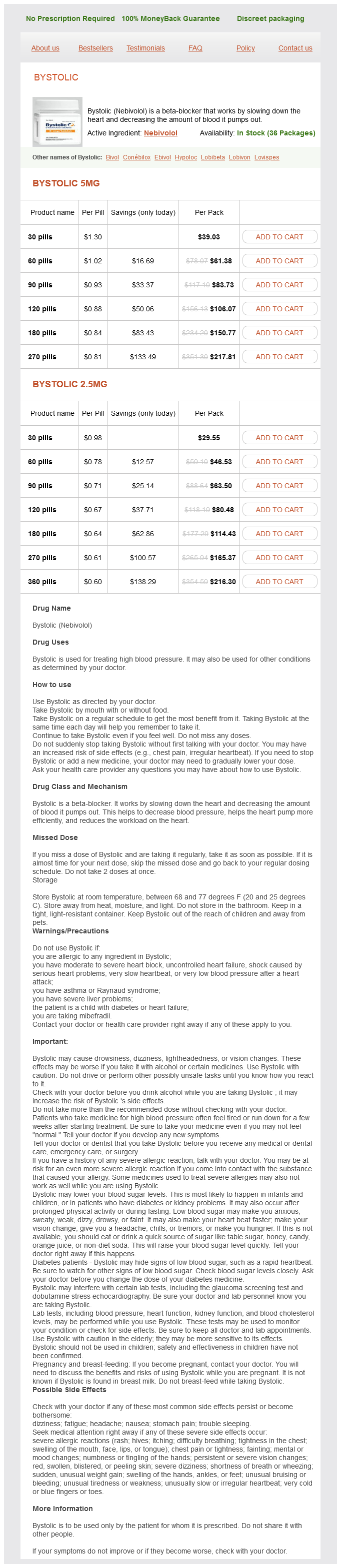
Bystolic
Bystolic 5mg
- 30 pills - $39.03
- 60 pills - $61.38
- 90 pills - $83.73
- 120 pills - $106.07
- 180 pills - $150.77
- 270 pills - $217.81
Bystolic 2.5mg
- 30 pills - $29.55
- 60 pills - $46.53
- 90 pills - $63.50
- 120 pills - $80.48
- 180 pills - $114.43
- 270 pills - $165.37
- 360 pills - $216.30
Bystolic dosages: 5 mg, 2.5 mg
Bystolic packs: 30 pills, 60 pills, 90 pills, 120 pills, 180 pills, 270 pills, 360 pills
In stock: 841
Only $0,64 per item
Description
Cardiomyocytes express nuclear steroid hormone receptors that modulate gene expression and nonnuclear receptors for the nongenomic results of sex steroid hormones arteria temporal bystolic 5 mg order otc. They interact with many alternative coregulators to confer tissue and temporal specificity in their transcriptional actions blood pressure chart 50 year old male buy discount bystolic 5 mg. These cell-specific coactivator and corepressor proteins are known as estrogen-related receptors blood pressure time of day bystolic 2.5 mg order visa. One such instance is stimulation of vascular endothelial nitric oxide synthase to mediate vascular dilatation heart attack vol 1 pt 14 bystolic 2.5 mg effective. In men, aromatase-mediated conversion of testosterone to estrogen maintains regular vascular tone. In addition to intercourse steroid hormone stimulation of nuclear or nonnuclear receptors, sex steroid hormone receptors might also induce rapid signaling of growth issue pathways within the absence of ligands. Aromatase additionally has protective effects, probably by way of its action to improve estrogen and to decrease testosterone. Gender differences in cardiac physiology should embrace consideration of the cellular physiology of sex steroid hormones in males and females; intrinsic variations in the physiology of cardiomyocytes, vascular clean muscle cells, and endothelial cells between males and females; and gender-based differences within the autonomic modulation of cardiac physiology. Specific cardiac receptors elicit their physiologic responses by various pathways. Cardiac receptors are in the atria, ventricles, pericardium, and coronary arteries. After central processing, efferent fibers to the center or the systemic circulation will provoke a selected reaction. The response of the cardiovascular system to efferent stimulation varies with age and period of the underlying situation that elicited the reflex in the first occasion. Baroreceptor Reflex (Carotid Sinus Reflex) the baroreceptor reflex is responsible for the maintenance of arterial blood stress. This reflex is able to regulating arterial pressure round a preset value via a negative-feedback loop. Changes in arterial blood strain are monitored by circumferential and longitudinal stretch receptors situated in the carotid sinus and aortic arch. The nucleus solitarius, positioned within the cardiovascular middle of the medulla, receives impulses from these stretch receptors by way of afferents of the glossopharyngeal and vagus nerves. The cardiovascular heart within the medulla consists of two functionally totally different areas; the realm answerable for rising blood pressure is laterally and rostrally situated, whereas the world answerable for lowering arterial blood strain is centrally and caudally situated. The latter space additionally integrates impulses from the hypothalamus and the limbic system. Typically, stretch receptors are activated if systemic blood strain is greater than 170 mm Hg. The response of the depressor system consists of decreased sympathetic exercise, leading to a decrease in cardiac contractility, coronary heart rate, and vascular tone. In addition, activation of the parasympathetic system further decreases the center price and myocardial contractility. The baroreceptor reflex plays an important helpful position throughout acute blood loss and shock. However, the reflex arch loses its useful capability when arterial blood strain is less than 50 mm Hg. Chemoreceptor Reflex Chemosensitive cells are situated within the carotid our bodies and the aortic body. At an arterial partial O2 stress (PaO2) of less than 50 mm Hg or in conditions of acidosis, the chemoreceptors ship their impulses alongside the sinus nerve of Hering (a branch of the glossopharyngeal nerve) and the tenth cranial nerve to the chemosensitive area of the medulla. This area responds by stimulating the respiratory facilities and thereby growing ventilatory drive. Pressure receptors in the wall of the carotid sinuses and aorta detect modifications in arterial strain within the circulation. These signals are conveyed to afferent receptive regions of the medulla via the Hering and vagus nerves. Output from effector parts of the medulla modulates peripheral tone and coronary heart rate. The enhance in blood stress results in increased activation of the reflex (right), which affects a lower in blood stress. Oculocardiac Reflex the oculocardiac reflex is provoked by strain applied to the globe of the attention or traction on the encircling buildings. Once activated, stretch receptors will ship afferent signals via the short- and long-ciliary nerves. The ciliary nerves will merge with the ophthalmic division of the trigeminal nerve at the ciliary ganglion. The trigeminal nerve will carry these impulses to the gasserian ganglion, thereby resulting in elevated parasympathetic tone and subsequent bradycardia. Administration of an antimuscarinic drug similar to glycopyrrolate or atropine reduces the incidence of bradycardia during eye surgical procedure (also see Chapter 84). An improve in right-sided filling pressure sends vagal afferent indicators to the cardiovascular middle within the medulla. These afferent alerts inhibit parasympathetic exercise, thereby increasing the center price. The modifications in coronary heart rate are depending on the underlying heart rate before stimulation. Bezold-Jarisch Reflex the Bezold-Jarisch reflex responds to noxious ventricular stimuli sensed by chemoreceptors and mechanoreceptors within the left ventricular wall by inducing the triad of hypotension, bradycardia, and coronary artery dilatation. Because it invokes bradycardia, the Bezold-Jarisch reflex is regarded as a cardioprotective reflex. This reflex has been implicated in the physiologic response to a variety of cardiovascular conditions similar to myocardial ischemia or infarction, thrombolysis, or revascularization and syncope. Thus the Bezold-Jarisch reflex may be much less pronounced in sufferers with cardiac hypertrophy or atrial fibrillation. Valsalva Maneuver Forced expiration towards a closed glottis produces elevated intrathoracic strain, increased central venous pressure, and decreased venous return. This decrease will be sensed by baroreceptors and will reflexively lead to a rise in heart fee and myocardial contractility through sympathetic stimulation. When the glottis opens, venous return will increase and causes the heart to reply by vigorous contraction and an increase in blood strain. This enhance in arterial blood stress will, in flip, be sensed by baroreceptors, thereby stimulating the parasympathetic efferent pathways to the guts. Cushing Reflex the Cushing reflex is a results of cerebral ischemia brought on by increased intracranial pressure. Cerebral ischemia at the medullary vasomotor center induces preliminary activation of the sympathetic nervous system. Such activation will result in a rise in coronary heart rate, arterial blood pressure, and myocardial contractility in an effort to improve cerebral perfusion. As a results of the excessive vascular tone, reflex bradycardia mediated by baroreceptors will ensue. Holubarsch C, Ruf T, Goldstein D, et al: Existence of the FrankStarling mechanism in the failing human heart, Circulation ninety four: 683-689, 1996. Yeager M: Structure of cardiac hole junction inter-cellular channels, J Struct Biol 121:231-245, 1998. DiFrancesco D: the position of the humorous present in pacemaker exercise, Circ Res 106(3):434-446, 2010. Bonne G, Carrier L, Richard P, et al: Familial hypertrophic cardiomyopathy, from mutations to functional defect, Circ Res eighty three:580-593, 1998. Trinick J, Tskhovrebova L: Titin: a molecular management freak, Trends Cell Biol 9:377-380, 1999. Fukuda N, Sasaki D, Ishiwata S, Kurihara S: Length dependence of tension technology in rat skinned cardiac muscle, Circulation 104:1639-1645, 2001. Capetanaki Y: Desmin cytoskeleton: a potential regulator of muscle mitochondrial behavior and function, Trends Cardiovasc Med 12:339-348, 2002. Mendelowitz D: Advances in parasympathetic management of heart rate and cardiac perform, News Physiol Sci 14:155-161, 1999. Endoh M: Cardiac alpha(1)-adrenoceptors that regulate contractile operate: subtypes and subcellular signal transduction mechanisms, Neurochem Res 21:217-229, 1996. Martinez A: Biology of adrenomedullin, Introduction, Microsc Res Tech fifty seven:1-2, 2002.
Angelica Sinensis (Dong Quai). Bystolic.
- How does Dong Quai work?
- Are there safety concerns?
- Are there any interactions with medications?
- What is Dong Quai?
- Dosing considerations for Dong Quai.
- Menstrual problems (dysmenorrhea), premenstrual syndrome (PMS), high blood pressure, joint aches and pains, ulcers, anemia, constipation, skin discoloration and psoriasis, the prevention and treatment of allergic problems, and other conditions.
- Premature ejaculation, when applied directly to the skin of the penis in combination with other medicines.
- Menopausal symptoms.
Source: http://www.rxlist.com/script/main/art.asp?articlekey=96899
This element is minor blood pressure medication vision 2.5 mg bystolic buy with mastercard, nonetheless arteria ovarica discount 2.5 mg bystolic with visa, and may hardly be measured under regular breathing arteriosclerosis vs atherosclerosis buy 2.5 mg bystolic overnight delivery, regardless of whether or not the lungs are healthy blood pressure chart time of day bystolic 2.5 mg with visa. Nonetheless, tissue inertia is massive throughout speedy air flow,38 and it could presumably be important during the speedy, shallow respiratory attribute of weaning failure or during high-frequency oscillation. Because the pleural strain gradient is oriented in accordance with gravity, the distribution of ventilation changes with physique place. Because compliance initially of inflation is less within the (already extra aerated) apex, air flow is preferentially directed to the base. In contrast, at excessive airflow, resistance (not compliance) is the vital thing determinant of distribution; because the resistance is decrease in upper, more expanded lung regions, growing flow fee equalizes the distribution of air flow, as proven by distribution of 133Xe gas in humans47,48. This is important during exercise or stress as a outcome of higher amounts of the alveolar-capillary floor area might be used. During inspiration, most gasoline goes to the basal models (dorsal, when supine; decrease right lung when in the proper lateral position). Three applications of this important precept are of key relevance to anesthesia. Schematic of regional alveolar and airway volume at an upper (A) and a decrease (B) lung degree (left panel). The proper panel reveals the distribution of ventilation and perfusion ratios from the multiple inert gas elimination method. A "regular" mode of air flow and blood circulate (A) could be seen comparable to the open and ventilated alveoli in the higher components of the lung. Distribution of air flow to higher versus lower lung areas as inspiratory circulate is altered. Flow is thru multiple generations of bronchi, and the web resistance falls with every division. After the fourteenth technology, airways merge with alveoli and participate in gasoline exchange (respiratory bronchioles). Because the number of gas molecules is constant, the rate falls quickly, which by the time the fuel enters the alveoli is miniscule (0. In the lung base, blood move is decreased probably because of increased interstitial stress that compresses further alveolar vessels. The conventional thinking about lung perfusion emphasised the significance of gravity58; however, factors apart from gravity are also essential. The peak (base to apex) of an adult lung is roughly 25 cm; subsequently, when a person is standing, the hydrostatic stress at the base is 25 cm H2O. The imply pulmonary arterial pressure is approximately 12 mm Hg on the degree of the guts, and the pulmonary artery strain at the lung apex can subsequently method zero. Thus, much less blood flow will occur on the apex (versus the base), and in the setting of constructive pressure air flow, the apical alveoli can compress the encompassing capillaries and prevent any native blood move. In the apex (zone I), the key problem is that pulmonary arterial stress is less than alveolar stress; therefore, no perfusion happens. First, the downstream blood move within the pulmonary capillaries is pulsatile, in distinction to the more constant systemic capillary flow. Whereas an abrupt enhance within the pulmonary arterial (or venous) pressure could cause breaks in the capillaries,54 slower will increase. The distributions from ventral to dorsal are comparable, no matter position, suggesting that that anatomic options (and not simply gravity) decide the distribution of flow. In addition, microsphere assessment demonstrated vital variability within iso-gravitational planes, and lung peak appeared to account for lower than 10% of the distribution of move in both the inclined or supine positions. Blood flow measured in the same gravitational aircraft was much less per unit of lung tissue at the apex than on the base. However, normally no region develops collapse because distal airways (<2 mm) close before alveoli collapse,81 trapping fuel and stopping further alveolar emptying. However, in airway obstruction, exhalation is impeded such that inspiration commences before the similar old resting lung volume is reached; thus end-expiratory volume is increased. It might be decrease in small lungs, lung fibrosis (restriction), after lung resection, or in cases of lung tissue destruction, such as emphysema. In this part, w describe the results of anesthesia and mechanical air flow on lung operate. Thus, the primary phenomenon that could be seen with anesthesia is loss of muscle tone with a subsequent change within the stability between outward forces. This causes or is paralleled by an increase within the elastic behavior of the lung (reduced compliance) and a rise in respiratory resistance. This alters the distribution of air flow and matching of ventilation and blood move and impedes oxygenation of blood and removing of carbon dioxide. At rest, equilibrium is often reached inside 25% to 30% of the capillary size, and nearly no fuel switch happens within the remaining capillary. Thickened alveolar-capillary membranes may also extend the equilibration course of and, if severe, can forestall equilibration occurring and increasing the propensity to hypoxemia. The Hb-bound oxygen creates no pressure in plasma, which is necessary as a outcome of it allows rather more oxygen to diffuse over the membranes earlier than a strain equilibration is reached. Chapter 19: Respiratory Physiology and Pathophysiology 457 and paralysis, was responsible. Raw Compliance and Resistance of the Respiratory System Static compliance of the whole respiratory system (lungs and chest wall) is decreased on common from 95 to 60 mL/ cm H2O throughout anesthesia. Anesthesia induces cranial shift of the diaphragm and a decrease of transverse diameter of the thorax. Morphologic research of those densities in varied animals supported the diagnosis of atelectasis. Computed tomography with transverse exposures of the chest when the subject is awake (upper panel) and anesthetized (lower panel). In the awake condition, the lung is properly aerated (radiations from a pulmonary artery catheter are seen in the heart). During anesthesia, atelectasis has developed within the dependent areas (grey/white irregular areas). The giant grey/white area in the center of the right lung area is brought on by a cranial shift of the diaphragm and the underlying liver. Thus, 15% to 20% of the lung is atelectatic during uneventful anesthesia, before surgical procedure has commenced; it decreases toward the apex, which usually stays aerated. However, this degree of atelectasis is larger (upwards of 50% of lung volume) after thoracic surgical procedure or cardiopulmonary bypass, and can final for several hours. Alternatively, the larger loss of lung (elastic recoil) versus chest wall tissue might serve to protect in opposition to atelectasis. A three-dimensional reconstruction of the thorax of an anesthetized patient with atelectasis in the dependent regions of each lungs. There is a slight decrease in the diploma of atelectasis towards the apex (distal on this image). The left panel is a cross-sectional slice of a computed tomographic picture of the chest of an anesthetized affected person, illustrating atelectasis within the basal (dorsal) areas. The proper panel illustrates the distribution of ventilation and perfusion all through that slice. The bulk of the ventilation is to the upper lung region (zone A), in contrast to the awake subject with out atelectasis, and it exceeds the level of local perfusion; this results in wasted ventilation. The farther from the highest of the lung, the upper the perfusion; nonetheless, within the lowermost areas perfusion decreases (see text). In the presence of an intrapulmonary shunt, such as with atelectasis, the blended venous blood is shunted directly into pulmonary venous blood causing arterial desaturation. Atelectasis formation in anesthetized subjects following preoxygenation with different inspired oxygen concentrations. The open circle at round an expired oxygen concentration (FeO2) of 25% represents information from anesthesia being induced whereas respiration 30% O2. Gamma camera photographs of lung blood circulate in an anesthetized topic within the lateral position. Of course, the picture presented is perfused tissue (not complete anatomic lung tissue; in the proper lateral place the upper-right lung would be larger).
Specifications/Details
Some modern anesthesia workstation designs have returned to the descending bellows to combine fresh gas decoupling arrhythmia in pregnancy cheap 5 mg bystolic. Improper seating of the plastic bellows housing can lead to insufficient ventilation as a result of a portion of the driving gasoline is vented to the environment blood pressure drop bystolic 2.5 mg visa. Hypoventilation can occur if the valve becomes incompetent as a outcome of anesthetic fuel is delivered to the scavenging system during the inspiratory part as a substitute of to the affected person arteria thoracica inferior quality bystolic 5 mg. Ventilator relief valve incompetency may finish up from a disconnected pilot line blood pressure chart meaning purchase 2.5 mg bystolic visa, a ruptured valve, or a broken flapper valve. In different phrases, when the ventilator relief valve opens and waste anesthetic gases are vented from the breathing circuit, the drive fuel from the bellows housing joins with these gases to enter the scavenging system. Under certain situations, the big volume of exhaust gases could overwhelm the scavenging system and cause air pollution of the operating room with waste anesthetic gases (see the section on scavenging systems). Other mechanical problems that can occur embody leaks within the system, faulty stress regulators, and faulty valves. Mechanically Driven Piston Ventilator A resurgence in using mechanically pushed anesthesia ventilators has occurred. These "piston"-type ventilators use a computer-controlled stepper motor as a substitute of compressed drive gasoline to drive the cylinder and actuate gasoline movement in the respiration system. This enchancment in effectivity may have medical significance when the anesthesia workstation is used in a setting where no pipeline gasoline supply is out there. Another advantage of the piston ventilator is the potential for very correct tidal quantity delivery. Because of the low compliance of the piston chamber, tidal quantity supply is closely related to piston movement. This is in distinction to bellows-type ventilators, by which the drive fuel may be topic to various degrees of compression. However, with either piston or bellows ventilators, suggestions mechanisms that help maintain stable tidal quantity supply have gotten more and more extra frequent. These embody circuit compliance compensation and the use of inspired tidal quantity measurement as a feedback signal. Note the situation of the ventilator throughout the breathing circuit on the Dr�ger Fabius system, the recent fuel decoupling valve (described later), and the truth that the respiratory bag participates in the mechanical ventilation mode. In addition, piston ventilators are inclined to be extraordinarily quiet, so the partially reassuring sound of the mechanical ventilator in operation is much more delicate. Some methods incorporate a respiration sound emulator that creates ventilator sounds to substitute for the traditional feedback noise. Similarly, if a circuit leak is present, piston ventilators might entrain room air by way of the leak, thereby diluting oxygen and anesthetic agent. Inspiratory phase of ventilation with a piston ventilator represented by Dr�ger Fabius anesthesia workstation. Note how the breathing bag is integral to circuit perform throughout mechanical ventilation. During the first step of exhalation the affected person exhales into the respiration bag, and recent gasoline continues to flow in retrograde trend, as proven. A positivepressure reduction valve on the ventilator prevents excessively excessive respiration circuit strain (60 to 80 cm H2O). The quantity reflector is practical and "incircuit" throughout all modes of ventilation. It is interposed between the patient and the reflector fuel module during positive-pressure air flow or between the patient and the respiratory bag throughout spontaneous or assisted ventilation. During the second step of exhalation the ventilator returns to its staring place, drawing in fuel saved inside the breathing bag and fresh fuel from the gas supply system. During managed positive-pressure air flow, the reflector fuel module supplies the driving drive for air flow by pushing gasoline out of the amount reflector to the affected person. At the tip of exhalation, the quantity reflector is crammed at its proximal finish (nearer the patient) with exhaled fuel and is crammed distally with a mixture of exhaled gases and reflector fuel. The reflector gas module is a solenoid-controlled oxygen move supply, which pushes the exhaled gas back out of the quantity reflector during inspiration, very like a piston, by way of the carbon dioxide absorber to the affected person. Fresh fuel combines with the amount reflector outflow to maintain the desired oxygen and anesthetic focus. The fresh fuel modules and the reflector fuel module work together in a coordinated method to control gasoline move and stress within the respiratory circuit so that operator decided ventilation parameters are maintained. When the workstation is within the spontaneous mode of air flow, the breathing bag is enabled, and the reflector fuel module is disabled. Because the reflector fuel module offers solely 100% oxygen, dilution of anesthetic fuel occurs on this circumstance. The machine is nearly entirely electronically interfaced; subsequently, an emergency handbook air flow backup mode is offered for circumstances of system failure. Fresh Gas Flow Compensation and Fresh Gas Decoupling On most anesthesia workstations, fuel flow from the contemporary gasoline line into the respiratory circuit is continuous and unbiased of ventilator activity. The amount of excess quantity (and pressure) that the affected person acquired was proportional to the direction and magnitude of the change in the contemporary gasoline circulate price. It was therefore common information that the operator needed to regulate the set tidal volume on the ventilator if the entire recent gasoline circulate price was changed to keep stable tidal volumes and airway stress. Many newer workstations have engineering features that provide compensation of recent fuel circulate to keep stable tidal volume supply. The method during which that is completed additionally accounts for a lot of the variation in breathing system design. During the inspiratory phase of ventilation, a decoupling valve positioned upstream from the piston ventilator diverts the recent gasoline stream towards the respiration bag and scavenge outlet during every positive-pressure breath. On traditional and plenty of up to date workstations and not utilizing a fresh gas decoupling function, inappropriate activation of the oxygen flush valve during the inspiratory section of mechanical air flow can add a substantial amount of quantity to the circuit and may end up in barotrauma or volutrauma (or both) as a result of extra strain and quantity might not be succesful of be vented from the breathing circuit. The patient exhales into the volume reflector, which serves as an exhalation reservoir. When the machine is placed within the guide mode of air flow, the breathing bag is enabled and the reflector fuel module is disabled. In the handbook mode, the affected person breathes out and in of the quantity reflector and can be assisted with the respiration bag. An adjustable pressure relief valve opens when the predetermined user-selected strain is reached. If the setting is simply too low, insufficient strain for ventilation may be generated and may end up in insufficient minute ventilation; if set too high, the extreme airway pressure should occur and end in barotrauma. Some machines can also embody a factory-preset inspiratory pressure security valve that opens at a preset airway strain, corresponding to 60 to eighty cm H2O, to reduce the risk of barotrauma. Therefore, modern workstations with out fresh gasoline decoupling often attain a maximum stress limit and terminate ventilation, launch strain, or sustain on the strain restrict. Therefore, scavenging minimizes operating room pollution by eradicating these excess gases. Fresh gas decoupling throughout an oxygen (O2) flush shown on the Dr�ger Fabius workstation. During inspiration the optimistic endexpiratory pressure/maximum pressure valve is held closed. This publication describes the role of regulatory companies, reviews scavenging and monitoring gear, and supplies suggestions. Leaks can occur in the high-pressure hoses, the nitrous oxide tank mounting, the high- or low-pressure circuits of the anesthesia machine, or the circle system, particularly at the carbon dioxide absorber assembly. The anesthesia care supplier have to be sure that the room suction and scavenging system is operational and adjusted correctly to ensure sufficient scavenging. Side-stream breathing gas analyzer waste move (50 to 250 mL/minute) should be directed to the scavenging system or returned to the respiratory system to prevent pollution of the operating room. With a "passive system," the pressure imposed by the venting of the breathing circuit produces circulate. The gas-collecting assemblies are the factors of waste gasoline exit from the respiratory circuit that connect with the transfer tubing. Conventional machines have separate outlet ports for these valves; however, many extra modern workstations solely have one. Some anesthesia workstations may exhaust the ventilator drive gas into the scavenging system. This is important because underneath circumstances of excessive contemporary gasoline circulate and excessive minute air flow, the gases flowing into the scavenging interface may overwhelm the evacuation system.
Syndromes
- Blood pressure changes - can be extreme (autonomic hyperreflexia)
- Always use safety equipment during activities that could cause a head injury. These include seat belts, bicycle or motorcycle helmets, and hard hats.
- Catheter embolization
- Slowed growth and sexual development (in children)
- ECG
- Diarrhea keeps returning, or the child is losing weight
- You should receive a flu vaccine every year.
- Trouble sleeping
- Scurvy
Related Products
Additional information:
Usage: t.i.d.
Tags: discount bystolic 2.5 mg line, bystolic 2.5 mg cheap visa, buy cheap bystolic 2.5 mg on-line, 5 mg bystolic safe, bystolic 2.5 mg purchase on line, bystolic 2.5 mg buy mastercard, bystolic 2.5 mg buy generic line, bystolic 5 mg cheap on line, purchase bystolic 2.5 mg with mastercard, buy 5 mg bystolic visa, purchase bystolic 5 mg, discount 5 mg bystolic with visa, bystolic 2.5 mg buy without a prescription, bystolic 5 mg discount free shipping, bystolic 5 mg line, bystolic 2.5 mg order with amex
8 of 10
Votes: 339 votes
Total customer reviews: 339
Customer Reviews
Karrypto, 27 years: Hypocapnic hyperventilation enhances and prolongs postoperative respiratory despair after fentanyl (10 and 25 g/kg). Gozuacik D, Kimchi A: Autophagy as a cell demise and tumor suppressor mechanism, Oncogene 23:2891-2906, 2004. Alterations in regional air flow are regulated by variations in alveolar compliance, inspiratory price, circulate rate, pleural pressures, and ventilatory strategies. One must do not neglect that the Tec 6 fashion desflurane vaporizer system is more accurately described as a dual-gas blender than a vaporizer.
Kliff, 32 years: Two themes emerge from these studies: very younger infants are at elevated danger, and anesthesia-related danger is lowered in facilities with specialised pediatric anesthesia amenities. The exact molecular targets answerable for the beautiful sensitivity of these networks to low concentrations of volatile anesthetics stay to be elucidated (see Chapters 19 and 27). Hemodialysis utilizing a high-flux dialysis method has been demonstrated to be efficient in removing sugammadex and the sugammadex-rocuronium complicated in patients with extreme renal impairment. Gene Expression the power of basic anesthetics to alter gene expression in the brain was first noticed for the extremely reactive quick early genes c-fos and c-jun.