
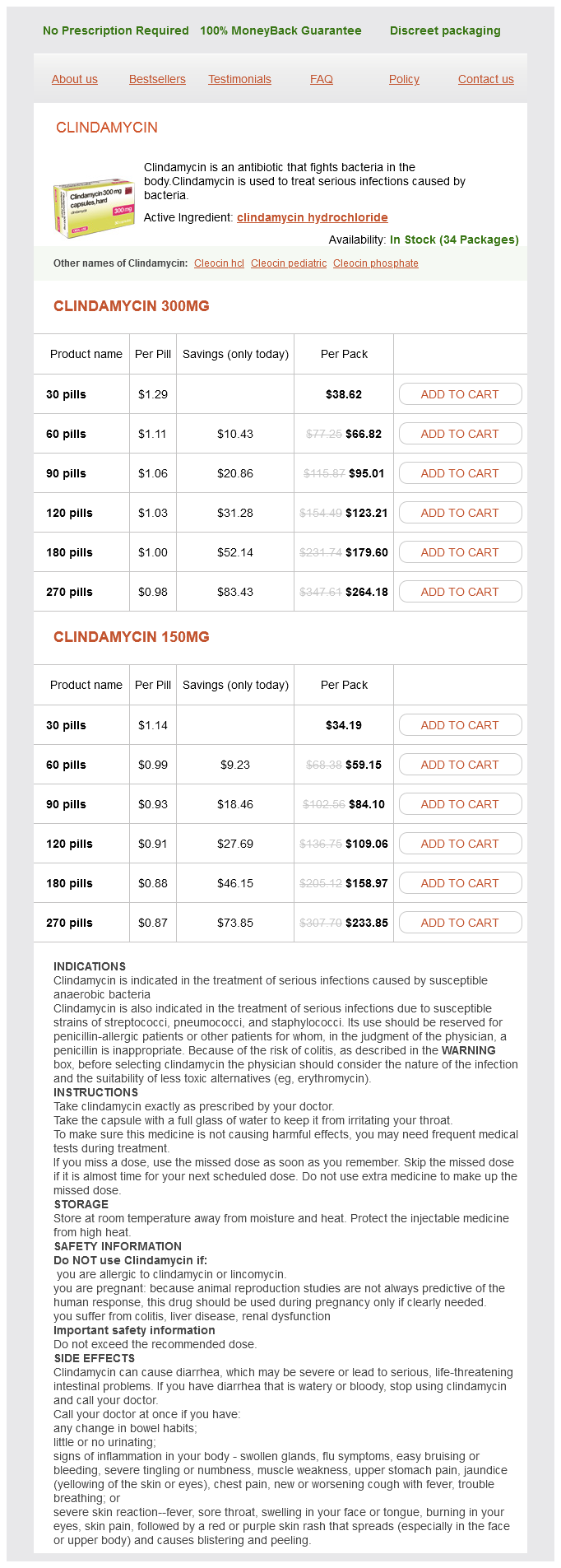
Clindamycin
Clindamycin 300mg
- 30 pills - $38.62
- 60 pills - $66.82
- 90 pills - $95.01
- 120 pills - $123.21
- 180 pills - $179.60
- 270 pills - $264.18
Clindamycin 150mg
- 30 pills - $34.19
- 60 pills - $59.15
- 90 pills - $84.10
- 120 pills - $109.06
- 180 pills - $158.97
- 270 pills - $233.85
Clindamycin dosages: 300 mg, 150 mg
Clindamycin packs: 30 pills, 60 pills, 90 pills, 120 pills, 180 pills, 270 pills
In stock: 955
Only $0,92 per item
Description
Moreover infection from bee sting discount clindamycin 150 mg, basiliximab was found to be noninferior to rabbit antithymocyte globulin for the prevention of acute rejection in a trial of 35 sufferers antimicrobial effects of spices buy 150 mg clindamycin fast delivery. Corticosteroids are nonspecific anti-inflammatory brokers that work primarily by lymphocyte depletion antibiotic natural 150 mg clindamycin order overnight delivery. Patients initially receive high doses of intravenous after which oral steroids which would possibly be steadily tapered over the following 6 months; typically the goal is to utterly withdraw steroid remedy antibiotics diabetes 300 mg clindamycin generic free shipping. Side effects embrace cushingoid appearance, hypertension, dyslipidemia, weight gain with central weight problems, peptic ulcer formation and gastrointestinal bleeding, pancreatitis, persona changes, cataract formation, hyperglycemia progressing to steroid diabetes, and osteoporosis with avascular necrosis of bone. The well-appreciated opposed profile of the corticosteroids has led to numerous revolutionary methods to remove them as early as attainable after the transplant surgery. Corticosteroids are normally the drug of first choice to deal with acute rejection as properly. Their primary mechanism of motion involves binding to particular proteins to kind complexes that block the motion of calcineurin, a key participant in T-cell activation. Critical and often limiting opposed results embrace nephrotoxicity in as many as 40% to 70% of patients, and hypertension with the event of left ventricular hypertrophy; both medicine trigger a roughly equal incidence of those untoward occasions. Therapeutic ranges have been sometimes carried out on trough blood draws, nevertheless it has been proven that cyclosporine focus 2 hours postdose (C2) is a extra accurate predictor of complete cyclosporine exposure. In the United States, tacrolimus is now out there in generic formulations, so the drug tends to be the calcineurin inhibitor of selection in most centers. Azathioprine was the earlier agent used on this class and served as the mainstay of immunosuppression even earlier than the routine use of cyclosporine. Sirolimus (often called rapamycin) and everolimus are two newer agents that block activation of T cells following autocrine stimulation by interleukin-2. They are also known to inhibit proliferation of endothelial cells and fibroblasts. Their action is complementary to calcineurin inhibitors, and both sirolimus and everolimus have been used as upkeep immunosuppression, as alternatives to standard immunosuppression, and as rescue medicine for rejection. The drugs have additionally been associated with the development of great pericardial effusions. Sirolimus has been more and more used to replace the calcineurin inhibitors as a technique to improve renal dysfunction or reverse left ventricular hypertrophy. This trial has been pivotal in shifting tacrolimus as the first calcineurin inhibitor used worldwide. As a outcome, successful coronary heart transplant groups should focus on more than the physical needs of the recently transplanted affected person. In an occasional affected person, the stress of the wait for transplant typically depletes the household of financial resources and emotional resiliency. It is crucial that a transplant heart have dedicated bodily therapists, nutritionists, and social staff or psychologists who can act in concert to address these noncardiovascular demands. This process is categorized into three major forms of rejection, utilizing histologic and immunologic standards: hyperacute, acute, and chronic. Within minutes after reperfusion, the center will stop contracting, resulting in what many surgeons have described as a "stone heart. The key event in both the initiation and the coordination of the rejection response is T-cell activation, moderated by interleukin-2, a cytokine. Therefore, the endomyocardial biopsy stays the gold normal for the diagnosis of acute rejection. Biopsies are performed via a transjugular approach weekly, then each other week for a quantity of months; month-to-month biopsies proceed for six to 12 months in many programs, and for years thereafter in some. AlloMap is a panel of 20 gene expression assays used within the calculation of an overall rating from 1 to forty; the decrease the score the decrease the danger of rejection, allowing the stratification of sufferers into low- (20), intermediate(21-30), and high-risk (>30) categories for rejection. Posttransplant ischemic injury, together with coronary allograft vasculopathy, has been related to a false-positive AlloMap score. The occurrence of a number of episodes of handled rejections during the first year is a danger factor for both a 5-year survival and development of transplant coronary disease. Current concepts counsel that donor heart dysfunction in the persistent levels of upkeep immunosuppression is both related to continual rejection, mediated by antibodies, or because of progressive graft loss from ischemia. These patients have been found to have a significantly worse prognosis and limited remedy. Infection Despite the advances in immunosuppressive management, a serious untoward consequence remains the prevalence of life-threatening infections. The commonest infections seen within the first month after surgery are nosocomial: bacterial and fungal infections related to mechanical air flow, catheters, and the surgical website. Mortality is highest for fungal infections, adopted by protozoal, bacterial, and viral infections. Aspergillus and Candida species are the most common fungal infections after heart transplant. The regimen increases substantially the number of medicines and potential drug interactions the recipient might experience. Clinical guideline: Part I: Suggested approach for fecal occult blood testing and interpretation in colorectal most cancers screening. After 5 years, over 90% of recipients have hypertension, at least 80% have hyperlipidemia, and greater than 30% of patients have diabetes, as shown in Table 40-5. Post-transplant lymphoproliferative disease and lung most cancers are the commonest deadly malignancies, as shown in Table 40-6. The cumulative quantity of immunosuppression is positively correlated with danger of malignancy. Accordingly, as illustrated in Table 40-6, transplant teams should be sure that the transplant recipient is satisfactorily screened regularly for the development of most cancers. Accumulating evidence suggests that their long-term outcomes, together with affected person survival and/or graft survival, may be adversely affected. Decreased B-cell insulin secretion and elevated insulin resistance secondary to the consequences of immunosuppression characterize new-onset diabetes. Impaired B-cell operate seems to be the primary mechanism of calcineurin inhibitor� induced new-onset diabetes. Hypertension the surplus danger of hypertension is primarily related to using calcineurin inhibitors, because of both direct results of the drugs on the kidney and the associated renal insufficiency that can be highly prevalent. Post-transplant hypertension is tough to management and sometimes requires a mix of a quantity of antihypertensive agents. Renal Insufficiency In a big registry of virtually 70,000 nonrenal strong organ transplant recipients, the chance of creating chronic renal failure was 16% at 10 years. Once early renal insufficiency occurs, progressive renal failure has appeared to be inexorable till lately. A number of drugs commonly used after transplant contribute to the hyperlipidemia observed. Thus caution must be used in the indiscriminate use of statin medication beyond the doses used within the randomized trials of simvastatin and pravastatin. Typically, the condition is characterised by concentric narrowing that affects the complete size of the coronary tree, from the epicardial to intramyocardial segments, resulting in speedy tapering, pruning, and obliteration of third order branch vessels. The only definitive remedy of transplant vasculopathy is a second coronary heart transplant procedure. In addition, statins have a direct affect on the expression of genes for progress factors which are important for the proliferation of smooth muscle cells. Randomized managed trials have proven that each medication end in significantly lower cholesterol levels, as properly as considerably improved survival charges, considerably fewer extreme rejections, and a considerably lower incidence of transplant vasculopathy. Generally, a complete go to is scheduled on the anniversary of the transplant process so that annual points may be reviewed past the standard cardiovascular problems addressed so regularly within the first 12 months. These embrace an intensive skin and eye examination and recommended screening examinations, similar to mammography, colonoscopy, and rectal and pelvic examinations, based on tips. This is the opportune time to reinforce the need of regular bodily exercise, maintenance of ideal physique weight, abstinence from tobacco, and moderation with alcohol. Similarly, most recipients are given nutritional vitamins, stool softeners, iron supplements, and proton pump inhibitors early after surgery, primarily from an empiric basis. These are components of the choices that should be made on a programmatic foundation for the transplant recipient. The growth of osteoporosis is a significant problem in the transplant population, and prophylaxis with calcium and vitamin D is usually initiated; vertebral fractures are frequent and end in marked debilitation. At least 50% of patients pretransplant have evidence of osteopenia, and osteoporosis is frequent in sufferers with advanced coronary heart failure. Depression, a standard discovering in heart failure, occurs in up to 25% of transplant recipients, and can remarkably intrude with a passable recovery.
Huo Xiang (Patchouly Oil). Clindamycin.
- Dosing considerations for Patchouly Oil.
- Are there safety concerns?
- How does Patchouly Oil work?
- What is Patchouly Oil?
- Colds, headaches, nausea, vomiting, diarrhea, stomach pain, bad breath, tumors, and other conditions.
Source: http://www.rxlist.com/script/main/art.asp?articlekey=96246
Given the presence of intensive phenotypic variability antibiotic use in animals clindamycin 300 mg discount free shipping, additional threat stratification and therefore an individual-based method is preferable antibiotics for sinus infection in india clindamycin 150 mg buy discount on-line. Recurrent syncope is a serious danger factor and necessitates in depth evaluation to determine the trigger antibiotic resistance join the fight buy clindamycin 150 mg fast delivery. Patients with impaired exercise tolerance and decreased oxygen consumption have been related to a excessive price of cardiovascular occasions antibiotics good or bad cheap clindamycin 150 mg. Amiodarone or dronedarone is used primarily for therapy of atrial and ventricular arrhythmias. Patients with new-onset atrial fibrillation are usually treated with electrical cardioversion to restore regular sinus rhythm. In basic, patients with extreme cardiac hypertrophy or outflow tract obstruction who develop atrial fibrillation develop severe symptoms. It is preferable to convert atrial fibrillation to and keep such sufferers in regular sinus rhythm. Those with persistent or intermittent atrial fibrillation are anticoagulated to reduce the risk of systemic embolization and stroke. Pharmacologic therapy of such sufferers consists of -blockers, verapamil and amiodarone, and presumably sotalol and dofetilide. Both approaches are effective in relieving the outflow tract obstruction and bettering symptoms. In distinction, the presence of comorbidities that increase the surgical danger considerably favors percutaneous interventions. The benefits and downsides of those two strategies are summarized in Table 21-4. Surgical myectomy (myomectomy), which is referred to as the Morrow process, involves partial resection of the base of the septum by way of a transaortic strategy. Surgical myectomy can be related to a major enchancment in pulmonary hypertension. It can also be very efficient in decreasing the outflow tract gradient and enhancing symptoms. In the largest North American research involving 874 participants, survival estimates at 1, 5, and 9 years after the process have been 97%, 86%, and 74%, respectively. In addition, a small fraction of sufferers develop late-onset full heart block after alcohol septal ablation. Cecchi F, Olivotto I, Montereggi A, et al: Hypertrophic cardiomyopathy in tuscany: medical course and outcome in an unselected regional inhabitants. Tsybouleva N, Zhang L, Chen S, et al: Aldosterone, by way of novel signaling proteins, is a elementary molecular bridge between the genetic defect and the cardiac phenotype of hypertrophic cardiomyopathy. Charron P, Carrier L, Dubourg O, et al: Penetrance of familial hypertrophic cardiomyopathy. Corrado D, Basso C, Schiavon M, et al: Screening for hypertrophic cardiomyopathy in younger athletes. Intraoperative research of the mechanism of obstruction and its hemodynamic penalties. Operative therapy and the outcomes of pre- and postoperative hemodynamic evaluations. Veselka J, Lawrenz T, Stellbrink C, et al: Early outcomes of alcohol septal ablation for hypertrophic obstructive cardiomyopathy: a European multicenter and multinational study. Thierfelder L, Watkins H, MacRae C, et al: Alpha-tropomyosin and cardiac troponin t mutations cause familial hypertrophic cardiomyopathy: a illness of the sarcomere. Richard P, Charron P, Carrier L, et al: Hypertrophic cardiomyopathy: distribution of disease genes, spectrum of mutations, and implications for a molecular diagnosis strategy. Erdmann J, Raible J, Maki-Abadi J, et al: Spectrum of scientific phenotypes and gene variants in cardiac myosin-binding protein c mutation carriers with hypertrophic cardiomyopathy. Torricelli F, Girolami F, Olivotto I, et al: Prevalence and scientific profile of troponin t mutations amongst patients with hypertrophic cardiomyopathy in Tuscany. Hayashi T, Arimura T, Itoh-Satoh M, et al: Tcap gene mutations in hypertrophic cardiomyopathy and dilated cardiomyopathy. Hayashi T, Arimura T, Ueda K, et al: Identification and useful analysis of a caveolin-3 mutation associated with familial hypertrophic cardiomyopathy. Hoffmann B, Schmidt-Traub H, Perrot A, et al: First mutation in cardiac troponin c, l29q, in a patient with hypertrophic cardiomyopathy. Minamisawa S, Sato Y, Tatsuguchi Y, et al: Mutation of the phospholamban promoter related to hypertrophic cardiomyopathy. Charron P, Dubourg O, Desnos M, et al: Clinical options and prognostic implications of familial hypertrophic cardiomyopathy associated to the cardiac myosin-binding protein c gene. Rottbauer W, Gautel M, Zehelein J, et al: Novel splice donor site mutation within the cardiac myosin-binding protein-c gene in familial hypertrophic cardiomyopathy. Richard P, Isnard R, Carrier L, et al: Double heterozygosity for mutations within the beta-myosin heavy chain and in the cardiac myosin binding protein c genes in a family with hypertrophic cardiomyopathy. Watkins H: Assigning a causal role to genetic variants in hypertrophic cardiomyopathy. Rigat B, Hubert C, Alhenc-Gelas F, et al: An insertion/deletion polymorphism within the angiotensin I-converting enzyme gene accounting for half the variance of serum enzyme ranges. Lombardi R, Bell A, Senthil V, et al: Differential interactions of skinny filament proteins in two cardiac troponin t mouse models of hypertrophic and dilated cardiomyopathies. Wolny M, Colegrave M, Colman L, et al: Cardiomyopathy mutations in the tail of betacardiac myosin modify the coiled-coil construction and have an result on integration into thick filaments in muscle sarcomeres in adult cardiomyocytes. Sarikas A, Carrier L, Schenke C, et al: Impairment of the ubiquitin-proteasome system by truncated cardiac myosin binding protein c mutants. Charron P, Dubourg O, Desnos M, et al: Genotype-phenotype correlations in familial hypertrophic cardiomyopathy. A comparability between mutations within the cardiac protein-c and the beta-myosin heavy chain genes. Anan R, Greve G, Thierfelder L, et al: Prognostic implications of novel beta cardiac myosin heavy chain gene mutations that trigger familial hypertrophic cardiomyopathy. Fujino N, Shimizu M, Ino H, et al: A novel mutation lys273glu in the cardiac troponin t gene exhibits excessive diploma of penetrance and transition from hypertrophic to dilated cardiomyopathy. Mogensen J, Kubo T, Duque M, et al: Idiopathic restrictive cardiomyopathy is part of the clinical expression of cardiac troponin I mutations. Fujino N, Shimizu M, Ino H, et al: Cardiac troponin t arg92trp mutation and progression from hypertrophic to dilated cardiomyopathy. Klaassen S, Probst S, Oechslin E, et al: Mutations in sarcomere protein genes in left ventricular noncompaction. Davis J, Wen H, Edwards T, et al: Allele and species dependent contractile defects by restrictive and hypertrophic cardiomyopathy-linked troponin I mutants. Burton D, Abdulrazzak H, Knott A, et al: Two mutations in troponin I that trigger hypertrophic cardiomyopathy have contrasting results on cardiac muscle contractility. Bing W, Knott A, Redwood C, et al: Effect of hypertrophic cardiomyopathy mutations in human cardiac muscle alpha-tropomyosin (asp175asn and glu180gly) on the regulatory properties of human cardiac troponin determined by in vitro motility assay. Lowey S, Bretton V, Gulick J, et al: Transgenic mouse alpha- and beta-cardiac myosins containing the r403q mutation show isoform-dependent transient kinetic differences. Sachdev B, Takenaka T, Teraguchi H, et al: Prevalence of Anderson-Fabry illness in male patients with late onset hypertrophic cardiomyopathy. A multisystem disease with mitochondrial abnormality demonstrated in skeletal muscle and pores and skin. Spirito P, Autore C, Formisano F, et al: Risk of sudden demise and end result in sufferers with hypertrophic cardiomyopathy with benign presentation and without threat components. Peteiro J, Bouzas-Mosquera A, Fernandez X, et al: Prognostic value of train echocardiography in sufferers with hypertrophic cardiomyopathy. Sorajja P, Allison T, Hayes C, et al: Prognostic utility of metabolic exercise testing in minimally symptomatic sufferers with obstructive hypertrophic cardiomyopathy. Axelsson A, Weibring K, Havndrup O, et al: Atrioventricular conduction after alcohol septal ablation for obstructive hypertrophic cardiomyopathy. Yamazaki T, Suzuki J, Shimamoto R, et al: A new therapeutic technique for hypertrophic nonobstructive cardiomyopathy in humans.
Specifications/Details
Given that some of the toxicity of cocaine is brought on by catecholamine extra and/or myocardial ischemia virus 43215 300 mg clindamycin cheap with mastercard, using -adrenergic blocking brokers seems to be a logical remedy 9999 bacteria clindamycin 150 mg cheap overnight delivery, each in terms of preventing further disease development bacteria fermentation purchase clindamycin 300 mg line, in addition to for treating the ventricular arrhythmias which are vulnerable to antibiotic resistance how buy discount clindamycin 300 mg on line develop in this setting. Two many years ago, the remedy of cocaine-induced cardiovascular effects favored using -blockers, especially propranolol. As the medical use of propranolol elevated, stories of accentuation of cocaine-induced hypertension and myocardial ischemia began to surface, blaming the unopposed -effects of the -blockers. Although these reports were isolated, the routine use of propranolol and subsequently all -adrenergic blockers decreased to the purpose that -blockers were thought-about comparatively contraindicated in treating cocaine-induced cardiovascular emergencies. As a end result, benzodiazepines have been the drug of alternative in treating the cerebrovascular and subsequent systemic hyperadrenergic problems of cocaine, and nitroprusside or phentolamine being advocated for peripheral vasodilatory results. It is now becoming obvious that treatment of cardiovascular effects of cocaine should contain a multifactorial strategy to combat each central nervous system and peripheral vasospastic results of cocaine. In this regard, -adrenergic blocking brokers, particularly -blocking agents with both - and -blocking properties such as labetalol or carvedilol, might play an necessary role in treating cocaine-related cardiomyopathy or chronic coronary heart failure. Anthracyclines, similar to doxorubicin (Adriamycin) and daunorubicin, produce cardiac toxicity possibly by growing oxygen free radical generation, platelet activating issue, prostaglandins, histamine, calcium, and C-13 hydroxy metabolites, or by interfering with the sarcolemmal sodium potassium pump and mitochondrial electron transport chain. The formation of oxygen free radicals which are generated by iron-catalyzed pathways seems to be an important pathway in the pathogenesis of anthracycline-induced cardiomyopathy as it has been noted that iron-chelating brokers that prevent era of oxygen free radicals, corresponding to dexrazoxane, are cardioprotective. The prognosis for anthracycline-induced cardiomyopathy relates to the time course of remedy and preexisting additional danger elements for myocardial harm, similar to radiation, coexisting coronary artery illness, and preexisting cardiac dysfunction. Prevention of anthracycline-induced myocardial harm by use of free radical "scavengers" and antioxidants may cut back cardiotoxicity in some patients. Other chemotherapeutic agents in most cancers related to cardiac toxicity complication are the monoclonal antibody trastuzumab (Herceptin), high-dose cyclophosphamide, taxoids, mitomycin-C, 5-fluorouracil, and the interferons. Other Myocardial Toxins In addition to the traditional toxins described previously, as shown in Table 19-1, there are a variety of different poisonous 307 1. High doses of decongestants, such as pseudoephedrine or ephedrine, have additionally been implicated in cardiotoxicity and are recommended to not be overused. Symptomatic heart failure is seen in roughly half of these sufferers with myocardial involvement. NoninfectiousCauses Hypersensitivity Myocarditis InfectiousCauses There are a variety of infectious diseases that can lead to dilated cardiomyopathy, together with viral myocarditis (see Chapter 26), Chagas disease (see Chapter 27), and Hypersensitivity to a variety of agents may end in allergic reactions that involve the myocardium, characterised by peripheral eosinophilia, and a perivascular infiltration of the myocardium by eosinophils, lymphocytes, and histiocytes. This is postulated to be caused by intermittent vascular spasm with intramyocardial Raynaud phenomenon. Thus progressive systemic sclerosis can result in conduction abnormalities, arrhythmias, heart failure, angina pectoris with regular coronary arteries, myocardial fibrosis, pericarditis, and sudden death. Late distinction enhancement with gadolinium may be used to characterize patchy fibrosis and myocardial edema interspersed with normal myocardium in scleroderma. Cardiac involvement in systemic sclerosis portends an ominous prognosis, and is probably most immediately associated to the extent of myocardial fibrosis. Hypersensitivity myocarditis is recognized only not often clinically, but may be enough to produce world and/or regional myocardial dysfunction detected by noninvasive strategies. This entity is usually first recognized on postmortem examination, and occasionally on endomyocardial biopsy. In a retrospective research of 172 sufferers with juvenile rheumatoid arthritis, symptomatic cardiac involvement occurred in 7. Both myocarditis and pericarditis are considered poor prognostic elements in rheumatoid arthritis. In basic the abnormalities in cardiac function often correlate with disease exercise. The myocardial involvement is frequently discovered at post-mortem or at endomyocardial biopsy and is less simply detected clinically. The myocardial lesions are characterised by a rise in interstitial connective tissue and myocardial scarring. Especially neonatal lupus is characterised by congenital coronary heart block, as nicely as cardiomyopathy, cutaneous lupus lesions, hepatobiliary illness, and thrombocytopenia. Scleroderma Cardiac sarcoidosis is mostly acknowledged in patients with systemic or other manifestations of sarcoidosis, and cardiac involvement may occur in isolation and go undetected. Although untested in scientific trials, early use of high-dose steroid therapy could halt or reverse cardiac damage. Cardiac involvement is patchy with granulomas and fibrosis, and endomyocardial biopsy may reveal myocardial granulomas characterized by clusters of mononuclear cells and large cells. In the setting of ventricular tachyarrhythmia, patients may require placement of an implantable cardioverter-defibrillator for primary prevention of sudden cardiac dying. Kawasaki illness represents an acute vasculitic syndrome of unknown trigger that primarily affects small and medium-sized arteries, including coronary arteries. In the past, the prognosis of this entity was made on clinical grounds; however, fashionable echocardiographic techniques have allowed more correct diagnoses by excluding instances of illnesses that mimic the medical signs and signs of coronary heart failure. Although its trigger stays unknown, most theories have focused on the hemodynamic, inflammatory, oxidative, and immunologic stresses of being pregnant and genetic susceptibility. Cardiomegaly that persists for more than four months after prognosis signifies a poor prognosis. Initial management is much like that of other types of nonischemic cardiomyopathy and consists of oxygen, fluid restriction, loop diuretics, and/or different diuretics, nitrates, and hydralazine (safe to use during pregnancy), especially for hypertension. During pregnancy, 1 selective brokers are preferred as a outcome of 2-receptor blockade might have an antitocolytic impact. Inotropic brokers can be used in patients with indicators of low cardiac output or with persistent congestion despite diuretics/afterload-reducing brokers. Aggressive use of implantable defibrillators and advances in medical remedy have considerably decreased the risk of sudden dying, and all-cause mortality rates. For these patients who stay refractory to conventional pharmacologic remedy, cardiac transplantation and mechanical circulatory support are viable options. Other treatment strategies summarized within the following paragraph remain investigational. A single nonrandomized study instructed that immunosuppression could profit girls with biopsy-proven myocarditis. For example, tissue damage secondary to ischemia or infection may result in autoantibody production because of alterations of self-antigens or publicity of antigens that are usually sequestered from the immune system. In such conditions, the generation of autoantibodies is the end result, and not the cause, of the tissue damage. Furthermore, observations about autoimmune responses are usually made in sufferers with established illness; accordingly, any inferences concerning trigger and impact are, invariably, oblique and circumstantial. Heart failure in the markedly overweight usually develops over an extended time period, and may be immediately associated to the period of weight problems. Recently, cardiac myocyte damage by lipotoxicity has been implicated as a potential mechanism, particularly in people with metabolic syndrome and insulin resistance. Cardiac lipotoxicity is hypothesized to arise from an imbalance between fatty acid uptake and use, leading to the inappropriate accumulation of free fatty acids and neutral lipids inside cardiomyocytes. This lipid overload causes cellular dysfunction, cell demise, and eventual organ dysfunction. A examine analyzing the relation between weight problems and heart failure in members in the Framingham Heart Study53 reported that after adjustment for established risk factors, there was a rise within the threat of coronary heart failure of 5% for males and 7% for women for every increment of 1 in physique mass index. When compared with subjects with a traditional body mass index, overweight subjects had a doubling of the risk of coronary heart failure. Obesity Obesity AutoimmuneMechanisms There has been growing proof suggesting that abnormalities in mobile and humoral immunity might contribute to the overall pathogenesis of dilated cardiomyopathy. Circulating autoantibodies to quite so much of cardiac antigens, together with G protein�linked receptors (such as these to 1adrenoreceptors and muscarinic receptors), mitochondrial antigens, adenosine diphosphate, adenosine triphosphate service proteins, and cardiac myosin heavy chain, have been recognized in patients with dilated cardiomyopathy. The number of sufferers in danger for demise at every 6-month interval is shown under the figure. From Bozkurt B, Deswal A: Obesity as a prognostic factor in persistent symptomatic heart failure. In addition to its recognized risk for development of heart failure, intuitively one would anticipate that obesity would adversely have an effect on the outcome of patients with established heart failure. Ongoing studies will provide extra perception into the obesity paradox in heart failure. There has been concern towards use of sibutramine in heart failure because of stories of growth of cardiomyopathy, and this treatment is contraindicated in heart failure. Because the prevalence of weight problems is rising within the general, as well as within the coronary heart failure, population, examination of weight problems and prevention and therapy choices will be critical in heart failure patients. Clearly, additional potential research are needed to higher outline which patients may be safely referred for bariatric surgical procedure, optimum surgical techniques, in addition to effects on long-term outcomes.
Syndromes
- Testosterone
- Convulsions (from breathing in large amounts)
- Osmotic fragility
- Progressive kidney failure
- A small thyroid growth (nodule or cyst)
- Hormone replacement therapy (HRT) -- You have a higher risk of breast cancer if you have received hormone replacement therapy with estrogen for several years or more.
- Stomach pain
- Gastric cancer
- Nausea
- The blood collects in a small glass tube called a pipette, or onto a slide or test strip.
Related Products
Additional information:
Usage: p.o.
Tags: discount clindamycin 300 mg fast delivery, clindamycin 150 mg buy without a prescription, buy clindamycin 150 mg without a prescription, clindamycin 150 mg quality, clindamycin 150 mg generic with visa, 300 mg clindamycin order with amex, order 300 mg clindamycin fast delivery, buy 300 mg clindamycin with mastercard, generic clindamycin 150 mg free shipping, buy 150 mg clindamycin with amex, 300 mg clindamycin generic with amex, cheap 150 mg clindamycin mastercard, 150 mg clindamycin discount free shipping, clindamycin 150 mg overnight delivery, clindamycin 300 mg buy without prescription, cheap 300 mg clindamycin
9 of 10
Votes: 145 votes
Total customer reviews: 145
Customer Reviews
Corwyn, 42 years: Okumura S, Takagi G, Kawabe J, et al: Disruption of type 5 adenylyl cyclase gene preserves cardiac operate against strain overload. When motion ends, the gelatinous mass continues to transfer for a second, which bends the stereocilia in the incorrect way.
Dennis, 52 years: Changes in extracellular fluid calcium ion concentra tion are detected by a calciumsensing receptor in para thyroid cell membranes. As the power of the stimulus is increased, the contractions get stronger as extra motor units are activated till a maximal stimulus (one that activates all motor units) is applied, which produces a maximal contraction.
Silvio, 53 years: Top, blue line: Many sufferers are inclined to follow an undulating however eventually progressive decline, in the end ending in refractory pump failure. Whether these effects were secondary to beneficial adjustments in myocardial construction or were related purely to afterload discount is unknown.
Ashton, 48 years: What distinguishes the chemical construction and capabilities of carbohydrates, lipids, proteins, and nucleic acids Abdel-Aty H, Cocker M, Meek C, et al: Edema as a really early marker for acute myocardial ischemia: a cardiovascular magnetic resonance study.
Cobryn, 65 years: Liver disease is frequent in Fontan sufferers due to a mixture of high central venous stress, decreased hepatic blood move, and perioperative liver damage. The energy of a muscle is decided mainly by its dimension, with a maximal contractile force between three and 4 kg/cm2 of muscle cross-sectional space.
Tom, 63 years: Because coronary heart failure is a manifestation of continual progression of these functional and structural defects, and a few of these same abnormalities could lead to myocardial infarction, stroke, renal failure, peripheral vascular disease, and different morbid cardiovascular events, efforts to cut back the prevalence of all these occasions would appear to be cheaper than focusing specifically on coronary heart failure. The latter portion is identified as the lactic acid oxygen debt and amounts to about eight liters.