
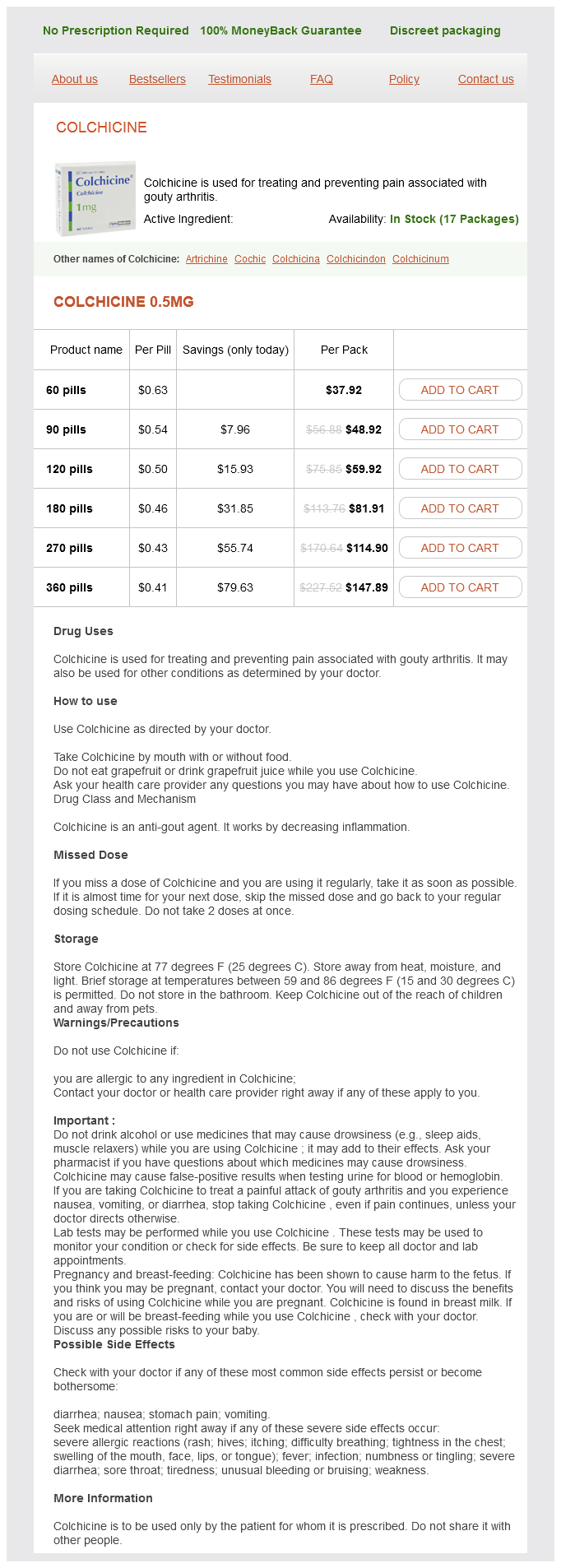
Colchicine
Colchicine 0.5mg
- 60 pills - $37.92
- 90 pills - $48.92
- 120 pills - $59.92
- 180 pills - $81.91
- 270 pills - $114.90
- 360 pills - $147.89
Colchicine dosages: 0.5 mg
Colchicine packs: 60 pills, 90 pills, 120 pills, 180 pills, 270 pills, 360 pills
In stock: 883
Only $0,44 per item
Description
Since the unique report by Denborough and Lovell in 1960 infection urinaire traitement colchicine 0.5 mg low cost, as bigger expertise was gained with this entity antibiotics queasy cheap colchicine 0.5 mg otc, it proved in some circumstances to be a metabolic myopathy inherited as a dominant trait infection after knee replacement 0.5 mg colchicine otc, rendering the individual weak to any volatile anesthetic agent antibiotics for uti liquid 0.5 mg colchicine cheap with amex, notably halothane, and to the muscle relaxant succi nylcholine. The elementary trigger in a big proportion of circumstances is an aberration in a part of the ryanodine calcium channel. Malignant hyperthermia has been esti mated to occur approximately once in the course of each 50,000 administrations of general anesthesia. The full scientific image is striking but anesthesiolo gists have become adept at detecting its earliest levels and aborting the process. As halothane or a similar inhalational anesthesia is induced, or succinylcholine is given for mus cular leisure, the jaw muscles unexpectedly turn out to be tense quite than relaxed and shortly rigidity extends to all the muscles. Circulatory collapse and dying might ensue in approximately 10 p.c of instances, or the affected person may survive with gradual restoration: In some cases there is the same sequence of occasions (increased temperature and aci dosis) with out muscular spasm. With sur vival for several days, samples of muscle reveal scattered segmental necrosis and phagocytosis of sarcoplasm with out inflammation. Patients with a particular congenital myopathy (central core myopathy), and those with King Denborough syndrome mentioned later, will be inclined to malignant hyperthermia as noted in Chap. In sufferers with the familial types of periodic paralysis, the induction of hyperthyroidism is alleged to not increase the frequency or intensity of assaults. Therefore, it appears doubtless that thyrotoxicosis has unmasked another kind of hereditary periodic paralysis, though a famil ial prevalence within the thyrotoxic cases is phenomenal. Clinically, the attacks of paralysis are a lot the same as those of familial hypokalemic type apart from a higher legal responsibility to cardiac irregularity. Potassium chloride restores energy in paralytic attacks, and treatment of the hyperthyroidism prevents their recurrence (see "Myasthenia Gravis With Hyperthyroidism" in Chap. In primary aldo steronism, the cause for the hypersecretion is within the adrenal gland itself, normally an adrenal cortical adenoma, much less typically adrenal cortical hyperplasia. Although the dysfunction is uncommon (occurring in roughly 1 percent of unselected hypertensive patients), its recognition is essen tial for effective remedy. Persistent aldosteronism is frequently associated with hypematremia, polyuria, and alkalosis, which predispose to assaults of tetany in addition to to hypokalemic weak spot. Conn and associates (1964), in an analysis of 145 patients with primary aldosteronism, discovered that persistent muscular weak point was a major grievance in 73 percent; intermittent attacks of paralysis occurred in 21 %; and tetany in another 21 %. During the rigor section, oxygen consumption in muscle will increase threefold and serum lactate, 15- to 20-fold. It has been postulated that halothane acts in a fashion just like caffeine-that is, to release calcium from the sarcoplasmic reticulum and prevent its reaccumulation, thus interfering with chill out ation of the muscle. Insight into the illness has been gained from a breed of pigs, inbred for muscular development, during which mus cle spasm (true contracture) and hyperthermia follow the administration of anesthetic brokers. However, one of several related defects in ryanodine is present in somewhat fewer than 20 p.c of individuals with the susceptibility to malignant hypothermia. It is presumed that different but unidentified allelic mutations of this receptor protein or another that controls the structure of the calcium channel account for the rest of instances. Clues as to which sufferers are in danger for this condi tion come from several sources. Other members of the family could have difficulties or have died during anes thesia. Some vulnerable people exhibit myopathic and musculoskeletal abnormalities (Isaacs and Barlow). This is understandable insofar as both issues have been linked to the gene encoding the ryanodine receptor; the two diseases are a result of allelic varia tions (Quane et al). It has been identified that another uncommon muscle illness (Evans myopathy, named after the affected family) may be a predisposing situation. Other measures ought to embrace body cooling, intravenous hydration, sodium bicarbonate infusion to appropriate acidosis, and mechanical hyperventila tion to lower acidosis. Thereafter, halothane and other volatile anesthetic brokers and succinylcholine ought to be averted in such individuals and surgical procedures, if nec essary, should be carried out with different agents, such as propofol, nitrous oxide, fentanyl, thiopental (or other barbiturate), or native anesthesia. It shares some features with malignant hyperthermia but is a definite entity, as dis cussed in Chap. In vitro studies indicate that the mutation impairs the ability of preformed channels to migrate to the membrane floor and also impedes the current-carrying capability of the potassium channel system. This defect could be anticipated to impair repo larization of the muscle membrane, thereby making both skeletal and cardiac muscle hyperexcitable. Various tests for susceptibility to malignant hyperthermia have undergone phases of recognition. The solely currently legitimate one involves in vitro exposure of a muscle biopsy specimen to halothane and to caffeine and the detection of muscle contracture with each agents. The evaluation by Denborough could also be consulted for fur ther particulars on the testing and medical elements of the illness. Tre atm e nt this consists of discontinuation of anesthesia at the first trace of masseter spasm or rise of temperature. The intra venous administration of dantrolene, which inhibits the discharge of calcium from the sarcoplasmic reticulum, may be lifesaving. Hyperhidrosis, weight reduction, insomnia, and hallucinations may occur, and most circumstances so far described have ended fatally in a mat ter of months (Serratrice and Azulay). Plasma change reversed the syndrome in the case described by Ligouri and colleagues. Whether the antibodies are liable for the cerebral signs is unknown, however the connection is plausible. An interesting class of disease has emerged as being brought on by antibodies to the voltage-gated potas sium channel (Thieben et al), sometimes parallel to an idiopathic or paraneoplastic "limbic" encephalitis, which is described in Chap. Also mentioned right here for completeness are several diseases that outcome from secondary dysfunction of these same ion channe ls. Most of these conditions are acquired and autoimmune in nature, for instance, the Lambert-Eaton myasthenic syndrome that results from an autoimmune assault on calcium channels (see Chap. Thus, ion channels, being ubiquitous in all excitable tissues, may be anticipated to produce a big variety of ailments that have an effect on central and peripheral nervous constructions. Despite this, every of the genetic and bought processes has remarkably specific options which are pertinent solely to the channel as expressed in a single tissue. This phenomenon is noticed in hypothyroidism, the place the muscle fibers contract and loosen up slowly, a response readily demonstrated in the tendon reflexes, significantly the Achilles reflex. The foundation of this dysfunction appears to be slowness in the reaccumulation of calcium ions within the endoplasmic reticulum and within the disengagement of actin and myosin filaments. A intently related syndrome, wherein painless con tracture is induced by exercise, has been described by Lambert and Goldstein, and by Brody. Muscle contraction is regular but the leisure section becomes increasingly sluggish throughout exercise. Lambert and Goldstein referred to it as an uncommon type of myotonia, and Brody, as a lower of "enjoyable issue"; the gradual leisure has also been attributed to a decreased uptake of calcium by the sarcoplasmic reticulum. This latter course of may be more intently aligned with the muscular dystro phies and is talked about in Chap. In each these ailments, an in any other case wholesome baby, adolescent, or grownup begins to complain of weak point and stiffness and sometimes ache on utilizing the limbs. Muscle contraction and relaxation are regular when the patient is in repose, this toxic dysfunction is characterized by persistent spasms of skeletal muscular tissues, owing to the impact of the tetanus toxin on spinal neurons (Renshaw and different cells), the pure function of which is to inhibit the motor neurons. The impact of tetanus toxin on the spinal inhibitory neurons is analogous to that of strychnine. There can also be an motion of the toxin at the neuromuscular junction, which has been harder to evaluate within the face of its highly effective central action. Having injected this toxin domestically in animals, Price and associates demonstrated its localiza tion at motor endplates. Healthy individuals experience intermittent twitch ing of a muscle (or even a part of a muscle), such as one of many muscular tissues of the thenar eminence, eyelids, calves, or orbicularis oculi. Quantitative research of the motor unit dimension could also be useful in these circumstances by demonstrating nor mally modeled models within the benign type and abnormally large models because of reinnervation within the case of motor neuron illness. Occasionally, benign fasciculations are widespread and should final for months and even years. Pain of aching or burn ing sort may improve after activity and cease throughout rest. We suspect that this fasciculatory state reflects a illness of the terminal motor nerves, for a couple of of our patients have proven slowing of distal latencies, and Coers and associ ates have discovered degeneration and regeneration of motor nerve terminals in related instances.
Wild Pepper (Ginseng, Siberian). Colchicine.
- What other names is Ginseng, Siberian known by?
- Common cold. Some research suggests that taking a specific commercial product containing Siberian ginseng plus andrographis (Kan Jang) might reduce some symptoms of the common cold.
- Are there any interactions with medications?
- Dosing considerations for Ginseng, Siberian.
- A viral infection called herpes simplex 2.
- What is Ginseng, Siberian?
- How does Ginseng, Siberian work?
Source: http://www.rxlist.com/script/main/art.asp?articlekey=96946
In unaffected family members virus colorado safe 0.5 mg colchicine, the left hippocampal-amygdaloid region was smaller than in healthy folks antibiotic bone cement buy colchicine 0.5 mg on-line, but barely bigger than in affected family members infection viral order colchicine 0.5 mg overnight delivery. This hope was never realized however there are cases infection the game 0.5 mg colchicine buy with visa, difficult to interpret, by which these medicine have induced a prolonged relapse in a schizophrenic patient. Similarly, when methionine, a potent source of methyl teams, was noticed to exacerbate the symp toms of some schizophrenic sufferers, it was thought that a main metabolic fault had been discovered; elevated serum concentrations of dimethoxyphenylethylamine and N-methylated indoleamines lent support to this idea. In summarizing the many cerebral changes noticed in schizophrenic sufferers, Harrison concluded that a quantity of are quite constant. These embrace delicate enlargement of the lateral and third ventricles; decreased cortical quantity, perhaps disproportionate in the tem poral lobe; microscopically, diminution in size of corti cal and hippocampal neurons; a diminished variety of neurons in the dorsal thalamus; and a notable absence of gliosis. Detailed neuropsychologic testing has dis closed deficits in attention and abnormalities of the P300 waves (cortical "event-related" potentials). It is unclear, nonetheless, if these changes symbolize main defects or are secondary to an inherent lack of motivation. Attention has additionally been drawn to the regional altera tions of cerebral blood circulate in persistent stable schizophrenic patients, as revealed by positron emission tomography biochemical speculation is based on the response of psychotic signs to phenothi azine and associated medicines, which implicates the dopaminergic system of the temporal lobe (see evaluate by Carlsson). The evidence for that is circumstantial however is supported by observations that antipsychotic medicine scale back the electrical exercise of mesolimbic dopaminer gic neurons in experimental models. Furthermore, there have been a number of demonstrations of elevated concentra tions of dopamine or its metabolite, homovanillic acid, in schizophrenic brains obtained at autopsy. The discovering that dopamine receptors are organized in two systems, one limbic and the opposite cortical, has led to an expanded but speculative hypothesis that an extra of dopaminer gic exercise in the mesolimbic system gives rise to the optimistic symptoms of schizophrenia-i. The involvement of the mesolimbic system, which plays a job in atten tion, has prompted additional hypothesis that the thought dysfunction of schizophrenia is attributable to a breakdown of the traditional "filtering" of stimuli reaching cognition. As pointed out in the evaluate by Freedman, nevertheless, the dopamine speculation has many weaknesses, probably the most outstanding of which is the relative ineffectiveness of dopamine-blocking medication in assuaging many features of the disease. The complexity of dopamine methods and their interaction with other neurotransmitter circuits make a simplistic mechanism unlikely. More just lately, a hypothesis based mostly on changes in the serotoninergic system was proposed. As with the dopa minergic model, consideration was drawn to mechanisms referring to a new class of antipsychotics (clozapine, ris peridone), which have major results on the serotonin sys tem and had been discovered to ameliorate the psychosis. Several groups have reported alterations in serotonin receptors in the brains of schizophrenic patients (see later). Weinberger and colleagues in blood move within the prefrontal areas throughout cognitive performances. Friston and associates found consistent abnormalities in the left parahippocampal area in all types of chronic schizophrenia. Studies of regional glu cose metabolism and postmortem norepinephrine mea surements have yielded equivocal information, although most sufferers present a discount in glucose metabolism within the thalamus and frontal cortex. Several traces of investiga tion point to the medial part of the left temporal lobe and associated limbic and frontal techniques as being the main target of a developmental abnormality (see Tsuang et al and Friston et al for pertinent references). According to Sabri and col leagues, the inconsistent findings on practical imaging may be accounted for by correlations between sure blood move patterns and particular signs. For instance, the formal thought dysfunction corresponded to increased circulate in the frontal and temporal regions, whereas delu sions and hallucinations have been related to decreased move in the cingulate, left frontal, and temporal areas. One of their drug-naive patients with visible and auditory hallucina tions showed activation in these areas. This implicates the glutaminergic system, but it must be pointed out that the dopaminergic and glutaminergic systems converge on certain cortical neurons and that glutaminergic release is modulated in a number of places in the brain by dopamine. A great number of physiologic and endocrine differ ences between schizophrenic and healthy subjects have been claimed. Because psychoses could complicate corticosteroid administration and certain endocrine issues (Cushing syndrome, thy rotoxicosis, see later), there have been many attempts to uncover such abnormalities in the schizophrenic affected person. Thus whenever this syndrome is recognized, these several causes need to be differentiated. Lacking these options, and specifically with a full remission, one assumes the occur rence of hypomania or of a toxic-metabolic psychosis, which can be detected by laboratory screening for medication and endocrine diseases. Only 10 percent of patients with classic schizophrenia could have such an acute episode. Adherence to the criteria enumerated earlier, notably to these devised by Feighner and colleagues will avoid most errors in diagnosis. Is the traditional separation of depressive disease, bipolar illness, and schizophrenia biologically sound Neurologists ought to keep an open mind about these and different theoretical issues that lack a firm genetic and neuropathologic foundation. Behind all these recommendations was the notion that disturbed interpersonal relations within the fam ily ultimately interfered with the conventional maturation of persona. The often-cited observations of Harlow on the del eterious results of maternal and peer deprivation in primates opened the likelihood that similar deprivations in humans may be liable for the event of schizophrenia. However, such severe degrees of familial deprivation have hardly ever been documented in people and once they have been, as in some orphans, the consequences have been only transitory. A affected person with a wholesome household and premorbid his tory with an acute illness having lots of the typical options of schizophrenia but associated with confusion, forgetfulness, and / or clouding of consciousness. Thus the illness combines the features of an affective dysfunction, schizophrenia, and a confusional state. This syndrome is character istic of persistent hallucinogenic drug use, notably phencyclidine intoxication, corticosteroid psychosis (drug-induced or Cushing disease), thyrotoxic psy chosis, and puerperal psychosis. Usually restoration is full, and schizophrenia is excluded by the fact that the patient remains nicely. Differentia l Diag nosis From a neurologic standpoint, the main initial distinction to be made is between an acute schizophrenia-like psy chosis and the continual illness, schizophrenia. The latter could have triggered seizures, hallucinations, and withdrawal symptoms or could have resulted in habit. Such patients are normally categorized as having a borderline character or "sociopathy" that appears to return several years. These forms of personality problems and social maladjustments tum out not to be schizophrenia. Many such indi viduals will indeed be found to have easy schizo phrenia (so-called pseudoneurotic form). Here errors in prognosis usually result from a failure to assess mental standing fastidiously and to ascertain the life profile of the disorder. And though what are thought to be "schiz oid" traits may be acknowledged in childhood, a frank psychosis is hardly recorded at this age. Of specific importance in such youngsters is to exclude the presence of metabolic errors, psychological retardation, or an early-onset depressive illness. Similarly, youngster hood autism and particularly its milder forms, corresponding to Asperger syndrome discussed in Chap. Only later do a few of these patients drift right into a quiet hallucina tory, mildly paranoid state, with rather bland have an effect on. If signs of focal cerebral or brainstem disease are absent, one is tempted to make a analysis of catatonic schizo phrenia, not appreciating that catatonia as a phenom enon could additionally be indistinguishable from akinetic mutism (see Chap. Treatment the goals of remedy are to suppress psychotic symptoms, ameliorate the dysfunction of pondering and the apathetic state, prevent relapse, and optimize social adjustment. It is usually possible, once the analysis of schizophrenia is established and the optimal regimen of medicine determined upon, for a basic doctor to share the duty for following the affected person with a psychiatric social employee or nurse. Many basic hospitals and specialized psychiatric institutions have facilities for the management of such patients; state hospitals and different institutions are capable of present long-term therapy. The aim of hospitalization is to defend the patient, relieve the family of the necessity for fixed vigilance and supervision, and guarantee the administration of drugs until the exacerbation spends itself. Later, as an alternative of mere custodial care, the affected person wants a supervised program of deliberate activities, voca tional and milieu therapy, typically in a "midway house," which includes the affected person as a contributing member dur ing the more continual phases of the disease. If treatment is profitable in stopping progressive decompensation, the patient can many instances return to the household and com munity. It is invaluable to have a competent social employee or nurse maintain frequent contact with the affected person and his household and guarantee continuity of medicine. It can also seem with widespread disease of the associational cortices and as males tioned earlier, with severe despair, certain con fusional states, and hysteria. The authors have seen cases of hypoxic and different metabolic encephalopa thies, Schilder illness, sure storage illnesses, and Creutzfeldt-Jakob disease mistaken for schizophrenia due to failure to adhere to this precept. A patient with temporal lobe epilepsy who, other than intermittent psychomotor seizures, has long peri ods (weeks or months) of hallucinations, delusions, bizarre behavior, and disorganization of pondering. Such a psychological disturbance reflects the presence of a persistent state of temporal lobe seizures (temporal lobe status epilepticus), which in some cases has been demonstrated by depth electrodes to originate within the amygdaloid or different medial temporal areas.
Specifications/Details
Nor did patients with endogenous despair differ in this respect from those with reactive melancholy antibiotic hepatic encephalopathy 0.5 mg colchicine with mastercard. Left unanswered is the question of why some individuals are subject to a reactive despair virus wot discount colchicine 0.5 mg. One is tempted to conclude that many depressions attributed to psychosocial stress are contaminating a bunch of endogenous depressions infection knee joint 0.5 mg colchicine generic otc. Treatment of Depression using medications for despair is now so extensive unfold that every one physicians ought to be conversant in them virus zero portable air sterilizer reviews colchicine 0.5 mg discount amex. Those untrained in psychiatry would, nonetheless, be unwise to undertake the administration of bipolar disease or a serious endogenous despair with out the recommendation or assistance of a psychiatrist. The pharmacologic properties and modes of action of these medicine were thought of in Chap. It must also be said that meta-analyses of several massive studies on the therapeutic effects of antidepressants suggest that clinical enchancment attributable to the medicine themselves happens in approximately 50 % of sufferers; remarkably, an additional improvement in as a lot as 25 percent is attributable to a placebo impact or, more doubtless, to the natural course of the illness. The incremental value of sure forms of psychotherapies is discussed additional on. These medicine have much less sedating and anticholinergic results than the tricyclic antidepressants discussed under, and will have a barely sooner onset of impact towards despair. Fluoxetine has a tendency to produce insomnia and weight reduction, making it significantly useful in the remedy of depressions which might be characterized by overeating and hypersomnia. Patients with anorexia, insomnia, and high levels of anxiety could do better with a extra sedating medicine, corresponding to amitriptyline. Fluoxetine can be a reasonable selection for sufferers in whom lethargy is a outstanding complaint. Certain unwanted facet effects such as loss of libido and erectile dysfunction occur in a proportion of patients and are troublesome to differentiate from the indicators of melancholy. Other side effects occur in a proportion of patients, together with gastrointestinal upset, elevated anxi ety as discussed in Chap. The contentious problems with (1) inducing mania, (2) precipitating suicide soon after the institution of those drugs, and (3) the utilization of these drugs in youngsters are essential points that can solely be addressed right here cur sorily. The tricyclic antidepressants comprise amitriptyline, imipramine, desipramine, doxepin, clomipramine, and trimipramine, and the carefully related drugs nortriptyline and protriptyline. Among this group, most psychiatrists start with imipramine or amitriptyline because of their relative safety. In common, all of these medication are equally efficient, though an individual affected person might have a better response or tolerance to one than to one other. The starting dose for amitriptyline or imipramine is 25 mg/ d, which is then raised by 25 mg q3-4d as needed up to a hundred and fifty mg/ d. These drugs, taken at bedtime, are also very useful in assuaging the insomnia that accompanies melancholy. Common unwanted effects are orthostatic hypotension, dry mouth, constipation, tachycardia, urinary hesitancy or retention (especially in sufferers with prostatic hypertrophy), tremor, and drowsiness. Caution ought to be exercised in aged sufferers with cardiac problems of every kind due to the potential for causing coronary heart block or arrhythmia. For such sufferers, the serotonin drugs or one of a extra moderen group of nontricyclic antidepressant drugs-bupropion and trazodone-may be preferable, however the latter causes orthostatic hypoten sion and sedation in doses required for constant antide pression effects. The latter drugs appear to be as efficient as the tricyclic brokers within the therapy of depression with out the adverse anticholinergic and cardiotoxic effects. In one of many many new "effectiveness" trials sponsored by the National Institutes of Mental Health, as distinguished from "efficacy" in managed and randomized trials, fail ure of citalopram to accomplish remission of depression (about half of patients, as expected), altering to bupro pion, sertraline, or venlafaxine had equivalent results and were profitable in 25 p.c of circumstances (Rush et al). Phenelzine, isocarboxazid, and tranylcypromine are on this class, of which the first is claimed to be the least likely to produce serious unwanted aspect effects. The ordinary starting dose is 15 mg tid, which is gradually elevated as wanted to a most of forty five mg tid. Patients taking these medicine should keep away from foods with a high tyramine content material (aged cheese, many choose led meals, rooster liver, beer, wines, yeast extract) in addition to medicines containing sympathomimetic agents or L-dopa (decongestants, amphetamines, caffeine) and the aforementioned serotonin agonists. Supplementation of antidepressants with the admin istration of an antiepileptic medication is a well-liked strategy with many psychiatrists. There are few credible studies by which to judge the worth of this strategy, but these drugs might provide some extra benefit as "temper stabilizers," if only as antianxiety brokers. More persuasive are the information recommend ing that antiepileptic drugs are useful in remedy of the manic state. Treatment, if profitable, ought to be continued for six to 9 months and customarily combined with some kind of psychotherapy. Rapid discount could lead to withdrawal symp toms (nausea, vomiting, malaise, and muscular pains). If depressive signs recur upon withdrawal, the effec tive dose ought to be progressively reinstituted. Mann (2005) offers an intensive review of the medical therapy of depression; the unwanted side effects of each are given in tabular type and adapted for Table 52-3. Haloperidol (Haldol), or one of the newer anti psychosis brokers mentioned in Chap. The ordinary dosage of lithium is 1,200 to 2,400 mg every day in divided oral doses, which produces a desired serum degree of 0. The serum level of lithium should be checked frequently, both to ensure that a therapeutic dose is being taken and to guard in opposition to toxicity (see later). The side effects of lithium are nausea and vomiting, diarrhea (especially if the dose is elevated too rapidly), a sense of mental dullness, action tremor, weak spot, ataxia, slurred speech, blurred imaginative and prescient, dizziness, nystag mus (especially vertical or down beating), stupor, and coma. A confusional psychosis with polymyoclonus and ataxia-simulating Creutzfeldt-Jakob disease (including periodic sharp waves within the electroencephalogram) might happen at poisonous ranges. Failing this, a "temper stabiliz ing" drug such as lamotrigine or divalproex has been used. Other mixtures have been used such as olanzapine with a serotonergic antidepres sant. These are ably summarized in the evaluation by Frye but taken together the effectiveness of those new approaches serve to emphasize the impor tance of proper analysis of bipolar illness in contrast to unipolar melancholy. Haloperidol could also be essential to control a dangerous manic episode while one of these newer medications turns into efficient. The technique is comparatively simple and, in correctly supervised clinics, fairly protected. In the standard method, an electrode is positioned over each temple and a current of about four hundred rnA and 70 to 120 V is passed between them for 0. The solely absolute contraindication is the presence of elevated intracranial strain, as could happen with a neoplasm or intracranial hematoma. This remedy should also be used cautiously in the presence of uncontrolled systemic hypertension or with a identified sensitivity to the anes thetic agents that are used as premedication, significantly malignant hyperthermia. Following a course of 6 to 14 therapies, near ninety p.c of patients recovered within 2 months or less. At the identical time, there ought to be vigilance for suicidal ity, admittedly a troublesome task given its unpredictability. Tomes have been written about varied psychody namic approaches to psychotherapy and the authors are unable to comment authoritatively on them. A structured and problem-oriented method to psychotherapy utilizing "cognitive-behavioral" and "interpersonal" strategies has gained appreciable reputation since its introduction within the Seventies by Beck It draws to a restricted extent on psy choanalytic and different psychodynamic theories and has been utilized in sufferers with despair and in those with nervousness chronic pain, and other disorders. According to Blenkiron, cognitive-behavioral remedy is most effec tive in patients with gentle to reasonable (not chronic) despair, generalized anxiousness and panic dysfunction, and obsessive-compulsive and phobic issues. Essentially, within the quick time period, the therapist provides the affected person with info on the nature of the illness, its frequent signs, and the energetic interventions which are to be undertaken by the affected person with assistance from the therapist to alter the specific misperceptions and the dysfunctional behaviors that spring from them. In troublesome continual types of melancholy, Keller and colleagues in contrast an antidepression drug (nefazodone), cognitive-behavioral remedy, or the mixture, and found remissions in approximately 50 p.c of every of the primary two groups and in 85 % of the combined remedy cohort by 12 weeks. This stands as one of the higher demonstrations of the worth of modern, result-oriented psychotherapy. Noteworthy is the opinion of Gabbard that behavioral-cognitive psy chotherapy has been proven to be no higher or worse than other forms of psychotherapy, but it has the virtues of relative brevity, uniformity of utility, and straight forwardness that avoids blaming the affected person, family, setting, or other external forces. Su icide Some 30,000 suicides are recorded annually within the United States, and attempted suicides exceed this number by approximately 10 times. Suicide is the eighth main cause of demise amongst adults in the United States and the second leading trigger amongst persons between the ages of 15 and 24 years, figures that emphasize the importance of recognizing depression that has a high potential for self-destruction.
Syndromes
- Middle ear infections
- The flu shot contains killed (inactive) viruses. So you cannot get the flu from this type of vaccine. Some people do get a low-grade fever for a day or two after the shot. The flu shot is approved for people age 6 months and older.
- Endoscopy -- the placement of a camera down the throat to see the extent of burns to the esophagus and the stomach
- Controlling high blood pressure
- Keep infants away from buttons, popcorn, coins, grapes, nuts, or similar items.
- Itching before the boil develops
- Headache
- Liver failure
- Participating in risky physical activities
Related Products
Additional information:
Usage: q._h.
Tags: buy discount colchicine 0.5 mg, purchase 0.5 mg colchicine with mastercard, colchicine 0.5 mg low cost, buy cheap colchicine 0.5 mg online, cheap colchicine 0.5 mg on-line, colchicine 0.5 mg order amex, colchicine 0.5 mg otc, colchicine 0.5 mg cheap, cheap colchicine 0.5 mg with mastercard, 0.5 mg colchicine buy fast delivery, buy 0.5 mg colchicine with visa, order colchicine 0.5 mg on line, colchicine 0.5 mg order, colchicine 0.5 mg buy on-line, colchicine 0.5 mg cheap line, 0.5 mg colchicine buy mastercard
10 of 10
Votes: 75 votes
Total customer reviews: 75
Customer Reviews
Jesper, 29 years: Several of our sufferers have taken up dancing and report that their steadiness in every day circumstances is improved. These findings tend to negate the significance of several different components that had been thought to be causative, namely, malnutrition, ergot contamina tion, and toxins derived from Vicia sativa, the common vetch that grows alongside the lathyrus species.
Garik, 53 years: Cryptococcus, which causes menin goencephalitis and, not often, a cerebral granuloma, in our expertise, seldom causes spinal lesions. Physiologic jaundice tends to have been extreme and pro longed (up to three months), and this, along with widening of the posterior fontanelle and mottling of the skin, should elevate suspicion of the disease.
Bernado, 44 years: Several biochemical findings implicated in diabetic polyneuropathy and their interpretations were reviewed by Brown and Greene, who advanced the concept that persistent hyperglycemia inhibits sodium-dependent myoinositol transport. This syndrome is character istic of persistent hallucinogenic drug use, significantly phencyclidine intoxication, corticosteroid psychosis (drug-induced or Cushing disease), thyrotoxic psy chosis, and puerperal psychosis.
Miguel, 48 years: These are particu larly prominent in circumstances which are accompanied by cramp and biochemical contracture (phosphorylase and phosphofructokinase deficiency). Cogan described a twitching of the upper eyelid that seems a second after the affected person moves the eyes from a downward to the primary place ("lid-twitch" sign).
Folleck, 41 years: Moreover, each of those membrane-binding proteins (adhalin, merosin, and lam inin) is implicated in specific muscular dystrophies, as discussed later in this chapter. Cranial nerves are affected much less regularly, however ptosis and lateral rectus, facial, and vocal twine palsies have been noticed.