
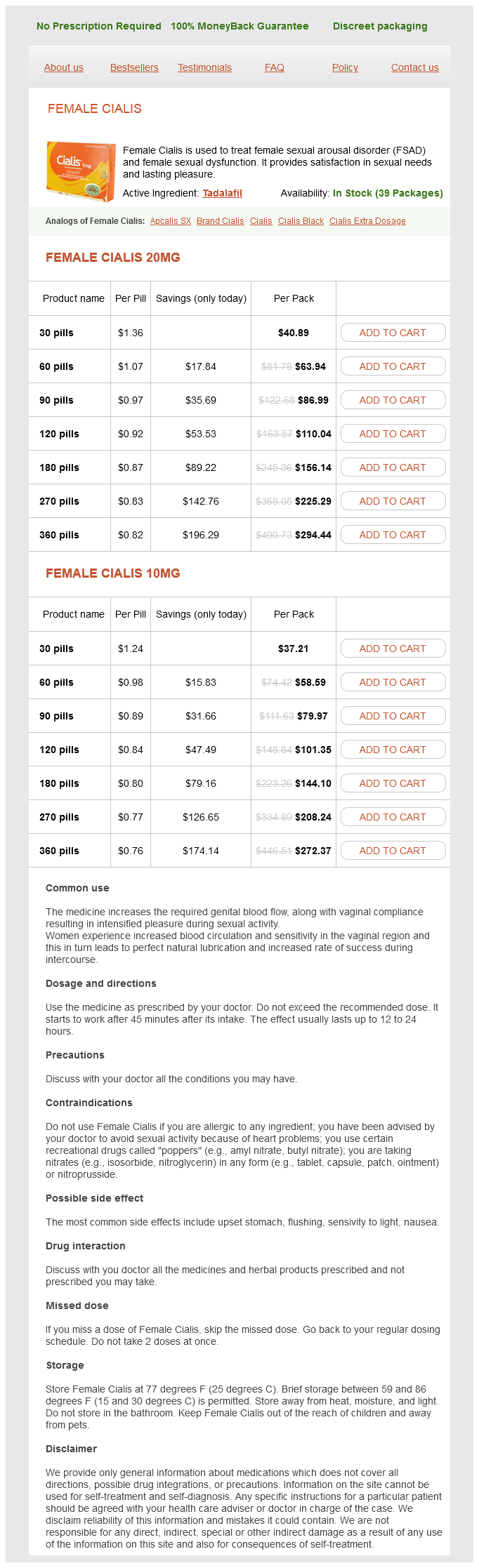
Female Cialis
Female Cialis 20mg
- 30 pills - $40.89
- 60 pills - $63.94
- 90 pills - $86.99
- 120 pills - $110.04
- 180 pills - $156.14
- 270 pills - $225.29
- 360 pills - $294.44
Female Cialis 10mg
- 30 pills - $37.21
- 60 pills - $58.59
- 90 pills - $79.97
- 120 pills - $101.35
- 180 pills - $144.10
- 270 pills - $208.24
- 360 pills - $272.37
Female Cialis dosages: 20 mg, 10 mg
Female Cialis packs: 30 pills, 60 pills, 90 pills, 120 pills, 180 pills, 270 pills, 360 pills
In stock: 512
Only $0,8 per item
Description
Hemodialysis induced repetitive myocardial damage ends in global and segmental reduction in systolic cardiac function pregnancy freebies discount female cialis 20 mg without prescription. The prevalence of cardiovascular dysfunction in patients with acute renal failure will increase inhospital mortality charges menopause herbs buy female cialis 10 mg without prescription. Elevation in ranges of circulating proinflammatory cytokines is viewed because the pathophysiologic Chapter 104 / Cardiovascular Problems in Acute Kidney Injury 645 menstruation 2 weeks apart female cialis 20 mg purchase. International differences in dialysis mortality reflect background common inhabitants atherosclerotic cardiovascular mortality menstruation 2 female cialis 10 mg generic fast delivery. Relation between renal dysfunction and cardiovascular outcomes after myocardial infarction. Hemodialysisinduced repetitive myocardial injury results in world and segmental reduction in systolic cardiac perform. Acute renal failure in the cardiac unit: etiologies, outcomes, and prognostic factors. Immediate penalties of acute kidney injury: the impression of traditional and nontraditional issues on mortality in acute kidney injury. Cardiovascular responses in spontaneously hypertensive rats with acute renal failure. Isolation of "myocardial depressant factor(s)" from the ultrafiltrate of heart failure patients with acute renal failure. Plasma and urinary cytokine homeostasis and renal function during cardiac surgical procedure without cardiopulmonary bypass. The interaction between heart failure and different heart ailments, renal failure, and anemia. Interleukin-2 administration causes reversible hemodynamic modifications and left ventricular dysfunction much like those seen in septic shock. Molecular mechanisms underlying mixed kidney-lung dysfunction throughout acute renal failure. Describe the widespread electrolyte disturbances seen in sufferers with acute renal failure. Water and electrolyte disturbances are among the most typical complications of acute renal failure. Imbalances in plasma sodium, potassium, calcium, and phosphate are the most common electrolyte disturbances and require a comprehensive method to management. External factors refer to the renal and extrarenal factors controlling potassium steadiness within the serum. Internal elements are those who mediate the transcellular distribution of potassium. The main extrarenal site of potassium elimination is within the colon, where mineralocorticoids may affect potassium secretion. This source of potassium loss is negligible during acute renal failure however may account for as a lot as 10% of dietary potassium elimination among patients with chronic renal failure under the direct stimulation of elevated aldosterone. It is troublesome to induce hyperkalemia among sufferers with regular renal operate strictly by increasing ingestion of potassium. Acidosis, also a prominent characteristic of acute renal failure, promotes potassium exit from the cells. Because 98% of complete body potassium is situated intracellularly, small shifts of whilst little as 1% to 2% could cause will increase in serum potassium that indeed could be life threatening. These problems are exacerbated dramatically in acute renal failure, in which ability to excrete this potassium load is decreased. In acute renal failure, hyperkalemia results from either exogenous or endogenous sources. Pathomechanisms of endogenous potassium accumulation such as tissue hypoxemia, particularly from skeletal muscle necrosis or red cell lysis, resorption of hematoma, or tumor lysis, typically lead to a dramatic shift of potassium from the intracellular to the extracellular area, with resultant lifethreatening hyperkalemia. Treatment of Hyperkalemia in Acute Renal Failure Surprisingly, regardless of the dogmatic approach that has been advocated, actual evidence-based analysis of therapy for life-threatening hyperkalemia is fairly scant. Review of the obtainable literature reveals the woeful inadequacy of current data about efficient therapies for hyperkalemia. Initially, antagonism of the membrane effects of the increased potassium should be facilitated with the administration of calcium and, potentially, the use of hypertonic sodium if the affected person is notably hyponatremic in affiliation with the hyperkalemia. Thereafter, the administration of glucose plus insulin and sodium bicarbonate, to induce shifting of potassium from the extracellular to the intracellular area, must be the subsequent step. Finally, removing of the excess potassium have to be facilitated by either renal or extrarenal mechanisms. A retrospective case-controlled trial revealed a statistically vital however clinically minimal distinction among hospitalized sufferers with delicate hyperkalemia handled with polystyrene sulfonate versus conservative measures (0. Because sodium ions trade theoretically one for one with potassium ions, a 30-g dose of Kayexalate would maximally remove only 120 mEq of potassium. The restricted change becomes obvious on analysis of the potassium focus in the lumen of the bowel: at no level in the bowel lumen does the potassium focus attain 120 mEq/L. Actual knowledge reporting the diploma of serum potassium lower with using Kayexalate are nonexistent. Thus, notably among critically unwell sufferers, Kayexalate enemas are more doubtless to be ineffective and are potentially harmful. New potassium binders have been launched into the therapy armamentarium lately: zirconium cyclosilicate and patiromer. Removal of potassium with peritoneal dialysis is said to the relative dimension of the fluid-membrane contact surface area, as properly as the blood flow to the peritoneal floor. Peritoneal fluid typically has a zero potassium tub, so exchange must be conducted roughly on an hourly foundation for life-threatening hyperkalemia. The most popular method for management of hyperkalemia in acute renal failure is use of blood-based dialytic techniques. Very little proof is available, nonetheless, concerning the reliable decrement of plasma potassium with respect to dialysis potassium baths. Several issues must be addressed with respect to rapid shifts in potassium among critically sick patients. In fact, a research performed in 1996 showed better tolerance from the attitude of lowering ventricular dysrhythmias by means of a stepwise potassium modeling method to dialytic potassium focus. In severe acute hyperkalemia, nevertheless, steady therapies might not remove the potassium shortly sufficient. An initial session of intermittent hemodialysis, followed by establishment of continuous therapies, has been used with success in many facilities, together with our own. This strategy could additionally be particularly advantageous amongst critically unwell patients with hypoperfusion and ongoing shock. As in patients with out renal failure, nonetheless, a systematic strategy to diagnosis is beneficial. Patients who clinically appear to be hypervolemic have amassed an extra of sodium however proportionately extra water. Commonly, these sufferers are these affected by extreme congestive heart failure, hepatic dysfunction, and renal failure. Fortunately, cellular mechanisms directed at rectifying the motion of water from the extracellular to the intracellular area are stimulated by hypo-osmolality-most usually brought on by hyponatremia. Initially, cells combat this swelling by exporting potassium, sodium, and chloride. The lower in these "osmolytes" may be seen within minutes to hours after induction of hyponatremia. These substances embrace glutamine, creatine, taurine, myoinositol, glutamine, and glycerol phosphorylcholine. Their export requires a carrier-mediated Optimally, dialysis should be considered the first modality for removal of potassium during an episode of acute renal failure and significant illness�associated hyperkalemia. Obviously, this protocol will require mobilization of resources for placement of intravenous access safely and expeditiously, and the provision of pressing dialysis. The best route of potassium removal for decreasing serum potassium in patients with acute renal failure is dialysis. Peritoneal dialysis yields variable outcomes with respect to control of emergent hyperkalemia, particularly among patients with acute renal failure. Complications arising from placement of a temporary peritoneal dialysis entry are widespread. These processes- notably the natural ion transport pathways-are reversed slowly, nevertheless. Therefore correction of hyponatremia should be achieved with extraordinary care to keep away from fast will increase in serum tonicity. Cellular contraction resulting from osmotic motion of water from the intracellular to the extracellular area may outcome from overly fast correction of hyponatremia.
Radix Astragalus (Astragalus). Female Cialis.
- Are there safety concerns?
- Is Astragalus effective?
- How does Astragalus work?
- Are there any interactions with medications?
- Common cold; chest pain; diabetes; chronic fatigue syndrome (CFS); hepatitis; HIV/AIDS; fibromyalgia; and cancer including breast cancer, lung cancer, and cervical cancer.
- What is Astragalus?
Source: http://www.rxlist.com/script/main/art.asp?articlekey=96925
Continuous venovenous hemofiltration using personalized substitute fluid for acute kidney harm with severe hypernatremia pregnancy signs female cialis 10 mg buy free shipping. Continuous venovenous haemofiltration with citrate-buffered substitute answer is secure and efficacious in sufferers with a bleeding tendency: a potential observational research women's health clinic northfield buy 20 mg female cialis with mastercard. Continuous venovenous hemofiltration utilizing a phosphate-containing replacement fluid in the setting of regional citrate anticoagulation breast cancer cheer bows female cialis 20 mg buy cheap on line. Continuous venovenous hemodiafiltration with a low citrate dose regional anticoagulation protocol and a phosphate-containing solution: effects on acid-base status and phosphate supplementation wants womens health 30 day ab challenge buy female cialis 20 mg. A secure citrate anticoagulation protocol with variable therapy efficacy and excellent management of the acid-base status. Efficacy and security of regional citrate anticoagulation in liver transplant sufferers requiring post-operative renal replacement therapy. Phosphate addition to hemodiafiltration solutions during continuous renal replacement therapy. Biochemical results of phosphate-containing substitute fluid for steady venovenous hemofiltration. Hypomagnesemia and mortality in sufferers admitted to intensive care unit: a scientific review and meta-analysis. Bioenergetic acquire of citrate anticoagulated continuous hemodiafiltration - a comparability between 2 citrate modalities and unfractionated heparin. Handling steady renal replacement therapy-related adverse results in intensive care unit sufferers: the dialytrauma concept. Discuss the sensible features of initiating and withdrawing dialysis in critically sick patients. The mixture offers the idea for the decision-making process in initiating therapy with dialysis. The unique combination of factors in a selected case should dictate the timing and kind of therapy supplied. Although the stability between dangers and advantages of invasive procedures should be considered rigorously within the particular person affected person, proof in favor of early intervention has grown steadily. In 1998 Bellomo and Ronco proposed 12 indications for initiating dialysis in critically unwell patients. Hyperkalemia, severe hyperphosphatemia, extreme hyperuricemia, severe acidemia, and uremia-related issues (coma, pericarditis, seizures) are accepted indications for beginning dialysis. Aside from situations by which there are severe derangements, most nephrologists have a tendency to avoid dialysis for so long as attainable. The longer the time for collection, the higher is the probability for errors brought on by inaccurate recording of time and incomplete urine collection. Several studies have shown that short-duration (1 to four hours) creatinine measures are possible in the critically unwell, and studies have validated the strategy evaluating to 24-hr clearance. Combined derangements should result in initiation of remedy before the suggested limits have been reached. Indications and standards for initiating renal replacement therapy within the intensive care unit. The mixture of fluid overload and low urine output most likely may information toward initiation of therapy. Decreasing output in the face of evolving sepsis is tolerated poorly and is unlikely to reply to diuretics. It rarely improves quickly enough to forestall the necessity for dialysis in the absence of volume depletion. The use of diuretics to support urine flow has been debated within the literature with no clear indication that it both hurts or helps in oliguria. Given the added consolation of volume control, maintenance of urine volume with or without diuretics might delay unnecessarily the onset of dialysis in select individuals. Use of creatinine as a marker is confounded by age, muscle mass, hydration status, assay interference, and certain Chapter a hundred and forty four / Starting and Stopping Renal Replacement Therapy in the Critically Ill the beginning of the nephrology consultation (42 vs. Mukau and Latimer confirmed that 95% of their sufferers with postoperative acute renal failure had fluid excesses of greater than 10 L at initiation of dialysis. Moreover, such renal help offers quantity "space," which permits the administration of nutritional support without limitations. Conservative strategies involve minimizing inputs, increasing oxygen supply, maximizing diuretics, controlling the heart price, and employing vasodilators. When these options fail to preserve the oxygen saturation at 90% or larger, extracorporeal volume elimination becomes necessary. If placement of a brief dialysis catheter is delayed till oxygen saturation reaches this threshold, the affected person might not tolerate mendacity supine for the procedure. Administration of insulin and glucose or high-dose -adrenergic therapy can every lower potassium by as a lot as 1 mEq/L. Typical circumstances would involve massive cell lysis, as may be observed in hepatic necrosis, rhabdomyolysis, and a few myeloproliferative issues. Both can inhibit the passage of potassium into the intercellular fluid, minimizing the flexibility to compensate for a potassium load. There is a lack of capacity to remove potassium from the physique with potassium-exchange resins. It is necessary to determine whether or not the colon has been eliminated or whether the patient has intestinal obstruction or ileus before utilizing this technique. Severe acidemia contributes to hypotension (by multiple mechanisms), hyperkalemia, hyperventilation, and respiratory fatigue. The preliminary step in management must be to improve the hematocrit to 30%, to enhance pink cell rheology. The potassium concentration is merely too excessive to be lowered quickly right into a protected range by shifting it into the intracellular 876 Section 23 / General Principles of Acute Renal Replacement Therapy of myoglobin with a clearance of myoglobin that surpassed all beforehand reported dialysis methods. It is unclear if peritoneal dialysis has a bonus over hemodialysis for the treatment of uremic bleeding. Acute uremic encephalopathy is reversible with dialysis with time lag of 1 to 2 days. Similarly, acute uremic peripheral neuropathy often is an exacerbation of a preexisting process similar to diabetic neuropathy. Patients with these situations could enhance with establishment of dialysis, sometimes dramatically. Dialytic intervention in such hopeless circumstances probably ought to be thought-about futile remedy. Consequently, offering dialysis could be seen as a form of renal help quite than mere replacement. This terminology distinguishes between the technique of replacing particular person organ perform and considered one of offering help for all organs. The freedom to present continuous fluid management permits the applying of unlimited nutrition, changes in hemodynamic parameters, and achievement of steady-state solute management, which is troublesome with intermittent therapies. It is thus potential to widen the indications for renal intervention and supply a customized approach for the administration of every affected person. The benefits of supporting other organs depend on the stability between the burden imposed by clinical circumstances and the current capacity of the kidneys to handle fluid and the metabolic load. The imbalance between other organs calls for and kidney operate results in unmet needs, which may be ameliorated by additional renal help. Some key factors contribute to demand on renal perform and determine renal excretory capability. In a less extreme situation with lower fluid accumulation, normal catabolic rate, and in a less severely ill patient, a degree of compromised renal function could possibly meet the wants of different organs. Removal of lithium and ethylene glycol, for example, are associated with improved outcomes when early remedy is initiated. A extra individualized method for every patient could be better, weighing the risks of the process and the probability for renal restoration towards the advantages of supporting the kidney and different organs to improve renal recovery. A well timed intervention would provide optimum opportunity for patient improvement and recovery from the underlying illness. More goal assessment kidney function restoration can be obtained by measurement of creatinine clearance (CrCl), which must be greater than 10 to 12 mL/min. However, a exact degree of kidney perform needed to allow discontinuation of renal help has not been established; nonetheless, a CrCl less than 12 mL/min might be inadequate to permit discontinuation of therapy. The treatments must be spaced closely sufficient to keep away from attainable deleterious hemodynamic penalties of excessive ultrafiltration. In critically unwell sufferers, the underlying severity of illness and resulting alterations in organ perform create a metabolic and volume demand on renal perform.
Specifications/Details
Recovery of renal perform and survival after continuous renal alternative therapy throughout extracorporeal membrane oxygenation breast cancer ki 67 scores buy female cialis 10 mg fast delivery. Neutrophil gelatinase-associated lipocalin ranges during extracorporeal membrane oxygenation in critically unwell kids with congenital heart disease: preliminary expertise zithromax menstrual cycle female cialis 20 mg cheap line. Early renal substitute therapy throughout pediatric cardiac extracorporeal assist will increase mortality women's health center at baptist buy cheap female cialis 20 mg line. The impression of extracorporeal membrane oxygenation on survival in pediatric patients with respiratory and heart failure: evaluation of our expertise women's health northwest 20 mg female cialis generic fast delivery. Outcome of pediatric sufferers treated with extracorporeal life help after cardiac surgical procedure. Extracorporeal cardiopulmonary resuscitation in grownup patients with cardiac arrest. Extracorporeal membrane oxygenation for therapy of cardiorespiratory operate failure in adult patients. Haemofiltration in newborns treated with extracorporeal membrane oxygenation: a case-comparison research. Management of fluid steadiness in continuous renal alternative remedy: technical evaluation in the pediatric setting. How to carry out a haemodialysis utilizing the arterial and venous traces of an extracorporeal life assist. Assessment of Current Continuous Hemofiltration Systems and Development of a Novel Accurate Fluid Management System for Use in Extracorporeal Membrane Oxygenation. Renal alternative therapy in critically Ill sufferers receiving extracorporeal membrane oxygenation. Impact of preexisting organ dysfunction on extracorporeal life support for non-postcardiotomy cardiopulmonary failure. Relationship between renal function and extracorporeal membrane oxygenation use: a single-center expertise. Comparative results of ventricular help device and extracorporeal membrane oxygenation on renal function in pediatric coronary heart failure. Acute kidney damage and renal substitute remedy independently predict mortality in neonatal and pediatric noncardiac sufferers on extracorporeal membrane oxygenation. Effects of Renal Replacement Therapy in Patients Receiving Extracorporeal Membrane Oxygenation: A Meta-Analysis. The Impact of Renal Failure and Renal Replacement Therapy on Outcome During Extracorporeal Membrane Oxygenation Therapy. Laboratory and clinical predictors of thrombosis and hemorrhage in 29 pediatric extracorporeal membrane oxygenation nonsurvivors. Hemolysis in pediatric patients receiving centrifugal-pump extracorporeal membrane oxygenation: prevalence, threat elements, and outcomes. Survival and renal function in pediatric sufferers following extracorporeal life assist with hemofiltration. Prognosis of sufferers on extracorporeal membrane oxygenation: the impression of acute kidney injury on mortality. Outcome of sufferers on mixed extracorporeal membrane oxygenation and continuous renal substitute remedy: a retrospective research. Prognostic components for adult patients receiving extracorporeal membrane oxygenation as mechanical circulatory support�a 14-year expertise at a medical heart. For the needs of this chapter, the time period pulmonary-renal syndrome is used preferentially instead of Goodpasture syndrome. Small vessel vasculitis encompasses many pathologies that may be seen as pulmonary-renal syndrome1: 1. Define the range of situations inflicting immune-mediated alveolar and glomerular damage leading to acute pulmonary issues, especially hemorrhage and acute kidney damage. Acute kidney damage and respiratory failure are widespread problems affecting patients in the intensive care setting. This article discusses systemic circumstances that affect the lung and kidney simultaneously, with a give attention to immune-mediated ailments. Rapid access to prognosis is crucial because severe circumstances may lead to fatal pulmonary hemorrhage and oliguric kidney failure, and instances of all severities are probably reversible with early recognition and aggressive management. The pathogenesis of immunemediated pulmonary-renal syndrome is complicated and entails both autoantibody deposition or native recognition of autoantigen peptides by autoimmune effector T cells. Tissue injury outcomes from small vessel inflammation triggered by these humoral and mobile mechanisms in addition to their downstream activation of the complement pathway, leukocyte recruitment, and subsequent launch of soluble tissue-damaging mediators, including enzymes, reactive oxygen species, arachidonic acid�derived merchandise, cytokines, and chemokines. This cascade of immune activation leads to native irritation, tissue damage, increased capillary permeability, and lack of affected tissue construction and function. In the lung and kidney this leads to necrosis, hemorrhage, and loss of efficient glomerular filtration and pulmonary gasoline change, inflicting the clinical syndromes of respiratory failure and oliguric kidney failure. It is a cryptic epitope, and case studies implicate hydrocarbons, infections, cigarette smoking, and lithotripsy11 in the onset of illness, perhaps via revealing the epitope to the systemic autoimmune process. Histologically, robust linear deposition of IgG is seen in affected kidney and lung biopsy specimens. Such small vessel necrosis affects glomerular filtration within the kidney and gas exchange within the lung. In the kidney, inflammation induces acute proliferative, focal and segmental, necrotizing, crescentic glomerulonephritis with little antibody deposition, therefore the term "pauci-immune crescentic glomerulonephritis. Although pulmonary involvement is rare, it may happen and might present as pulmonary hemorrhage. Immune complicated deposition also could additionally be associated with a number of non�immune-mediated causes of quickly progressive glomerulonephritis, which concurrently can involve the lung. These embrace subacute bacterial endocarditis, by which host immunity to persistent intravascular microbiologic 766 Section 19 / Interaction of the Lung and Kidney ground-glass opacities with areas of consolidation. Urgent kidney biopsy is indicated within the presence of acute kidney damage and an lively urinary sediment, with or with out proof of pulmonary hemorrhage. Histopathology not only establishes the prognosis but additionally provides data concerning illness exercise, prognosis, and comorbid situations, all of which can affect therapeutic choices. Because pulmonary-renal syndrome is often a manifestation of a systemic immune-mediated course of, features such as skin rash, serositis, neurologic involvement, mononeuritis multiplex, and gastrointestinal signs ought to be sought on history taking and scientific examination. Glomerulonephritis in pulmonary-renal syndrome is associated with an active urinary sediment, which may be detected at the bedside by way of urine evaluation demonstrating hematuria and proteinuria. Urine microscopy might affirm the glomerular origin of hematuria by the presence of dysmorphic pink blood cells. Red cell casts on microscopy are suggestive of heavy glomerular bleeding and glomerular necrosis. The presentation of pulmonary hemorrhage ranges from medical silence to severe respiratory failure. Symptoms might embrace dyspnea, cough, and chest ache, whereas signs similar to overt hemoptysis or rusty-colored sputum are sometimes much less distinguished. Chapter 126 / Pulmonary-Renal Syndrome best determinants of survival, and the presence of crescents and continual histopathology changes added little in determining need for chronic dialysis. Despite this, maybe only one third of patients with pulmonary hemorrhage have an immune-mediated cause. In addition, kidney failure may be related to pericardial and pleural effusions. Nevertheless, unexplained pulmonary infiltrates must be evaluated promptly for the presence of an immune-mediated process using urine evaluation, serology, and tissue histopathology to guide appropriate management. In one small randomized trial, the addition of plasma change to prednisolone and cyclophosphamide increased the proportion of sufferers with retained renal operate from 33% to 75%. This group usually stays dialysis-dependent despite therapy (7% in contrast with 90%). Should delayed pulmonary issues come up, aggressive immunosuppression must be initiated regardless of kidney illness prognosis. This antigen is expressed in the alveolar and glomerular basement membranes in addition to the testis and choroid plexus. In some research, males are affected more generally; nevertheless, that is inconsistent as are studies of racial bias. Those who acquired plasma trade demonstrated more rapid induction of remission and earlier weaning of steroids but with no difference in the fee of relapsed illness. Despite excessive charges of full remission within the first 18 months of remedy, relapse remains frequent, affecting 30% to 50% of these treated with a cyclophosphamide-based regimen31,44 and 32% of those receiving rituximab-based induction. Cyclophosphamide-based induction therapy results in improved 5-year survival, whereas long-term knowledge for rituximab are nonetheless awaited.
Syndromes
- Candies (some)
- Damage to the skin and bones
- Excessive tiredness
- Europe
- You are very sick (for example, you have a very high temperature, blood pressure problems, or nausea and vomiting that does not go away)
- Breathing problems
- Difficulty emptying your bladder, which may require a catheter
- Have no family support and do not follow their treatment
Related Products
Additional information:
Usage: ut dict.
Tags: 20 mg female cialis fast delivery, cheap female cialis 20 mg on line, female cialis 10 mg lowest price, generic 10 mg female cialis, cheap female cialis 20 mg with mastercard, female cialis 20 mg buy amex, discount female cialis 10 mg line, female cialis 20 mg generic visa, generic 10 mg female cialis, purchase female cialis 10 mg fast delivery, cheap female cialis 20 mg, female cialis 10 mg generic with mastercard, 10 mg female cialis with mastercard, 10 mg female cialis generic mastercard, buy 20 mg female cialis, order female cialis 20 mg otc
10 of 10
Votes: 64 votes
Total customer reviews: 64
Customer Reviews
Falk, 50 years: Exclusively, the protein-free (unbound) moiety of medicine is able to diffuse within the physique and to be cleared off from plasma by kidney, liver, or extracorporeal clearance. A spinoff measure of biocompatibility is given in scientific follow by steady measure of end-to-end stress drop in the unit throughout the treatment.
Grubuz, 25 years: A thorough historical past of chemical compounds or drugs taken is imperative in any sufferers affected by renal harm. Interstitial exclusion of albumin in rat tissues measured by a continuous infusion method.
Miguel, 56 years: In-hospital mortality and profitable weaning from venoarterial extracorporeal membrane oxygenation: analysis of 5,263 patients using a nationwide inpatient database in Japan. Complications arising from placement of a temporary peritoneal dialysis access are common.
Sugut, 34 years: Increased hepcidin-25 and erythropoietin responsiveness in patients with cardio-renal anemia syndrome. The key primary administration strategy for a affected person with cerebral edema is to maintain regular physiology (Table 131.
Vibald, 27 years: An imbalance in this cohort of mechanisms often causes deterioration in cardiac and renal function. Renal tubular defects are frequent in these circumstances, and renal failure might ensue as a end result of interstitial renal illness.
Bernado, 57 years: Identify the factors that affect drug removing by way of intermittent hemodialysis. Raising consciousness of acute kidney harm: a world perspective of a silent killer.