
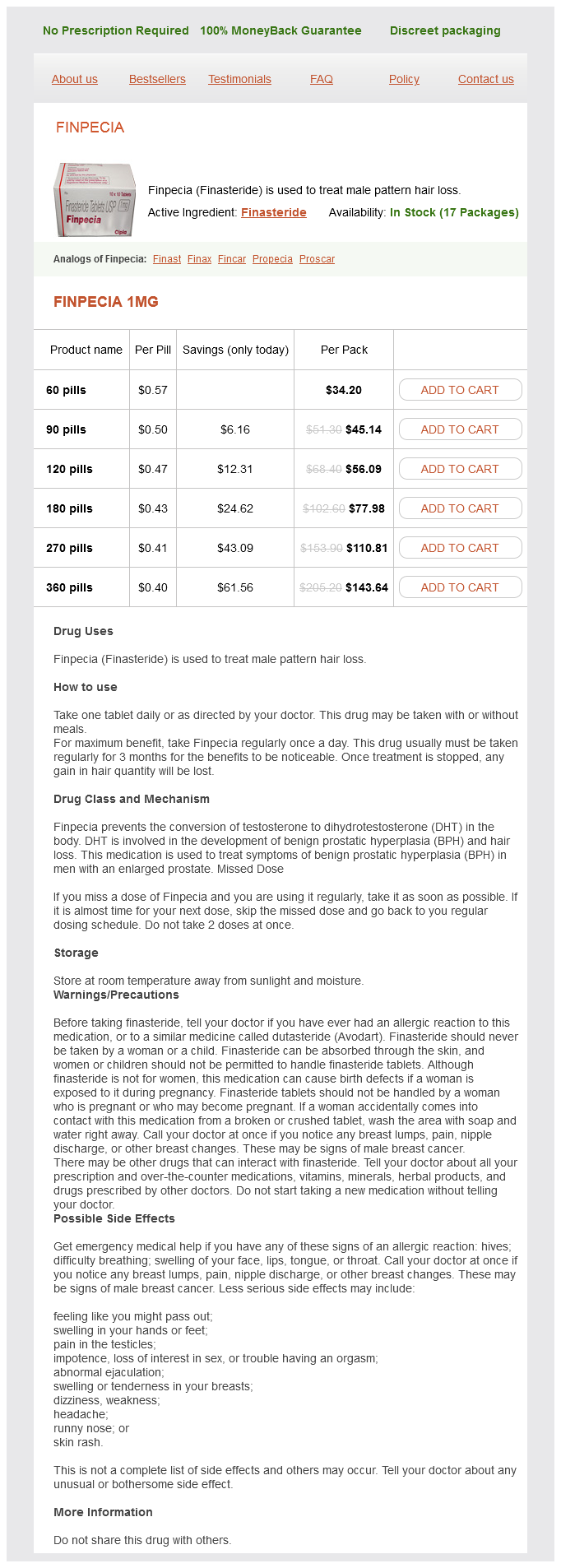
Finpecia
Finpecia 1mg
- 60 pills - $34.20
- 90 pills - $45.14
- 120 pills - $56.09
- 180 pills - $77.98
- 270 pills - $110.81
- 360 pills - $143.64
Finpecia dosages: 1 mg
Finpecia packs: 60 pills, 90 pills, 120 pills, 180 pills, 270 pills, 360 pills
In stock: 808
Only $0,42 per item
Description
The neurobiology of the placebo effect has progressed to the point at which we now know that some medicine act particularly to enhance placebo analgesia hair loss gluten cheap finpecia 1 mg overnight delivery. This fascinating discovering was first proven by Benedetti and associates (53) in a randomized hair loss cure release date 1 mg finpecia trusted, double-blind controlled trial of sufferers following posterolateral thoracotomy hair loss in men 3 button finpecia 1 mg purchase with amex. After sufferers had recovered from the overall anesthetic hair loss in men zip up boots discount finpecia 1 mg visa, they have been randomly assigned to obtain a hidden or open injection of saline or proglumide, a cholecystokinin antagonist. Patients in the open injection group received the injection by a doctor in full view of the infusion pump and were informed that it was a potent analgesic. Patients receiving the hidden injection (by way of an infusion pump that was out of sight) had been unaware that an injection had been administered. Not surprisingly, the outcomes confirmed that sufferers who obtained the hidden injection of saline reported no ache reduction in any respect. In comparability, sufferers who obtained the open injection of saline showed significantly more ache relief. These findings appear to be easy and suggest that proglumide is an effective analgesic because it produces more pain reduction than both a placebo injection and no treatment. However, this interpretation is clearly incorrect since patients receiving the hidden injection of proglumide confirmed a total lack of analgesic impact, equal to that of the management group that received the hidden injection of saline. These striking findings suggest that proglumide produces ache relief only in the context of a placebo procedure. Context performs an extremely important function in the expression of the placebo response. By context we imply the environmental cues and conditions that co-occur with a remedy, along with concurrent phrases, and previous and current meanings attributed to these words. One of essentially the most profound contextual cues recognized to produce a placebo response consists of the words spoken by a doctor to her affected person, and in particular, the diploma of certainty with which the message is conveyed (54�56). In addition to the background saline infusion, sufferers in all three teams acquired zero. Patients in group 2 (double-blind placebo) have been advised that the infusion was either buprenorphine or saline and thus had been unsure as to the contents of the infusion. Patients in group three (deceptive placebo) were informed the infusion contained a robust painkiller. From their perspective, group three patients had been sure they have been receiving a potent analgesic agent. The outcomes confirmed that the number of doses of buprenorphine received by the three teams differed considerably as a perform of the instructions they got and, by implication, the certainty with which sufferers believed they were receiving an active drug infusion. Patients who were told that the saline was a robust drug (deceptive placebo) demonstrated the largest placebo impact, a 33. Being less sure in regards to the analgesic properties of the saline infusion (double-blind placebo) produced a 20. Under sure circumstances, it has been observed that verbal suggestion, conditioning, or expectation can increase ache (57). The term nocebo hyperalgesia has been coined to describe the increase in ache that occurs after administration of an inert substance (58). This suggestion is supported by a latest examine showing that nocebo hyperalgesia is biggest amongst individuals excessive in pain anxiousness (59). Controlled research designed to higher perceive the placebo response could require sufferers to be deceived, offering that backup "rescue" medicine is immediately out there. Deceptive administration of a placebo in clinical apply is subsequently unethical, since doing so denies sufferers their legal and moral rights to knowledgeable consent and to refuse remedy (60). Nevertheless, it might be potential to leverage the desirable results of the placebo response with out deception, by emphasizing in a truthfully worded statement the benefits of a process or drug whose analgesic efficacy is properly documented (47,54). Hypnosis the manipulation of attention along with sturdy suggestion is part of the phenomenon of hypnosis. They could say that they felt a sharp tactile sensation or strong heat, however they preserve that the sensations by no means welled up into ache. A small proportion of people may be hypnotized deeply sufficient to undergo major surgery completely without anesthesia. For a bigger number of people, hypnosis reduces the quantity of pain-killing drug required to produce profitable analgesia. Despite the lengthy historical past of hypnotism, which has been used for lots of of years under different names corresponding to animal magnetism and mesmerism, very little is understood about its mechanisms. Is it a particular state of consciousness generally identified as a "trance state," or is it merely a trait of responsiveness to robust suggestion Nevertheless, anybody who has noticed the conduct of folks who have been hypnotized realizes that this is an particularly fascinating phenomenon. Under hypnosis, people tolerate pain, during demonstrations or experiments, from stimuli that would normally cause them to cry out and withdraw. Countless accounts of such observations are supplemented by reviews that hypnosis is effective in relieving severe medical pains, similar to phantom limb ache. Although wonderful studies of hypnotic analgesia have been carried out with experimentally induced pains (63), there are as yet no convincing research, using the necessary control teams, of scientific ache. About 30% of individuals can attain a state of deep hypnosis, 30% attain a reasonable state, 30% achieve a drowsy state, and 10% of people are not susceptible in any respect. An elegantly designed experiment (43) has proven that pain notion threshold and ache tolerance level are each strikingly increased during hypnosis but that only ache notion threshold is raised after administration of a placebo. In each circumstances, posttraumatic sequelae endured for years and included ache symptoms that resembled, in high quality and site, the very pain experienced throughout surgery. In addition to their similarity to the unique pain, these persistent pain signs have been triggered by stimuli related to the traumatic scenario, suggesting that they were flashbacks to the episode of consciousness underneath anesthesia. Forty-eight hours after surgery, measures of pain and negative affect had been obtained. This commonality in symptoms suggests the 2 problems may be mutually maintaining (71,74). The thought of mutual upkeep could additionally be linked to a common or shared underlying psychological vulnerability that places at-risk individuals at heightened propensity of creating one or both issues. The necessity to detect and treat both conditions concurrently underscores the importance of screening for both issues when either one is detected. Psychopathology has been proposed to underlie phantom limb pain (77), dyspareunia (78), orofacial ache (79), and a number of different situations including pelvic pain, belly ache, chest ache, and headache (80). However, given the complexity of ache transmission circuitry, many pains that defy our current understanding are probably in the future to be explained with out having to resort to a psychopathologic etiology. Yet every of these options of supposed psychopathology can now be explained by neurophysiologic mechanisms that contain an interaction between peripheral and central neural exercise (1,79,81). Recent data linking the immune and central nervous systems have provided an explanation for one more heretofore medically unexplained pain drawback. Mirror-image pain or allochiria has puzzled clinicians and primary scientists ever because it was first documented within the late 1800s (82). Injury to one aspect of the physique is skilled as pain on the web site of injury in addition to on the contralateral, mirror-image web site (83,84). Recent animal research show that induction of a sciatic inflammatory neuritis by perisciatic microinjection of immune system activators leads to hyperalgesia each ipsilaterally and at the mirror-image level on the opposite facet, within the territory of the intact contralateral sciatic nerve (85). Moreover, each ipsilateral and contralateral hyperalgesia are prevented or reversed by intrathecal Chapter 35: Psychological Aspects of Pain 783 injection of quite so much of antagonists to proinflammatory cytokines (86). Mirror-image pain is in all probability going not a unitary phenomenon and different, nonimmune mechanisms may also be involved (87). Recent human (88) and animal evidence (89) point to a mix of central and peripheral mechanisms. For instance, nerve injury to one aspect of the physique results in a 50% discount in the innervation of the territory of the identical nerve on the alternative aspect of the body in unhurt pores and skin (89). Interestingly, although documented contralateral neurite loss can occur within the absence of contralateral ache or hyperalgesia, the extent of contralateral neurite loss correlates with ache depth at the website of the harm (88). This observation raises the intriguing chance that pain at the website of an injury may be extended and exacerbated by contralateral neurite loss induced by the original ipsilateral harm (89)-a state of affairs that almost all clinicians would never have imagined possible. Attributing ache to a psychological disturbance is damaging to the affected person and provider alike, and poisons the patient�provider relationship by introducing an element of mutual distrust and implicit (or even explicit) blame. The concept that emotional and psychological processes could cause ache traditionally has been tied to the notion of psychopathology. There is ample proof that pain could additionally be triggered by emotional and psychological processes in psychologically healthy individuals (77). The spherical knob at the finish of the inhibitory link implies that its motion could additionally be presynaptic, postsynaptic, or both.
Soya (Soy). Finpecia.
- Heart disease.
- Reducing protein in the urine of people with kidney disease.
- Treating diabetes type 2.
- Reducing muscle soreness caused by exercise.
- Reducing the duration of diarrhea in infants.
Source: http://www.rxlist.com/script/main/art.asp?articlekey=96936
A subsequent examine of a hundred forty five sufferers suffering low back and musculoskeletal pain additionally revealed that compensated and noncompensated patients had virtually equivalent sensory and complete pain scores and pain descriptor patterns (138) hair loss kelp finpecia 1 mg generic without a prescription. The solely variations have been small but significantly decrease affective scores in the low again group and lower evaluative scores in the musculoskeletal group hair loss reversal best 1 mg finpecia. Comparison of ache scores hair loss in men explain generic finpecia 1 mg amex, utilizing the McGill Pain Questionnaire hair loss herbs finpecia 1 mg purchase line, obtained from women during labor (138) and from sufferers in a general hospital pain clinic (118) and an emergency department (13). Other ache ratings come from research of patients with continual ache circumstances together with lung most cancers pain (132), low again pain (155), complex regional pain syndromes (156), neuropathic pain (157), preamputation pain (158), and rheumatoid arthritis (159), as well from patients with acute ache after belly gynecological surgical procedure (111) and lower stomach surgery (160). Severe, continuous low back ache is reported by about 33% of women during labor (146). It is described as being qualitatively different from the pains associated with uterine contractions. The ache of contractions felt in the again is commonly reported as "driving on" the continual low again ache, in order that both collectively could reach "horrible" or "excruciating" intensities. Continuous low back pain might be brought on by the distention and stress on adjacent visceral and neural constructions within the peritoneum, in distinction to the rhythmic pains that are clearly associated to contractions of the uterus. It is possible that each of these main sorts of ache may be managed by completely different anesthesiologic and psychological procedures. A additional examine by Niven and Gijsbers (147) attempted to determine whether episodes of acute low back pain previous to being pregnant are predictive of low back pain during labor. In distinction, low again ache throughout menstruation is positively correlated with labor ache scores recorded for front and back contraction ache in addition to for continuous back ache. The significant correlation of labor ache with again ache during menstruation means that each share a common underlying mechanism. The correlation of low again ache during pregnancy with episodes of acute low again ache earlier than being pregnant means that the strain on back muscle tissue throughout pregnancy might activate the mechanisms that underlie the standard types of low back ache. Pain scores have been obtained from 60 women in early labor (dilation 2�5 cm) who alternated between the two positions. These outcomes, along with earlier observations by Roberts and associates (149), point out that many women in early labor have much less ache and are typically more comfy in a vertical than in a horizontal position. Since early labor comprises a substantial proportion of the complete means of labor and supply, any easy process that alleviates ache without hazard to mom or baby, such as shifting from a horizontal to a vertical place, ought to be promoted and employed. During the later levels of labor, nevertheless, women prefer to lie down rather than sit because they find the former position extra comfy (149). Epidural blocks are usually administered in the course of the first stage of labor at the request of the mom when the pain approaches intolerable levels. However, the 10% of women who experience a failed epidural block are deeply dissatisfied. In some of these circumstances, the epidural appears to be efficient for the primary hour or so, however then the ache returns at its previously excessive intensity or larger, generally with an unusual spatial distribution (143). In one study (143), the failure fee was about 30%, which is unusually excessive, and possibly was as a outcome of the inexperience of incoming residents in anesthesiology. The variability of the effectiveness of anesthesiologists is as distressing as the variability of effectiveness of ready childbirth trainers to ladies whose expectations of ache relief are unfulfilled (150). As a mannequin of acute ache, labor ache highlights particular person differences-extraordinary variability occurs in each aspect of ache. Recent studies have revealed a multitude of factors, both psychological and bodily, that contribute to the variability of labor ache. Each makes a small contribution, but no single one of them is prepotent in its contribution to ache. The intensity of the emotions of guilt, anger, and failure in some girls after they anticipate a "pure, painless birth" and are then confronted with such extreme pain or problems that they require an epidural or a cesarean section lately has been documented. Stewart (152) reviews that some women might turn out to be miserable and depressed (even suicidal), might lose interest in intercourse and in their marriage, and should require psychotherapy. In some circumstances, the husbands of ladies who anticipated "pure" births required psychotherapy after intense feelings of nausea on the sight of blood or seeing their wives in such terrible ache. They experienced a profound sense of guilt and helplessness, and needed remedy for impotence, phobias, and depression. The Leboyer methodology to forestall a "violent delivery" has no demonstrable results (154), and the concept of "early bonding" has fallen by the wayside (155). Even epidural blocks may fail, forcing women to deal with deep disappointment along with pain. The enormous particular person variations in each parameter described result in the identical conclusion reached by Lumley and Astbury: It is absurd to treat all women and all labors in the identical way (150). Women ought to be knowledgeable that the "average" labor is a statistical idea, and many ladies may have patterns of pain that deviate from this idea. In quick, any prepared childbirth training course should spend considerable time getting ready the possible mother for potential deviations from the "common"-preparing her for the possibility that she could (or might not) want an epidural block, a forceps delivery, or a cesarean section. Prepared childbirth coaching and elegantly administered epidural analgesia (see Chapter 23) are compatible, complementary procedures that permit recognition of the individuality of each woman. All of those elements contribute to the expertise and report of pain and must be fastidiously assessed longitudinally with uniform, validated instruments earlier than the effectiveness or lack thereof of any therapy could be known. As reiterated in the ultimate chapter of this e-book, psychological studies and the fashions which have sprung from them are crucially relevant not merely to day by day practice, but additionally to the discovery of new medication and scientific strategies that may carry regional anesthesia and pain medication properly into the twenty first century. Katz is supported by a Canada Research Chair in Health Psychology at York University. Preparation of this chapter was facilitated by infrastructure help funded by the Canadian Foundation for Innovation and the Ontario Innovation Trust. Ethnic differences among housewives in psychophysical and pores and skin potential responses to electric shock. Ethnic differences in thermal pain responses: A comparison of South Asian and White British wholesome males. Acute pain in an emergency clinic: Latency of onset and descriptor patterns associated to totally different accidents. The various response to ache in psychiatric issues: A research in abnormal psychology. Effects of hysteria and morphine on discrimination of intensities of painful stimuli. Stratagems for controlling pain: Contributions of auditory stimulation and suggestion. Helping children and caregivers deal with repeated invasive procedures: How are we doing The use of digital reality and audiovisual eyeglass systems as adjunct analgesic techniques: A evaluation of the literature. Virtual actuality as an adjunctive ache management during burn wound care in adolescent sufferers. Virtual actuality immersion method of distraction to control experimental ischemic pain. Use of digital actuality for adjunctive therapy of adult burn ache throughout physical therapy: A controlled examine. Pain-related worry is extra disabling than ache itself: Evidence on the position of pain-related fear in persistent again pain incapacity. Fear of movement/(re)injury in continual low again ache and its relation to behavioral efficiency. The treatment of worry of movement/(re)injury in continual low back ache: Further evidence on the effectiveness of publicity in vivo. Variation within the placebo effect in randomised managed trials of analgesics: All is as blind as it appears. Neuropharmacological dissection of placebo analgesia: Expectation-activated opioid systems versus conditioning-activated specific subsystems. Placebo analgesia is accompanied by massive reductions in pain-related brain exercise in irritable bowel syndrome patients. The contributions of suggestion, want, and expectation to placebo effects in irritable bowel syndrome sufferers. The neurobiology of placebo analgesia: From endogenous opioids to cholecystokinin. Methodologies of Hypnosis: A Critical Appraisal of Contemporary Paradigms of Hypnosis.
Specifications/Details
The high therapeutic index of the oral form of this compound has facilitated its adoption as an opioid adjuvant for acute postoperative pain (11) and as an opioid adjuvant or sole agent for neuropathic ache hair loss 3 months after giving birth buy finpecia 1 mg line, together with that because of hair loss cure ayurveda 1 mg finpecia discount otc malignancy (361 hair loss herbs 1 mg finpecia discount visa,362) hair loss qatar 1 mg finpecia discount free shipping. In distinction, administration of lidocaine did produce nonselective neural blockade. Insight into the function of these mediators is a key advance in understanding pain physiology for the rationale that prior version of this text a decade ago (368,369). Given systemically, ketamine appears to block central summation of experimental second pain and to scale back ache depth in instances of neurogenic pain, as in postherpetic neuralgia or phantom limb pain (371). Choe and colleagues, for instance, discovered a higher length of analgesia and discount in supplemental postoperative analgesic necessities when ketamine 60 mg was added to morphine 2 mg given epidurally earlier than induction of anesthesia. Ozyalcin and colleagues found that epidural ketamine supplied superior analgesia after thoracotomy than intramuscular ketamine (374). No long-term results upon either type of ache were evident, though the investigators famous a long-term benefit upon mood in the patients who acquired ketamine. Because the incidences for long-term stump and phantom pain were decrease than these reported within the literature, they speculated that their combined spinal-epidural native anesthetic improved ache management, so that their research may have been underpowered to detect a ketamine impact. Consolidation of the related literature is difficult owing to species and developmental variations, the affect of the preservative in the explicit ketamine formulation used, and the reality that undertreated pain itself produces persistent detrimental effects in the very younger (377) as properly as in adults (378). However, neither agent is formulated for spinal use, and clinical trials have administered them orally. Phencyclidine given intrathecally in a pilot medical research abolished allodynia and hyperpathia due to persistent neurogenic ache. According to the 2007 Polyanalgesic Consensus Conference, a stage 5 drug "is beneficial with caution and apparent informed consent relating to the paucity of knowledge concerning the protection and efficacy of their use" (30). Other scattered case stories adopted, and within the early to mid 1990s were augmented by numerous preclinical observations of spinal twine release of prostanoids together with excitatory amino acids during nociception from peripheral nerve damage or inflammation (393,394). Adenosine and Nonopioid Peptides Adenosine receptors are expressed on the floor of nearly all cells. Five adenosine receptors have been identified by way of pharmacologic and cloning techniques, of which the A1 receptor seems most intently linked to analgesia, although a delayed analgesic impact mediated through the A2 receptor has been reported (399). The affinity of numerous adenosine analogs for the A1 receptor seems to correlate nicely with their in vivo analgesic potency. Indirect evidence means that analgesia from central administration of opioids (400) or serotonin is mediated by spinal twine adenosine launch (401). However, though a variety of adenosine analogs produce analgesia when given intrathecally in animals (402), and blockade of endogenous adenosine by spinal application of theophylline produces hyperalgesia (403), scientific trials of the potential analgesic results of spinal adenosine have been few in number. On the opposite hand, a postoperative pain trial disclosed no benefit in girls present process abdominal hysterectomy (407). Very low doses of substance P itself potentiate opioid analgesia (411), as do peptide hybrids that mix substance P agonism and opioid agonism (126,412). Of the analgesic peptides employed for spinal administration, the inhibitory peptide somatostatin stands alone in its combination of success and controversy (416). Hence, its use was deserted until the steady somatostatin analog octreotide was introduced. The broad energy of such an strategy little question reflects the multivariate nature of those medical circumstances and the utility of attacking as many variables as possible to decisively deliver such problems under management, significantly in circumstances by which no single agent will suffice. The use of multiple brokers for spinal analgesia was already mentioned in earlier evaluations of this matter, together with the prior version of this text, the place it was termed combination analgesic chemotherapy (23). Unfortunately, the requirements of rigorous clinical evidence have nearly wholly been ignored during this progress, and uncontrolled case sequence or case reviews form by far the biggest proportion of this literature. Considering that the variety of possible combinations of different analgesics increases as a factorial function of the number of obtainable choices, the optimum selections and relative doses of medication to apply to completely different affected person populations with totally different origins of pain require in depth scientific examine (417). The corresponding chapter within the prior edition of this volume served as a place to begin for a complete systematic evaluation (32) whose findings parallel those of different current reviews (30,310,335). That systematic review, and this portion of the present chapter, assessed whether analgesics available for spinal administration provide a better therapeutic ratio if mixed, somewhat than if both element is run singly (418,419). We therefore employed a search strategy (Table 40-11) to determine randomized controlled trials that included an experimental group treated with a drug mixture and management teams that were each given one element of that mixture. Only such trials (A + B versus A versus B) allow comparison of analgesic and security outcomes ensuing from the combination and each of its elements (420). We did, nonetheless, look at trials by which a second drug, by itself not capable of produce analgesia, was added to a identified analgesic drug. The potential benefits that we sought were threefold: improvement in analgesic efficacy, discount in unwanted effects, and slowing of opioid dose escalation. The use of implanted programmable infusion pumps in the management of nonmalignant, persistent low-back ache. For example, a single epidural injection of morphine plus sufentanil combines the short onset time produced by sufentanil with the lengthy duration of analgesia attributable to morphine, thus providing extended analgesia after cesarean supply (421). Animal studies present that combining opioids with totally different receptor selectivity has a strong dosage-sparing effect (128), particularly for - plus -selective medicine (422,423). The addition of epidural fentanyl to a local anesthetic improves intraoperative surgical analgesia (meta-analysis of 18 managed trials) (431), and continued infusion of epidural opioids and local anesthetics is commonplace apply for management of postoperative ache (432) (Table 40-12). Not all opioids induce tolerance at the similar fee, and cross-tolerance is incomplete. Tolerance develops more slowly with opioids that have high intrinsic exercise than throughout persistent administration of lower-affinity opioids, such as morphine (23,426). Three randomized, managed trials investigated the mix of epidural fentanyl (428,429) or sufentanil (430) with epidural morphine after belly surgery in 289 patients. Early postoperative analgesia was improved by the use of the combination in all three research, and this profit for early analgesia was evident even when morphine was given forty five minutes before fentanyl (428,429). A lower dose of morphine (3 mg) was used in the group coadministered sufentanil in contrast with the group given morphine alone (5 mg). Both the sufentanil-only group and the morphine-sufentanil combination group had bigger supplemental opioid necessities than the morphine-only group within the 24 hours after surgical procedure. Not solely did the combination not permit a discount in dosage, however the incidence of unwanted effects was equal between teams (430). In the opposite two research, a variety of dose mixtures of morphine (2�4 mg) and fentanyl (50�100 g) have been investigated with respect to analgesic efficacy. One of these research reported no augmentation of analgesia when a second drug was added to morphine doses of larger than 2 mg and fentanyl doses of greater than 50 g (428). The different examine reported improved late analgesia when a bigger dose of 4 mg of morphine (alone or together with fentanyl) was compared with 2 mg of morphine (429). A discount in supplemental opioid necessities within the first 24 hours after surgical procedure was reported by Tanaka and colleagues (428) when mixture therapy was in contrast with both drug as a single remedy. The reduction in opioid requirements had little medical importance as a outcome of no significant reduction in nausea was reported with the combination in comparability with single drugs (429,430). In the study by Tanaka and colleagues (428), an additive increase in unwanted effects (vomiting and pruritus) was seen with the biggest doses of epidural morphine and fentanyl. In abstract, the addition of a comparatively rapid onset opioid to morphine improves early analgesia however evidence to support this as a routine follow based upon lowering the incidence of opposed results throughout combination regimens of this kind is inconclusive. For persistent ache, clinicians report that opioids are often the primary drug of alternative for spinal administration, however native anesthetics have long been seen because the preliminary supplemental agent when ache is refractory to single-drug administration (434). Animal research reveal synergistic antinociception with coadministration of morphine and lidocaine intrathecally (435) or epidurally (436). However, as a outcome of an analgesic response was obtained with smaller doses of morphine within the combination group, and since no crosstolerance was observed, there was an indirect advantage of lidocaine coadministration in that smaller doses of morphine induced less tolerance than bigger doses (435). Acute Pain these research assessed whether a mix of a neighborhood anesthetic with an opioid administered spinally produces equal analgesia but fewer side effects, or improved analgesia without elevated side effects in comparison with both drug administered singly. Five research investigated analgesic efficacy for the first 24 hours after main lower limb, stomach, or thoracic surgery, and one research investigated analgesia for two hours after a single bolus of examine drug throughout labor (438). Because of early exclusions (often for unrelated causes earlier than the administration of examine drug), knowledge were capable of be evaluated for 262 sufferers, of whom 239 sufferers completed the deliberate research period. The latter withdrawals were predominantly as a end result of inadequate analgesia in two studies (439,440). Two research investigated analgesia after bolus administration, either a single dose throughout labor (438) or four doses of various medicine given in a random order at 6-hour intervals in the course of the first 24 hours after surgery (441). Analgesic efficacy of the mix was higher than that of native anesthetic alone however was not different from opioid alone within the research by Cooper and colleagues (439), whereas Torda and colleagues (441) found no distinction among the many effects of boluses of fentanyl alone, native anesthetic alone, or mixture remedy. In two research, general affected person satisfaction was assessed, once more with variable results. Cooper and colleagues (439) reported comparable ranges of satisfaction after both combination remedy or opioid alone, however each have been significantly better than local anesthetic alone. Kopacz and co-workers (440) reported related satisfaction with the combination or local anesthetic alone and located both to be significantly better than with opioid alone.
Syndromes
- Difficulty breathing
- Intermittent (short-term) catheter
- Vitamin D, resulting in rickets (childhood) or osteomalacia (adult)
- Contrast can be given through a vein (IV) in your hand or forearm. If contrast is used, you may also be asked not to eat or drink anything for 4-6 hours before the test.
- The transducer picks up the echoes of sound waves and transmits them as electrical impulses. The echocardiography machine converts these impulses into moving pictures of the heart. Still pictures are also taken.
- Ear tubes for repeated ear infections
- Amount swallowed
- Is not better 5 minutes after you take nitroglycerin (your health care provider may tell you to take three total doses)
Related Products
Additional information:
Usage: p.c.
Tags: discount 1 mg finpecia fast delivery, purchase finpecia 1 mg overnight delivery, 1 mg finpecia discount with mastercard, 1 mg finpecia cheap fast delivery, 1 mg finpecia order with visa, buy 1 mg finpecia overnight delivery, order finpecia 1 mg otc, finpecia 1 mg buy free shipping, buy discount finpecia 1 mg on line, buy 1 mg finpecia fast delivery, finpecia 1 mg with amex, 1 mg finpecia amex, finpecia 1 mg amex, finpecia 1 mg purchase visa, cheap finpecia 1 mg with amex, order 1 mg finpecia free shipping
9 of 10
Votes: 75 votes
Total customer reviews: 75
Customer Reviews
Tizgar, 62 years: In patients with ache lasting longer than 1 12 months, however, practically all patients who would benefit from surgery were recognized by their response to steroid (falsenegative, 15%).
Gorn, 36 years: Distribution of huge and small fibers in the L7 dorsal root of the cat at selected distance from root entry zone.
Carlos, 24 years: Responses of thoracic dorsal horn interneurons to cutaneous stimulation and to the administration of algogenic substances into the mesenteric artery in the spinal cat.
Abbas, 23 years: In this technique, each site on the body surface is faithfully mapped, and this map is maintained to the cortex.
Yorik, 64 years: The single injection in the back on the lower lumbar stage supplies blockade of the femoral, lateral femoral cutaneous, and often the obturator nerves, thus permitting analgesia of the complete anterior medial and lateral portions of the knee joint the place the trocar insertion websites are positioned.