
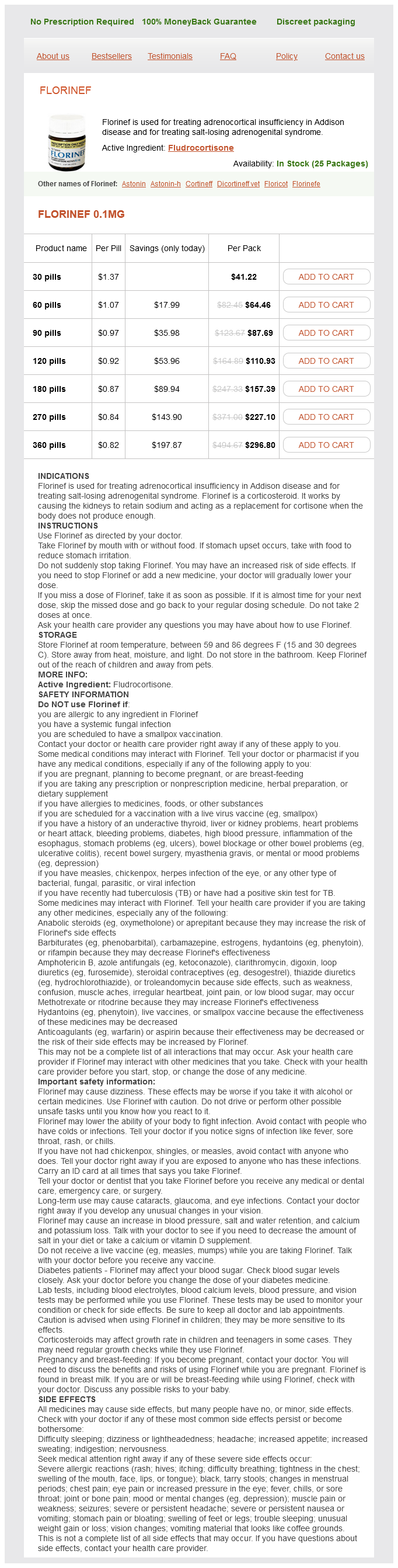
Florinef
Florinef 0.1mg
- 30 pills - $41.22
- 60 pills - $64.46
- 90 pills - $87.69
- 120 pills - $110.93
- 180 pills - $157.39
- 270 pills - $227.10
- 360 pills - $296.80
Florinef dosages: 0.1 mg
Florinef packs: 30 pills, 60 pills, 90 pills, 120 pills, 180 pills, 270 pills, 360 pills
In stock: 820
Only $0,88 per item
Description
In case of fluid overload with preserved diuresis lymphocytic gastritis definition florinef 0.1 mg order with amex, the use of diuretics is normally recommended to achieve unfavorable fluid steadiness gastritis diet 3-2-1 discount florinef 0.1 mg overnight delivery. The daily maintenance complete fluid input ought to equal urine losses plus insensible fluid losses (400 mL/m2 physique surface space plus a 12% per centigrade physique temperature above 37�C) gastritis diet milk florinef 0.1 mg purchase free shipping, minus the desired internet fluid loss gastritis diet untuk buy 0.1 mg florinef with mastercard. Hyperkalaemia must be treated aggressively when potassium will increase rapidly or when serum levels exceed 6. Conservative therapy entails elimination of potassium administration through intravenous fluids and diet and administration of an exchange resin. Immediate measures to lower serum potassium include intravenous furosemide, administration by intravenous route or inhalation of beta-mimetics, calcium and dextrose-insulin infusions, and alkalizing remedy. Hypocalcaemia may occur secondary to use of furosemide, impaired synthesis of 1,25 vitamin D by the diseased kidney, and/or extreme hyperphosphataemia. Hypernatremia normally is the consequence of repeated buffering with sodium bicarbonate in oligoanuric patients. Basal vitality expenditure may be estimated by the Kennedy�Caldwell equation: Resting power expenditure (kcal / day) = 22 + 31 � weight [kg] + 1. Hence, the nutritional protein administration should meet the really helpful dietary intake appropriate for age. Regarding the preferred route of nutrition, enteral feeding may be problematic because of impaired gastrointestinal motility because of medications, decreased nutrient absorption secondary to bowel oedema, mechanical ventilation, and numerous different elements. However, the supply of vitamins via the gut lumen helps keep gut integrity, decreases intestine atrophy, and reduces bacterial and endotoxin translocation. Furthermore, enteral diet ought to exert protective results on the danger of stress ulcers or bleeding. In catabolic sufferers, administration of insulin could also be required to achieve appropriate utilization of glucose and amino acids. However, the danger of severe hypoglycaemic episodes increased fivefold, arguing for considered, closely monitored use of intense insulin therapy in hyperglycaemic critically sick youngsters. It is beneficial to adopt the preferred glycaemic target within the 110�150 mg/dL (6. It can be applied even in preterm neonates, the place vascular entry points limit the usage of extracorporeal techniques. Intermittent and steady haemodialysis and haemofiltration present larger solute clearances and permit for more efficient fluid control. Red blood cell packs should be used to prime the extracorporeal system if the extracorporeal quantity exceeds 10% of the blood quantity. Whereas each modalities confer comparable filter survival, citrate-based anticoagulation protocols clearly reduce the danger of bleeding issues (Brophy et al. Extracorporeal remedy essentially the most critical think about paediatric extracorporeal remedy is to ensure a proper vascular entry. Catheter measurement should be adapted to body size; the minimal measurement of a dual-lumen catheter permitting an applicable blood circulate (> 100 mL/m2 physique floor area) is 6. Whereas the inner jugular route reportedly supplies the most effective method survival (Hackbarth et al. Both for intermittent and continuous extracorporeal remedies, dialysis units tailored for paediatric use with blood, filtrate, and dialysate/substitution fluid move charges adjustable over a variety, extremely accurate volumetric ultrafiltration management, and filters and tubing sets tailored to paediatric measurement ought to be used. Plasma and urine neutrophil gelatinase-associated lipocalin in septic versus non-septic acute kidney harm in important illness. Risk factors of acute renal failure in critically ill youngsters: a prospective descriptive epidemiological research. Prophylactic theophylline to stop renal dysfunction in newborns uncovered to perinatal asphyxia-a study in a developing country. Dopamine versus no remedy to forestall renal dysfunction in indomethacin-treated preterm new child infants. Differential cytotoxic actions of Shiga toxin 1 and Shiga toxin 2 on microvascular and macrovascular endothelial cells. Theophylline for renal perform in term neonates with perinatal asphyxia: a randomized, placebo-controlled trial. Renal supportive remedy for pediatric acute kidney injury in the setting of multiorgan dysfunction syndrome/sepsis. Selective peripheral dopamine-1 receptor stimulation with fenoldopam in human important hypertension. A randomised, double blind, placebo managed trial of the effect of theophylline in prevention of vasomotor nephropathy in very preterm neonates with respiratory misery syndrome. Biomarker strategies to predict want for renal substitute therapy in acute kidney harm. Demographic characteristics of pediatric steady renal alternative remedy: a report of the Prospective Pediatric Continuous Renal Replacement Therapy Register. Acute kidney harm is an unbiased risk factor for pediatric intensive care unit mortality, longer size of stay and prolonged mechanical ventilation in critically unwell kids: a two-center retrospective cohort research. Fluid overload is associated with impaired oxygenation and morbidity in critically ill youngsters. Renal operate in late survivors of Iranian kids with most cancers: single centre experience. Continuous renal replacement therapy for kids 10 kg: a report from the Prospective Pediatric Continuous Renal Replacement Therapy Registry. Acute kidney harm is independently associated with mortality in very low birthweight infants: a matched case�control evaluation. Fluid overload and mortality are related to acute kidney harm in sick near-term/ time period neonate. Paediatric acute kidney injury in a tertiary hospital in Nigeria: prevalence, causes and mortality fee. Theophylline for prevention of kidney dysfunction in neonates with extreme asphyxia. Comparison between fractional excretions of urea and sodium in kids with acute kidney harm. Prognosis in critically ill kids requiring steady renal alternative remedy. Fluid overload before steady hemofiltration and survival in critically sick children: a retrospective evaluation. Pediatric sufferers with multi- organ dysfunction syndrome receiving continuous substitute therapy. Acute renal substitute remedy in kids with diarrhea-associated hemolytic uremic syndrome: a single middle 16 years of expertise. Effect of volume resuscitation on regional perfusion in dehydrated pediatric sufferers as measured by two-site near-infrared spectroscopy. Outcomes of critically sick kids requiring continuous renal substitute therapy. Effects of low-dose dopamine on renal and systemic hemodynamics throughout incremental norepinephrine infusion in wholesome volunteers. Prospective analysis of acute and persistent renal operate in children following matched related donor hematopoietic stem cell transplantation. A randomized, double-blind, placebo-controlled trial of the results of prophylactic theophylline on renal operate in term neonates with perinatal asphyxia. The fractional excretion of urea in the differential diagnosis of prerenal failure and acute tubular necrosis in neonates. Liver-type fatty acid-binding protein attenuates renal harm induced by unilateral ureteral obstruction. Evaluation of glomerular and tubular renal perform in neonates with birth asphyxia. Urinary cystatin C as an early biomarker of acute kidney damage following adult cardiothoracic surgical procedure. Urinary liver-type fatty acid-binding protein in septic shock: Effect of polymyxin B-immobilized fiber hemoperfusion. Urinary aprotinin as a predictor of acute kidney harm after cardiac surgical procedure in kids receiving aprotinin remedy. Application of the brand new classification criteria of the Acute Kidney Injury Network: a pilot research in a pediatric inhabitants.
Pineapple Enzyme (Bromelain). Florinef.
- Are there any interactions with medications?
- Are there safety concerns?
- Preventing muscle soreness after exercise.
- What other names is Bromelain known by?
- Knee pain, severe burns, inflammation, reducing swelling after surgery or injury, improving antibiotic absorption, hayfever, preventing cancer, shortening of labor, making it easier to get rid of fats, ulcerative colitis, and other conditions.
Source: http://www.rxlist.com/script/main/art.asp?articlekey=96862
Renal autoregulation provides a constant filtered load and stabilizes the pressure profile inside the microcirculation gastritis diet ÷òî 0.1 mg florinef discount fast delivery. Accordingly gastritis diet öèòðóñ florinef 0.1 mg, a broadly held view is that renal autoregulation is essential for normal renal operate and volume homeostasis gastritis diet øàðëîòêà cheap 0.1 mg florinef visa. Nevertheless gastritis symptoms pdf florinef 0.1 mg buy with amex, a growing number of animal models show extreme impairments in renal autoregulation and none display abnormalities in quantity regulation (Loutzenhiser et al. It is generally assumed that lack of this acute response would affect the renal haemodynamic influence of sustained hypertension. It has been advised that a 3rd renal autoregulatory mechanism with slower kinetics may be concerned, although its nature, at current, is unresolved (Just et al. However, in spite of the clear link between renal harm and hypertension the vast majority of hypertensive patients are spared, as the person threat is < 0. These observations are explained by the existence of renal protecting mechanisms that normally prevent the transmission of systemic hypertension to the glomerular capillaries. These are the identical mechanisms that contribute to the acute autoregulatory response. Thus for the clinician, the primary importance of renal autoregulation may be its worth as an indicator of renal safety. Loss of renal autoregulatory capacity may thus suggest the necessity for aggressive remedy of hypertension. The use of radiotelemetry has allowed an accurate evaluation of the quantitative relationships between blood stress and glomerular injury in animal models. Such research illustrate that kidneys with intact autoregulation are protected in opposition to hypertensive injury when blood pressures stay within the autoregulatory vary. It is just when blood pressures exceed the restrict of autoregulation that glomerular damage is seen. In both conditions, the glomerular damage correlates quantitatively with the increases in blood stress (Bidani et al. In general, reductions in glomerular damage correlate with the blood pressure-lowering results without affecting the slope relationship between the 2 parameters. The clear exceptions are the L-type Ca2+ channel blocking brokers, which attenuate the hypertension however enhance the slope, such that extra harm happens at any level of blood strain improve (Griffin et al. This impact is due to the general capability of Ca2+ channel blockers to dilate the afferent arteriole and to the particular results of these agents on the mechanisms mediating acute autoregulation. Of the autoregulatory mechanisms, the faster myogenic response is likely most important in offering renal safety (Bidani, et al. Accordingly, to obtain safety, the vasculature must be capable of adapting to elevations on this sign. Thus, the oscillating pulse is related to corresponding oscillations in renal blood flow, an remark that led to the previously held view that such speedy events are handled passively by the renal vasculature. Recent research suggest that this will not be the case and that the afferent arteriole has the potential to reply exclusively to the systolic stress signal (Loutzenhiser et al. This attribute is because of the distinctive kinetic features of the myogenic response, particularly the speedy onset of the contraction and the longer delay within the relaxation or offset of the response (Loutzenhiser et al. Steady-state tone changes with a time constant of 3�4 seconds, offering autoregulatory adjustments, but the stage of tone is about by the systolic signal, providing safety over the complete frequency range of the blood strain energy spectrum (Loutzenhiser et al. Deleterious results of calcium channel blockade on pressure transmission and glomerular damage in rat remnant kidneys. Renal blood move regulation and arterial stress fluctuations: a case study in nonlinear dynamics. Dynamics and contribution of mechanisms mediating renal blood move autoregulation. Dynamic characteristics and underlying mechanisms of renal blood circulate autoregulation in the conscious dog. Short-term modulation of distal tubule fluid nitric oxide in vivo by loop NaCl reabsorption. Renal autoregulation: new views regarding protecting and regulatory roles of the underlying mechanisms. Systolic and mean blood pressures and afferent arteriolar myogenic response dynamics: A modeling approach. Summary the unique structural and practical properties of the renal vasculature are essential in facilitating the huge filtration and reabsorptive processes required for normal renal function. Specifically, pre-glomerular vessels are regulated by membrane potential alterations affecting the activity of L-type voltage-activated Ca2+ channels; whereas voltage-independent mechanisms regulate the efferent arteriole. The renal myogenic mechanism, which has the potential to adjust steady-state tone in response to the oscillating systolic stress signal, moreover plays an essential role in protecting the kidney from the damaging results of hypertension. Ruilope Introduction the existence of a relation between cardiac hypertrophy and the kidney was first famous by Bright in 1836 even before it was attainable to measure blood pressure. The kidney participates in the regulation of each volume and vasoconstriction (Box 210. Some defect in renal operate must be present in any type of arterial hypertension, whether or not primary or secondary. However, hypertension seems prone to be the first explanation for renal injury less incessantly than we used to assume (see Chapter 211). Salt sensitivity Pressure natriuresis is impaired in all types of hypertension, together with human essential hypertension (Hall et al. However, in response to adjustments in salt consumption, patients segregate into those in whom arterial pressure is relatively insensitive to changes within the sodium content material of the diet and those exhibiting related modifications in arterial stress with changes in salt intake (salt sensitive). Salt-insensitive hypertensives exhibit a shift of pressure-natriuresis curve to larger pressures in parallel with the normal curve. In distinction, in salt-sensitive hypertensives in whom plasma renin activity is frequently low, the curve can be shifted to higher ranges of arterial strain, but the slope is flat. When salt content material in the food plan is low, blood pressure is normal, nevertheless it will increase progressively, when the salt content within the food plan is elevated. Hall (1991) postulated that the presence of a flat slope signifies that further abnormalities of renal function must be current in addition to a easy increase in glomerular resistance. Salt sensitivity has been shown to be particularly prevalent in black, in overweight, and in aged hypertensive sufferers. These are incessantly associated with diminished renal function and by a considerably enhanced cardiovascular danger. Both renal and cardiovascular risk have been proven to run in parallel, and, in reality, mild alterations in renal function represent one of the best predictors of an increased cardiovascular risk (Ruilope et al. Salt sensitivity Salt and water excretion Pressure natriuresis An elevation in renal perfusion stress leads to an elevated excretion of sodium and water, a phenomenon known as pressure-natriuresis diuresis. If this was unmoderated, ultimately this would over-ride all other blood strain control mechanisms. Pressure natriuresis is intrinsic to the kidney, as a result of it may be demonstrated utilizing an isolated perfused kidney preparation (Aperia et al. Second, when renin is secreted as a outcome of stenosing lesions within the renal vessels, inflicting renal ischaemia as in renovascular hypertension or in dialysis-resistant hypertension in patients with superior renal illness (Wilkinson et al. Renal dysfunction can be the origin of arterial hypertension (B) or could be the consequence of the elevation in arterial stress (A). All three mechanisms stimulate renin launch by the cells of the juxtaglomerular equipment. Further angiotensin metabolites similar to angiotensin (2-8), angiotensin (1-7), and angiotensin (3-8) also have organic actions, which may be mediated by way of alternative receptors. Renin hypersecretion by the kidney is overtly answerable for hypertension in people in two scientific situations. The latter parameters remain fixed throughout the limits of autoregulation, which operates in the range of perfusion stress values between about 80 and 200 mmHg. Third, it causes vascular hypertrophy because of its known trophic effects (Dickinson, 1981; Lever, 1986; Elijovich et al. Vascular remodelling It was initially thought that high peripheral arterial resistance was maintained by way of structurally mounted luminal narrowing of resistance vessels. There is a good correlation between arterial pressure and renal nerve exercise measured in crossbreeds of spontaneously hypertensive rats (Judy et al. Acute renal denervation shifts the relationship between sodium excretion and arterial strain in direction of lower pressure values (Roman and Cowley, 1985). Activation of sympathetic tone markedly blunts strain natriuresis in aware canine (Ehmke et al. These findings indicate that the renal nerves exert a tonic affect on the pressure-natriuresis relationship.
Specifications/Details
Over time gastritis symptoms heartburn buy cheap florinef 0.1 mg on line, the urea level in the box will fall gastritis location buy 0.1 mg florinef with amex, nonetheless the rate of removing of urea will sluggish as the focus of urea within the field falls (see oblique relationship between clearance and focus as described in Equation 258 gastritis diet salad florinef 0.1 mg discount with visa. We can name the clearance gastritis blog purchase florinef 0.1 mg with mastercard, or volume from which urea is totally removed over time, K, mL/min. This is as a result of over time the efficiency of the clearance will lower with lowering focus of urea within the field. Therefore, the curve of urea concentration within the field plotted in opposition to time would display the place C is the post-dialysis urea concentration, C0 is the pre-dialysis urea concentration, K is clearance, t time, V quantity of distribution of urea, e is a mathematical constant-the base of the natural logarithm, approximately equal to 2. This equation is the simplified answer to the differential equation listed in Equation 258. It successfully models the removing of a substance from the physique where that substance decreases in an exponential trend, describing the disappearance curve of urea during a dialysis session. The idea of single-pool (spKt/V) urea depends on the assumption that urea is evenly distributed in a single pool of body water which has even access to the dialyser. Due to the extraordinarily environment friendly nature of a contemporary dialysis remedy session where urea is faraway from the plasma space at a price that exceeds equilibration from outside the plasma house, this assumption now not holds true. In deference to the single-pool model, urea is distributed in varying concentration all through the body throughout dialysis, evidenced by the rebound phenomenon of equilibration on the finish of dialysis when urea moves from tissue areas of decrease perfusion again into the vascular area. This is typically referred to as two-compartment distribution or the double-pool mannequin the place one compartment is taken into account the vascular area and the other compartment is every little thing outdoors of the vascular area (Daugirdas and Smye, 1997). Cardiopulmonary recirculation refers to the distribution of dialysed blood to the center and shortly again to the dialysis entry by way of the cardiopulmonary circuit, bypassing slower areas of circulation that may allow for extra even distribution of urea. The effect of cardiopulmonary recirculation is basically absent about a minute after dialysis (Schneditz et al. The third part, the gradual motion of urea from areas of decrease perfusion and mobile spaces, can take as a lot as 30�60 minutes following the completion of dialysis, depending upon the patient (Tattersall et al. Dialysis associated components corresponding to blood move, quantity of ultrafiltration performed, and patient-related factors such as age, heart function, muscle mass, and blood pressure can affect the quantity of urea rebound skilled (Pedrini et al. For example, muscle is assumed to contain about 60% of the entire physique water but blood move to the muscle throughout dialysis is comparatively low which contributes to a rebound in urea stage after dialysis (Daugirdas, 1995). In contrast, organs obtain a considerable amount of cardiac output however relatively less physique water. Due to these gradients established during dialysis, within the post-dialysis period when organ blood combines with muscle blood, one would expect a urea rebound. The distinction between single-pool Kt/V and actual Kt/V after equilibration is allowed to occur has been described in Equation 258. More superior formulation have tried to account for fluid eliminated with dialysis and estimate urea era during dialysis (Daugirdas, 1990; Garred et al. Most scientific tips recommend reaching a minimum single-pool Kt/V urea of 1. The equation is also prone to error if utilized exterior normal thrice-weekly 4-hour dialysis in regimens of quick, lengthy, or frequent dialysis. This inherent property makes the spKt/V models above inappropriate for frequent haemodialysis regimens such as daily or nocturnal dialysis. In such steady-state conditions, simple clearance calculations could be undertaken because the volume of effluent dialysate is understood. Values of a and b could be determined through linear regression analysis of Kt/V and K/V based on pre- and post-dialysis blood urea levels utilizing Equation 258. The slope of the line, a, relies upon the diploma of urea redistribution within the body among intracellular/extracellular space and numerous organ compartments and upon blood flow to muscle and bone primarily based on predictions of cardiac output and vascular access move: Kt / V = 0. The equilibrated (eKt/V), sometimes referred to because the double-pool Kt/V, was developed to estimate and adjust the single-pool Kt/V for post urea rebound in lieu of the extra painful, time consuming various. Post-dialysis urea rebound is essentially believed to have three phases, access recirculation, cardiopulmonary recirculation, and urea redistribution from less accessible body compartments. The phenomenon of disparate urea content material in numerous physique compartments is especially evident with the utilization of an arteriovenous dialysis access. The first part, access recirculation, usually resolves in a interval of 10�15 seconds after the blood pump is stopped or slowed In the next equations, time of dialysis and the worth of the single-pool Kt/V are added which converts the change in Kt/V to an adjusted, equilibrated Kt/V. These equations are generally utilized to calculate the equilibrated Kt/V (Daugirdas, 1995): eKt / V = spKtV - zero. The distinction in urea distribution during cardiopulmonary recirculation between different dialysis entry types necessitates two equations. Alternative methods to calculate equilibrated Kt/V are mentioned elsewhere (Smye et al. The key advantage of the equilibrated Kt/V is avoidance of the error generated in single-pool strategies which overestimate of dialysis dose as a outcome of urea rebound. This advantage is particularly evidenced when the remedy time is brief and the dialysis method efficient (short, quick dialysis). For example, if blood circulate to the muscle is decrease in a specific patient then the coefficient of zero. Other limitations of the single-pool mannequin described above are nonetheless relevant to the equilibrated Kt/V and should be kept in mind during interpretation of the outcomes. The commonplace Kt/V could be calculated from pre- and post-dialysis urea ranges with urea kinetic modelling to calculate urea generation (G) or may be approximated with Equation 258. This equation makes use of the equilibrated Kt/V and subsequently takes into account post urea rebound. Fluid removal throughout dialysis or residual renal operate is uncared for and the equation assumes that the dialysis schedule is symmetrical within the week. More frequent methods of dialysis require a special method where the dose of dialysis is expressed independently of the frequency of dialysis as a steady clearance. This concept depends on the steady-state assumption where clearance of a solute is the identical as the era of solute. Therefore beneath a steady-state assumption, urea generation and time averaged urea concentration can be input into Equation 258. This technique of calculation underestimates the true clearance (K) throughout dialysis due to fixed volume assumptions. Alternatively, the typical peak or predialysis urea could probably be enter into Equation 258. In this fashion, the K (mL/ min) could become the hypothetical continuous renal urea clearance that might achieve the imply predialysis urea focus. Adding the parameter of time (min) and normalizing to volume of distribution (mL) yields the dimensionless normal weekly Kt/V (stdKt/V), with the time interval being set at one week (10,080 minutes): stdKt / V = G / C m * 10080 / V (258. The utility of standardizing the Kt/V to a steady weekly clearance can be appreciated mostly when comparing patients on completely different dialysis regimens. If the dialysis regimen was elevated to four instances weekly, it will not be stunning to see the eKt/V drop to zero. Superficial evaluation of the difference between these two values for eKt/V could lead one to erroneously suspect that a decrease eKt/V signifies less dialysis delivered. In different words, to evaluate dialysis adequacy between different dialysis modalities of differing therapy duration, the standard Kt/V or the equivalent renal urea clearance is the preferable methodology. Due to the close relationship of urea level with dietary protein consumption, evaluation of dialysis adequacy could probably be considered to be incomplete without an evaluation of dietary intake. As an example, consider the dialysis affected person with subclinical uraemia which is limiting dietary intake due to nausea. Often on this setting predialysis urea levels shall be low due to decreased protein intake. In certain settings, restricted protein intake can even yield indexes of dialysis adequacy which may be inside objective vary. Nutritional standing of dialysis sufferers is likely to have a major impression on clinical outcome. Low dietary protein consumption has been associated with elevated mortality in dialysis sufferers (Kalantar-Zadeh et al. In explicit, tendencies of declining protein catabolic fee over time in a dialysis affected person portend a poor prognosis whereas rising protein catabolic price over time is related to improved survival (Shinaberger et al. Use of the term protein catabolic rate is taken into account to be a misnomer by some because not all protein in dialysis sufferers is misplaced to catabolism.
Syndromes
- Return of the hernia
- Blurred vision
- Pneumothorax (collapsed lung)
- Coma
- Drooling
- Activated charcoal
- Loss of appetite
Related Products
Additional information:
Usage: a.c.
Tags: florinef 0.1 mg line, discount 0.1 mg florinef overnight delivery, order florinef 0.1 mg otc, buy 0.1 mg florinef, florinef 0.1 mg buy generic, buy florinef 0.1 mg amex, 0.1 mg florinef discount overnight delivery, discount florinef 0.1 mg fast delivery, cheap florinef 0.1 mg line, cheap florinef 0.1 mg without a prescription, 0.1 mg florinef sale, generic florinef 0.1 mg, florinef 0.1 mg generic without a prescription, discount florinef 0.1 mg mastercard, florinef 0.1 mg lowest price, buy 0.1 mg florinef visa
8 of 10
Votes: 103 votes
Total customer reviews: 103
Customer Reviews
Jose, 38 years: In patients with symptomatic and/or extreme hypokalaemia, aggressive therapy is indicated using intravenous substitution. Shiga toxin-associated hemolytic uremic syndrome: absence of recurrence after renal transplantation.
Mojok, 28 years: The indications for taking such medicines vary from minor ones like constipation, impotence, and menstrual issues to critical problems like cancer and renal failure. Sleep-disordered breathing and train daytime sleepiness in persistent kidney illness and hemodialysis.