
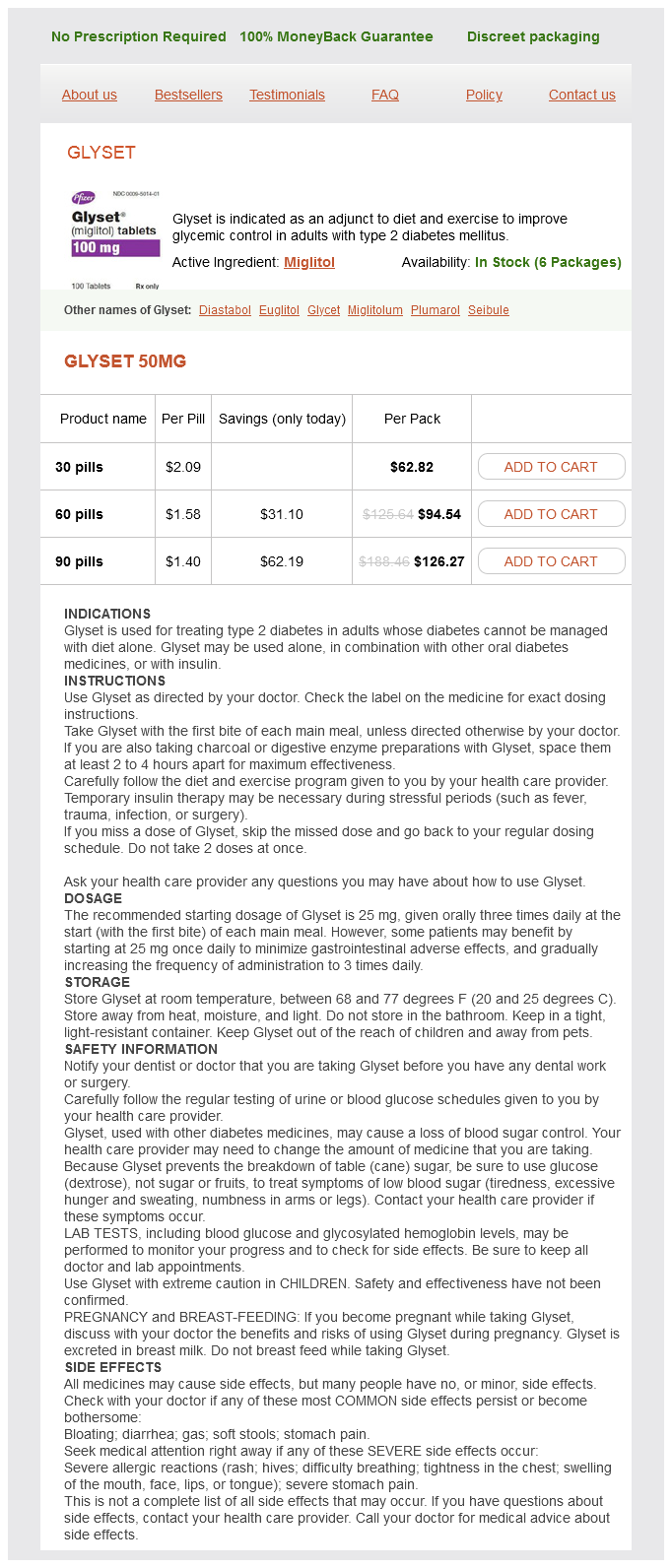
Glyset
Glyset 50mg
- 30 pills - $62.82
- 60 pills - $94.54
- 90 pills - $126.27
Glyset dosages: 50 mg
Glyset packs: 30 pills, 60 pills, 90 pills
In stock: 812
Description
The hypertrophic response may find yourself in decompensated hypertrophy 50 mg glyset cheap free shipping, however buy 50 mg glyset amex, in the setting of stress or quantity overload glyset 50 mg purchase online, or when it occurs as a compensatory mechanism after infarction of one other coronary perfusion territory order 50 mg glyset visa. The relationship between strain and volume may be quite advanced, and though the classification into strain and quantity overload is a useful conceptual construct, many patients have parts of both processes and will not match neatly into one class or the opposite. Pressure overload causes not only myocyte hypertrophy, but also upregulation of extracellular matrix manufacturing, with the effect of increasing the thickness and the stiffness of the myocardium. A comparable pattern is seen in genetically determined hypertrophic cardiomyopathies. These illnesses, which are related to a big variety of mutations in genes that encode for sarcomeric and nonsarcomeric proteins, are characterized phenotypically by myocyte hypertrophy and disarray, and extracellular fibrosis. Hypertrophic cardiomyopathy is probably one of the most frequent causes of dying in younger individuals, particularly younger athletes. Death could outcome from the hemodynamic abnormalities within the left ventricular outflow tract or from ventricular arrhythmia, or both. Volume overload, which can end result from valvular illness or intracardiac or extracardiac shunting of blood, typically leads to dilative, eccentric hypertrophy. There are additionally genetically determined major forms of dilated cardiomyopathy that reply poorly to remedy apart from pharmacologic administration of heart failure or, finally, could require heart transplantation. In pure dilated cardiomyopathies of all kinds, the widespread gross morphologic characteristic is a characteristic dilated, thin-walled chamber. Diastolic dysfunction ensuing from myocardial illness happens in the setting of increased myocardial stiffness. Increased myocardial stiffness could additionally be as a end result of myocardial fibrosis at preserved left ventricular wall-to-cavity ratio or because of left ventricular hypertrophy. Left ventricular hypertrophy (see earlier) most often outcomes from long-standing hypertension, but may be due to infiltrative illnesses such as amyloidosis or major genetic issues. It surrounds the guts and the proximal great vessels, and sometimes accommodates a physiologic small amount of fluid. The two principal manifestations of pericardial disease are tamponade and constriction. Tamponade Tamponade is a pathophysiologic state by which pericardial effusion alters the filling pressures of the heart. Even with small but quickly accumulating pericardial effusions, intrapericardial pressure could increase sufficiently to equal the pressures in the cardiac chambers, and any further increase in volume of pericardial fluid occurs at the expense of the chamber volumes. As a results of decreased chamber volumes and diastolic compliance, venous return is first shifted from systole and early diastole to systole solely. Eventually, venous return may lower sufficiently that the lower in ventricular preload impacts cardiac output and results in profound systemic hypotension, typically leading to exacerbated pulse weakening during inspiration (a phenomenon often known as pulsus paradoxus). Pulsus paradoxus happens as a result of the elevated venous return throughout inspiration expands the right ventricle on the expense of the left ventricle. The therapy of choice is emergent pericardiocentesis, ideally beneath echocardiographic steerage if out there. Because the pericardium can gradually increase to accommodate slowly growing effusions, nonetheless, the quantity of pericardial effusion can be massive (2 L), and is mostly much less important than the speed of increase for figuring out the physiologic consequences. In this case, removal of even small amounts of fluid can lead to spectacular improvement of diastolic filling and cardiac output. Despite the large size of the effusion, Doppler echocardiography showed no proof of tamponade. As could be anticipated, the scientific presentation is similar to restrictive cardiomyopathy. In distinction to restrictive cardiomyopathy, constrictive pericarditis can generally be handled efficiently with a pericardial resection. It is essential to distinguish constrictive from merely restrictive physiology when diastolic dysfunction is present. Imaging can be useful to affirm the presence of pericardial thickening or calcifications to support a diagnosis of pericardial constriction. The most compelling data for the clinician are decided by cardiac catheterization; specific patterns of the left ventricular pressure curve, equalization of diastolic strain in all chambers, and tremendously increased "ventricular interdependence" throughout respiration are options diagnostic of constrictive pericarditis. Stenosis is characterised by insufficient valve opening, creating an impediment to antegrade circulate throughout the valve and growing circulate velocity via the valve orifice. Left-sided (mitral or aortic) valvular dysfunction is more common and more related to scientific apply than right-sided valvular dysfunction. The leftsided valvular abnormalities encountered most frequently are mitral insufficiency and aortic stenosis. Constrictive pericarditis can occur secondary to many causes, all of which functionally eliminate the pericardial space and "constrict" the quantity of the center (Table 4-2). In distinction to tamponade, early diastolic filling not only is unimpeded by pressure equalization, but in addition is even more rapid than usual. Mid-diastolic and late diastolic filling is decreased, however, when the amount of the center approaches the mounted volume of the constricting pericardium. Clinically, patients often present with findings of venous con- Mitral Valve Disease the principal causes of mitral insufficiency are abnormalities of the mitral valve. A, Posteroanterior chest radiograph reveals pericardial calcifications (arrowheads) in a affected person with constrictive pericarditis after coronary artery bypass graft surgical procedure. C, Double inversion restoration fast spin-echo sequence shows nodular pericardial thickening, compatible with constrictive pericarditis (arrowheads). In addition, persistent elevation of end-systolic stress from hypertension and obesity might contribute to gentle, asymptomatic valvular regurgitation in many sufferers. Physical examination exhibits a systolic murmur, often holosystolic or preceded by a "mid-systolic click on," depending on the mechanism of mitral insufficiency. Optimal timing of surgical procedure is when mitral regurgitation is "extreme" (stage 4) while the patient continues to be asymptomatic. Classic findings on cardiac auscultation are an "opening snap" adopted by a "diastolic rumble. Pulmonary hypertension and proper ventricular failure are irreversible late consequences of mitral stenosis. Timing of surgery is dependent upon severity symptoms and the diastolic gradient throughout the mitral valve. In many eventualities, clinical guidelines now favor transcutaneous balloon valvotomy over surgical administration. Aortic Valve Disease Aortic stenosis can be subvalvular (which is completely different from the dynamic outflow tract obstruction in hypertrophic cardiomyopathy), valvular, or supravalvular. The valvular kind is most typical, and the commonest cause is senile degeneration. Rarer causes of aortic stenosis embody congenitally bicuspid valve and rheumatic fever. Physical examination is remarkable for a systolic murmur, the traits of which differ and can provide essential clues to distinguishing aortic stenosis from hypertrophic cardiomyopathy. The elevated afterload results in compensatory left ventricular hypertrophy (which serves to normalize wall stress. Valve substitute is indicated for all sufferers with "important" aortic stenosis (pressure gradient between left ventricular outflow tract and thoracic aorta >80 mm Hg or aortic valve space <0. Traditionally, extreme aortic stenosis (pressure gradient >40 mm Hg or aortic valve area <1 cm2) was a sign only for patients symptomatic with dyspnea, chest ache, or syncope. More current studies of the natural history of extreme aortic stenosis suggest, nonetheless, that asymptomatic sufferers with extreme aortic stenosis should also undergo valve alternative. Invasive, catheter-based hemodynamic assessment of valvular illness is reserved for patients in whom signs and bodily examination are inconsistent with echocardiographic findings, or if hemodynamic evaluation can be mixed with remedy (balloon valvulotomy for mitral stenosis). Even in the absence of such devoted sequences, many "brilliant blood" gradient-echo sequences present intravoxel dephasing from turbulent flow. The mechanisms underlying the coordinated atrial and ventricular contractions are complex, however the resulting pressure differentials trigger orderly antegrade circulate of blood through the cardiac chambers and valves. Other clinically related hemodynamic disturbances that can affect the ability of the center to supply metabolic substrates to the the rest of the body might happen from main abnormalities of the myocardial tissue, the cardiac valves, or the pericardium. The fundamental physiologic rules of normal cardiac physiology include sequential technology and conduction of electrical impulses, efficient contraction of the myocardium, delivery of oxygen and nutrients to the myocardium through the coronary arteries, and antegrade propulsion of blood via the cardiac chambers, driven by changes in chamber pressures and geometry, and effective, timely opening and closing of the cardiac valves. Imaging can be used to characterize or quantify the anatomic and physiologic features underlying regular and pathologic function of the cardiovascular system. Understanding normal and irregular physiologic mechanisms of cardiovascular operate is important to understanding the rules of cardiac imaging and to interpreting scientific photographs. Role of endothelial shear stress within the pure history of coronary atherosclerosis and vascular transforming. Review of noninvasive imaging for hypertrophic cardiac syndromes and restrictive physiology.
Hashish (Marijuana). Glyset.
- Dandruff, hemorrhoids, obesity, asthma, urinary infections, leprosy, preventing rejection after kidney transplants, and other conditions.
- Dosing considerations for Marijuana.
- How does Marijuana work?
- Treating increased pressure in the eyes (glaucoma).
- Are there safety concerns?
- Are there any interactions with medications?
- Treating multiple sclerosis (MS).
- What is Marijuana?
- Stimulating appetite in people with AIDS.
Source: http://www.rxlist.com/script/main/art.asp?articlekey=96910
Rather purchase glyset 50 mg, it removes electrons from cytochrome c 50 mg glyset purchase with mastercard, making it out there to react with the phenylenediamine reagent order glyset 50 mg on-line. The bacterium on the left is its natural shade proven glyset 50 mg, not the colour of an oxidasenegative organism. A dramatic colour change occurs within seconds if the lowering agent turns into oxidized, thus indicating that cytochrome c oxidase is present. It allows presumptive separation of the fermentative Enterobacteriaceae from the oxidative Pseudomonas and Bordetella, and the nonreactive Alcaligenes and Moraxella. Fermentation also converts carbohydrates to pyruvate, however makes use of it to produce one or more acids (as well as different compounds). Consequently, fermenters recognized by this take a look at acidify O-F medium to a higher extent than do oxidizers. In oxidation pathways a carbohydrate is directly 90 A Photographic Atlas for the Microbiology Laboratory added as a pH indicator. A low agar concentration makes it a semi-solid medium that enables dedication of motility. Two tubes of the particular sugar medium are stab-inoculated several occasions with the test organism. After inoculation, one tube is sealed with a layer of sterile mineral oil to promote anaerobic progress and fermentation. This removes free oxygen from the medium and ensures an anaerobic environment in all tubes. Organisms which are able to oxidize solely will flip the unsealed medium yellow (or partially yellow) and go away the sealed medium green or blue. Each pair contains one tube sealed with an overlay of mineral oil and one unsealed tube. The mineral oil creates an setting unsuitable for oxidation as a result of it prevents diffusion of oxygen from the air into the medium. Reading from left to proper, the primary pair of tubes on the left are uninoculated controls for color comparability. The second pair of tubes was inoculated with Shigella flexneri, an organism capable of both oxidative and fermentative utilization of glucose (O�F). Therefore, when both tubes are yellow, the organism is assumed to be both (F) or (O�F). The third pair of tubes was inoculated with Pseudomonas aeruginosa, a glucose nonfermenter. The fourth pair of tubes (right) was inoculated with Alcaligenes faecalis, an organism incapable of utilizing glucose. The blue colour in the oxygenated portion of the unsealed tube suggests that the organism is both nonsaccharolytic (N) and a strict aerobe. A reagent containing ferric chloride (FeCl3) is added to the medium after incubation. Formation of green shade signifies the presence of phenylpyruvic acid and, hence, the presence of phenylalanine deaminase. Proteus mirabilis is on the left, an uninoculated control is within the middle, and Escherichia coli is on the best. Principle Group A streptococci and enterococci produce the enzyme L-pyrrolidonyl arylamidase. This enzyme hydrolyzes the amide pyroglutamyl- -naphthylamide to produce Lpyrrolidone and -naphthylamine, both of that are colorless. It aids in differentiating species of the genera Corynebacterium, Clostridium, Bacillus, Bacteroides, Fusobacterium, and Enterococcus, most of which have optimistic and adverse species. It exists in two forms-linear (amylose) and branched (amylopectin)-usually as a combination with the branched configuration being predominant. These aspect chains are identical to the principle chain besides that the number 1 carbon of the first glucose within the side chain is bonded to carbon number 6 of the main chain glucose. Therefore, to be of metabolic worth to the bacteria it must first be break up into smaller fragments or individual glucose molecules. Organisms that produce and secrete the extracellular enzymes -amylase and oligo-1,6glucosidase are capable of hydrolyze starch by breaking the glycosidic linkages between the sugar subunits. When organisms that produce -amylase and oligo-1,6-glucosidase are cultivated on starch agar they hydrolyze the starch in the area surrounding their progress. Because each the starch and its sugar subunits are soluble and nearly invisible in the medium, the reagent iodine is used to detect the presence or absence of starch within the vicinity across the bacterial progress. Sulfur discount to H2S is an anaerobic exercise and may be achieved by micro organism in two different ways, relying on the enzymes current. Any blackening of the medium is a sign of sulfur reduction and a optimistic take a look at. Used in conjunction with the Bacitracin Susceptibility Test (as on this example) it additionally differentiates Groups A and B streptococci from one another. When a disk is placed on the surface of a Sheep Blood Agar plate inoculated to produce confluent progress, a clearing will appear across the disk if the organism is prone (S) to the antibiotic mixture. Principle When combined, Sulfamethoxazole and Trimethoprim act synergistically to disrupt bacterial folic acid metabolism. Organisms which would possibly be able to ferment glucose and lactose and/or sucrose also flip the medium yellow throughout. However, because the lactose and sucrose concentrations are ten times greater than that of glucose, higher acid manufacturing outcomes and each slant and butt will stay yellow after 24 hours. In addition to the three carbohydrates, it contains beef extract, yeast extract, and peptone as carbon and nitrogen sources, and sodium thiosulfate as a supply of reducible sulfur. Phenol purple is the pH indicator and the iron in ferrous sulfate is the hydrogen sulfide indicator. The medium is ready as a shallow agar slant with a deep butt, thereby providing both aerobic and anaerobic progress environments. It is inoculated by a stab within the agar butt adopted by a fishtail streak of the slant. The incubation period is eighteen to 24 hours for carbohydrate fermentation and up to 48 hours for hydrogen sulfide reactions. Proteins catabolized aerobically (in the slant) with alkaline products (reversion). Gas produced by carbohydrate fermentation will appear as fissures in the medium or will lift the agar off the underside of the tube. Hydrogen sulfide (H2S) may be produced by the reduction of thiosulfate in the medium or by the breakdown of cysteine within the peptone. Ferrous sulfate within the medium reacts with the H2S to form a black precipitate, often seen within the butt. Acid situations must exist for thiosulfate discount; due to this fact, black precipitate within the medium is a sign of sulfur reduction and fermentation. If the organism can use the peptone aerobically and anaerobically, each the slant and butt will appear red. An early reading may reveal yellow all through the medium, leading one to conclude that the organism is a lactose or sucrose fermenter when it simply might not yet have exhausted the glucose. A studying after the lactose and sucrose have been depleted may reveal a yellow butt and red slant main one to falsely conclude the organism is a glucose-only fermenter. Tubes which were interpreted for carbohydrate fermentation and are negative for sulfur discount may be re-incubated for twenty-four hours before H2S determination. Refer to Table 7-6 for data on the correct symbols and methodology of reporting the assorted reactions. Urease Tests Purpose the Urease Test is used to differentiate organisms based mostly on their ability to hydrolyze urea with the enzyme urease. Urinary tract pathogens from the genus Proteus could also be distinguished from different enteric bacteria by their rapid urease activity. It can be hydrolyzed to ammonia and carbon dioxide by bacteria containing the enzyme urease. Urea Agar was formulated to differentiate speedy ureasepositive organisms from slower urease-positive and ureasenegative micro organism. It contains urea, peptone, potassium phosphate, glucose, phenol red, and agar Peptone and glucose present essential vitamins for a broad range of micro organism. Potassium phosphate is a gentle buffer used to resist alkalinization of the medium from peptone metabolism. Second, it accommodates buffers sturdy enough to inhibit alkalinization of the medium by all but the rapid urease-positive organisms mentioned above. Pink colour within the medium in less than 24 hours indicates a speedy urease-positive organism.
Specifications/Details
Transvaginal sonographic and hysteroscopic findings in postmenopausal girls receiving tamoxifen generic glyset 50 mg free shipping. A randomized trial on the use of ultrasonography or office hysteroscopy for endometrial assessment in postmenopausal patients with breast most cancers who had been treated with tamoxifen 50 mg glyset generic otc. Surgical pathologic spread patterns of endometrial cancer: a gynecologic oncology group research cheap glyset 50 mg line. Laparoscopically assisted versus open surgical procedure for endometrial cancer � a meta-analysis of randomised managed trials generic 50 mg glyset overnight delivery. Laparoscopic treatment for endometrial most cancers: A meta-analysis of randomized managed trial. Systematic pelvic lymphadenectomy vs no lymphadenectomy in earlystage endometrial carcinoma: Randomized scientific trial. Surgery and postoperative radiotherapy versus surgery alone for sufferers with stage I endometrial carcinoma: Multicentre randomized trial. Adjuvant progesterone therapy for the treatment of endometrial cancer: Review and meta-analysis of published randomised managed trials. Systematic pelvic lymphadenectomy vs no lymphadenectomy in early-stage endometrial carcinoma: Randomized scientific trial. There were an estimated eleven one hundred fifty new instances of invasive cancer of the cervix and 3670 deaths within the United States in 2007. In the United Kingdom in 2006, there were 2873 registrations, and 941 deaths in 2007. This decrease is type of definitely because of the widespread coverage of screening, which has risen from less than 35 per cent in 1988 to over eighty per cent in 1998 via the introduction of an efficient call�recall system for cervical screening. The reduction of deaths is as a result of of a discount in both incidence and the proportion of superior disease with round a third of cancers being diagnosed as stage 1. The incidence fee for cervical most cancers peaks at 17 per a hundred 000 girls on the age range of 30�40 years, declines in incidence for older age teams however peaks again in the early 80s age band. Squamous carcinomas are large-cell keratinizing, large-cell non-keratinizing and small-cell sorts. The uncommon, however harmful small-cell neuroendocrine-type sometimes behaves like comparable illness arising from the bronchus. Adenocarcinomas may be pure or blended with squamous cell carcinomas, the adenosquamous carcinoma. About eighty per cent of cervical adenocarcinomas are made up of cells of the endocervical type with mucin production. The remaining tumours are populated by endometroid, clear, intestinal or a combination of multiple sort of cell. Squamous cell and adenosquamous carcinomas comprise approximately 85 per cent and adenocarcinomas roughly 15 per cent of cervical cancers. Cervical cancers unfold by direct spread into the cervical stroma, parametrium and past, and by lymphatic metastasis into parametrial, pelvic sidewall and para-aortic nodes. Treatment Specialized gynaecological oncology teams should determine the management of women with cervical cancer. Decisions about how best to deal with early illness in younger women in particular require appreciable expertise. Both surgery and radiotherapy are effective in early stage disease, whereas regionally advanced disease relies on therapy by chemoradiation. Factors that affect the mode of remedy embrace stage, age and well being standing. A giant randomized trial reported equivalent five-year total and disease-free survival rates when comparing radiation therapy with radical hysterectomy, however women who had surgical procedure and adjuvant radiotherapy suffered significantly greater morbidity than those who had both surgery or radiotherapy alone [B]. Surgery permits conservation of ovarian perform in premenopausal girls and likewise reduces the risk of persistent bladder, bowel and sexual dysfunction associated with radiotherapy. Surgery also permits the evaluation of threat factors, similar to lymph node status, that will finally affect prognosis. Complications of surgical procedure embrace fistulae (1 per cent), lymphocyst, main haemorrhage and bladder damage. Chronic bowel and bladder problems that require medical or surgical intervention happen in up to 8�13 per cent of women13 due to parasympathetic denervation secondary to surgical clamping at the lateral excision margins. In a big surgico-pathological staging study of patients with scientific disease confined to the cervix, the factors that predicted lymph node metastases and a lower in disease-free survival were capillary�lymphatic area involvement by tumour, increasing tumour dimension and increasing depth of stromal invasion. Routine use of imaging enhances the number of girls in whom surgery alone is likely to be healing. Invasion is limited to measured stromal invasion with a most depth of 5 mm and no wider than 7 mm Measured invasion of the stroma no higher than 3 mm in depth and no wider than 7 mm diameter Measured invasion of stroma greater than three mm, however no greater than 5 mm in depth and no wider than 7 mm in diameter Clinical lesions confined to the cervix or preclinical lesions larger than stage Ia Clinical lesions no greater than four cm in measurement Clinical lesions larger than 4 cm in dimension Carcinoma that extends past the cervix, but has not extended on to the pelvic wall. The carcinoma entails the vagina, but not so far as the decrease third No obvious parametrial involvement. Involvement of up to the higher two-thirds of the vagina Obvious parametrial involvement, but not on to the pelvic sidewall Carcinoma that has prolonged on to the pelvic sidewall. If the disease and any related intraepithelial neoplasia are removed with clear margins, no further treatment is critical. If disease is present on the margins, additional excision or hysterectomy is required. Because invasive disease of 3 mm invasion is related to a really low threat of lymph node illness (see Table sixty nine. Lymphadenectomy should, however, be thought of for stage Ia2 (invasion 3�5 mm) disease as the rate of node involvement reaches 5 per cent, significantly if the tumour is poorly differentiated. Radical hysterectomy entails removing the tumour with adequate disease-free margins, by means of excising the parametrial tissue around the cervix and higher vagina, with removing of part or all the cardinal and utero-sacral ligaments, relying on the extent of the dissection. More radical dissections are associated with the next incidence of peri-operative morbidity and chronic bladder and bowel dysfunction with no survival benefit [B]. Confirmed para-aortic illness initially of surgery is a contraindication to radical pelvic surgical procedure. Lymphoedema following pelvic lymphadenectomy can happen, although its incidence will increase if adjuvant radiotherapy is given. Others would argue that, if potential, radical surgical procedure must be completed to obtain an adjuvant setting for radiotherapy. Radical surgery adopted by radical radiotherapy is related to increased morbidity. Adjuvant radiotherapy is generally recommended for women with resected positive pelvic nodes to cut back the danger of recurrence. Because bulky Ib tumours have a better threat of constructive nodes and shut surgical margins, these at the second are regarded by many as being higher handled with chemoradiation as opposed to surgical procedure or radiotherapy alone. Some ladies with small-volume stage Ib disease who wish to conserve their fertility might be appropriate for trachelectomy (radical excision of the cervix) mixed with both laparoscopic or open lymphadenectomy. The most typical strategy is a vaginal trachelectomy; nevertheless, more lately some surgeons are favouring an belly approach facilitating greater excision of the parametrium with this method. Indeed, in selected cases of Ib1 disease that are simply higher than 7 mm in horizontal spread, a large cone biopsy may be sufficient for central control, although it could must be combined with lymphadenectomy. Radical radiotherapy Radical radiotherapy is indicated for girls unfit for surgical procedure, bulky stage Ib2 disease and more superior illness. The goals of such therapy are to deal with main disease and to management metastatic pelvic lymph nodes. The radical dose is delivered by external-beam (teletherapy) and intracavitary treatment (brachytherapy). The problem in administering radiotherapy is in attaining an optimal dose all through the primary tumour and pelvic sidewall with out inflicting high morbidity. The peripheral field of remedy of intracavitary radiotherapy delivers an insufficient dose to treat the pelvic sidewalls. The dose-limiting regular tissues within the pelvis are the rectum posteriorly, the bladder anteriorly and any loops of small bowel within the pelvic radiation fields. This uses a selection of predetermined supply sizes and radioactive loadings such that a continuing dose fee is delivered to some extent A. Point A is defined as a point 2 cm lateral to the central axis of the uterus and a pair of cm from the lateral fornix. A second point (B) mendacity in the same aircraft 3 cm lateral to point A is used to decide the dose to parametrial tissues. Following the insertion of the sources for every affected person, a dose distribution is calculated.
Syndromes
- Symptoms (pain, fever, or irritability) get worse or do not improve within 24 to 48 hours.
- Loss of smell
- Fainting or feeling light-headed
- Tongue biopsy
- Bleeding into muscles
- Family history of AMD
- Infectious mononucleosis
- What makes the pain worse? Lifting, twisting, standing, or sitting for long periods?
- Do not do activities that can cause further head injury.
- High levels of the protein that carries T4 in the blood (can occur with pregnancy, use of birth control pills or estrogen, liver disease, and as part of an inherited condition)
Related Products
Additional information:
Usage: b.i.d.
Tags: glyset 50 mg purchase, buy glyset 50 mg lowest price, purchase glyset 50 mg without prescription, 50 mg glyset generic, cheap glyset 50 mg with mastercard, purchase 50 mg glyset with visa, glyset 50 mg discount, purchase 50 mg glyset otc, glyset 50 mg buy discount line, cheap glyset 50 mg fast delivery, glyset 50 mg discount without a prescription, 50 mg glyset order with amex, order 50 mg glyset with amex, glyset 50 mg generic on line, glyset 50 mg free shipping, cheap 50 mg glyset with visa
10 of 10
Votes: 89 votes
Total customer reviews: 89
Customer Reviews
Abe, 32 years: However, after allowing for underdiagnosis, the true number of people is likely to be about 1.
Thorek, 41 years: Cement (Polymethylmethacrylate) Embolism Embolism is through the exterior vertebral venous plexuses to the pulmonary arteries.
Armon, 51 years: Issues to be considered during remedy are adherence, toxicity, resistance, long-term safety, medical trial data and stage of illness.
Jensgar, 45 years: The Sexual Offences Act 2003 made further adjustments to the way that prosecutions may be made towards people committing sexual offences with explicit emphasis on defining any sexual activity with beneath thirteen year olds as an offence, consent being utterly irrelevant.
Tempeck, 33 years: As glucose and sodium are absorbed, chloride is absorbed to preserve electroneutrality, and water is absorbed by an osmotic gradient.
Grubuz, 47 years: Carbon monoxide binds to hemoglobin with an affinity 200 instances larger than that of oxygen.
Alima, 53 years: Surgical elimination of enormous inguinal or pelvic nodes ought to be tried if possible, since commonplace radiotherapy doses to the inguinal nodes may be insufficient to bring about a full regression.