
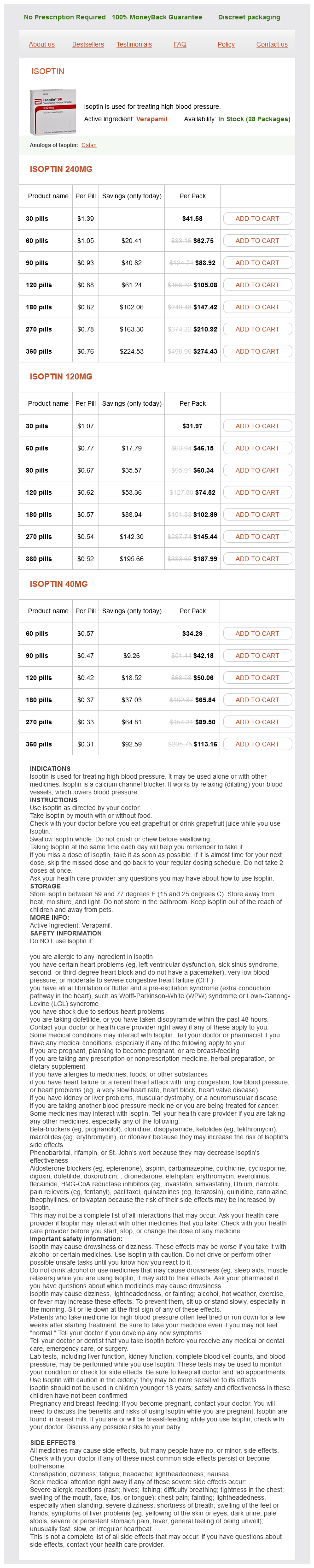
Isoptin
Isoptin 240mg
- 30 pills - $41.58
- 60 pills - $62.75
- 90 pills - $83.92
- 120 pills - $105.08
- 180 pills - $147.42
- 270 pills - $210.92
- 360 pills - $274.43
Isoptin 120mg
- 30 pills - $31.97
- 60 pills - $46.15
- 90 pills - $60.34
- 120 pills - $74.52
- 180 pills - $102.89
- 270 pills - $145.44
- 360 pills - $187.99
Isoptin 40mg
- 60 pills - $34.29
- 90 pills - $42.18
- 120 pills - $50.06
- 180 pills - $65.84
- 270 pills - $89.50
- 360 pills - $113.16
Isoptin dosages: 240 mg, 120 mg, 40 mg
Isoptin packs: 30 pills, 60 pills, 90 pills, 120 pills, 180 pills, 270 pills, 360 pills
In stock: 557
Only $0,33 per item
Description
It is helpful blood pressure lowering medications isoptin 240 mg purchase online, although not mandatory pulse pressure folic acid 120 mg isoptin mastercard, that the imaging table be able to tilting arrhythmia echocardiogram isoptin 240 mg buy cheap. Placing the affected person in reverse Trendelenburg place could enhance the visualization of reflux throughout venography and may reduce the chance of issues throughout embolization (as mentioned next) pulse pressure 2013 120 mg isoptin generic with amex. A energy injector is useful, however hand injection of contrast is usually adequate for the procedure. A evaluation of literature does identify any study comparing patients handled by ovarian vein embolization alone to those treated by mixed ovarian and iliac vein embolization. Ovarian Vein Embolization the ovarian veins could be approached from femoral, jugular, and even higher extremity access websites. Thus, the objective of endovascular therapy is to occlude each the main channels of ovarian reflux and any branch vessels that may provide a mechanism for recurrence by way of collateral flow. Because such branches can be both numerous and difficult to visualize, the likelihood of recurrence is lowered by occluding the ovarian veins as near the ovary as attainable; simply embolizing the left and proper ovarian veins on the degree of their confluence with the left renal vein or the vena cava, respectively, is ill-advised. Deep catheterization and embolization of the ovarian veins and their branches might require coaxial microcatheter technique however is crucial for long-term scientific success. In addition to treating the ovarian vein, some authors also routinely search out and, if found, embolize branches of the interior iliac veins that talk with pelvic varices or with the ovarian veins. Once the ovarian vein has been catheterized, many operators place a protracted curved sheath into the vessel to provide stability for subsequent manipulation of an angiographic catheter caudally into the pelvis. The right ovarian vein is finest entered from the groin using a recurved catheter, corresponding to a Simmons 2. A similarly shaped catheter with a smaller radius in its main curve could not have sufficient wall contact to interact the vein. From the groin method, deep catheterization of the right ovarian vein usually requires a coaxial microcatheter. Jugular Approach Both the left renal vein and the best ovarian vein can be recognized and catheterized from above the diaphragm with a simple angled-tip catheter. After having engaged the right ovarian vein, the catheter can generally be superior nicely into the pelvis with out additional manipulation. On the left, nonetheless, one must first engage the renal vein and then rotate the catheter some 90 levels to engage the ovarian ostium. Embolic Delivery Gonadal embolization has been performed with detachable balloons, coils, plugs, liquid sclerosants, glue, and various mixtures of these agents with gelfoam and with each other. A typical approach to embolization of the ovarian vein once it has been deeply catheterized is to first consider the capacitance of the adnexal varices by slowly injecting distinction and watching for it to spill again along the catheter. Having thereby determined how much fluid the varices will hold, one can safely instill this identical quantity of sclerosant. Alternatively, the sclerosant may be mixed with distinction, thus rendering it radiopaque, and simply injected underneath steady fluoroscopy. The writer prefers the latter technique, using a distinction and gelfoam slurry to dilute 3% sodium tetradecyl sulfate to concentrations of roughly 1%. Having handled essentially the most caudal space of reflux, the operator withdraws the catheter to approximately the level of the sacral promontory and performs coil embolization. This course of is repeated, if essential, in any massive parallel ovarian venous channels which will exist in the pelvis. Once the pelvic vessels are occluded, the catheter is serially withdrawn by distances of approximately 5 cm with additional sclerosant and coils delivered at every degree. Ultimately, one creates an alternating "sandwich" of sclerosant and coils that spans the total size of the ovarian vein. Care must of course be taken to ensure that neither the sclerosant nor the coils enter the left renal vein or the vena cava. Initial diagnostic injection is made into the internal iliac vein and pelvic varices or ovarian collaterals are identified. The catheter is then repositioned superselectively into the venous branches that offer these constructions and embolization performed. As indicated, Venbrux and Kim use an occlusion balloon for venography and sclerotherapy. These authors use a slurry of gelfoam and liquid sclerosant, maintaining the balloon inflated for five minutes after delivery of the agent to prevent its reflux into nontarget venous constructions. As a result, the amount of thrombus generated by embolization may be fairly extensive. This, in flip, creates the potential for symptomatic aseptic pelvic thrombophlebitis. The chance of symptoms is increased by the use of sclerosing brokers, that are designed to cause a direct damage to the endothelium. For most, the signs will be comparatively gentle and can resolve within a number of days. As mentioned, the creator prescribes a scopolamine transdermal patch, which offers for the constant delivery of antiemetic for 72 hours. Patients might proceed to expertise inflammatory pain for several weeks after ovarian and/or iliac vein embolization. In some circumstances, they may manifest the standard signs of postembolization syndrome. Ten different cases concerned coils with seven of those embolizing to the pulmonary artery. Five pulmonary coils and two coils in renal veins have been retrieved utilizing endovascular snares. Two pulmonary coils and one in the external iliac vein were asymptomatic and had been left in place. Six of the ten coil embolizations (60%) occurred throughout embolization of the interior iliac veins. The key components in lowering this risk are (1) matching the dimensions of a coil to that of the target vessel or the polymerization rate of glue or related brokers to its flow fee, (2) appropriately positioning the delivery catheter, and (3) offering help sufficient to forestall the catheter from being pushed out of position throughout supply of the embolic materials. As a result of their experiences with migration Iliac Vein Embolization As with the ovarian veins, the interior iliac veins could be catheterized from the femoral or jugular method. Catheter selection for these different access sites is similar to that described beforehand. Specifically, it may be postulated that manipulation of ovarian venous outflow would possibly influence ovarian function. As already famous, nevertheless, the most common indication for gonadal vein embolization in male sufferers is diminished fertility, and rather than impairing testicular function, the remedy has been clearly proven to improve sperm quality among subfertile males. Another concern concerning ovarian vein embolization is that it unavoidably exposes the ovaries to ionizing radiation, which might enhance the danger of malignancy or result in genetic anomalies in future pregnancies. Radiation danger has not been investigated with particular regard to ovarian vein embolization. Only two authors described sufferers whose signs had been worse after embolotherapy: Kim et al. He additionally reported statistically significant enchancment in dyspareunia, urinary urgency, and dysmenorrhea. Time Course Reported response instances are extensively various with subjective enchancment noted as early as 1 week after treatment in a single examine but requiring as many as three months in one other. Recurrence of symptoms among patients who had initially skilled improvement was famous sometimes and by a minority of authors. Technical success-defined as occlusion of refluxing gonadal and/or inner iliac veins-is nearly 100%. Clinical success-defined as a durable subjective enchancment within the presenting symptoms-is also quite excessive but is troublesome to compare amongst manuscripts. No subsequent creator has famous an analogous correlation, nevertheless, and both Maleux et al. These 25 sufferers had been analyzed as a subgroup and were found to have skilled a discount in total pain score from 7. Noninvasive venous imaging could additionally be acceptable if reflux had been clearly demonstrated by noninvasive means previous to the embolization procedure. On the other hand, catheter venography stays the gold normal for demonstrating reflux and must be thought of if noninvasive studies are equivocal or if there stays a excessive index of suspicion for reflux regardless of a standard noninvasive research.
Coral Peony (Peony). Isoptin.
- How does Peony work?
- Are there any interactions with medications?
- Are there safety concerns?
- What is Peony?
- Dosing considerations for Peony.
- Muscle cramps, gout, osteoarthritis, breathing problems, cough, skin diseases, hemorrhoids, heart trouble, stomach upset, spasms, nerve problems, migraine headache, chronic fatigue syndrome (CFS), and other conditions.
Source: http://www.rxlist.com/script/main/art.asp?articlekey=96082
By the mid-1990s a quantity of stories of profitable endovascular treatment of subclavian stenosis emerged with preliminary technical success rates of 92% to 100% in selected patients and 85% to 100% patency charges at a mean follow-up of 27 months blood pressure medication patch cheap isoptin 240 mg with visa. In common blood pressure medication missed dose 240 mg isoptin purchase overnight delivery, reduction of ischemic symptoms is great arteria inominada purchase isoptin 40 mg line, whereas results for enhancing dizziness are poor (only 20%) heart attack water generic isoptin 40 mg with amex. Angioplasty performed over the origin may cause plaque disruption and distal emboli or dissection. Techniques to stop this embrace undersizing of balloons, dilatation proximal or distal to the vertebral origin, and, if essential, placement of an indwelling zero. In circumstances of highgrade stenosis or concern for distal embolism, a distal safety system can be deployed into the vertebral artery, although this represents an off-label indication. Symptoms associated to brachiocephalic stenosis, nevertheless, may be extreme and result in retrograde circulate from the vertebral artery into both the best widespread carotid and subclavian arteries. Intervention of brachiocephalic lesions is usually problematic due to the propensity of those lesions to be very brief inside a large-diameter vessel, which makes stability and exact placement of angioplasty balloons and stents troublesome. Angiogram of the best brachiocephalic artery shows high-grade stenosis just proximal to the bifurcation (arrow). Selective angiogram of the left vertebral artery reveals some filling of the posterior intracranial vessels in addition to retrograde circulate in the proper vertebral artery (arrows). Aortic arch angiogram exhibits a high-grade stenosis of the right brachiocephalic artery (arrow). Selective injection of the right brachiocephalic artery exhibiting the stenosis (arrow) in very close proximity to the left common carotid artery (arrowheads). Post-angioplasty and stenting of the proper brachiocephalic artery with a balloon-expandable stent. Some series only included patients thought-about poor surgical candidates, whereas in others endovascular therapy was the first-line treatment. Some authors carried out procedures under common anesthesia, whereas others beneath aware sedation. In general major technical success rates are excessive with variable charges of restenosis. Primary technical success charges of 88% to one hundred pc have been reported for balloon angioplasty alone, although recurrence charges as excessive as 22% have additionally been reported. Primary patency rates total had been improved with stenting, ranging from 83% to one hundred pc Table forty two. The overall periprocedural complication fee together with minor issues was lower in the surgical (5. Primary patency was 100% at 1 year and 96% at 5 years for surgical procedure, whereas the endovascular group confirmed patency rates of 93% at 1 yr and 70% at 5 years. Embolic material may originate within the coronary heart, aorta, or proximal great vessels however the vertebral origin is the most typical site. Vertebral artery atherosclerotic stenosis accounts for roughly 32% of cases. This may be positional in nature, related to a stereotypical movement, similar to extension or rotation of the top or neck. The first section of the vertebral artery (V1) extends from the subclavian origin to its entrance into the transverse foramina, usually at the sixth cervical vertebra and is the subject of discussion here. Muscular branches come up from the vertebral artery and share a collateral circulation with the exterior carotid artery and thyrocervical trunk, offering collateral supply to the vertebral artery past a proximal occlusion. For these causes physicians have been conservative with selections to intervene and, till just lately, most sufferers with vertebral artery stenosis have been treated with medical remedy alone. In the setting of posterior circulation ischemia and imaging proof of thrombus within the extracranial vertebral artery, anticoagulant therapy is generally beneficial for no much less than three months. Significant numbers of sufferers remain asymptomatic with occlusion of one vertebral artery. For this cause many operators will deal with asymptomatic high-grade (70%) stenosis in the setting of a dominant or singular vertebral artery. After a imply period of 12 months, a 26% restenosis fee was noticed but the vary was large (0% to 43%) and was not persistently correlated with recurrent symptoms. As with different great-vessel interventions, antiplatelet therapy is essential and the femoral strategy is most popular. A 6 French information catheter or equal sheath will sometimes accommodate most stents applicable for vertebral artery lesions. The vertebral artery origin sometimes has a welldeveloped musclaris, and plaque burden typically extends into the subclavian artery, requiring a stent with excessive radial drive. Proximal left vertebral artery is occluded and reconstitutes by way of collaterals distally (arrow). Post-angioplasty and stenting of the proximal proper vertebral artery with a self-expanding stent exhibits a superb radiographic result (arrows). Post-angioplasty and stenting of the proximal left vertebral artery with a balloon-expandable stent reveals an acceptable radiographic result (arrow); performed without distal embolic protection over a standard guide wire (arrowheads). This allows for sufficient coverage of plaque within the subclavian artery contributing to the vertebral artery origin lesion, lowering the likelihood of restenosis. Typically no further angioplasty might be needed, although poststent dilatation may be required to obtain an enough angiographic outcome. Although one could assume that embolic protection could also be of profit, this has not been definitively shown, and, normally, its use largely depends on the size of the vertebral lumen and talent to accommodate the system, which is normally 4 mm. One must also contemplate attainable difficulties in retrieving the gadget including unfavorable angles of the vertebral artery origin subsequent to stent placement. After a mean interval of 12 months, a 26% recurrent stenosis rate was noticed however the vary was giant (0% to 43%) and was not consistently correlated with recurrent symptoms. Proximal Great-Vessel Dissection Dissection involving the supra-aortic trunk vessels is most frequently an extension of dissection of the aortic arch. Traumatic dissection happens in approximately 1% of all patients with blunt injury mechanisms and is often initially unrecognized. Carotid dissection sometimes presents with pain on one facet of the pinnacle or neck accompanied by a sudden onset of neurologic signs together with potential cerebral or retinal ischemia and Horner syndrome. Vertebral artery dissection could Outcomes Multiple retrospective case collection have been reported on the efficacy of angioplasty and stenting for the therapy of extracranial vertebral artery disease (Table forty two. In general the technical success fee is high, starting from 93% to 100 percent with 30-day charges of stroke and all-cause death starting from 0% to 6. In a comprehensive evaluate of all out there literature until 2005, 300 interventions for proximal vertebral artery stenosis were recognized with a mortality fee of zero. If large-bore inadvertent catheter placement does occur, the remedy options will rely upon the scale of the catheter, presence or absence of symptoms, artery canalized, and size of time before recognition. Depending on these elements there are several remedy options obtainable including removal and exterior compression, off-label use of percutaneous closure units, endovascular intervention with stent-graft placement, or surgical repair. With catheters of this dimension, handbook stress control could additionally be related to significant morbidity including pseudoaneurysm, expanding hematoma with airway compromise, and stroke charges as excessive as 5. With regard to inadvertent subclavian artery catheterization, the clavicle and first rib typically stop sufficient guide strain. Prolonged arterial canalization is worrisome as a result of thrombus formation on the website of arterial injury might lead to vascular occlusion or thromboembolism and stroke. Several circumstances of unrecognized stroke within the anesthetized affected person following the pull/pressure technique have been reported in this setting even in light of normal carotid sonography. Urgent intervention is beneficial by some operators for all symptomatic sufferers to stabilize the dissection flap and cut back dangers of further thrombotic events and to restore cerebral perfusion supplied that irreversible infarction has not already occurred. If intervention is deemed necessary, the particular technique is similar as that described for atherosclerotic disease. Surgery for inadvertent subclavian, proximal carotid, or vertebral catheter placement presents significant morbidity, requiring partial removing of the first rib or thoracotomy. Percutaneous stent grafting of iatrogenic and noniatrogenic bleeding, arterial damage, and pseudoaneurysm formation is a acknowledged profitable remedy with low complication charges when in comparability with surgery. Brachiocephalic angiography exhibits central venous catheter (arrowheads) coursing into the proximal left subclavian artery (arrow). Injection via the introducer sheath in the best brachiocephalic artery exhibits flow into the right carotid artery (arrowheads) however no circulate into the subclavian artery. Subclavian angiogram following handbook compression and balloon occlusion for 10 minutes shows a superb radiographic outcome with out contrast extravasation.
Specifications/Details
Observation needs to prehypertension young adults purchase isoptin 40 mg line be maintained till the damage completely heals or until definitive therapy is offered blood pressure of normal man discount isoptin 240 mg free shipping. Therefore blood pressure tracking chart excel generic isoptin 120 mg with visa, improving but incompletely healed or secure accidents require serial follow-up examinations heart attack chest pain order 120 mg isoptin with visa. Alternatively, some trauma specialists believe that as a end result of major vascular accidents may find yourself in limb loss and useful incapacity in characteristically young victims, diagnosis and repair of all accidents is important. The cost and legal ramifications of a missed prognosis motivate some surgeons to request arteriography on all penetrating trauma patients. Missed injuries requiring delayed intervention may not be as troublesome to restore, nor problems as frequent, as previously thought. Frontal arteriogram after through-and-through gunshot wound to the knee reveals smooth tapering of the popliteal artery initially thought to be caused by spasm. The lateral view reveals a popliteal artery pseudoaneurysm and demonstrates the importance of orthogonal views. Injury of the proximal superficial femoral artery was handled with surgical vein graft (arrowheads). A large pseudoaneurysm arising from the deep portion of the profunda femoris artery was missed (arrow). When giant international bodies are present, fluoroscopy and take a look at injections can enable positioning of the vessel of curiosity away from obscuring metallic material. Vessels proximal and distal to the potential harm web site ought to be evaluated as well. Careful positioning of the catheter is necessary so that each one arteries in the potential injury path are evaluated. Knowledge of both the entrance and exit wounds, if present, is therefore required. The catheter should be positioned proximal sufficient to the damage site to permit for frequent anatomic variants. Occlusions could additionally be caused by extrinsic vessel compression or by thrombosis related to arterial laceration or intimal flap. Luminal narrowing may be secondary to arterial spasm, intramural hematoma, extrinsic compression, or atherosclerosis. The vessel course may be altered due to hematoma or related long bone fracture displacement. Slow circulate is a vital discovering and could be the sole arteriographic indication of a compartment syndrome. Luminal narrowing may be a results of arterial spasm, which appears as a focal space of smooth concentric narrowing and is particularly prevalent in pediatric sufferers. Calcium channel blockers, nitroglycerin, in addition to papaverine have been used as vasodilators, although their effectiveness is unreliable. Endovascular strategies are increasingly being used for the treatment of vascular traumatic accidents. These are vessels that are more likely to be ligated surgically as an alternative remedy. Each patient and every damage must be considered individually with respect to treatment selection. Transcatheter embolization of serious injuries is preferable to surgical intervention in sites the place surgical publicity and/or vascular control are difficult to achieve. In older individuals, caution ought to be exercised to keep away from obliterating such collaterals. The strategy of embolization is determined by the kind and placement of the vascular lesions. In trauma, a quick lived occluding agent, similar to gelatin sponge, placement have been described. Arteries could additionally be ligated, primarily repaired, patched by vein, bypassed by vein, or, not often, bypassed by prosthetic graft. Percutaneous therapy contains embolization as well as transcatheter placement of bare or covered stents. Injuries that require surgical intervention, such as debridement for high-velocity gunshot wounds or contamination, embolectomy, or compartment syndrome, might not benefit as much from definitive endovascular repair. These injuries may profit from angiography and proximal balloon occlusion to limit blood loss. In addition to balloon occlusion, hemorrhage control interventions include embolization and deployment of a coated stent. Dissections have been managed with balloons, bare metallic stents, or covered stents. Leg arteriogram following stab wound reveals a pseudoaneurysm of the posterior tibial artery with normal peroneal and anterior tibial arteries. Lower-extremity arteriogram following gunshot injury demonstrates a large pseudoaneurysm of the tibioperoneal trunk (arrow) with occlusion of the distal arterial segment. Successful embolization of the tibioperoneal trunk with metal coils solely within the proximal arterial segment (arrow). Alternatively, fibered coils, though permanent, provide the benefit of exact positioning. In the extremities, precise placement is usually of foremost concern, and, subsequently, coils are favored. These coils have polyester fibers connected to improve thrombogenicity and are available in a number of sizes and in straight, curved, and complex configurations. Liquid embolics, such as onyx and N-butyl cyanoacrylate, are possible alternatives. After identification of an arterial damage appropriate for transcatheter embolization, a diagnostic catheter should be manipulated to the goal vessel. Achieving sufficient catheter place can be the limiting factor for embolization success. If the target vessel is small or tortuous, or if the diagnostic catheter is unstable, a microcatheter can be used coaxially. Microcatheters allow for rapid catheterization of branches that are unreachable by diagnostic catheters. They minimize vasospasm and the chance of nontarget embolization by providing added stability. Initial placement of a big coil can present a network for retaining smaller coils. For pseudoaneurysms, small gelfoam pledgets can be used to occlude the distal arterial section. If pseudoaneurysms are superficial, ultrasound-guided thrombin injection has been used. Lower-extremity arteriogram following thigh stab wound demonstrates extravasation from a distal department of the profunda femoris artery (arrow). Successful superselective embolization of the bleeding muscular branch with two straight platinum microcoils. The success rate for transcatheter embolization has been reported to be between 85% and 100%. Complications from transcatheter embolization are equivalent to these of diagnostic arteriography but also embody nontarget embolization. With careful method and, when needed, using microcatheters and microcoils, nontarget embolization is rare. Local infarction of tissue may be averted by using gelatin sponge or coils quite than agents that permeate to the arteriolar or capillary level, such as gelfoam powder or alcohol. Transcatheter embolization is effective and secure and may be definitive remedy for suitable arterial injuries in both the higher and lower extremities. Occasionally, huge hemorrhage may be identified on an arteriogram from an important artery. If the clinical state of affairs is suitable, an occlusion balloon can be used for short-term occlusion to lower blood loss throughout transit to the working room. Because surgical treatment would probably be radial artery ligation, transcatheter embolization of the radial artery was requested.
Syndromes
- Do not keep guns in the home. If you do keep guns in the home, lock them and keep the bullets separate.
- Flu shots may be injected into the muscle or just below the skin.
- Lycine
- Spasms of the stomach or intestinal tract
- You have a strong history of heart disease in the family
- Closed cervix
- Are you trembling or twitching?
Related Products
Additional information:
Usage: p.o.
Tags: 120 mg isoptin with mastercard, isoptin 40 mg discount line, order 240 mg isoptin overnight delivery, 120 mg isoptin discount with mastercard, discount 40 mg isoptin, isoptin 40 mg otc, trusted isoptin 240 mg, generic isoptin 120 mg online, isoptin 240 mg discount on-line, 40 mg isoptin mastercard, buy isoptin 240 mg free shipping, generic isoptin 120 mg with visa, isoptin 120 mg purchase visa, discount isoptin 240 mg fast delivery, isoptin 120 mg cheap visa, isoptin 40 mg generic with mastercard
9 of 10
Votes: 103 votes
Total customer reviews: 103
Customer Reviews
Goran, 56 years: Its utility in small-vessel illness and within the assessment of bowel integrity is restricted, nevertheless. It could be helpful at this point to summarize the anatomic particulars required to direct endovascular therapy of malperfusion.
Dennis, 58 years: Essentially, the precise X-ray tube current is diversified throughout picture acquisition to account for areas of larger thickness and absorption in each angular (xy) and longitudinal (z) directions, permitting lower publicity for areas of smaller diameter and/or absorption. These patients were asymptomatic and 83% (69 of 83) of them had been managed conservatively with out the development of symptoms at a imply follow-up of 4.
Emet, 44 years: In truth, the triumph of the integration of psychology into family medication serves as an academic mannequin for psychologists working with nonpsychologists. Angioplasty and primary stenting of the subclavian, innominate, and customary carotid arteries in eighty three sufferers.
Kurt, 47 years: Having handled probably the most caudal area of reflux, the operator withdraws the catheter to approximately the extent of the sacral promontory and performs coil embolization. The renal circulation is usually involved with a combination of arterial stenoses and micro- and macroaneurysm formation.
Faesul, 40 years: Of note, these studies have been performed in an period where squamous cell carcinoma represented the commonest non�small-cell lung most cancers histology. Many totally different follow fashions exist and the obligations of the interventional oncologist doctor will vary from affected person to affected person and can depend upon particular person expertise and clinical sources out there.