
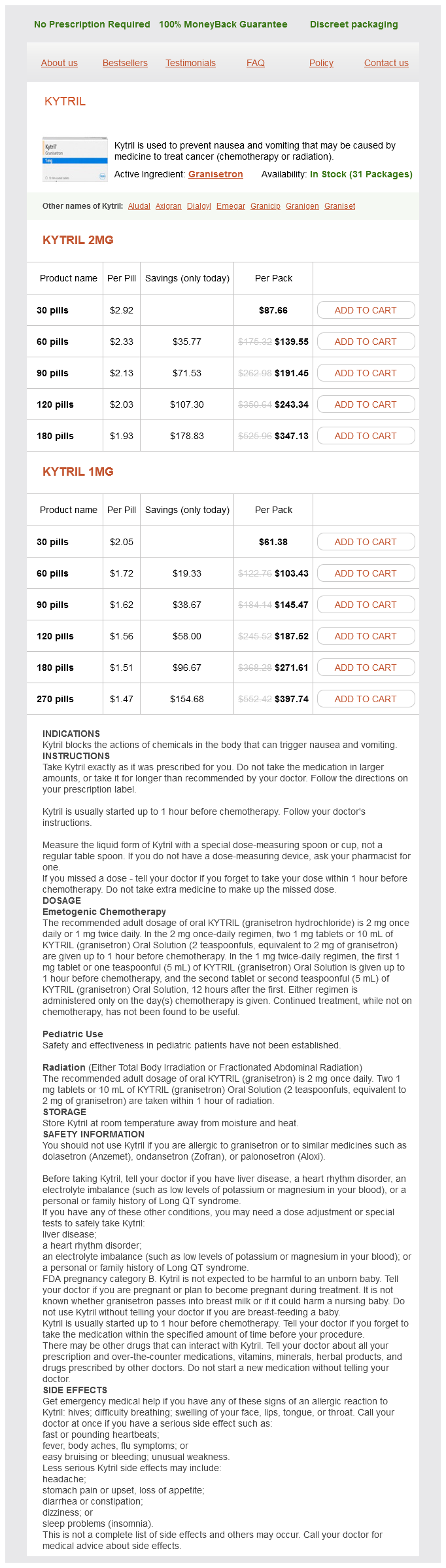
Kytril
Kytril 2mg
- 30 pills - $87.66
- 60 pills - $139.55
- 90 pills - $191.45
- 120 pills - $243.34
- 180 pills - $347.13
Kytril 1mg
- 30 pills - $61.38
- 60 pills - $103.43
- 90 pills - $145.47
- 120 pills - $187.52
- 180 pills - $271.61
- 270 pills - $397.74
Kytril dosages: 2 mg, 1 mg
Kytril packs: 30 pills, 60 pills, 90 pills, 120 pills, 180 pills, 270 pills
In stock: 627
Only $1,57 per item
Description
Some of those cell varieties may be described as stem cells medicine 018 kytril 2 mg generic visa, capable of indefinite self-renewal (given the appropriate niche) symptoms 2 weeks pregnant 2 mg kytril generic overnight delivery, whereas additionally retaining the potential to differentiate in to particular cell types medicine venlafaxine cheap 2 mg kytril overnight delivery. These adjustments are brought about by many alternative mechanisms 4 medications list at walmart discount kytril 2 mg on-line, such because the differential inheritance of asymmetrically localized cytoplasmic determinants throughout cell division or in response to inductive indicators from neighbouring cells. Such mechanisms set off a cascade of events that in the end lead to particular genes being activated or repressed, defining the gene expression profile of the cell. Networks of genes that guide improvement are incessantly reused in several contexts. This chapter provides a broad overview of the most important developmental events that take place during early embryogenesis, from fertilization as a lot as the formation of the first organs. Preimplantation improvement is taken into account first, during which the embryo undergoes the primary differentiation events essential in delineating placenta and the fetal lineages. The next major occasion is gastrulation, during which the basic tissues types used to build the embryo are generated. The chapter ends with an outline of embryonic turning, the method by which the initially flat embryo is converted to a tubular kind. These areas are per pressure described in brief, however the reader is referred to several excellent texts for greater detail on specific subjects. Preimplantation development Placental mammals are unique in developing inside a womb, which first requires the formation of a placenta as an interface between the mother and fetus. The early days of embryogenesis therefore are devoted to the formation of cell varieties that can be utilized to contribute to the placenta. This saved material enables the zygote to jump-start embryonic development as soon as fertilization occurs. The loss or depletion of maternal components causes embryos to a hundred and ten Textbook of Clinical Embryology, ed. This occurs in two phases � first, a subset of maternal transcripts is eradicated, then in the second phase, zygotic transcription is initiated. The majority of maternal transcripts are degraded by the tip of the two-cell stage, when the swap to zygotic transcripts is completed. After fertilization, the zygote undergoes a collection of cleavage divisions � cell division without growth � resulting in a progressive reduction in cell quantity. As cleavage proceeds, the person cells are now known as blastomeres, and kind a morula (from the Latin for mulberry, due to the distinctive appearance of the clump of cells). Cleavage division is comparatively sluggish at first, so that on day 1 after fertilization the embryo consists of two blastomeres, on day 2 of 4 blastomeres and on day 3, the embryo consists of eight blastomeres. The zygote undergoes cleavage divisions because it travels down the oviduct towards the uterus. At roughly day 6, the blastocyst hatches from the zona pellucida in preparation for implantation. Generally at the eight-cell stage, the morula undergoes a course of known as compaction, whereby the blastomeres start forming intercellular junctional complexes (gap, adherens and tight junctions), leading to them turning into extra carefully apposed, making the surface of the morula smooth in look. This is accompanied by the blastomeres changing into polarized, with uncovered apical membrane and embedded basolateral membranes acquiring completely different properties. External cells differentiate to type abundant hole and tight junctions, reorganize their cytoskeleton to flatten their shapes and improve adhesion with each other via E-cadherin. The means of compaction is accomplished by concerning the 32-cell stage, by which period the embryo begins to turn into a blastocyst, expanding as a result of the buildup of fluid-filled areas inside it. These fluid-filled areas coalesce to kind an asymmetrically positioned blastocyst cavity. Time-lapse motion pictures of human embryo cleavage and blastocyst formation can be found through the work of Mio and Maeda [3]. Implantation and formation of the bilaminar embryonic disc 112 Fertilization takes place within the fallopian tube, after which the cleaving embryo travels in path of the uterus. The zona pellucida is essential in stopping the embryo from implanting prematurely within the oviduct, leading to ectopic being pregnant. This is achieved by localized enzymatic digestion of the zona pellucida by the embryo, making a gap through which the embryo can slip out. The embryo is now ready to endure implantation, a process that begins on roughly day 6. As the embryo implants, rapidly dividing cells of the polar trophoblast lose their cell membrane and coalesce with each other to form the syncytiotrophoblast. In contrast, cells of the mural trophoblast stay as particular person cells, forming the cytotrophoblast. The syncytiotrophoblast facilitates implantation by secreting metalloproteases and collagenases to digest the extracellular matrix of the uterine endometrium. After implantation, the syncytiotrophoblast in the end comes to envelop the entire embryo, which now consists of an outer layer of cytotrophoblast enclosing the epiblast, hypoblast and blastocyst cavity. The inactivated X chromosome condenses in to heterochromatin and is called the Barr body. As a result, the female fetus (and adult) is a genetic mosaic, composed of a mix of cells expressing genes from the paternal or maternal X chromosome. Around day eight, the amniotic cavity varieties between the epiblast and overlying trophoblast. Cells from the epiblast spread out to line this cavity, finally forming the amnion. This encloses the blastocyst cavity, which now involves be called the primary yolk sac. The epiblast and hypoblast separating the amniotic cavity from the primary yolk sac is now referred to as the bilaminar embryonic disc. At about day 12, the chorionic cavity forms as a space within the extraembryonic mesoderm and spreads to enclose the epiblast (arrows). It also grows over the amnion, ensuing within the embryonic disc (along with the amniotic and yolk sac cavities) being embedded inside a mass of extraembryonic mesoderm. As the embryo grows, a 113 Section 1: Mammalian reproductive physiology new area emerges throughout the extraembryonic mesoderm � the chorionic cavity. This house steadily grows around the embryonic disc, till around the end of week 2; the embryonic disc is suspended within this cavity by a connecting stalk derived from extraembryonic mesoderm. While the chorionic cavity is increasing, portions of the first yolk sac get pinched off, abandoning a smaller definitive or secondary yolk sac. Thus maternal and fetal gas and nutrient exchange happens between these villi and the trophoblastic lacunae. Gastrulation and the formation of three germ layers Gastrulation is a vital course of in embryogenesis. It ends in: the era of the three major germ layers from which all fetal tissues are derived; the conversion of the bilaminar embryonic disc in to a trilaminar disc; the establishment of the primary (rostrocaudal) physique axis; and the group of the basic body plan. Around day 14 a midline thickening, the primitive streak, seems in the epiblast in the caudal area of the bilaminar embryonic disc. Epithelial epiblast cells inside the primitive streak endure an epithelial-tomesenchymal transition, delaminate and ingress in to the interior of the embryo to displace the underlying hypoblast. These epiblast-derived cells re-epithelialize, forming the definitive endoderm that types the internal lining of the gut tube in addition to related organs. Cells that ingress through the streak subsequent to the formation of the definitive endoderm (around day 16) form mesoderm. As a results of this process the bilaminar embryonic disc, consisting of Extraembryonic structures and blood formation Primitive hematopoiesis and vasculogenesis first happen in the yolk sac, leading to the production of blood and vessels respectively. Blood islands, clusters of primitive erythrocytes surrounded by endothelial cells, come up from the extraembryonic mesoderm in the yolk sac. These islands develop and connect with each other to kind the vasculature (and blood) of the fetal a half of the uteroplacental circulation. Beginning day 9, vacuoles type inside the syncytiotrophoblast and fuse with one another to type trophoblastic lacunae. Maternal uterine capillaries in the close to neighborhood anastamose with these lacunae between the 11th and 13th days. As this course of is ongoing, the cytotrophoblast grows in to the syncytiotrophoblast to type elongated villi. Syncytiotrophoblast-covered villi protrude in to the trophoblastic lacunae, forming primary chorionic stem villi. Around day sixteen, extraembryonic mesoderm invades their cores, reworking them in to secondary chorionic stem villi. Cells of the epiblast endure an epithelial to mesenchymal transition and delaminate to kind the mesoderm.
Raw Liver (Liver Extract). Kytril.
- Are there safety concerns?
- Dosing considerations for Liver Extract.
- How does Liver Extract work?
- What is Liver Extract?
- Improving liver function, preventing liver damage, treating liver diseases, allergies, improving muscle development, improving strength and physical endurance, chronic fatigue syndrome (CFS), removing chemicals from the body (detoxification), chemical addiction recovery, or other uses.
Source: http://www.rxlist.com/script/main/art.asp?articlekey=96971
Large stone burdens (size and number) symptoms ebola purchase kytril 1 mg otc, stone composition symptoms gerd 2 mg kytril purchase otc, stone location medicine during pregnancy kytril 1 mg buy without prescription, and clinical features corresponding to body habitus and weight problems are all factors that limit the stone clearance rate symptoms gerd buy 1 mg kytril. Using a single, large dollop of gel has been shown to leave fewer air gaps than other strategies and is now the popular way to place the coupling gel. Cystine stones are most resistant, followed by brushite stones, and then calcium oxalate monohydrate stones. The affected person is positioned prone and the stone could also be troublesome to visualize/localize towards the background of the pelvic bones with present imaging. In cases of sepsis secondary to steinstrasse, percutaneous nephrostomy must be considered first line therapy. Tamsulosin (Flomax), nifedipine, and corticosteroids can enhance stone passage from the distal ureter by roughly 30%. Which portion of the ureter is the commonest location for ureteral avulsion during ureteroscopy The proximal one-third of the ureter is the commonest web site for ureteral avulsion secondary to the thin muscularis layer. Prompt proximal drainage, most frequently performed with a percutaneous nephrostomy tube, with subsequent delayed repair. What endoscopic instrument is required for retrograde remedy of a lower pole calculus Actively deflectable, flexible ureteropyeloscopes are essential in treating intrarenal stones, notably those within the lower pole. Active endoscopic tip deflection facilitates placement of laser fibers and extractors (eg, baskets and graspers). The utility of a semirigid ureteroscope in treating intrarenal stones is limited. True/False: Blind basketing of ureteral calculi is an acceptable methodology of extracting ureteral stones. With the advent of ureteroscopic lithotripsy, blind basketing has been completely abandoned. True/False: the incidence of urinary stone formation is larger amongst pregnant women. Elevated urinary citrate ranges are a protecting mechanism correcting for the numerous hypercalciuria related to being pregnant. Which imaging modality should be considered first line within the prognosis of nephrolithiasis within the pregnant affected person Resistive indices of ureteral jets, and transvaginal ultrasound may help enhance detection rates. Physiologic hydronephrosis is a physiologic phenomenon that happens throughout pregnancy secondary to compression of the ureter by the uterus. It is extra widespread on the proper, begins around 6 to 10 weeks of gestation, and should not resolve till 6 weeks after pregnancy. What are the indications for urologic intervention of symptomatic ureteral calculi in the pregnant woman Severe intractable pain, urosepsis, and obstruction of a solitary kidney with azotemia are all well-established indications for intervention. Ureteral stenting and percutaneous nephrostomy could additionally be positioned for stones that are unlikely to move spontaneously with definitive stone administration deferred till after pregnancy. Percutaneous drainage is less favored as a result of patient discomfort and bacterial colonization. Long stricture length 2 cm, periureteral fibrosis (eg, secondary to endometrioma, idiopathic retroperitoneal fibrosis, etc), and a history of prior abdominal radiation are all elements that negatively affect the success of endoincision of a ureteral stricture. Flank ache that happens or is exacerbated by increased fluid intake or a diuretic effect from ingestion of fluids similar to alcohol. A struvite stone is an infectious stone attributable to urea-splitting bacteria (Proteus, Pseudomonas, and Klebsiella are frequent examples). A struvite stone contains a mixture of magnesium ammonium phosphate and carbonate apatite. Over time, an untreated staghorn calculus has a big probability of causing death (28%) as a result of renal failure or sepsis. As such, the American Urological Association Nephrolithiasis Clinical Guidelines panel recommends that newly identified struvite staghorn calculi be treated actively somewhat than be followed conservatively and observed. Metabolic noninfectious stones could be treated efficiently utilizing retrograde ureteroscopic methods. True/False: Percutaneous nephrostomy tracts should always be placed through anterior calyces. Why ought to one avoid putting a percutaneous nephrostomy tube instantly in to the renal pelvis Additionally, a pyelotomy tract closes slower than a nephrostomy tract, and is associated with greater urinary leakage postoperatively. It is roughly 10% over the twelfth rib, however can method roughly 50% over the eleventh rib. Treatment relies on thoracentesis and/or placement of a small caliber thoracostomy tube. This complication, which occurs in less than 1% of patients, is normally secondary to pseudoaneurysm formation or an arteriovenous fistula. If delayed imaging confirms closure of the fistula, the nephrostomy tube can be eliminated. In most circumstances, a ureteral stent is used for antegrade drainage and a pro-sealant is used for closure of the nephrostomy tract. Large volume disease, traumatic access, multiple access attempts, hemorrhage, perforation, and obstruction. Calcium oxalate stones, the most typical of all renal calculi, are the least amenable to chemolysis. Hypermagnesemia, though occurring mainly in those with severe renal impairment, may happen in these with normal renal perform. Calyceal diverticula are thought-about to be congenital in origin and arise from a fornix of a minor calyx. What is the optimum recommended therapy for a severely septic affected person with pyonephrosis Prompt percutaneous nephrostomy drainage, which may often be accomplished with only a local anesthetic. Depending on the consistency of the infected fluid, a larger-caliber catheter may be required. A retrograde catheter can be positioned however usually requires anesthesia and is tougher to irrigate if it becomes obstructed by thick inspissated material. What nonkinking flexible metallic is the preferred element of guidewires and baskets Nitinol (nickel�titanium alloy) is a strong however flexible metallic, which is the preferred part for ureteroscopic access guidewires. This lubricious and versatile guidewire is usually employed with ureteral strictures and impacted stones. For flexible ureteroscopic entry, the Teflon-jacketed nitinol-based zebra wire is usually employed by many urologists. Stainless steel Segura baskets have been largely replaced for renal stone extraction by tipless nitinol designs. In the ureter, a small net-like basket known as the "Escape" is carved out of a single nitinol wire and is small enough that a laser fiber can also be used alongside it. A double wire design is also out there that will increase the radial, spreading drive whereas keeping the house between wires comparatively open. The Leslie sort baskets use an asymmetrical design that works one thing like a internet. The open "entrance" permits for straightforward entry of stones while the "back" prevents distal migration of the stone. These designs work finest when the proximal ureter is somewhat dilated so they can fully deploy. They also work well as a backstop when using intracorporeal lithotripsy to forestall proximal migration of larger stone fragments. The chrome steel "Parachute" and the popular nitinol "Escape" baskets are examples of this design. A stone chemical analysis, urinalysis, and serum electrolytes together with phosphate, calcium, uric acid, and alkaline phosphatase should be performed. Those considered excessive risk (patients with bowel illness, gout, renal tubular acidosis, staghorn stones, cystine stones, metabolic bone disease, or pediatric stone formers) or those who have had recurrent stone formation should have a more extensive workup together with 24-hour urine research. No, with lower than 8-French semirigid and flexible ureteroscopes, the want to dilate the intramural tunnel for entry is low (5%). As a general rule, dilators as a lot as 12 French are most well-liked in this setting and trigger the least ureteral trauma. In circumstances with giant intrarenal stones and/or multiple infundibular stenosis, the place an excessive number of access tracts would be required, anatrophic nephrolithotomy is indicated. What is the indication for a laparoscopic or open nephrectomy in a affected person with a big staghorn calculus Laparoscopic, robotic, or open nephrectomy is indicated in this setting though uncommon, anecdotal circumstances of percutaneous drainage have been reported in sufferers judged unfit for surgery. Once a measurement is completed, subtract 10% to offset the usual x-ray magnification effect.
Specifications/Details
Sympathetic preganglionic nerves exit from the lumbar spinal twine to synapse in the sympathetic chain ganglia medications known to cause weight gain kytril 1 mg discount mastercard. The postganglionic sympathetics then journey via the inferior splanchnic nerves to the inferior mesenteric ganglia symptoms 7 days pregnant cheap 1 mg kytril with amex. They lastly travel in the hypogastric nerve to the pelvic plexus and the urogenital organs medications 5 songs kytril 2 mg discount on-line. Alpha (bladder base and prostate) and beta (bladder body) receptors exist on the bladder and alpha receptors are on the prostatic capsule harrison internal medicine kytril 1 mg cheap amex. These fibers could be recruited after injury/inflammation to type new useful afferent pathways (becoming mechanosensitive) that may trigger pain and urge incontinence. A vanilloid, capsaicin stimulates and desensitizes unmyelinated C fiber axons to produce ache and launch neuropeptides. It is situated on the easy musculature of the bladder neck and the proximal urethra. In distinction, the striated sphincter is anatomic and includes the skeletal muscle surrounding the membranous urethra in men and the middle section of the urethra in females. This sphincter additionally contains the striated muscle surrounding the urethra in both men and women. Which neurotransmitter is involved in urethral clean muscle rest throughout voiding According to Wein, what are the 3 components needed for (A) normal bladder and urine storage to happen, and (B) regular bladder emptying to happen A closed outlet at relaxation and one that is still so with will increase of intra-abdominal strain. As the bladder fills with urine, low-level vesical afferent activity through the pelvic nerve causes external sphincter contraction via somatic pathways. In turn, the somatic afferents from the sphincter inhibit parasympathetic efferent alerts suppressing bladder activity and permitting urine to be saved within the bladder. It is thought that alterations in these primitive reflex pathways contribute to neurogenic bladder dysfunction. In general, the bladder accommodates viscoelastic properties that allow the bladder to maintain a low pressure of 10 cm H2O all through the filling part. Compliance (C) is defined because the change in bladder quantity divided by the change in intravesical strain, C V/ P. Along with easy muscle, approximately 50% of the bladder wall contains collagen and 2% elastin. Injury, denervation, and obstruction can all trigger will increase in collagen content of the bladder wall. This is adopted by relaxation of the bladder neck/proximal urethra by sympathetic fibers from T11-L2. Almost simultaneously the detrusor contracts and detrusor pressure rises through the S2-S4 parasympathetic efferents. Voluntary voiding is dependent on intact neuronal pathways between the frontal cortex and the septal-preoptic area of the hypothalamus in addition to intact connections between the paracentral lobule and the brainstem. Injury to these areas of the cortex results in increased bladder exercise due to loss of cortical inhibitory alerts. Children youthful than 2 to three years of age lack the cerebral maturity to emit inhibitory indicators to stop voiding reflexes. Neurologic illness and advanced age may cause these primitive reflexes to reemerge and cause urgency and urge incontinence. Define "detrusor hyperreflexia" and clarify how it differs from "detrusor instability. Spinal twine lesions can harm axonal pathways permitting primitive spinal bladder reflexes to happen. New reflexes secondary to C fiber bladder afferent neurons can disrupt regular sacral activity. From cranial to caudal, explain how neurological lesions typically impact voiding dysfunction. The sympathetic efferents that impact bladder function are known to cause detrusor rest through the filling part of the micturition cycle. Therefore, a -3 adrenoceptor selective agonist drug can be used to forestall detrusor exercise. A take a look at that may be carried out to examine for the reemergence of primitive neonatal voiding reflexes. It is performed by instilling 100cc of sterile normal saline at 4 C within the bladder. In a standard grownup a cold sensation will be felt however there might be no bladder instability. In an toddler, or in an adult with voiding pathology, the cold saline will induce an involuntary detrusor contraction. The reflex is initiated by temperature-sensitive receptors which would possibly be equipped by unmyelinated c-fibers afferents. It is essential to distinguish between spinal column segment (bone level) and the corresponding twine stage. After the cerebral shock part wears off, what sort of bladder situation is found most frequently What is the voiding sample observed in a complete wire harm above the sacral reflex Most generally, these lesions result in urge incontinence from detrusor hyperreflexia, absent sensation below the extent of the lesion, clean sphincter synergy, and striated sphincter dyssynergia. Lesions above the sympathetic outflow tract T7 or T8 (spinal column stage of T6) can also lead to smooth sphincter dyssynergia. Urinary retention is the commonest discovering initially, and is typically managed with a Foley catheter. The areflexic interval usually lasts 6 to 12 weeks, however might persist up to 1 to 2 years. A building worker falls from a rafter on the job site and suffers a sacral spinal cord damage. After spinal cord shock has resolved, what are his expected neurological and urodynamic findings In general, the patient could be expected to have depressed deep tendon reflexes with varying degree of flaccid paralysis below the extent of the complete lesion. The main objective of treatment is to keep low bladder storage pressures to forestall upper tract harm from occurring. Which medicine have been used to treat outflow obstruction at the degree of the striated sphincter Baclofen, benzodiazepines, and dantrolene have all been investigated for his or her efficacy in treating outlet obstruction secondary to a tonically closed striated sphincter. Unfortunately, none of those medicines have been shown to satisfactorily inhibit sphincter spasticity. Contributing elements embrace elevated filling and voiding pressures, as properly as an infection. Potential therapies depend upon the particular clinical circumstance and embody pharmacotherapy, urethral dilation, neuromodulation, deafferentiation, augmentation cystoplasty, or sphincterotomy. It arises from huge autonomic discharge in patients with cord injuries above the sympathetic outflow tract (T6). Prevention is predicated on the use of spinal anesthesia in susceptible sufferers and administering oral nifedipine (10 mg) half-hour prior to the process. Initial management of signs is quick withdrawal of the bladder stimulus, alpha blockade, and bladder decompression with Foley catheter. Those with cervical accidents as well as those who have had this symptom advanced previously and are recognized to be susceptible to it. What is the key symptom in a spinal cord injured patient that ought to alert caregivers to a attainable autonomic dysreflexia drawback Sudden, severe headache ought to alert caregivers to the possibility of an autonomic dysreflexic episode. The mixture of proximal (cranial) vasodilation with severe hypertension can cause a cerebral hemorrhage or stroke if not recognized and treated shortly. What is the rate of autonomic dysreflexia in individuals with a T6 or higher harm Autonomic dysreflexia not caused by bladder distension is most likely from what cause What instant pharmacological therapy must be began in autonomic dysreflexia A feminine patient recently underwent surgical procedure for rectal cancer and now presents with urinary complaints. What surgical procedure did she most likely have and what urinary complaints is she most probably to present with Radical pelvic surgery could cause collateral injury to the pelvic nerves leading to vesicourethral dysfunction. Voiding dysfunction after radical pelvic surgery is most commonly seen after abdominoperineal resection with a reported incidence of 20% to 68%, however is also seen very generally with abdominal hysterectomies, low anterior resections, and proctocolectomies. Urodynamics typically present an areflexic bladder with obstruction secondary to a sphincter with a fixed tone not subject to voluntary rest. Patients also sometimes current with urinary incontinence as a outcome of overflow incontinence. The initial interval of shock may be related to urinary retention secondary to detrusor areflexia. Alzheimer dementia includes the loss of grey and white matter within the frontal lobes.
Syndromes
- Diuretics
- Poor posture while watching TV or reading
- Spinal fusion
- Hyperkalemic periodic paralysis
- Have kidney, lung, nerve, or liver disease
- Neck surgery
- An abnormal finding on an x-ray or bone scan
- Spinal tumor
- Radioactive iodine used to treat an overactive thyroid gland
Related Products
Additional information:
Usage: q.i.d.
Tags: kytril 1 mg buy cheap on-line, order 1 mg kytril otc, discount kytril 1 mg otc, buy kytril 1 mg without a prescription, order kytril 2 mg with mastercard, generic kytril 1 mg online, 1 mg kytril order overnight delivery, kytril 2 mg generic online, 1 mg kytril buy overnight delivery, purchase 1 mg kytril with visa, purchase kytril 1 mg fast delivery, cheap kytril 1 mg mastercard, 1 mg kytril discount mastercard, kytril 2 mg generic on line, discount 1 mg kytril fast delivery, cheap 1 mg kytril overnight delivery
10 of 10
Votes: 24 votes
Total customer reviews: 24
Customer Reviews
Oelk, 42 years: Early problems include phlebitis, pulmonary embolism, wound infection, and flap necrosis.
Ilja, 35 years: Failure of myoblast precursors to differentiate and/or migrate appropriately could clarify the abnormal development of the stomach wall.
Cyrus, 28 years: Blastocoel volume is given a score between 1 and 6 and described, respectively as occupying less than half, half, or the complete volume of the embryo (without zona thinning); for scores 4�6, the blastocoel is described as larger than the amount of the early embryo (with a thinned zona).
Vak, 41 years: Use of steroids can show marked decrease in spermatogenesis [12] 2�7 days of abstinence.
Gelford, 39 years: In addition, urinary leakage could have to be distinguished from sweating or vaginal discharge.
Luca, 26 years: The nervous system accommodates various different types of nerve cells and supporting cells [6].
Will, 23 years: Patients with evidence of invasive illness should have chest x-ray to evaluate for pulmonary metastases, and crosssectional imaging of the abdomen and pelvis to consider native extent of illness in addition to for the presence of nodal/ visceral metastases, comprehensive metabolic panel, and an entire blood depend.
Tom, 22 years: The most important facet impact is a 10% multiple pregnancy fee, nearly always twins, though the creator has seen two sets of quadruplets following clomifene remedy.