
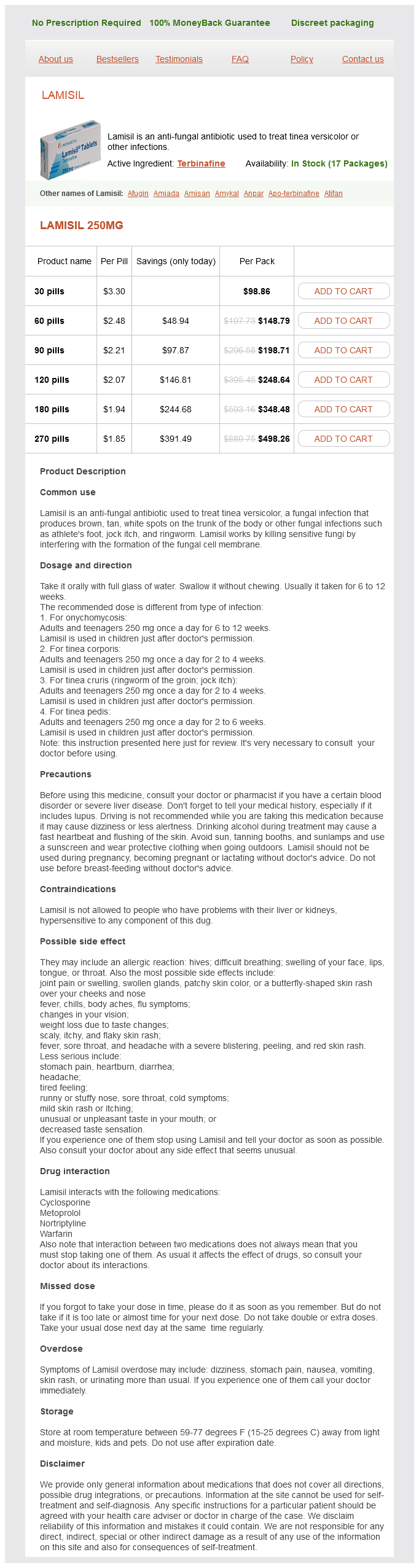
Lamisil
Lamisil 250mg
- 30 pills - $98.86
- 60 pills - $148.79
- 90 pills - $198.71
- 120 pills - $248.64
- 180 pills - $348.48
- 270 pills - $498.26
Lamisil dosages: 250 mg
Lamisil packs: 30 pills, 60 pills, 90 pills, 120 pills, 180 pills, 270 pills
In stock: 970
Only $1,96 per item
Description
Inducible Clindamycin Resistance in Staphylococci Two completely different resistance mechanisms confer macrolide sand for fungus gnats generic 250 mg lamisil with mastercard. The positive reaction is famous by a flattening of the zone across the clindamycin disk within the area by which there was diffusion of erythromycin and clindamycin molecules fungus rock lamisil 250 mg cheap on-line. The msrA gene codes for an efflux mechanism fungus jokes discount lamisil 250 mg free shipping, which outcomes in resistance to erythromycin but susceptibility to clindamycin antifungal fruits lamisil 250 mg generic without prescription. Consequently, when an erythromycinresistant and clindamycin-susceptible staphylococcal isolate is encountered, a D-zone check for inducible clindamycin resistance have to be performed earlier than clindamycin is reported to be prone. For the D-zone check, an erythromycin disk is placed adjoining to a clindamycin disk (15 to 26 mm, edge to edge) as a part of a standard disk diffusion check. No flattening indicates that the isolate is erythromycin-resistant only (because of msrA). When an isolate demonstrates inducible resistance, clindamycin is reported as resistant. Enterococci Ampicillin or penicillin is efficient in treating uncomplicated enterococcal infections. These cell wall lively brokers are only bacteriostatic towards enterococci, and when administered alone are insufficient for treating very serious infections, corresponding to endocarditis, that require bactericidal therapy. To acquire a bactericidal effect, ampicillin or penicillin (or vancomycin in the penicillin-allergic affected person or with E. Hence dilution exams have to be considered closely, and inhibition zones in disk diffusion testing have to be examined using transmitted (rather than reflected) mild; any growth within the zone must be thought-about significant. Low-level vancomycin resistance is intrinsic in the motile enterococcal species Enterococcus gallinarum and Enterococcus casseliflavus. Most isolates are susceptible to later-generation cephalosporins and aztreonam; nevertheless, spontaneous mutations happen that may result in novel -lactamases that may inactivate extended-spectrum cephalosporins, penicillins, and aztreonam. The enzymes are characterised and numbered based on their relationship to the mother or father enzymes. Some of these -lactamases give rise to subtle or troublesome to detect resistance among cephalosporins, penicillins, or aztreonam. Recently these enzymes have been found in different genera and species, together with Proteus mirabilis, Salmonella spp. The use of multiple antimicrobial agent will increase the sensitivity of detection. Enterococci are inherently resistant to low concentrations of aminoglycosides, precluding their use as single agents for remedy of enterococcal infections. This low-level resistance is caused by poor drug uptake by the enterococcal cells. For isolates with low-level aminoglycoside resistance, a synergistic interplay occurs when an aminoglycoside is administered along with a cell wall active agent corresponding to ampicillin, penicillin, or vancomycin. High-level aminoglycoside resistance in enterococci is often the results of enzymatic inactivation of the medication, and the enzymes that destroy gentamicin also destroy tobramycin, amikacin, and kanamycin (Table thirteen. Consequently, none of these brokers are utilized in treating critical infections brought on by enterococci with high-level gentamicin resistance. In vitro checks for the detection of high-level aminoglycoside resistance include broth, agar, or disk diffusion strategies. For screening, gentamicin is examined at concentrations of 500 �g/mL and streptomycin at 2000 �g/mL (agar) or a thousand �g/mL (broth). The exams are performed as described for routine dilution tests, and growth at the excessive concentration indicates that the isolate has high-level resistance to the agent examined. Disk diffusion checks have also been described that use special disks containing excessive amounts of gentamicin (120 �g) or streptomycin (300 �g). The incidence of vancomycin resistance in enterococci increased sharply in the Nineteen Nineties and the early part of the primary decade of this century. Isolates which are extremely immune to vancomycin can be readily detected as vancomycin resistant when tested by standard antimicrobial susceptibility test methods. Inactivation of the disk is analyzed by putting that carbapenem disk on a garden plate of a carbapenemsusceptible control pressure, leading to no zone of inhibition after overnight incubation. Because these organisms are resistant to carbapenems, infections usually are treated with colistin or polymyxin antimicrobials with blended outcomes. The standard disk diffusion test is carried out with cefotaxime and ceftazidime, with and without clavulanic acid. Automated Antimicrobial Susceptibility Test Methods Principles of Technologies Used the automated susceptibility testing devices which might be currently obtainable represent a alternative of a quantity of completely different ranges of automation. The devices that supply the very best stage of automation accomplish these tasks using robotics to move the panels or cards within the instrument through the incubation-reading sequences or to add reagents to certain test wells for biochemical checks. Current devices use certainly one of two optical approaches for analyzing the take a look at wells of the antimicrobial-containing panels or playing cards. Most present instruments use the precept of turbidimetric detection of bacterial growth in a broth medium using a photometer to study the check wells. The dedication of antimicrobial susceptibility primarily based on lack of development of turbidity (suppression of growth) or, conversely, a sign of resistance primarily based on a rise in turbidity within the presence of an antimicrobial agent, is the same precept as that used when deciphering growth end factors manually. The second means of development detection is the detection of hydrolysis of a fluorogenic progress substrate included in a special take a look at medium. With this expertise, growth is detected by a fluorometer as emission of a fluorescent signal when a microorganism consumes fluorophore-labeled substrate in the check medium during growth. Instruments for antimicrobial susceptibility testing could present help in the interpretation of test outcomes after a standard overnight incubation period or may allow outcomes to be determined in a shortened analysis period of 5 to 15 hours. All the instruments rely heavily on microprocessor-controlled capabilities and use private computer hardware to provide ultimate printed reports and to store and retrieve information on antimicrobial susceptibility. The subject of automated identification and susceptibility testing of microorganisms is continually evolving. A comparatively current predicted by in vitro checks performed utilizing commonplace inoculum density. These organisms carry resistance genes, typically carried on plasmids, to carbapenem antibiotics, and are important to detect for affected person therapy and infection control functions. Organisms possessing these enzymes are sometimes resistant to one or more of the carbapenems. There are molecular methods to detect carbapenemase genes, however these tests have limitations when it comes to required expertise, time, and sample number. Analysis pace, sensitivity, and selectivity are key attributes offered by this technique. Such a technique will enable better directed antimicrobial therapy in a timely manner. These methods are comparatively inexpensive compared with current automated strategies. Currently Available Automated Systems Reader Devices for Broth Microdilution Susceptibility Tests Every commercial producer of broth microdilution antimicrobial susceptibility testing panels offers a view box or mirror device to facilitate the guide studying of outcomes after incubation. Products that characteristic freeze-dried antimicrobial panels also supply a mechanized device to simplify hydration and inoculation of panels. A similar instrument, the MicroScan TouchScan, is available from Siemens Healthcare Diagnostics (Munich, Germany) and can be utilized with the MicroScan system. These instruments are configured with private computers for report printing and long-term knowledge storage. Automated Instrument Systems Currently, 4 instruments are available which might be capable of producing speedy (5 to 15 hours) or overnight (16 to 24 hours) susceptibility check outcomes. The check panels are inoculated manually by a simple, gravity-fed switch of inoculated medium all through the disposable cartridge after pouring inoculated broth through an opening in the test device. The Phoenix system uses a redox indicator system (similar to resazurin) to measure bacterial progress in the susceptibility take a look at wells. The type of check to be carried out is indicated on an instrument-readable bar code label positioned on the end of each panel. The instrument incubates the panels for the suitable period (depending on the type of panel and organism), robotically positions the trays to add reagents if needed, and moves them under the central photometer station to carry out the final readings of progress finish points at the conclusion of the tests. Standard dried panels are read turbidimetrically by the WalkAway after 16 to 18 hours of incubation with 24-hour holds for specific bacteria. The instrument presents the chance of early, read-when-ready interpretations of the usual panels in four. Organisms with inducible or slow to be expressed resistance are routinely extended to 16- or 18-hour incubation. This older rapid know-how, however, is being phased out in favor of the read-when-ready method. It suits onto the AutoReader and makes use of an inner bar code scanner to determine every plate sort and assign the suitable incubation time; when the assigned time has elapsed, the plate is then transported to the AutoReader for fluorescence measurement, with no manual intervention.
Beta 1,3 Glucans (Beta Glucans). Lamisil.
- Lowering cholesterol levels when taken by mouth.
- How does Beta Glucans work?
- Stimulating the immune system in people with AIDS or HIV infection, to increase survival in people with cancer, or to prevent infections in people who have had surgery or trauma when used by injection.
- What other names is Beta Glucans known by?
- Dosing considerations for Beta Glucans.
- Are there safety concerns?
- What is Beta Glucans?
- Are there any interactions with medications?
Source: http://www.rxlist.com/script/main/art.asp?articlekey=96996
This is especially helpful when the slide culture from a known isolate is stored in a set for future comparison against isolates awaiting identification fungus gnats chemical control 250 mg lamisil mastercard. In the hair perforation checks antifungal killer purchase 250 mg lamisil with mastercard, sterile 5- to 10-mm hair fragments are floated on sterile water supplemented with a few drops of sterile 10% yeast extract antifungal bath 250 mg lamisil discount mastercard. Conidia or hyphae from the dermatophyte in question are inoculated onto the water surface fungus gnats in worm bin 250 mg lamisil buy overnight delivery. Some laboratories have used this take a look at to distinguish penetration-capable Microsporum canis from M. Tubes of Christensen urea agar are very frivolously inoculated with the dermatophyte and held for 5 days at room temperature. Although several vitamin deficiencies are acknowledged in fungi, the check for thiamine requirement is perhaps the single most useful dietary check for dermatophytes. Tubes of media with and with out thiamine are inoculated with a tiny, medium-free portion of the colony and noticed for progress after 10 to 14 days. Great care have to be exercised to avoid transfer of culture medium with the inoculum as a outcome of even minuscule quantities of vitamin carried over can adequately provide the requirement and thereby result in a false development response. This is the typical response by Trichophyton mentagrophytes, whereas Trichophyton rubrum causes solely floor erosion of hair shaft. Seven completely different Trichophyton agars, numbered 1 through 7, are used to determine the dietary necessities of Trichophyton spp. Each of the media has completely different nutritional components; after inoculation and incubation, development is scored on a scale of 1 to four. After 10 days of incubation at room temperature, the medium is observed for progress. The germ tube test is probably crucial and easiest check to perform for the identification of yeasts. The normal procedure (see Appendix C) requires the use of serum or plasma, such as fetal bovine serum. Care should be taken to not incubate the test beyond 3 hours as a result of other species are able to forming germ tubes with extended incubation. This take a look at offers only a presumptive identification as a end result of not all strains of C. True germ tubes lack constriction at their bases, the place they connect to the mom cell. Such constricted germ tubes, referred to as pseudo� germ tubes, are extra attribute of C. Sugar fermentation exams, though priceless, are time- and labor-intensive, making them impractical to be used within the routine microbiology laboratory. Carbohydrate assimilation exams, however, could be readily carried out as part of routine identification protocols. Assimilation checks establish which carbohydrates a yeast can use aerobically as a sole carbon source. Assimilation patterns may be decided from such methods as an automated identification system or various handbook procedures and commercial kits. The individual laboratory ought to adopt the method that may be practically implemented into its specific working surroundings. Yeast Germ tube + + Growth at 42� C � Candida albicans Candida Cornmeal dubliensis Blastoconidia Pseudohyphae Blastoconidia True hyphae � Carbohydrate assimilations Blastoconidia Pseudohyphae True hyphae Arthroconidia Blastoconidia solely Cryptococcus sp. In this assay, a collection of freeze-dried sugars are placed into wells on a plastic strip. Yeast isolates are suspended in an agar basal medium, pipetted into the wells, and incubated at 30� C for seventy two hours. A code is derived from the assimilation patterns and matched towards a computerized database. Identifications are accompanied by a percentage, which signifies the chance that the identification is right. Although this take a look at is dependable, different auxiliary testing should accompany assimilation outcomes earlier than a final identification is made. Many of these systems use enzyme and assimilation reactions to aid in yeast identification. A number of media containing chromogenic substrates are available for the presumptive identification of yeasts. Identification is based on completely different colony colors, depending on the breakdown of chromogenic substrates by the completely different species. Yeast morphology on cornmeal agar is second in significance to sugar assimilation in figuring out identification of yeasts (see Appendix C). Recognition of four different varieties of morphology is a crucial clue to identification-blastoconidia, chlamydoconidia, pseudohyphae, and arthroconidia. Blastoconidia are the characteristic budding yeast varieties often seen on direct mounts of yeasts. The cross-walls assist decide whether or not the constructions are true hyphae or pseudohyphae. Cross-walls of pseudohyphae are constricted and never true septations, whereas true hyphae remain parallel at cross-walls, with no indentation. Arthroconidia start as true hyphae however break aside on the crosswalls with maturity. Yeast isolates producing the enzyme urease can be detected easily with Christensen urea agar. This assay is a chromogenic check primarily based on the activation of the horseshoe crab coagulation cascade by (1,3)-D-glucan and makes use of amebocyte enzymes from Limulus polyphemus. Clinical research have demonstrated the utility of this assay for the prognosis of invasive fungal infections. However, numerous substances, as properly as some bacteria, can lead to falsepositive results. The detection of galactomannan is now a part of the diagnostic criteria for possible invasive aspergillosis. This assay has glorious analytical sensitivity, with the power to detect one to three colony-forming models of Candida per milliliter of blood. One of the most important advantages is that the results are rapidly out there, usually within 4 hours in a single study, in contrast with over a hundred hours for conventional blood cultures. Several obtainable assays detect the glucuronoxylomannan element of the Cryptococcus antigen. It is a rapid point-of-care dipstick test that uses a monoclonal antibody towards the cryptococcal antigen. Skin testing for diagnosing fungal infection is efficacious provided that the patient has a history of a nonreactive skin check. Although few are commercially obtainable, assays to detect antibodies to fungi have also been used to assist diagnose infection. Doubleimmunodiffusion might be probably the most generally used method; nonetheless, interlaboratory discrepancies have been famous. One problem with serologic assays is the ever-present nature of lots of the opportunistic fungi. Antifungal Susceptibility Antifungal Agents In the last 25 years, fungal infections have steadily elevated in incidence. This enhance may be attributed to advances in medication which have prolonged life expectancy, particularly for those with chronic ailments. Physicians have far fewer choices for treating fungal infections compared with bacterial infections. Current options for treating fungal an infection include medication primarily from 4 classes-polyene, azole, echinocandin, and allylamine. The azoles are important as a outcome of they exhibit affordable activity against fungi whereas causing fewer side effects. It is extensively utilized by many practitioners to treat all forms of infections, together with vaginitis and thrush. Unfortunately, its overuse or misuse has resulted in the growth of resistance, most notably with C. Immunodiagnosis of Fungal Disease Skin check reactivity to fungal antigens is sometimes used in the analysis of fungal allergy symptoms and infections. This class targets cell wall synthesis, which makes it an attractive possibility for treating fungi that have developed resistance to other brokers. These compounds intervene with the synthesis of ergosterol, a principal sterol within the plasma membrane of many fungi.
Specifications/Details
As famous fungus acne lamisil 250 mg buy on-line, commercial microdilution susceptibility check merchandise have turn out to be the preferred in U antifungal hair spray buy lamisil 250 mg on-line. In addition antifungal nasal wash purchase 250 mg lamisil, the computerized data administration systems that accompany a few of the instruments may be helpful to some laboratories for the storage and calculation of cumulative antibiograms and different susceptibility statistics fungus pills lamisil 250 mg purchase amex. A laboratory could carry out automated antimicrobial susceptibility testing to generate take a look at results more rapidly than may be achieved by guide methods or to cut back the quantity of labor required for susceptibility exams. Provision of necessary laboratory results a day or even hours ahead of by conventional methods is a logical advancement in affected person care. Studies have documented a decrease in affected person morbidity or mortality, in addition to demonstrated substantial price financial savings. One of the earlier shortcomings of speedy susceptibility testing methods was some sacrifice within the capability to detect certain inducible or in any other case refined antimicrobial resistance mechanisms. In some cases, this has meant reformulating the check devices or improving the software program used to interpret the susceptibility testing results, which may be aided partly by the use of computer skilled methods that may detect widespread technical errors and explain some newer resistance mechanisms. The idea that automated susceptibility instruments can cut back labor necessities by way of higher efficiency has been solely partially realized. Some time financial savings could be achieved when using panels that enable antimicrobial susceptibility testing and organism identification on the same panel. In addition, a number of the newer instruments have mechanized or simplified panel inoculation and studying to achieve some labor savings. The magnitude of the labor financial savings realized in scientific chemistry or hematology by way of automation has but to be fully achieved in scientific microbiology. If a critical mechanical failure happens, solely checks from devices that use standard microdilution trays usually interpreted after in a single day incubation could be completed by manual incubation and interpretation. The designed probes goal transcripts that determine the organism uniquely on the species level and concurrently allow its transcriptional response to antibiotic exposure to be measured. Because massive numbers of transcripts could be investigated in a pool, organism id and drug susceptibility are determined in a single assay. Currently nucleic acid amplification testing methods can be found, such because the Verigene (Nanosphere; see Chapter 36), that may detect resistance genes, corresponding to mecA in S. The indicator in the agar leads to the resistant organism showing a characteristic color totally different from that proven by other organisms in the culture. These methods could probably reduce time to susceptibility reporting, significantly helpful in critical cultures, to a number of hours. There is little question that this area is altering continuously, and new methods will proceed to evolve. Routine susceptibility testing is done utilizing planktonic populations of cells, with individual cells uncovered to the antimicrobial. In the case of biofilms, a sessile population of bacteria is being tested for its susceptibility to the antimicrobial. Instead, the antimicrobial agent is exposed to what could presumably be described as a skin of microorganisms. This microbial skin, similar to the pores and skin of the human body, protects the entire cellular organism from opposed events. Thus, along with the mechanisms of resistance that particular person micro organism could need to antimicrobial brokers. The antimicrobial must now be able to penetrating the biofilm to come into contact with most micro organism within the biofilm. Subpopulations of the bacteria within the biofilm could also be uncovered to subinhibitory concentrations of the antibiotic due to differential diffusion, which permits inducible resistance to happen and will stimulate the production of exopolysaccharides. Exposure to higher concentrations of by-products of microbial development could inhibit the activity of the antimicrobial. Antimicrobial inhibitory factors from cells which were killed by the antimicrobial could also be released. Special Antimicrobial Susceptibility Tests Case in Point Viridans group streptococcus was isolated from all six blood tradition bottles submitted for a patient with suspected bacterial endocarditis. The physician considered this data along side medical observations of the patient and documentation within the literature of previous experiences with sufferers with related conditions. These checks assess the power of antimicrobial brokers to inhibit the growth of micro organism and are sufficient for guiding antimicrobial remedy in most conditions. In very select instances, a physician may want to determine how properly specific antimicrobial agents kill micro organism or how the activity of a combination of antimicrobial agents compares with that of a single agent. Molecular assays for mecA, the gene that codes for oxacillin resistance in staphylococci, are used in some clinical laboratories. Lack of association between different resistance genes and scientific resistance has limited the development of additional gene assays. Several special antimicrobial susceptibility tests are generally carried out solely in specialised laboratories and are utilized in only some defined scientific settings (Table thirteen. In immunosuppressed patients and sufferers with severe infections such as endocarditis, meningitis, and osteomyelitis, immune defense mechanisms are suboptimal. Inhibitory concentrations of the drug will not be adequate, and acquiring bactericidal concentrations of antimicrobial agents at the infection site is important for achieving a cure. For many kinds of infections, the bactericidal capacity of a selected antimicrobial regimen may be predicted based on earlier expertise. On the opposite hand, the bactericidal exercise of -lactams and different cell wall lively brokers. For the colony depend plate, immediately after inoculation, the expansion control tube was diluted 1: 1000, and 0. By definition, the concentration of drug within the respective tube can be considered bactericidal. In the previous, numerous methodological variations compromised the use of the test results. A small aliquot from the growth management tube or nicely is diluted in saline or broth to get hold of a countable number of colonies; the ultimate dilution is plated on an agar medium. After in a single day incubation, the number of colonies which have grown on the colony depend plate is noted. Sometimes extra colonies are growing on subcultures at larger drug concentrations than at decrease concentrations. This decreased bactericidal activity at larger concentrations is referred to as a paradoxical (Eagle) impact. Finally, tolerance to the intrinsic bactericidal impact of an antimicrobial agent is demonstrated when the numbers of colonies growing on subculture plates exceeds the 0. Tolerance has been associated with a defect in bacterial mobile autolytic enzymes. Briefly, take a look at bacteria in the midlogarithmic progress phase are inoculated into several tubes of broth containing numerous concentrations of antimicrobial agent and a progress control tube with out the drug. The number of bacteria remaining in each pattern is plotted over time to decide the speed of antimicrobial agent killing. Generally, a 3 log10 reduction or greater in bacterial counts within the antimicrobial suspensions compared with the growth management indicates an sufficient bactericidal response. Synergy Tests Some types of infections require therapy with a combination of two or extra antimicrobial brokers. Enterococcal endocarditis, for instance, requires use of a penicillin (or vancomycin) and an aminoglycoside for reliable killing of the organism. The targets of mixture remedy are to acquire broad-spectrum protection, enhance antibacterial exercise via synergistic interactions, and minimize resistance growth. In vitro synergy tests may be carried out utilizing a broth dilution checkerboard technique or time-kill assay. The checkerboard assay is a type of two-dimensional take a look at; all steps are performed as for single agents, however two brokers are tested in every properly or tube. A wide number of combos of concentrations are tested by dispensing drugs in a two-dimensional checkerboard format, and every drug tested in the mixture can also be examined by itself. Time-kill assays also can be used to research synergistic interactions by testing a combination of medicine in a single tube and every drug individually in extra tubes. A change of lower than a 10-fold improve or decrease in colony counts from the mixture tube in contrast with the most lively single-agent tube represents indifference. All three diagrams depict the outcomes of testing mixtures of two medicine (diluted in geometric twofold increments along the x and y axes, drug A alongside the x axis and drug B along the y axis). Shading indicates visible development, and concentrations are expressed as multiples of the minimal inhibitory focus. In Lorian V, editor: Antibiotics in laboratory medicine: making a distinction, ed 5, Philadelphia, 2005, Lippincott Williams & Wilkins.
Syndromes
- Right-to-left heart shunts, usually the result of congenital heart disease
- Seizures
- Stroke and other neurological disorders
- Complete blood count (CBC) to determine amount of blood loss
- The time it was swallowed
- Male hormone (androgen) levels
Related Products
Additional information:
Usage: q._h.
Tags: buy cheap lamisil 250 mg line, generic 250 mg lamisil fast delivery, 250 mg lamisil purchase with visa, lamisil 250 mg otc, discount lamisil 250 mg visa, generic lamisil 250 mg online, lamisil 250 mg generic fast delivery, 250 mg lamisil generic free shipping, discount lamisil 250 mg without a prescription, lamisil 250 mg discount without a prescription, lamisil 250 mg buy generic on-line, discount lamisil 250 mg with amex, lamisil 250 mg buy generic online, lamisil 250 mg buy generic on line, lamisil 250 mg quality, order lamisil 250 mg with amex
10 of 10
Votes: 64 votes
Total customer reviews: 64
Customer Reviews
Curtis, 26 years: Use of Proper Disinfectant Covering the work surface with a towel or absorbent pad soaked in a disinfectant reduces the accidental creation of infectious aerosols.
Ismael, 40 years: Rapid emergence of daptomycin resistance in medical isolates of Corynebacterium striatum: a cautionary story.
Lukar, 65 years: This tumor is a tumor of the left-sided visible system and its extensions including the splenium.
Charles, 30 years: An oxacillin disk (1 �g) can be utilized to display for penicillin susceptibility in S.
Miguel, 60 years: With this unfavorable stain, budding yeast cells surrounded by a large clear space in opposition to a black background are presumptive evidence of C.
Cronos, 36 years: The first order of enterprise is to remove any opercula of the junctional space that stimulate unfavorable.
Rune, 53 years: Testing for these components with X and V strips and the porphyrin take a look at are necessary features of laboratory identification procedures.