
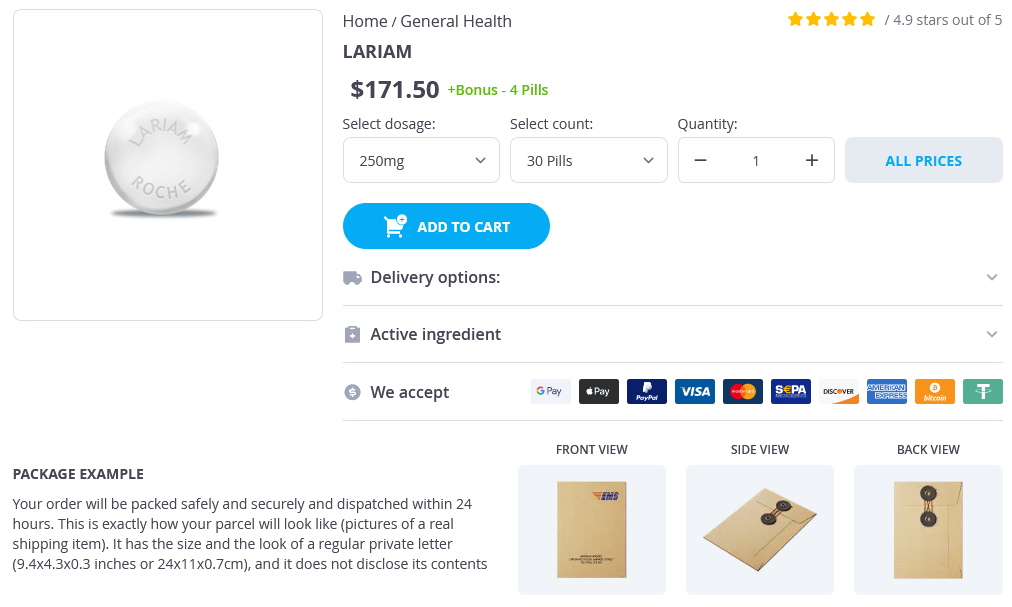
Lariam
- 250mg × 30 Pills - $190.56
Lariam dosages: 250 mg
Lariam packs: 30 pills
In stock: 953
Description
Symptoms help distinguish influenza from acute bronchitis or pneumonia (Table 10-8) symptoms thyroid cancer buy 250 mg lariam with visa. Comparison of features in influenza medications with aspirin lariam 250 mg buy, community-acquired pneumonia medicine kit order lariam 250 mg line, and acute bronchitis medications with pseudoephedrine buy discount lariam 250 mg online. Influenza mortality rates are 200 times larger in sufferers over age sixty five than in sufferers aged 0�49 years. Influenza pneumonia (1) Often develops inside 1 day of onset of influenza (2) Most frequent in sufferers with underlying cardiopulmonary disease, diabetes mellitus, immunodeficiency states, and being pregnant. Obtain a chest film in sufferers with influenza and shortness of breath to rule out pneumonia. Postinfluenza (secondary) bacterial pneumonia (1) Suspect when preliminary enchancment is followed by relapse with worsening cough, purulent sputum, and rising fever. The absence of fever and cough helps decrease the chance of flu in sufferers of all ages, however less so in patients aged 60 years or older. Fever and cough, significantly in older patients, will increase the probability of influenza. In addition, the rule requires a minimal of 2 instances of confirmed influenza within the community). Confirmation is often not required for affected outpatients however is really helpful for all hospitalized patients with suspected influenza. During influenza outbreaks, empiric remedy (see below) with out laboratory affirmation is suitable in sufferers with typical symptoms, clear lung fields, and no history of vaccination who present within 48 hours of symptom onset. Testing is most appropriate in noninfluenza durations and may be significantly useful in figuring out outbreaks to implement management measures. Institutionalized sufferers are at greater danger for respiratory syncytial virus, which can mimic influenza. A variety of vaccines are available, together with (1) Inactivated influenza vaccine, which can be trivalent or quadrivalent, (2) Recombinant influenza vaccine, trivalent (3) Live attenuated intranasal influenza vaccine, quadrivalent b. Inactivated influenza vaccine (1) Uses inactivated (killed) viruses that are currently prevalent. Live attenuated intranasal vaccine (1) Uses live-attenuated strains administered intranasally that replicate poorly within the warmer lower respiratory tract. Compared with placebo, reside attenuated intranasal vaccine increases nasal congestion (45% vs 27%) and sore throat (28% vs 17%). Oseltamivir and zanamivir are neuraminidase inhibitors energetic towards influenza viruses A and B and are usually extremely efficient as chemoprophylaxis. Indications for chemoprophylaxis (1) Persons at excessive risk (or those who are available contact with such persons) who have been vaccinated after exposure to influenza (continue therapy till 7 days after last exposure or 2 weeks after vaccination). Additionally, such sufferers ought to obtain chemoprophylaxis if there was a poor match between the vaccine and circulating virus pressure. When given within forty eight hours of symptom onset, they scale back the symptom severity and the length of symptoms roughly 1�2 days. A benefit may be current when started within ninety six hours of signs in hospitalized sufferers. Taking the drug with meals decreases nausea and vomiting, which occurs in 10% of patients. Drug resistance (1) A pressure of influenza A (H1N1) was found to be resistant to oseltamivir in the 2008�2009 season (99% of isolates). All hospitalized sufferers, sufferers with severe influenza (pneumonia), and patients at excessive threat for problems together with pregnant patients (see above Complications) b. Therapy must be began inside forty eight hours when possible but should still present a profit in severely sick sufferers when started inside 5 days of symptom onset. Consider for patients without threat elements for issues who current within forty eight hours of symptom onset and wish to shorten the length of illness. A variety of clinical conditions enhance the chance that sufferers are colonized with multidrug resistant bacteria. Risk components embody current or present hospitalization, mechanical ventilation, nursing house and assisted-living residence, hemodialysis, infusion remedy or immunosuppression. The analysis of pneumonia is often made clinically by the presence of a model new lung infiltrate and 2 of the following: fever > 38�C, leukocytosis or leukopenia, and purulent secretions. The American Thoracic Society Guidelines recommend obtaining a lower respiratory tract tradition in these sufferers. Antimicrobial spectrum should be broadened to cowl afore talked about micro organism taking into account local resistance patterns and out there culture knowledge B. Recent recipients of antibiotics should embrace antibiotics from a unique class C. Pertussis Textbook Presentation the typical adult with pertussis presents with "viral kind" higher respiratory infection signs of nonproductive cough, rhinorrhea, sore throat, and sneezing. However, as an alternative of resolving over 3�7 days the cough persists and is paroxysmal, usually extreme and sometimes even terminates in posttussive emesis. Typical symptoms embrace rhinitis, lacrimation, sore throat, coughing, and sneezing. Paroxysmal phase begins within the second week with suits of 5�10 or extra forceful coughs (paroxysms) in an otherwise nicely appearing affected person. Unusual complications from coughing in adults embody hernia, pneumothorax, rib fracture, and weight reduction. Among patients with cough of > 6�7 days the prevalence of pertussis is 3� 20% however the chance increases in grownup sufferers with acute cough > 3weeks 12�32%. Productive cough makes pertussis unlikely (occurs in 3% of sufferers with pertussis) Pertussis is unlikely in sufferers with productive coughs. Without postexposure prophylaxis (see below) the secondary attack price is > 80% amongst vulnerable individuals. Infected patients ought to avoid contact with younger kids and infants and working in healthcare facilities for a minimum of 5 days after beginning antibiotics. Postexposure prophylaxis beneficial for individuals in close contacts with pertussis regardless of the immunization standing. Updated Guidelines for Using Interferon Gamma Release Assays to Detect Mycobacterium tuberculosis Infection � United States, 2010. Tuberculosis: still missed as a explanation for community-acquired pneumonia�how to not miss it. Testing strategies within the preliminary management of patients with community-acquired pneumonia. Clinical indicators of radiographic findings in sufferers with suspected community-acquired pneumonia: who wants a chest x-ray Diagnostic accuracy of serum 1,3-D-glucan for Pneumocystis jiroveci pneumonia, invasive candidiasis, and invasive aspergillosis: systematic evaluation and meta-analysis. Rapid Diagnostic Testing for Influenza: Information for Health Care Professionals. Population-based incidence of pertussis among adolescents and adults, Minnesota, 1995�1996. B is a previously wholesome 70-year-old man who underwent proper higher lobectomy for localized squamous cell lung most cancers 5 days ago. A patient whose psychological standing change is acute could have both fluctuating or nonfluctuating symptoms. Whereas delirium is acute, normally reversible and almost always has an underlying, non-neurologic etiology, dementia is persistent and seldom reversible. A disturbance in consideration (ie, reduced capability to direct, focus, maintain, and shift attention) and consciousness (reduced orientation to the environment). The disturbance develops over a short period of time, represents a change from baseline attention and awareness, and tends to fluctuate in severity through the course of a day. An further disturbance in cognition (eg, memory deficit, disorientation, language, visuospatial capability, or perception). There is proof from the history, physical exam, or laboratory findings that the disturbance is a direct physiologic consequence of one other medical condition, substance intoxication or withdrawal, or exposure to a toxin, or is as a result of of a number of etiologies. Evidence of serious cognitive decline from a earlier level of performance in 1 or more cognitive domains (complex attention, government function, studying and reminiscence, language, perceptual-motor, or social cognition) based on: 1. Concern of the individual, a knowledgeable informant, or the clinician that there was a significant decline in cognitive function; and a pair of. A substantial impairment in cognitive efficiency, ideally documented by standardized neuropsychological testing or, in its absence, another quantified scientific assessment.
Palm oil carotene (Palm Oil). Lariam.
- Decreasing symptoms of malaria.
- Are there any interactions with medications?
- Are there safety concerns?
- What is Palm Oil?
- How does Palm Oil work?
- Vitamin A deficiency.
Source: http://www.rxlist.com/script/main/art.asp?articlekey=97083
A statistically important dose-related enhance within the incidence of kidney tumors (tubular cell adenomas and adenocarcinomas) was noticed in male rats within the high-dose group (160 mg/kg) treatment resistant schizophrenia lariam 250mg purchase with visa. A statistically significant increase within the incidence of lymphomas and leukemias and a statistically important lower within the incidence of adrenal cortical adenomas symptoms of pneumonia 250mg lariam order overnight delivery, adrenal pheochromocytomas symptoms synonym lariam 250mg buy online, and thyroid c-cell adenomas was noticed in male rats in the high-dose group in comparison with controls medications pictures cheap lariam 250mg without prescription. However, examine authors instructed that the incidence of renal tumors was the only endpoint that was biologically significant with respect to chloroform therapy (U. The mixed incidence of hepatocellular adenomas and carcinomas was 2% in the high-dose group compared with 6% within the management groups. Based on this reexamination, it was found that animals exposed to average doses of 81 or 160 mg/kg/day of chloroform displayed low-grade renal tubular injury with regeneration, primarily within the mid to deep cortex. The changes included faint basophilia, cytoplasmic vacuolation, and simple hyperplasia in proximal convoluted tubules. In some animals, single-cell necrosis, mitotic figures, and karyomegaly had been also noticed. Hyperplasia was visualized as an increased variety of nuclei crowded collectively in tubule cross-sections. These modifications have been observable in the one hundred sixty mg/kg/day dose group at 12, 18, and 24 months, and in the 81 mg/kg/day dose group at 18 and 24 months. The effect of the car on the hepatotoxicity of chloroform was evaluated utilizing male and female B6C3F1 mice. Doses of zero, 60, a hundred thirty, or 270 mg/kg/day in corn oil or in 2% emulphor had been administered by way of gavage for ninety days. Based on measurements of serum enzyme ranges, serum and tissue triglyceride levels, and histological examination of the livers, the authors concluded that hepatotoxic effects were enhanced by the administration of chloroform by way of corn oil versus chloroform administered in an aqueous suspension. The authors instructed that the trigger may be absorption kinetics or interplay between chloroform and the corn oil vehicle (U. Male and female Wistar rats have been administered chloroform in ingesting water at concentrations of zero or 2,900 mg/L for seventy two weeks. Concentrations of chloroform were then lowered to 1,450 mg/L for an additional 113 weeks until all animals had died (approximately 185 weeks). The common dose for males and females was approximately 200 or 150 mg/kg/day, respectively (U. Treated females (but not males) showed a statistically vital enhance in the incidence of hepatic neoplastic nodules, and each males and females had a statistically significant improve within the incidence of hepatic adenofibrosis. The potential carcinogenicity of chloroform was evaluated in mice following oral administration through oil or water. When administered in oil, 250 mg chloroform/kg/day produced 17 an increased incidence in tumors (tissue not specified), whereas there were no increases in the incidence of tumors noticed in mice handled with 15 mg/kg/day. No will increase in tumor incidence have been noticed in mice handled with as a lot as 42 mg/kg/day via consuming water (U. DeAngelo (1995) exposed male F-344 rats to chloroform in consuming water for a hundred weeks. Interim sacrifices of groups of 6 animals were performed at 26, 52, and 78 weeks, and the ultimate sacrifice at a hundred weeks included 50 animals per group. At each time level, liver and kidney had been examined for gross and microscopic lesions. In kidney, a extensive variety of continual nephropathies were observed in both management and exposed animals. The incidence of these nephropathies was not considered to be different than spontaneous background charges. Nasal toxicity of chloroform in male F-344 rats and female B6C3F1 mice following a 1-week inhalation publicity. Examination of the nasal passages 18 revealed that chloroform caused a posh set of responses within the ethmoid turbinates, predominantly in rats. These lesions have been most extreme peripherally and generally spared the tissue adjoining to the medial airways. The solely change noted within the mouse was elevated cell proliferation with out osseous hyperplasia. Animals were uncovered to concentrations of chloroform ranging from 2-300 ppm (10-1460 mg/m3) for 6 hours per day, both 5 or 7 days per week, for up to 13 weeks (90 days). All animals had been examined for histological lesions of liver, kidney, and nasal epithelium. Exposure to chloroform brought on histopathological lesions in liver, kidney, and nasal epithelium of each rats and mice. Lesions in liver have been characterized by scattered vacuolated hepatocytes and necrotic foci, generally with irritation, mainly within the centrilobular and midzonal areas. Renal lesions occurred primarily in the epithelial cells of the proximal convoluted tubules in the cortex. Changes included vacuolation, a basophilic appearance, tubule cell necrosis, and enlarged cell nuclei. Nasal lesions were characterized as atrophy of olfactory epithelium, mainly within the ethmoid portion of the nasal passage. However, atrophy of the nasal epithelium was observed in rats on the lowest publicity level examined (2 ppm). Histological adjustments were generally accompanied by statistically vital will increase in Labeling Index, although not at all times at exactly the same publicity stage. These will increase in Labeling Index are interpreted as evidence that the cytotoxic responses in these tissues triggers a regenerative hyperplasia. Increased cell proliferation was not found in both intercourse of rats exposed to chloroform for six weeks and held (without exposure) until week 13, suggesting that cell proliferation depends on the presence of chloroform and represents a regenerative response to cytotoxicity. Summary of chloroform-induced cytotoxicity and cell proliferation through inhalation Liver Kidney Nasal epithelium Exposure Histopath. Groups of male and female rats and mice have been uncovered to goal chloroform vapor concentrations of zero, 10, 30, or 90 ppm or zero, 5, 30, or ninety ppm, respectively, 6 hours/day, 5 days/week for 104 weeks. To avoid lethality in the high-dose groups, mice in the 30-ppm and 90-ppm groups were uncovered to chloroform concentrations of 5 and 10 ppm for two weeks each and then 30 ppm for 100 weeks or 5, 10, and 30 ppm for two weeks every after which ninety ppm for ninety eight weeks, respectively. The authors reported that both male and female rats and mice confirmed necrosis and metaplasia of the olfactory epithelium and goblet cell hyperplasia of the respiratory epithelium. Ossification was observed within the nasal turbinate and in the nasal septum of rats and mice, respectively, on the lowest publicity ranges. Statistically important increases in the incidence of overall renal cell adenoma and renal cell carcinoma were observed in male mice in the 30 (7/50) and ninety (12/48) ppm groups in comparison with controls (0/50). The general incidence rates of renal cell carcinoma have been statistically significantly elevated in males within the 90-ppm group (11/48) in comparison with controls (0/50). There were no statistically vital changes in tumor incidence for female mice or for male or female rats in any exposure group. These authors observed cytotoxicity and hyperplasia in the kidneys of male mice exposed to 30 or ninety ppm throughout a 90-day publicity period. These observations are according to the hypothesis that cytotoxicity and regenerative hyperplasia are key occasions in the neoplastic response to chloroform. A preliminary research was carried out to consider embryonic and fetal growth of Sprague-Dawley rats administered chloroform in corn oil at doses of 79, 126, 300, 316, or 516 mg chloroform/kg/day through oral gavage on days 6�15 of gestation. Significantly decreased food consumption and physique weights have been noted in dams administered 126 mg/kg/day or higher. Fetotoxicity, acute 21 toxic nephrosis, hepatitis, and maternal demise occurred in animals administered 316 mg chloroform/kg/day and better. In the principle examine, groups of pregnant rats (25/group) had been administered zero, 20, 50, or 126 mg chloroform/kg/day through intubation on days 6�15 of gestation. Caesarean part was performed 1 or 2 days prior to anticipated parturition and fetuses had been removed and examined. Maternal toxicity, together with decreased weight gain and mild fatty modifications within the liver, occurred in dams administered 50 or 126 mg chloroform. A statistically vital enhance within the frequency of bilateral further lumbar ribs and a statistically vital lower in fetal weight had been noticed in fetuses from the 126 mg/kg/day dose teams in comparison with controls. Pregnant Dutch-belted rabbits were administered 0, 25, sixty three, one hundred, 159, 251, or 398 mg chloroform/kg/day in corn oil on days 6�18 of gestation in a preliminary range-finding study. Results showed decreased maternal survival (60%�100%) in dams administered a hundred mg/kg/day or greater. Anorexia, weight reduction, diarrhea, abortion, and one maternal dying had been noticed in females administered 63 mg/kg/day.
Specifications/Details
There is also evidence that longer time under anesthesia may be related to a larger probability of improvement of postoperative cognitive dysfunction medications 8 rights order lariam 250mg with visa. Preexisting dementia medicine logo 250 mg lariam fast delivery, especially when gentle medicine 4h2 buy cheap lariam 250 mg on line, could also be overlooked before surgical procedure symptoms juvenile rheumatoid arthritis lariam 250mg buy, however appears to be associated with greater charges of cognitive decline after surgery. Whether common anesthesia causes postoperative cognitive dysfunction or simply unmasks a preexisting downside in unclear. Many hypotheses have been put forward to explain how basic anesthesia would possibly lead to postoperative cognitive dysfunction. Further research is required to ascertain the true incidence and severity of postoperative cognitive dysfunction and its association with anesthetic publicity if such an affiliation exists. The goals of anesthesia are patient consolation and security and the creation of optimum conditions for surgical procedures. Palliative care is gaining extra recognition, particularly within the industrially developed getting older societies. This care requires a multidisciplinary approach to treat signs, control pain, and tackle the psychologic, social, and spiritual needs of the patient and his or her family. By coaching, anesthesiologists are invaluable consultants on pharmacologic and procedural pain administration. Common challenges include these involving patient autonomy, surrogate determination making, and do-not-resuscitate standing in the hospital and in the operating room. The ultimate choice regarding which medical therapy is to be employed rests with the patient. Essential standards for knowledgeable consent embody provision of enough information, affected person competence, and voluntary decision making (Table 28-6). Patients with potential dementia must be referred for competency evaluations to assess psychological perform and decisionmaking capability. If the affected person is too compromised to give consent, a surrogate should be identified based on a dwelling will or a durable power of legal professional. Cause and prognosis of cardiac arrest and the success price of resuscitation are markedly different when the arrest occurs within the working room than when it happens outside it. However, knowledgeable consent for (or knowledgeable refusal of) medical intervention is guided by the identical ethical rules throughout endof-life care, no matter location. Just beneath the sternoclavicular joints, the cartilages of the first ribs are attached to the sternum. The junction between the manubrium and the physique of the sternum normally forms a prominent ridge, accentuated by the two components of the sternum forming a slight angle with one another, the sternal angle of Louis. Along the inferior and inside surface of the posterior a half of every rib, a groove-the sulcus costae-affords safety to the intercostal vessels and nerve. The first rib (see Plate 1-2) could be very short and relatively heavier than the other ribs. On the superior surface of the first rib, two grooves are divided by a tubercle-the tuberculum scaleni-that forms the point of insertion of the anterior scalene muscle. The groove in front of the muscle is occupied by the subclavian vein, whereas the subclavian artery follows the groove behind the tubercle. Each inside intercostal muscle arises from the lower border of the rib above and runs downward and outward to insert on the higher border of the rib beneath. The sternohyoid and sternothyroid (see Plate 1-1) are skinny, straplike muscles that come up from the superior border and posterior floor of the sternum and insert into the hyoid bone and the thyroid cartilage, respectively. Of the deeper neck muscle tissue, the three scalene muscular tissues originate from the transverse processes of the cervical vertebrae. The elements of the cervical nerve plexus emerge from the groove between the anterior and middle scalene muscles. In this house the common carotid artery, inner jugular vein, and vagus nerve are enclosed in a typical connective-tissue sheath; the jugular vein runs most superficially and the vagus nerve lies beneath, between the common carotid artery and inside jugular veins. On the left side the thoracic duct (see Plate 1-1) crosses over the subclavian artery and runs anteriorly to empty into the proximal subclavian vein. The internal thoracic arteries originate from the inferior surface of the subclavian arteries and run downward, lateral to , and (for a brief distance) with the phrenic nerve, reaching the posterior floor of the anterior chest wall. Along their course the internal thoracic arteries give rise to branches to the thymus, mediastinum, and pericardium posteriorly; to the perforating branches to the pores and skin and subcutaneous tissues anteriorly; and finally to the lateral branches that cross alongside the rib cartilages and anastomose with the posterior intercostal arteries. The 10 decrease intercostal veins on the best enter the azygos vein, and the upper two intercostal veins enter both the azygos or the brachiocephalic (innominate) vein. The lower intercostal veins on the left side enter the hemiazygos or accessory hemiazygos vein. The three left superior intercostal veins enter the left brachiocephalic vein by a typical stem, the left superior intercostal vein. Most of the thoracic cavity is occupied by the 2 lungs, each of which is enclosed by its pleura. That part of the mediastinal pleura that covers the pericardium known as the pericardial pleura; the rest (visceral pleura) covers the lung. The digital house between the visceral and parietal pleurae accommodates a tiny amount of clear fluid. The proper lung consists of three lobes-the superior, middle, and inferior lobes-and is somewhat larger than the left lung, which has two-the superior and inferior lobes (see Plate 1-1). The smaller dimension of the left lung outcomes from the eccentric position of the heart, which encroaches on the left pleural cavity. Originating from the convexity of the arch, from the proximal to the distal place, are the brachiocephalic, left frequent carotid, and subclavian arteries. The left vagus nerve runs between the subclavian vein and the aortic arch, giving rise to the left recurrent nerve (see Plate 1-5), which similarly loops across the arch to ascend along the trachea. Behind the trachea runs the usually collapsed esophagus (see Plate 1-4), joined by the vagus nerves simply past the branching off of the recurrent nerves from the vagi. Behind the esophagus, between the azygos vein and the descending aorta, the thoracic duct (see Plate 1-2) ascends, coursing behind the aortic arch to enter the neck, where it empties into the left subclavian vein. The posterior mediastinum is a shallow house containing the lower portions of the esophagus, vagus nerves, descending aorta, azygos and hemiazygos veins, thoracic duct, and sympathetic nerve chains. The remaining and largest part of the mediastinum, the middle mediastinum, contains the pericardium, heart, lung roots, and phrenic nerves. The pericardial cavity is the third serous cavity contained in the chest, with the 2 pleural cavities. The pericardial cavity is conical in form, with the bottom of the cone lying posteriorly to the right and the apex anteriorly to the left. As with the pleura, a visceral portion of the pericardium is distinguished overlying the center and proximal great vessels, often referred to as the epicardium, as is a parietal portion. Most of the lateral and anterior portions are contiguous however not normally adherent to the pleura. Posteriorly, a blind recess of the pericardial cavity is bordered by the pericardial reflection between the pulmonary veins and inferior vena cava, known as the oblique pericardial sinus. Small recesses exist between the superior and inferior pulmonary veins on both sides and behind the fold of the left vena cava (ligament of Marshall), a small crease of pericardium working from the left side of the pulmonary trunk to the left atrium, between the neck of the left auricle and the left pulmonary veins. The left vena cava fold contains the vestigial remains of the left frequent cardinal vein. In situ the center occupies an uneven position, with its apex pointing anteriorly, inferiorly, and about 60 degrees toward the left. Its 4 chambers are arranged in two functionally comparable pairs, separated from one another by the cardiac septum (see Plate 1-5). The anatomic nomenclature of the heart removes it from the body and places it on its apex, and thus the cardiac septum is in a sagittal airplane. This practice has led to misconceptions and difficulties in orientation among cardiologists and surgeons. On a chest radiograph, for instance, the left cardiac border is fashioned by the left ventricle, but the proper border is formed by the proper atrium, not the right ventricle, which lies anterior. The main and important a half of the left atrium lies immediately posterior and within the midline in front of the backbone and esophagus, allowing the pulmonary veins to be as short as possible. To the left of the proper ventricle, a small segment of the left ventricle is seen, separated from it by the anterior interventricular sulcus (groove). The anterior interventricular (descending) branch of the left coronary artery (see Plate 1-5) lies in this groove, once more embedded in fats. To the proper of the pulmonary trunk lies the intrapericardial portion of the ascending aorta, the bottom of which is largely covered by the proper auricle (right atrial appendage). As this groove descends alongside the posterior facet of the proper atrium, it becomes less distinct. The posterior wall of the left atrium types the anterior wall of the oblique pericardial sinus.
Syndromes
- Increased risk of infections
- Sodium
- Not being able to urinate
- Hypothyroidism - primary
- Yellowing of skin (jaundice)
- Other birth defects
- Bluish skin color (cyanosis)
- Abdominal CT
Related Products
Additional information:
Usage: q.h.
Tags: 250 mg lariam with mastercard, cheap lariam 250mg otc, lariam 250 mg generic with mastercard, discount 250mg lariam fast delivery, lariam 250 mg discount on line, 250 mg lariam generic, 250 mg lariam with visa, order lariam 250mg with visa, order 250 mg lariam, purchase lariam 250mg fast delivery, 250mg lariam purchase otc, lariam 250 mg generic otc, order lariam 250mg overnight delivery, buy cheap lariam 250 mg line, discount lariam 250mg free shipping, lariam 250 mg generic without prescription
8 of 10
Votes: 123 votes
Total customer reviews: 123
Customer Reviews
Armon, 63 years: Positive blood tradition ends in the face of what must be sufficient antibiotic remedy ought to increase the suspicion of either antibiotic-resistant isolates or metastatic sites, corresponding to endocarditis or arthritis. Her symptoms have developed and she or he is now not describing ill-defined lightheadedness but somewhat dysequilibrium.
Julio, 24 years: Both the period of symptoms and the recent gastroenteritis should increase the chance of lactose intolerance. Infection control practices ought to be instituted to restrict spread of the infection.
Jens, 42 years: Bronchogenic cysts are usually lined by respiratory epithelium and esophageal duplications by intestinal mucosa, but ectopic mucosa could also be present in each lesions. Better ache management may additionally be achieved with extra liberal doses of intravenous opioids in infants present process mechanical air flow.