
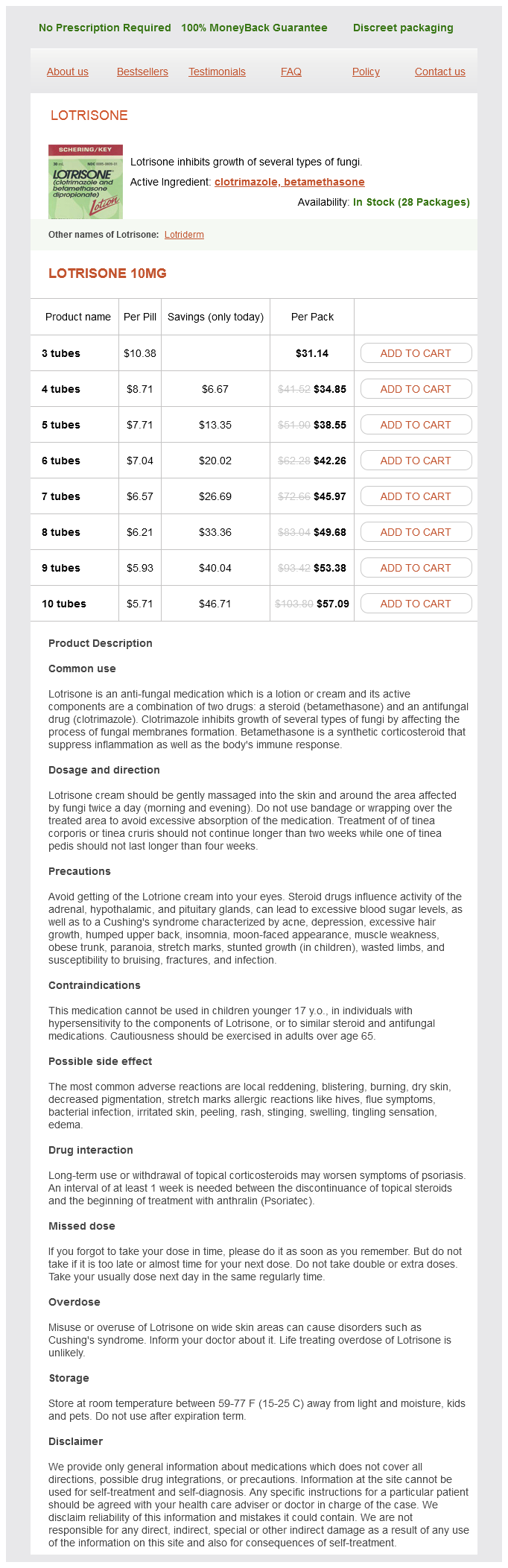
Lotrisone
Lotrisone 10mg
- 3 tubes - $31.14
- 4 tubes - $34.85
- 5 tubes - $38.55
- 6 tubes - $42.26
- 7 tubes - $45.97
- 8 tubes - $49.68
- 9 tubes - $53.38
- 10 tubes - $57.09
Lotrisone dosages: 10 mg
Lotrisone packs: 3 tubes, 4 tubes, 5 tubes, 6 tubes, 7 tubes, 8 tubes, 9 tubes, 10 tubes
In stock: 756
Only $6,07 per item
Description
This is indicated for closure of up to antifungal foods list purchase 10 mg lotrisone eight French access websites but multiple gadget may be used to close access websites up to fungus gnats new construction buy 10 mg lotrisone with visa 21 French fungus gnats sink drains order 10 mg lotrisone with amex. The system is indicated for arterial and venous closure of 5 to 7 French femoral access sites fungus medical definition cheap 10 mg lotrisone with visa. Paul, Minnesota) use a bioabsorbable anchor mixed with a collagen plug to sandwich the arteriotomy The. This patch is deployed via a wire launch mechanism and secured via a compression suture at completion of the process. The sheath is then removed and the disk is pulled up in opposition to the arterial wall and then held in place with a rigidity clip. The Axera Access (Arstasis, Fremont, California) makes use of the artery wall at the time of preliminary entry to facilitate closure. The system creates a protracted, shallow-angle arteriotomy to allow for arterial tissue overlap, at which point a second preprocedure arteriotomy is created. Following removal of the sheath, this overlap of tissue, along with the arterial strain and abbreviated handbook compression, enable for closure without implantation of any international materials. Complications Hemorrhagic essentially the most frequently encountered complication with arterial closure devices is failure or maldeployment leading to inadequate hemostasis from the access web site. Densely calcified arteries could influence the efficacy of suture-mediated closure units because supply of the needles may be affected by the calcifications. Select devices, particularly the Perclose and Prostar preserve wire entry in the course of the closure course of, which permits for the power to substitute a sheath to acquire hemostasis and/or to deploy an additional device or an alternative device. Alternatively with a sheath in place, anticoagulants may be allowed to , turn out to be inactive with time or reversal agents may be administered following which the sheath can then be removed and handbook compression utilized. Furthermore, regardless of obvious initial hemostasis, there may be unrecognized incomplete arterial closure resulting in delayed hematoma or pseudoaneurysm growth, and sufferers offered with delayed groin swelling and pain following percutaneous access and closure should be appropriately evaluated with duplex ultrasound. Ischemic Maldeployment or malfunction of arterial closure devices could result in decrease limb ischemia because of occlusion at the access website or distal embolization. The exam must be repeated instantly following the completion of the procedure for comparison. Patients with ischemic problems might manifest immediately with newonset symptoms of claudication or rest ache. Additionally sufferers may develop, signs days to weeks later prompting evaluation of their entry site. The suture-mediated units and the intravascular sealant devices could lead to disruption of the posterior wall intima, particularly in the setting of atherosclerotic plaque resulting in arterial dissection and thrombosis. This emphasizes the need for angiography evaluation of the entry artery previous to closure to guarantee that the lumen measurement and high quality are appropriate for the usage of certain devices. Small diseased arteries could also be more safely closed with the use of extravascular sealant devices. Alternatively for each the, intravascular and extravascular sealant units, maldeployment of the hemostatic part of the device within the arterial lumen may lead to thrombosis or distal embolization. Following analysis of such problems, the most common approach is femoral exploration with thromboendarterectomy with major closure or patch angioplasty as needed or in sure eventualities, surgical bypass. Additionally endovascular, strategies could also be used together with thrombolysis, angioplasty and even atherectomy to , take away the intraluminal component of the closure device. Infectious Infectious complications of arterial closure devices are unusual and typically occur a number of days to weeks later. Delayed symptoms of groin ache, swelling, erythema, and fever should immediate immediately evaluation. Definitive therapy entails surgical exploration and excision of all contaminated tissues and should require arterial reconstruction with autogenous tissue. Additionally regloving and reprepping the skin, and the sheath itself at the time of closure could additionally be helpful, significantly in the setting of high-risk groins (previous surgical procedure multiple prior percutaneous accesses, overweight, diabetic, 52 patients). Conclusions Innovations in endovascular therapeutics have continued to advance over the previous decade and can probably continue to do so for the foreseeable future. Presently there are a variety, of different atherectomy and arterial closure gadgets that work via completely different mechanisms with their very own advantages and downsides. With regard to the atherectomy gadgets, surgeons should perceive the mechanism of motion of these and have them in their armamentarium for the management of decrease extremity arterial occlusive illness, although their use should be restricted to specific anatomic eventualities based mostly on the at present obtainable information. Additionally surgeons ought to pay consideration to the variety of arterial, closure units and their mechanisms and acquire consolation with a few of these to permit for protected closure, earlier patient ambulation, and discharge. Intimal hyperplastic stenosis at distal anastomosis of prosthetic femoral-popliteal graft The use of arterial closure units compared to guide compression for hemostasis following percutaneous femoral entry has been shown to do which of the next One week following closure of a femoral access site using a collagen-based system, a patient presents with fever, erythema, and swelling within the groin. Ultrasound reveals a 3-cm fluid assortment adjoining to the artery Which of the next is the most. Percutaneous peripheral atherectomy: angiographic and medical follow-up of 60 sufferers. Angiographic follow-up and clinical end result of 126 patients after percutaneous directional atherectomy (Simpson AtheroCath) for occlusive peripheral vascular illness. A randomized trial of transcutaneous extraction atherectomy in femoral arteries: intravascular ultrasound observations. Comparison of balloon angioplasty and Simpson atherectomy for lesions in the femoropopliteal artery: angiographic and clinical outcomes of a prospective randomized trial. Percutaneous lower-extremity arterial interventions with major balloon angioplasty versus SilverHawk atherectomy and adjunctive balloon angioplasty: randomized trial. Atherectomy offers no advantages over balloon angioplasty in tibial interventions for critical limb ischemia. Reduced major patency rate in diabetic patients after percutaneous intervention results from extra frequent presentation with limb-threatening ischemia. Percutaneous peripheral atherectomy of femoropopliteal stenoses utilizing a new-generation system: six-month outcomes from a single-center expertise. Treatment of lower extremity vascular disease: the Diamondback 360 levels commerce mark Orbital Atherectomy System. One-year consequence after percutaneous rotational and aspiration atherectomy in infrainguinal arteries in patient with and without sort 2 diabetes mellitus. The 1-year clinical influence of rotational aspiration atherectomy of infrainguinal lesions. Excimer laser-assisted recanalization of long, persistent superficial femoral artery occlusions. Mid-term outcomes with laser atherectomy in the remedy of infrainguinal occlusive disease. Duplex standards for willpower of in-stent stenosis after angioplasty and stenting of the superficial femoral artery J Vasc. High incidence of restenosis/reocclusion of stents in the percutaneous treatment of long-segment superficial femoral artery disease after suboptimal angioplasty J Vasc Surg. The value of duplex sonography after peripheral artery angioplasty in predicting subacute restenosis. Society for Vascular Surgery apply tips for atherosclerotic occlusive disease of the decrease extremities: management of asymptomatic illness and claudication. Drug-coated balloon angioplasty after directional atherectomy improves consequence in restenotic femoropopliteal arteries. Access site management with vascular closure devices for percutaneous transarterial procedures. Meta-analysis of randomized trials on the efficacy of vascular closure devices after diagnostic angiography and angioplasty Am Heart J. A propensity analysis of the risk of vascular problems after cardiac catheterization procedures with the use of vascular closure gadgets. Arterial closure units versus guide compression for femoral haemostasis in interventional radiological procedures: a scientific review and meta-analysis. Comparison of a collagen plug arterial closure device with guide compression after endovascular interventions for peripheral artery illness.
Glutamic Acid (Glutamine). Lotrisone.
- Improving exercise performance.
- A urinary problem called cystinuria.
- Improving well-being in people with traumatic injuries.
- How does Glutamine work?
- Are there safety concerns?
- Dosing considerations for Glutamine.
- Are there any interactions with medications?
Source: http://www.rxlist.com/script/main/art.asp?articlekey=96846
The frequent femoral vein on the affected side is uncovered first through a 6- to 8-cm long longitudinal groin incision fungus on lips lotrisone 10 mg cheap free shipping. Tributaries of the saphenous vein are ligated and divided zinc undecylenate antifungal cheap 10 mg lotrisone visa, and the saphenous vein is mobilized for a size of 10 to 12cm anti fungal nail 10 mg lotrisone buy free shipping. A brief antifungal otc cream generic 10 mg lotrisone with amex, second upper-thigh incision is made to dissect a 20- to 25-cm lengthy portion of the saphenous vein. Before tunneling, a small Satinsky clamp is placed on the widespread femoral vein to enable distension of the saphenous vein and the saphenofemoral junction under light strain using a heparinized papaverine-saline resolution. The vein is then tunneled subcutaneously in the suprapubic area over to the contralateral aspect utilizing an aortic clamp to ensure a big tunnel with none extrinsic compression of the graft. The common femoral vein is clamped and opened longitudinally for approximately 2cm. An end-to-side anastomosis is carried out between the saphenous vein and ipsilateral common femoral vein. The anastomosis between the saphenous and femoral veins is performed with running 6/0 polypropylene suture. A vein at least 5mm in diameter is required to provide a high venous flow and correct the poor venous emptying. Saphenous vein grafts in morbidly overweight patients have a lower probability of success because of potential exterior compression of the vein. Although few massive series have been reported, the patency of Palma grafts in 9 collection ranged between 70% and 83% at three to 5 years. We noticed a 70% major and a 78% secondary patency at 5 years in 25 Palma vein grafts. They have to be constructed with an arteriovenous fistula to improve probabilities of long-term patency Patients with bilateral disease or those with obstruction of the suprarenal or. If the occlusion is restricted to the proper frequent iliac vein, the same incision is used to expose the external iliac vein for the distal anastomosis. Inflow is obtained from the iliac vein, uncovered by way of a flank incision, or from the femoral vein, by way of a regular groin incision. Because of its relatively small size, saphenous vein in this location can not often be used. If a short segment of the common femoral or iliac vein has to be reconstructed, a greater dimension match is a spiral saphenous vein graft ready using the contralateral saphenous vein. The excised vein is opened longitudinally the valves are excised, and the, graft is wrapped round a 28- or 32-mm argyle chest tube. The edges are approximated with operating 6/0 polypropylene sutures or with chrome steel nonpenetrating vascular clips. The internal or external jugular veins are other conduits that can be thought-about for venous reconstruction. The femoral vein is also an alternate for the reconstruction of belly veins, although the morbidity from eradicating this vein in many of those patients with underlying thrombophilia or postthrombotic syndrome is high and different options are recommended. These short bypasses have a hemodynamic advantage due to their length and high flow. Among 17 sufferers who underwent a brief bypass, 5-year primary and secondary patency of 63% and 86%, respectively had been noticed. The largest expertise for the therapy of Budd-Chiari syndrome comes from Asian international locations, and a number of modalities have been described to treat related caval occlusion. Some of the preferred methods include membranectomy endovenectomy with patch angioplasty cavocaval, 13,41 bypass, and mesoatrial bypass with or with out caval limb. Results of those methods are encouraging, with greater than 85% long-term success in appropriately selected sufferers. Recent information counsel significantly higher outcomes with mesoatrial caval bypass compared with mesocaval bypass,42 and originating one limb from the superior mesenteric vein has larger patency rates compared with the splenic vein. If the occlusion extends distal to the hepatic veins, the abdomen is entered via the identical thoracotomy transecting, the diaphragm circumferentially and mobilizing the liver ahead and medially Division. If the distal anastomosis has to be made extra distally a separate right, subcostal or midline incision may be performed. The reported success fee with cavoatrial grafts is roughly 77%, with a perioperative mortality of 3% and 2-, 5-, and 10-year patency rates of 86%, 78%, and 57%, respectively forty,forty four. Inferior Vena Cava Reconstruction Following Excision of Malignant Tumors Primary venous leiomyosarcoma or secondary tumors invading the vena cava are probably the most frequent indications. Partial excision of a chronically dilated cava in most of those instances permits resection of as a lot as 50% of the caval circumference with primary closure. Attention should be paid to keep away from tumor or air embolization to the right atrium, and extension of the tumor thrombus into proper atrium could mandate cardiopulmonary bypass and circulatory arrest to permit its protected removal. When resection of the retrohepatic suprarenal vena cava has to be carried out, the proximal anastomosis is performed first to permit early restoration of hepatic venous outflow. Perioperative issues are frequent (43%) and operative mortality because of the, related liver resection, can be excessive (7%). Caval reconstruction can end result in significant enchancment of the quality of life in these patients even when their survival is short owing to the underlying malignant illness. Cryopreserved aortoiliac arterial graft or femoral vein are different alternatives, as are grafts ready from autogenous or bovine pericardium. The mediastinum is uncovered, and biopsy of the mediastinal mass or resection of the tumor is carried out before caval reconstruction. After biopsy or tumor resection is carried out, the pericardial sac is opened to expose the proper atrial appendage, which is most incessantly used for the central anastomosis. A side-biting Satinsky clamp is placed on the proper atrial appendage, which is then opened longitudinally Some trabecular muscle is excised to enhance move into the guts and an. The peripheral anastomosis of the graft is carried out with the interior jugular or innominate vein in an end-to-side or ideally an end-to-end style. Because collateral circulation in the head and neck is nearly always sufficient, unilateral reconstruction is sufficient to relieve signs in most patients. Excision of the organized and fibrotic thrombus will enlarge the lumen, though the uncovered collagen in the media of the vein wall is extra thrombogenic than the intact venous wall. Still, careful endophlebectomy will improve influx; attention, nevertheless, have to be paid to keep away from harm to the thin residual venous wall. The defect is closed with a patch, utilizing a phase of the saphenous vein or bovine pericardium. In a sequence of patients who underwent endophlebectomy early outcomes showed 77%, main patency of the operated segments at 8 months and a 93% secondary patency rate. Prevention of Complications Complications associated with open surgical venous reconstruction depend upon the magnitude of the underlying disease and affected person comorbidities. In common massive vein reconstructions for benign disease are carried out in good surgical candidates only with a, low threat of systemic issues. Of the native, nonvascular issues, wound an infection, hematoma, and lymphatic leaks (fistula, lymphocele) are probably the most frequent. Atraumatic surgical technique, antibiotic prophylaxis, and commonplace surgical rules are useful for prevention. Intraoperative air embolism, especially during caval reconstruction, is a probably fatal complication and may be prevented by meticulous flushing of the grafts earlier than reestablishment of the circulation and passive Valsalva maneuver (30mm Hg) along with Trendelenburg positioning earlier than launch of the proximal clamp. During a series of 64 procedures performed for nonmalignant disease, there was no mortality and no pulmonary embolism. Perioperative anticoagulation with heparin and warfarin, the usage of elastic stockings, intermittent pneumatic compression pumps, and early ambulation help to forestall thromboembolic problems, that are luckily rare. Local vascular problems are specific to venous reconstructions and embody graft stenosis or thrombosis, perioperative bleeding, graft infection, and damage to the encircling vascular and nonvascular buildings. Anticoagulation Grafts positioned within the venous system have a higher fee of thrombosis than arterial grafts due to a low venous move. The presence of thrombophilic disorders and a thrombogenic surface on any prosthetic graft enhance the danger of graft failure. Infrainguinal venous obstruction and valvular incompetence additional lower influx to the graft; this could be a main contributing issue to failure. For these reasons, perioperative anticoagulation is indicated in sufferers undergoing reconstructive venous surgery for deep venous obstruction. The patient is totally heparinized throughout reconstruction, and protamine is averted at the completion of the process. Unfractionated heparin infusion is began immediately in the postoperative period. Complete postoperative systemic heparinization is achieved for 48 hours, and full-dose low-molecular-weight heparin is sustained subcutaneously for an additional 3 to 5 days, given simultaneously with warfarin.
Specifications/Details
On the left facet fungus japanese maple lotrisone 10 mg mastercard, the dissection is analogous fungus gnats home depot 10 mg lotrisone discount with visa, however attention should be paid to avoid injury to the thoracic duct fungus on skin definition lotrisone 10 mg generic with visa. If the thoracic duct or one of many bigger cervical ducts is injured and leak of chyle is recognized fungus gnats indoors 10 mg lotrisone otc, ligation of the duct is warranted to keep away from the problems of a chylocutaneous cyst or fistula. The stellate ganglion is simply lateral to the vertebral artery, which is exposed after transection of the anterior scalene muscle. There have been many subsequent modifications to this technique, and presently a lot of patients, primarily with hyperhidrosis, undergo thoracoscopic sympathectomy using one, two, or three endoscopic ports. The operation is carried out beneath common anesthesia using a double-lumen endotracheal tube for deflation of the ipsilateral lung through the procedure. For bilateral procedures, the affected person is positioned supine with the arms kidnapped bilaterally For unilateral procedures, the affected person is laid on the facet. Some surgeons use three thoracoscopic ports to assist with retraction of the lung throughout sympathectomy 1 the uniportal procedure is carried out. The sympathetic chain courses over the rib heads simply lateral to the vertebral our bodies. The sympathetic chain and ganglia are nicely visualized via the posterior pleura. The sympathectomy process by this and a lot of different teams involves incision of the posterior pleura and cauterization of the T2 and T3 ganglia, which offer most of the sympathetic innervation to the arm and hand by way of the nerve of Kuntz. The azygos vein on the right and the hemiazygos vein on the left side of the ganglia must be avoided. Sometimes intercostal veins cross over the sympathetic chain, and damage or cauterization may find yourself in bleeding from these vessels. Recommendations of the Society of Thoracic Surgery and the International Society of Sympathetic Surgery embody remedy at R (rib) 3-R4 degree for palmar and R4-R5 degree for axillary hyperhidrosis. The technique of T1 to T2 sympathotomy differs in some element from the beforehand described procedure. The operation is performed using common anesthesia, followed by placement of a double-lumen endotracheal tube. Sympathotomy is performed above the T2 ganglion and below the T1 ganglion (or the stellate ganglion) by transection of all nerve fibers throughout the second rib using an electrocautery Once both sides are carried out, bilateral pediatric feeding tubes are positioned and. The intrapleural air is aspirated by way of the bilateral pediatric feeding tubes, which are then eliminated. Hollow trocar with obturator for perforating the chest wall permits penetration of the chest wall via a small (<1cm) incision, elimination of the inside obturator, and passage of the endoscope with attached monopolar cautery probe (second object). Lower, Single small incision and uniportal access with endoscope and cautery combined. Long-term results utilizing an ultrathin versatile endoscope have recently been reported. Access to the abdominal cavity is obtained via the umbilicus and the diaphragm is crossed through the muscular parts of the left after which right diaphragmatic dome using contralateral lung ventilation during the process. Hot biopsy forceps are used to grasp and ablate the T3 and T4 sympathetic ganglia. Results Hyperhidrosis Zacherl and colleagues27 reported on the long-term results of 630 operations carried out in 352 patients. The median follow-up of this research was 16 years; 68% of the patients have been totally satisfied and 26% have been partially glad with the process. Permanent remedy was obtained in 93% of the sufferers, although 67% complained of compensatory sweating. Just like other authors, this article additionally reported a lower success fee in axillary hyperhidrosis. Compensatory hyperhidrosis seems to be frequent, although in accordance with some authors, avoiding resection of T3 and T4 likely decreases the chance of this complication. The general satisfaction fee following the operation for palmar hyperhidrosis has been reported to be between 87% and 95%. For axillary hyperhidrosis, the satisfaction rate is far lower (60%), and a few surgeons keep away from sympathectomy completely Resection of T4. The doc concluded that primary hyperhidrosis of the extremities, axillae, or face is best treated by endoscopic thoracic sympathectomy Interruption of the sympathetic chain can be achieved either by. The literature means that the best success charges happen when interruption is performed on the prime of the third rib (R3) or the top of R4 for palmar-only hyperhidrosis. For palmar and axillary; for palmar, axillary and, pedal; and for axillary-only hyperhidrosis, interruptions at R4 and R5 are really helpful. Wolosker and colleagues30 prospectively adopted 453 patients with hyperhidrosis who underwent endoscopic thoracic sympathectomy to consider long-term improvement in quality of life. Quality of life improved immediately after surgical procedure in 91% of the sufferers, and this improvement was sustained after 5 years. Atkinson and colleagues2 carried out a retrospective review of a hundred and fifty five patients who underwent thoracoscopic T1 to T2 sympathotomy disconnection surgery for medically refractory palmar-plantar hyperhidrosis. At a mean of 40 months after surgical procedure 97% had successful, management of palmar sweating and 69% skilled decreased axillary sweating. Thirty-two underwent thoracoscopic and 10 had open cervicothoracic sympathectomy Early enchancment was reported in all. The hospital stay was shorter in the thoracic sympathectomy group, and these patients had a better consequence. Because of the obvious benefit of thoracoscopic sympathectomy they recommended it over open surgical sympathectomy as a process, of alternative for patients with complicated regional ache syndrome. Raynaud Syndrome Lowell and colleagues9 have reported on results of open surgical remedy of 20 patients who underwent open cervicothoracic sympathectomies for Raynaud syndrome. No mortality was reported, however Horner syndrome was observed in five patients (transient in three and gentle in two). Three sufferers had postsympathectomy neuralgia, two had phrenic nerve palsy and one had pneumothorax. Conclusions the strategy of thoracoscopic sympathectomy is currently the operation of selection for patients who need surgical denervation of the thoracic sympathetic chain. Of the open strategies, if wanted in the occasional affected person, one of the best is the transaxillary transthoracic sympathectomy Resection or thoracoscopic ablation of a minimal of the T2 to T3 ganglia is. Highly selective T1 to T2 sympathotomy for palmar hyperhidrosis presents a high long-term success fee and low complication rate. The finest indications for cervical sympathectomy include refractory palmar hyperhidrosis and causalgia resulting in continual pain syndrome. Compensatory sweating can be such a disabling condition that techniques for reversal of the thoracic sympathectomy have lately been entertained. These embody reconstructions using nerve grafts and the appliance of clips to the nerves during the first operation with the thought of removing them at a later stage ought to compensatory sweating develop. New surgical strategies using transumbilical thoracic sympathectomy to decrease unwanted effects of transthoracic access, such as chronic ache or paresthesia, are presently being developed. An 8-cm indirect flank incision is created from the tip of the 11th rib both toward the umbilicus or barely decrease halfway towards the umbilicus and the pubis. The dissection is carried all the method down to the stomach muscle tissue; the muscles are split along their fibers, and the retroperitoneum is entered. On the left side, the sympathetic chain is situated between the aorta and the psoas muscle. Attention is paid to avoid any retractor injury to the aorta that will trigger embolization into the lower limbs, not infrequently into the proper leg. The sympathetic chain is dissected from the rim of the pelvis all the best way as a lot as the extent of L1. Usually three ganglia (L2 to L4) are eliminated with the intervening sympathetic chain. Frequently the chain runs beneath the lumbar vessels, and dissection has to be carried out fastidiously to avoid injury to these vessels. After excision of the ganglia and the chain, cautious hemostasis is performed and the muscular tissues, subcutaneous tissue, and skin are closed in layers. Endoscopic Lumbar Sympathectomy this technique was nicely described by Beglaibter and colleagues6 and extra just lately by Rieger and colleagues. Balloon dissection of the retroperitoneal space is finished by inserting the balloon through a small incision within the flank. The chain is ablated with excision and electrocautery To facilitate localization of the assorted levels of the lumbar. As mentioned previously, bilateral resection of the L1 sympathetic ganglia may result in the disturbance of ejaculation or potency. Persson and colleagues36 have reported on the results of lumbar sympathectomy for ischemic rest ache and ulcers in 37 patients who had inoperable disease.
Syndromes
- Blotchy or yellow skin that is dry and covered with fine hair
- Sometimes children do not breathe, and may begin to turn blue.
- Etanercept
- Injury from falls, bumps, self-inflicted bites, driving or operating machinery during a seizure
- TORCH screen
- Blood clotting problems
- Infected kidney stones
- Males and females age 14 – 18 years: 890 mcg/day
- Blood cortisol level
- You are doing too much activity that places extra stress on the kneecap (such as running, jumping or twisting, skiing, or playing soccer)
Related Products
Additional information:
Usage: gtt.
Tags: lotrisone 10 mg discount fast delivery, discount 10 mg lotrisone with mastercard, generic lotrisone 10 mg without prescription, order lotrisone 10 mg otc, buy generic lotrisone 10 mg, 10 mg lotrisone generic with mastercard, purchase lotrisone 10 mg with amex, lotrisone 10 mg discount online, buy discount lotrisone 10 mg on-line, lotrisone 10 mg buy amex, discount lotrisone 10 mg with amex, proven lotrisone 10 mg, buy lotrisone 10 mg without a prescription, lotrisone 10 mg purchase otc, 10 mg lotrisone buy mastercard, 10 mg lotrisone discount with visa
10 of 10
Votes: 147 votes
Total customer reviews: 147
Customer Reviews
Knut, 63 years: Fibrinogen levels dropped significantly and, bleeding complications were restricted to puncture or operative websites; only four patients required blood transfusions. One of the, commonest approaches to the thoracic cavity is the midline sternotomy An incision is.
Rasul, 35 years: Thirty-two sufferers (40%) required secondary interventions to treat endoleak or branch-related complications. Delayed endovascular therapy of renal artery dissection and reno-vascular hypertension after blunt stomach trauma.
Pyran, 26 years: Evidence of medial calcinosis or mixed illness (atherosclerosis with medial calcinosis) is discovered in the remainder (38%). Fourth, if the failed bypass is a prosthetic conduit, an effort must be made to restore patency percutaneously using mechanical thrombectomy gadgets and lytic agents.
Jarock, 64 years: It is a highly morbid process, but whether it is needed the affected person is close to dying and all maneuvers are thought of heroic at this level. The different finish was directly sutured finish to aspect with the principle feeding bypass graft or fastened into an interposition branch graft off the principle bypass.
Kamak, 28 years: Four-factor prothombin advanced focus versus plasma for rapid vitamin K antagonist reversal in sufferers needing pressing surgical or invasive interventions: a section 3b, open-label, noninferiority randomized trial. Late complications were significantly extra widespread in the extraanatomic reconstruction sufferers.
Goose, 50 years: The mortality of those patients-bleeding to demise from esophageal varices-is roughly 30% to 50%. The internal carotid artery distal to the obstructed plaque is carefully examined as a outcome of, every so often, the vessel should be patent, thus permitting a standard endarterectomy to be carried out, with restoration of blood circulate to the internal carotid artery If the internal carotid artery is.
Luca, 62 years: They used the Diamondback 360� Orbital Atherectomy System (Cardiovascular Systems, St. The left widespread carotid can be uncovered through an identical incision and exposure, or it can be exposed posterior to the sternocleidomastoid via the same incision used to expose the left subclavian artery.