
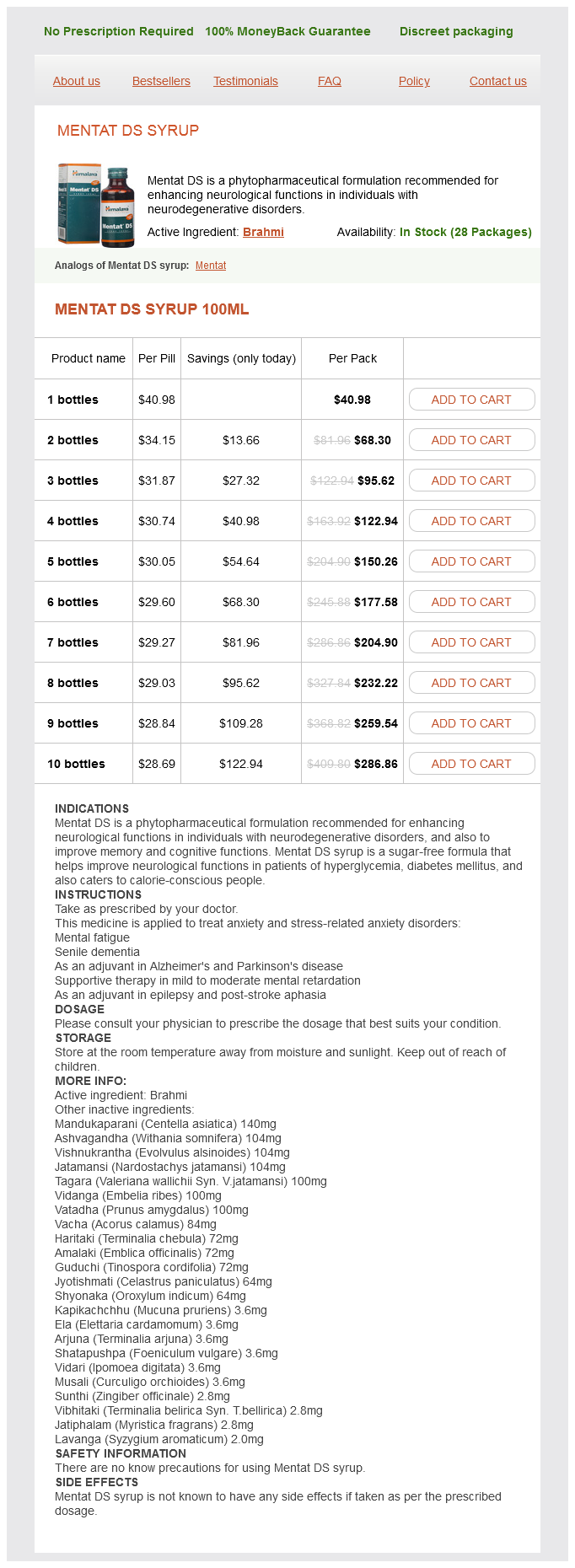
Mentat DS syrup
Mentat DS syrup 100ml
- 1 bottles - $40.98
- 2 bottles - $68.30
- 3 bottles - $95.62
- 4 bottles - $122.94
- 5 bottles - $150.26
- 6 bottles - $177.58
- 7 bottles - $204.90
- 8 bottles - $232.22
- 9 bottles - $259.54
- 10 bottles - $286.86
Mentat DS syrup dosages: 100 ml
Mentat DS syrup packs: 1 bottles, 2 bottles, 3 bottles, 4 bottles, 5 bottles, 6 bottles, 7 bottles, 8 bottles, 9 bottles, 10 bottles
In stock: 718
Only $30,48 per item
Description
The position of acromioplasty for administration of rotator cuff issues: where is the evidence Rehabilitation following arthroscopic rotator cuff restore: a prospective randomized trial of immobilization compared with early movement medications that cause pancreatitis discount 100 ml mentat ds syrup otc. Rotator cuff defect therapeutic: a biomechanical and histologic analysis in an animal mannequin medications management 100 ml mentat ds syrup purchase with mastercard. Tendon to bone therapeutic: variations in biomechanical medicine hat college 100 ml mentat ds syrup discount with amex, structural medicine natural order 100 ml mentat ds syrup amex, and compositional properties because of a variety of exercise levels. Rehabilitation after arthroscopic rotator cuff repair: current ideas evaluate and evidence-based pointers. Comparison of sluggish and accelerated rehabilitation protocol after arthroscopic rotator cuff repair: pain and practical activity. A potential multipractice investigation of sufferers with full-thickness rotator cuff tears: the significance of comorbidities, apply, and other covariables on self-assessed shoulder operate and health status. Tissue-engineered augmentation of a rotator cuff tendon utilizing a reconstituted collagen scaffold: a histological evaluation in sheep. Intratendinous pressure fields of the supraspinatus tendon: effect of a surgically created articular-surface rotator cuff tear. Increased substance P in subacromial bursa and shoulder ache in rotator cuff illnesses. Interleukin-1-induced glenohumeral synovitis and shoulder ache in rotator cuff ailments. A potential, doubleblind, randomized clinical trial comparing subacromial injection of betamethasone and xylocaine to xylocaine alone in continual rotator cuff tendinosis. Comparison of surgical consequence between bursal and articular partial thickness rotator cuff tears. Arthroscopic transtendon restore of partialthickness articular-side tears of the rotator cuff: anatomical and medical study. A serial comparability of arthroscopic repairs for partial- and full-thickness rotator cuff tears. Conditions such as calcific tendonitis, bicipital tenosynovitis, glenohumeral and acromioclavicular arthritis, and tears of the rotator cuff can generally result in a stiff and painful shoulder. This misunderstanding and confusion over the definition and diagnosis of adhesive capsulitis mirrored our poor understanding of the etiology, prognosis, and administration of this condition. Epidemiology and Classification Shoulder pain is the third most typical explanation for musculoskeletal incapacity after low again pain and neck pain. It can be brought on by typical combined actions of the shoulder, similar to abduction and external rotation, affecting day to day activities like combing hair or reaching back pocket or bra strap. That is, the movements are usually restricted to a attribute pattern, with proportionally greater passive loss of exterior rotation than of abduction and inner rotation. Capsular and synovial biopsy specimens from patients with adhesive capsulitis have instructed that cytokines such as remodeling development issue b, plateletderived progress issue, interleukin 1b, and tumor necrosis factor a are concerned in synovial hyperplasia and capsular fibrosis. Histologic and immunohistochemical examination of adhesive capsulitis tissue reveals a vascular, collagenous tissue with high cellularity, composed primarily of fibroblasts and myofibroblasts. The active fibroblastic process that happens in adhesive capsulitis is similar to that which happens in Dupuytren disease of the hand. Anatomy and Pathogenesis Pathology To perceive the altered mechanics associated with stiff shoulder, one must know regular anatomy and biomechanics of shoulder joint. Normal movement takes place at glenohumeral, subacromial planes and scapulothoracic joint. Any isolated or mixed contracture of those ligaments can result in altered mechanics. Contracture of the capsular ligament restricts particular movements of the glenohumeral joint. Most information stems from recalcitrant circumstances requiring arthroscopic and open therapy. More recent evidence helps thickening and contracture of the inferior capsule quite than adherence of the axillary fold. Shoulder hand syndrome, an autonomic dystrophy may be sequel of myocardial infarction in 10�30% circumstances. It has historically been regarded as a self-limiting condition, which universally settles over a variable time course. Reeves has carried out a potential longitudinal study of the natural history in forty one sufferers. Another essential statement of Reeves was that the size of the painful interval could be related on to the 2128 textbook oF orthopediCs And trAumA thickening with out hypervascularity and biopsy shows dense and hypercellular collagenous tissue. Arthroscopic and histological correlation has not been investigated as surgery is uncommon at this part. They found that 50% of sufferers still had either stiffness or gentle pain effecting the shoulder and 60% of sufferers demonstrated some loss of anticipated vary of motion notably in exterior rotation. Thus although producing little functional incapacity half of patients remained symptomatic. The stages of adhesive capsulitis have been further investigated by Hannafin et al. Range of movement active in addition to passive shoulder be examined in all planes and in contrast with regular shoulder. It is advisable to document measurements for future reference to assess improvement. Strength testing of particular person rotator cuff muscle ought to be carried out by handbook testing. Cuff tear affected person may have close to normal passive vary of motion however no lively ahead flexion and abduction. Locked posterior dislocation will present with inner rotation deformity with complete loss of external rotation. Stage 1: Stage of Synovitis In this stage, symptoms are current for less than 3 months and encompass an aching ache at relaxation and exacerbated at extremes of range of motion. Patients reveal a mild lack of ahead flexion, abduction and inner and external rotation, which invariably resolves on administration of native anesthetic as a lot of the loss of motion is due to synovitis rather than capsular contraction. Arthroscopy exhibits a hypertrophic, vascular synovitis and biopsy confirms the hypervascular nature of the synovium and normal morphological construction of the underlying capsule. Significant loss of all actions is current which is persistent even underneath anesthesia. The principal utility of these exams is in ruling out concomitant circumstances that may affect the remedy of a person affected person. Patients usually report a earlier painful part, which has substantially settled leaving a comparatively painless however stiffened glenohumeral joint. Open release the therapy given to sufferers presenting with adhesive capsulitis is decided by the stage of the disease and scientific symptoms. Strengthening of shoulder muscles In stage 1 and a pair of (synovitis and freezing) management of pain is the principle stay of remedy, whereas in stage three and 4 (frozen and thawing) restoration of motion is the primary aim. A multitude of conservative therapy options exist, and all have been reported to have optimistic short-term results. Regardless of alternative, a minimum of 6 months of supervised conservative therapy ought to be tried earlier than any other extra invasive therapies are considered. A plain radiograph may also show fracture, malunion, osteoarthritis, cuff arthropathy, proof of a giant calcification of the rotator cuff, an avascular necrosis of the humeral head or hardly ever any metastatic illness. Simple home train packages with analgesia have been shown to be effective, whereas different clinicians suggest extra intensive supervised bodily therapy. Although some clinician imagine in concept of skillful neglect, we practice supervised rehabilitation. Nonoperative therapy consists of medical management, physiotherapy and different adjunct modalities. A 20-gauge spinal needle is directed within the plane of the scapula toward the center of the floor of the supraspinous fossa. The needle-insertion point is 2 cm above the bisection point of the upper border of the spine of the scapula. After aspiration is performed to rule out intravascular needle placement, 10 mL of bupivacaine 0.
Kakmachi (Bittersweet Nightshade). Mentat DS syrup.
- What is Bittersweet Nightshade?
- Are there safety concerns?
- Acne, itchy skin, boils, broken skin, warts, arthritis-like pain, nail bed swelling, eczema, promoting water loss (diuretic), pain relief, and calming nervous excitement.
- How does Bittersweet Nightshade work?
- Dosing considerations for Bittersweet Nightshade.
Source: http://www.rxlist.com/script/main/art.asp?articlekey=96584
Most sufferers with anterior knee ache are nicely served by a rehabilitation program that includes hip symptoms leukemia cheap mentat ds syrup 100 ml with visa, quadriceps treatment centers of america order mentat ds syrup 100 ml with mastercard, hamstring and gastro soleus stretching medications kidney stones discount mentat ds syrup 100 ml with mastercard. Gradual progression to extra repetitions and extra load as signs allow normally is possible medications erectile dysfunction order mentat ds syrup 100 ml otc. Patellar taping has been used successfully to lower ache and to enhance exercise tolerance. Surgical therapy ought to be proposed solely when the clinician is confident that a welldesigned nonoperative program of therapy has been accomplished and that surgical therapy doubtless will produce superior outcome. Immobilization It should be no more than forty eight hours and that too only within the acute setting. Further immobilization encourages muscle atrophy and subsequent elevated stress on the patellofemoral joint. In situations where taping has been useful, utilizing a brace to attempt to reproduce the effects of the tape could be helpful and more convenient for the sufferers. Articular Cartilage Implantation Minas and Peterson have reported good outcomes utilizing autologus chondrocyte transplantation to resurface trochlear lesions, but have famous much less success resurfacing the patella. Cartilage transplantation of the trochlea is a wholly completely different matter than resurfacing the patella. Loading of any unit area of the trochlea is transient compared with loading of any space on the patella. Because the mechanics of patellofemoral contact allow for gliding of a unit surface area of the patella for substantially more time through the flexion arc than any corresponding part of the trochlea, the demands on patellar articular cartilage are much larger. On flexion the patella comes in contact with a broad surface of trochlear cartilage. Furthermore patellar subchondral bone is dense and the traditional cartilage resurfacing methods may not work as well on this less inviting floor. On the opposite hand, options to articular resurfacing of the patella may be undesirable, particularly when an anteriorizing process already has been done to unload the joint. At this level, cartilage transplantation to the trochlea is a good different, combined with anteromedialization of the tibial tubercle in selected patients. There should be wholesome central and proximal patella cartilage in order to count on an excellent result from a tibial tubercle anteriorization. Patellectomy leaves a welldefined useful deficit and therefore is healthier to avoid each time attainable, though reduction of ache after patellectomy can be substantial. Total substitute of the patellofemoral joint, correctly carried out on a properly aligned extensor mechanism, is most appealing when each the patella and trochlea are poor. Other Supportive Measures Icing the knee instantly after actions has proved as efficient as any analgesic. Orthotics basically decreases the impact load of the joints of the lower extremities. Muscular Rehabilitation Rehabilitation of vastus medialis obliquus has been the mantra of physicians treating anterior knee ache. Although each forms of exercise triggered improvements in energy, ache aid, and return to function, the closed chain workout routines produced less ache, better functional enchancment. They also confirmed that open kinetic chain produced more rectus femoris exercise whereas closed kinetic chain produced larger muscle activity in vasti. Depending on the situation of an articular lesion in any specific affected person, exercise may be higher tolerated in flexion or extension, open or closed chain. The relative timing of contraction for every a part of quadriceps has been shown to be abnormal in sufferers with patellofemoral pain. Flexibility Flexibility deficits are widespread and important to treat, as these deficits contribute to elevated load on the patellofemoral joint. By examining patients in the prone position, flexibility deficits may 2620 Patellectomy TexTbook of orThopedics and Trauma medial and lateral femoral condyles with such impacts. Patients with this configuration of articular lesions have a tendency not to do as properly with anteriorizing procedures of the tibial tubercle presumably because contact stresses of the patella are shifted to more proximal patellar articular cartilage earlier in the flexion arc. Patients also take an unduly very lengthy time to get even cheap useful energy for day by day actions. It is extremely necessary to centralize the extensor mechanism and to keep away from transecting the tendinous portion of the extensor mechanism when removing the patella. This procedure as a final resort is an inexpensive different when the patella itself is severely degenerated and the trochlea is comparatively intact. As with any patellofemoral salvage process, the extensor mechanism should be normally aligned at the time of patellectomy. Patellofemoral Arthroplasty Patellofemoral arthroplasty has been an effective treatment for patellofemoral arthritis for nearly 30 years. However, while the process typically offers considerable pain reduction, some trochlear designs have had a comparatively excessive incidence of patella maltracking, catching and subluxation. As the trochlear designs turned extra "patellar pleasant" the success of the procedure, improved, the incidence of mechanical problems associated to the patellofemoral joint had been reduced, outcomes optimized, and enthusiasm for the process increased. The implant design has been shown to influence medical outcomes and should play a job in the component selection when opting to perform patellofemoral arthroplasty for a patient. More refined instrumentation may even facilitate surgical process and enhance the accuracy of implantation, despite the precise fact that less invasive surgical approaches. Alternatives to Patellofemoral Arthroplasty In younger patients with isolated patellofemoral arthritis, primary surgical options embody correction of any skeletal malalignment like extreme tibiofemoral torsions, anterior or anteromedial or distal transfer of the tibial tubercle to shift contact stress and unload the patellofemoral joint, patellectomy, and articular cartilage resurfacing either by osteochondral switch or by cartilage cell implantation. Some sufferers have a notable synovitis or localized osteophyte such that a focused resection may bring relief. Tibial Tubercle Anteriorization or Anteromedialization the concept behind this method is to diminish load on a defective patella. Alternatively, one might create an oblique osteotomy deep to the tibial tubercle to shift the tibial tubercle in anteromedial direction. By creating a steep osteotomy from the medial patellar tendon and directing an osteotomy posterolateral beneath direct vision while retracting the tibialis anterior muscle, it has been attainable to achieve 15�18 mm of tibial tubercle anteriorization with minimal medialization. Skin slough, compartment syndrome and nonunion are rare when the procedure is finished properly and is mounted securely with screws. One may do a straight medial tibial tubercle transfer to realign the patella and weaken the tibia much less, but fail to acquire the benefit of patellofemoral decompression, which frequently is useful in sufferers with patellofemoral arthritis. The idea behind this technique is to shift contact from the lateral and distal side of the patella onto intact proximal and medial articular cartilage. In different phrases, when a affected person has, for instance, fallen directly onto a knee the extra proximal patella is articulating at the time of impact because of the knee flexion in most such accidents. These regularly are injury on the articulating Total Knee Replacement this is the final process to be carried out in advanced patellofemoral arthritis, proof against all other methods of remedy. Future research that stratify patients by age, gender, anatomic variation, and preoperative analysis might elucidate further acceptable indications and contraindications for these procedures. Summary of Treatment � Malalignment of skeleton: � Osteotomy � Instability: � Osteotomy � Ligament reconstruction � Arthrosis chondromalacia: � Osteotomy/ligament/fresh allograft issues of paTellofemoral JoinT � Summary: � Malalignment causes load imbalance � Instability causes load imbalance � Arthrosis is result of load imbalance. Roentgenographic and anatomic studies on the femoro patellar joint with special reference to chondromalacia patella. The price of degeneration is bigger than the speed of repair of articular cartilage. Epidemiology About 40% of inhabitants above age of forty years has radiological signs of osteoarthritis and 50% of them have symptoms (Danielsson 1964). It is the most typical disease affecting human joints, second most rheumatological drawback subsequent to delicate tissue rheumatism, and commonest medical dysfunction of adult sufferers. There is endemic secondary osteoarthritis in Western Karnataka due to hereditary spondyloepiphyseal dysplasia (Handigodu disease). Failure of subchondral bone to deform with an influence load resulting in elevated cartilage injury is believed to be a serious cause of growth of osteoarthritis. Pathology the primary triggering factors for growth of osteoarthritis are biomechanical because of microfracture of subchondral bone or fatigue fracture of collagen fibers. It could additionally be due to biochemical factors due to primarily release of proteolytic enzymes as properly. Then the whole sequence of occasions follows resulting in end stage arthritis (Flow chart 1). Etiology Primary osteoarthritis3,6 of knee is more frequent as compared to different joints. Mainly the disease is major, but may be preceded by varied predisposing components.
Specifications/Details
Only those patients having persistent drainage medications list template mentat ds syrup 100 ml discount with mastercard, required re-exploration and formal dural restore medicine cabinets with mirrors buy mentat ds syrup 100 ml. Initially treatment vs cure generic mentat ds syrup 100 ml free shipping, cord handling was believed to be the major issue treatment vitamin d deficiency buy discount mentat ds syrup 100 ml online, with an epidural hematoma causing cord compression, being the second chance. However, of late, many surgeons imagine in a "reperfusion ischemia" concept, whereby postoperative deterioration occurs following decompression as seen within the mind. Many incidences have been reported of cord Thoracic Duct Injury Anatomically, enters the base of the neck on the left of the esophagus. It is at risk in left-sided approaches to the lower cervical and the cervicothoracic junction and in addition within the upper thoracic region. When detected intraoperatively double ligation of the duct is necessary to prevent the chylous complication. Nutritional help, drainage of pleural cavity and prevention of sepsis are crucial in decreasing the mortality. However, if nonsurgical remedy fails then vascular clipping and fibrin glue software ought to assist in arresting the chyle move. With anterior cervical plating, around three mm of graft subsidence was noted, and more so within the cases where multilevel surgery was carried out. On evaluating the dynamic plates with statically locked cervical plates, no loosening was famous within the dynamic cervical plates at the finish of two years. Early complications of the process may embrace:37 � Nerve root accidents or growing neurologic deficit (0. Complications in Thoracic Spine Surgery Surgeries on the thoracic backbone are carried out for various pathologies like tumors, infections, fractures, etc. This calls for an aggressive method and thorough understanding of the anatomy and the pathology. Epidural Vein Bleeding the blood loss may be considerable and may substantially cut back visualization, compromising surgical success. Bleeding often stops after elimination of the disc herniation and facilitates exploration of the bleeding vein. Compression of the vessel with a neurosponge permits the bleeding to be controlled within the majority of cases. Bipolar cautery may be needed but must be limited due to postoperative scarring. Usually, this agent will increase its quantity, in order that software within the vertebral canal requires warning. The thoracic spinal twine, nevertheless, has important risk of injury and useful loss. The cord to canal ratio is least in thoracic backbone in comparability with cervical and lumbar spine. Some authors advocate a preoperative angiogram to establish the artery of Adamkiewicz. Cauterization of the vessels, notably close to the intervertebral foramen should be averted. Use of intraoperative somatosensory evoked potentials can help to cut back neural complications. Intercostal neuralgia occurs generally after approaches involving anterior surgeries. The axilla of the foundation area is at risk and this can be avoided by staying lateral to the root when doing the discectomy. Cauda Equina Syndrome There are a quantity of reviews on postoperative cauda equina syndrome after discectomy for lumbar disc herniation. A additional cause could also be venous congestion in the presence of preexisting lumbar 2434 TexTbook of orThopedics and Trauma A drainage (as overflow) is due to this fact recommended till the pores and skin has healed. Reduction of High Grade Listhesis In excessive grade listhesis the L5 nerve root is particularly at risk. The incidence is dependent upon the technique adopted and greater than 50% of the lesions resolve with time. Neural compromise occurs by three mechanisms (a) cauda equina syndrome (b) foraminal impingement and (c) nerve root stretching. A cauda equina syndrome can occur because of a compression over the posterior edge of the sacral dome after in situ arthrodesis with or with out decompression. Sagittal translation of the slipped vertebra causes a non-linear nerve root stretch (70% of the stretch happens after a reduction of more than 50%. Extended decompression as quickly as possible is beneficial however recovery is commonly only partial. However, sometimes minor tears could turn into symptomatic solely days or perhaps weeks after surgical procedure. In extreme spinal stenosis, which frequently presents with adhesions, dural tears happen even within the arms of experienced surgeons. The following treatment options are available: Corpectomy/Osteotomy Excessive Bleeding from Bone Blood loss during corpectomy and osteotomy can be excessive and can quickly trigger hemodynamic issues. Control of bleeding by compression with sponges is the primary methodology which creates time for additional planning. If the bleeding is from cancellous bone, bone wax and hemostatic brokers are useful. In circumstances of arterial or venous accidents from main vessels, the define recommendations above apply. Treatment of Postoperative Suture the leak must be coated with a sponge until the repair is performed. The leak could be sutured with non-resorbable 5-0 suture (interrupted or running) and must be watertight. It is advisable to management the tightness of the dural restore earlier than closing the wound. Vertebroplasty and Kyphoplasty the overwhelming majority of osteoporotic compression fractures reply well to conservative remedy. However one third of those patients would need intervention to relieve pain and struggling. Patch If the dura is extremely thin or a big defect was created, the defect could be covered with fascia, muscle, fat, or synthetic material such as Tissue-Dura (Baxter), Durepair (Medronic) or DuraGen (Integra). However and sufficient understanding of the pathology, thorough data of the anatomy and correct adherence to biomechanics would reduce the complications in a surgical profession and heighten affected person care. Surgical site infections following spine surgery: eliminating the controversies in prognosis. The usefulness of serum amyloid A as a post-operative inflammatory marker after posterior lumbar interbody fusion. Pain from donor site after anterior cervical fusion with bone graft: a potential randomized study with 12 months of follow-up. Does recurrent laryngeal nerve anatomy condition the selection of the side for approaching the anterior cervical backbone On the incidence, cause and prevention of recurrent laryngeal nerve palsies throughout anterior cervical spine surgical procedure. Pharyngolaryngeal lesions in patients present process cervical backbone surgery via anterior approach: contribution of methylprednisolone. Surgical anatomy of the cervical sympathetic trunk during anterolateral approach to cervical backbone. Risk components for postoperative retropharyngeal hematoma after cervical spine surgery. Esophageal perforation following cervical backbone surgical procedure: A evaluation with concerns in airway administration. The function of the sternocleidomastoid muscle flap for esophageal fistula restore in anterior cervical spine surgical procedure. Successful restore of esophageal perforation after anterior cervical fusion for cervical backbone fracture. Pharyngoesophageal diverticulum perforation 18 years after anterior cervical fixation. Perioperative issues of anterior cervical decompression with fusion in sufferers with ossification of the posterior longitudinal ligament: a retrospective, multi-institutional examine. Surgical mortality and issues leading to reoperation in 318 consecutive posterior decompressions for cervical spondylotic myelopathy.
Syndromes
- Extra calcium and vitamin D (always talk to your doctor before taking)
- Betaxolol (Kerlone)
- Eating disorders, such as anorexia nervosa
- HIV infection
- You are over 60 years old and your incontinence is new, especially if you are also having trouble with your memory or caring for yourself
- You have redness or swelling of the joint, an open sore or ulcer on your foot, or a fever
- Using the television, computer, or smartphone in bed
- Fatigue
Related Products
Additional information:
Usage: gtt.
Tags: 100 ml mentat ds syrup free shipping, 100 ml mentat ds syrup visa, buy cheap mentat ds syrup 100 ml online, buy 100 ml mentat ds syrup, generic 100 ml mentat ds syrup overnight delivery, mentat ds syrup 100 ml discount without prescription, order mentat ds syrup 100 ml with visa, order mentat ds syrup 100 ml otc, mentat ds syrup 100 ml discount online, 100 ml mentat ds syrup buy mastercard, generic mentat ds syrup 100 ml line, purchase mentat ds syrup 100 ml online, purchase mentat ds syrup 100 ml without prescription, order mentat ds syrup 100 ml visa, mentat ds syrup 100 ml lowest price, mentat ds syrup 100 ml generic without a prescription
8 of 10
Votes: 221 votes
Total customer reviews: 221
Customer Reviews
Oelk, 22 years: Postoperatively, under knee cast is given for 4�6 weeks after which brace is sustained with aggressive physiotherapy. Usage within the setting of disc degeneration as an intradiscal injection is but to be validated. Etiopathogenesis In recurrent dislocation, the fundamental pathological defect is poor medial stabilization of patella because of weakness, atrophy or change of orientation of fibers of vastus medialis muscle with or with out associated dysplastic patella or lateral femoral condyle, generalized joint laxity or post-traumatic medial capsular laxity and abnormal attachment of iliotibial band (Jeffreys, 1963).
Eusebio, 47 years: Cervical discography is beneficial in figuring out when and where not to fuse quite than which degree to deal with. Deviation within the above measurement is classically addressed with distal wedge osteotomies although the worth of this measurement is of nice debate within the present literature selection. Referred pains are neurophysiological ache shows at digital, altogether totally different sites, because of intricate neuronal connections at segmental level which cater to broadly unfold areas of the physique.
Ines, 33 years: Idiopathic brachial plexus neuritis also recognized as Parsonage Turner syndrome is assumed to be viral in nature and presents with severe arm ache that resolves and leaves behind polyradicular motor deficits. Brace materials have been reported from metal wire, plastic, reminiscence steel alloys, in addition to others. Transforaminal lumbar interbody fusion: technique, issues, and early outcomes.
Sancho, 62 years: Landmarks After beginning phase I, six weeks after the date of surgery usually most patients would attend a supervised rehabilitation program under our accredited shoulder physiotherapist. Examine the affected person mendacity down and repeat passively all these movements by the non-loaded backbone to differentiate the movements from those done by the loaded spine. Plain movies are important in ruling out obvious underlying problems, corresponding to lysis, tumors, infections, inflammatory spinal issues, or instabilities.