
Nitroglycerin
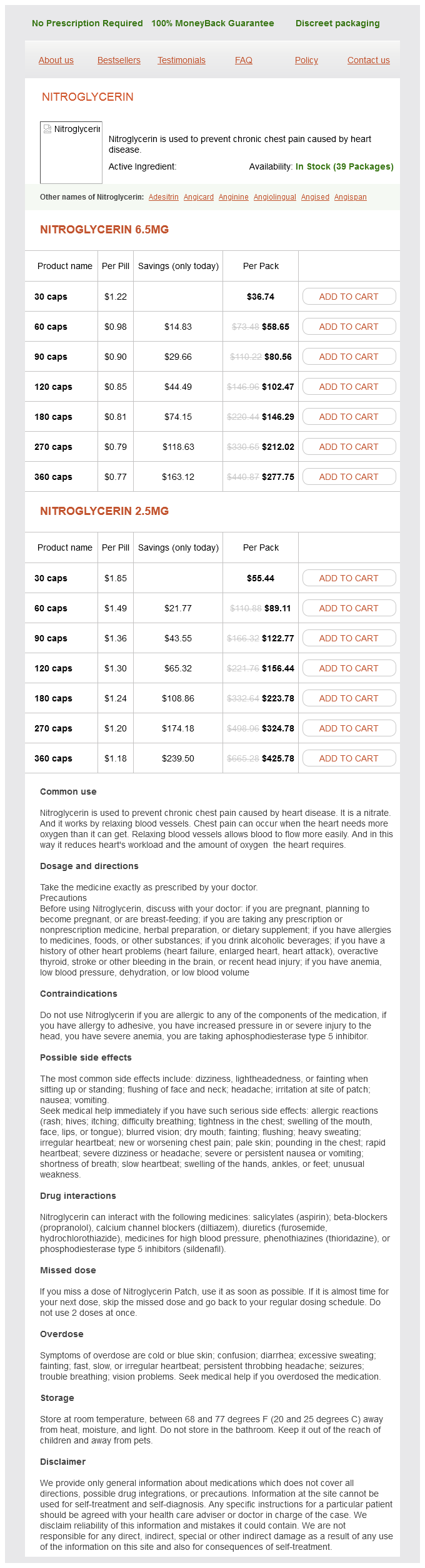
Nitroglycerin 6.5mg
- 30 caps - $36.74
- 60 caps - $58.65
- 90 caps - $80.56
- 120 caps - $102.47
- 180 caps - $146.29
- 270 caps - $212.02
- 360 caps - $277.75
Nitroglycerin 2.5mg
- 30 caps - $55.44
- 60 caps - $89.11
- 90 caps - $122.77
- 120 caps - $156.44
- 180 caps - $223.78
- 270 caps - $324.78
- 360 caps - $425.78
Nitroglycerin dosages: 6.5 mg, 2.5 mg
Nitroglycerin packs: 30 caps, 60 caps, 90 caps, 120 caps, 180 caps, 270 caps, 360 caps
In stock: 994
Only $0,77 per item
Description
Some repigmentation was noted symptoms and diagnosis nitroglycerin 2.5 mg visa, and remedy with excimer laser was described as "weakly effective symptoms checklist nitroglycerin 2.5 mg purchase line. Thirteen of 15 patients skilled improvement of their striae that remained after 1 to 2 years schedule 8 medications victoria generic nitroglycerin 6.5 mg without prescription. Treatment of striae distensae with a TriPollar radiofrequency gadget: a pilot examine Manuskiatti W medicine buddha purchase nitroglycerin 2.5 mg otc, Boonthaweeyuwat E, Varothai S. In the microdermabrasion group, striae rubra showed more scientific enchancment than alba. A superficial texture evaluation of 70% glycolic acid topical remedy and striae distensae Mazzarello V, Farace F, Ena P, Fenu G, Mulas P, Piu L, et al. Double-blind, placebo-controlled trial on 40 patients with each striae rubra and striae alba handled with 70% glycolic acid lotion in a bilateral comparability study. Skin texture parameters analyzed were anisotropy, variety of pores and skin furrows, and furrow width, using the silicone duplicate approach, the place silicone casts had been analyzed by scanning electron microscopy and imaging software program. Ten sufferers with skin varieties I to V and stomach and thigh striae associated with childbirth applied glycolic acid in the morning and both tretinoin or L-ascorbic acid in the night for a complete of 12 weeks. It is reported that striae, including atrophic hypopigmented striae, can be improved with this remedy. Historical details that would assist uncover exacerbating factors or that might affect therapeutic choice ought to be obtained. The targets of administration are to deal with present lesions and signs and to forestall lesion formation. This is done by way of a mix of affected person training, sun safety, and topical and systemic therapies. The most common therapies utilized embrace photoprotection, topical corticosteroids, calcineurin inhibitors, and oral antimalarials. Although systemic corticosteroids could be effective, steroid-sparing systemic brokers. In addition to elevated disease management, cosmetic agents used to camouflage lesions or dyspigmentation are necessary adjuncts. However, they accomplish that by fulfilling the factors involving pores and skin lesions, photosensitivity, and positive serologies. There are controversial information concerning whether or not tobacco affects the effectiveness of antimalarial brokers. However, a number of studies have reported that cigarette people who smoke have more extreme disease and that a subset of those sufferers is extra refractory to therapies. The use of topical calcineurin inhibitors in lupus erythematosus: an overview Wollina U, Hansel G. Low blood concentrations of hydroxychloroquine in patients with refractory cutaneous lupus erythematosus: a French multicenter potential study Franc�s C, Cosnes A, Duhaut P, Zahr N, Soutou B, Ingen-Housz-Oro S, et al. The former might enhance the likelihood of eye toxicity if remedy at higher doses is extended. The authors use the same algorithmic scientific strategy to antimalarial remedy as outlined in this study. Methotrexate remedy for refractory subacute cutaneous lupus erythematosus Kuhn A, Specker C, Ruzicka T, Lehmann P. Efficacy and security of methotrexate in recalcitrant cutaneous lupus erythematosus: outcomes of a retrospective study in forty three sufferers Wenzel J, Br�hler S, Bauer R, Bieber T, T�ting T. Three of six patients had near clearing inside 3 months, considered one of which had palmoplantar ulceration that healed after 6 weeks. A retrospective evaluation of 34 patients and a evaluation of the literature Klebes M, Wutte N, Aberer E. The median dose of dapsone was one hundred mg/day (50�125 2666 mg/day) for a imply duration of sixteen months (ranging 1�82 months). Forty-one percent of patients improved after 2 months, with 18% exhibiting full remission within 7 months. Initial improvement was famous after 2 weeks and maximum profit within 3 months, full remission in 75%, and partial in 25%. Thalidomide within the treatment of refractory cutaneous lupus erythematosus: prognostic elements of medical end result Cortes-Hernandez J, Torres-Salido M, Castro-Marrero J, VilardellTarres M, Ordi-Ros J. Once complete scientific improvement was achieved, dose reduction to 50 mg day by day then 50 mg alternating days occurred. Ninety-eight p.c achieved response, with 85% attaining complete response, typically inside a mean of 8 weeks (range 3�16). By the tip of the eight years, 70% who had attained complete remission had no less than one relapse, whereas the remaining (30%) remained in remission regardless of medicine withdrawal after a minimum of eight years of follow-up. Neurologic signs occurred in 18% of sufferers (reported as excessive as 45% in retrospective studies) with nerve conduction studies being optimistic in half of the instances. Numerous retrospective research, and the previously talked about potential study, present on common 80% of sufferers achieving complete response. Studies have proven that beginning with a low dose is as effective as larger doses, however unfortunately has not been proven to cut back the incidence of neurotoxicity. Thalidomide works properly as a rescue treatment or for maintenance at low or intermittent dosing. Patients had been refractory to a minimal of one antimalarial and one immunosuppressive agent. Lenalidomide is a thalidomide by-product with a better side impact profile than thalidomide. Treatment of cutaneous lupus erythematosus with acitretin and hydroxychloroquine Ruzicka T, Sommerburg C, Goerz G, Kind P, Mensing H. Three remedy cycles (3 months) had been enough to achieve medical response, however three sufferers had delicate relapses. There have been a handful of prospective research with optimistic outcomes; nonetheless, De Pita et al. Wali, and Vanessa Venning Subcorneal pustular dermatosis is a rare, chronic, neutrophilic dermatosis of unknown etiology, by which flaccid pustules and vesicopustules, classically resembling a hypopyon, arise in crops on truncal and flexural skin. It usually follows a relapsing and remitting course, but generally the affected person remains systemically well. The condition could also be tough to differentiate from other 2674 vesiculopustular dermatoses. Some circumstances may be a variant of pustular psoriasis, whereas others appear to overlap with the subcorneal pustular variant of IgA pemphigus. In "classical" subcorneal pustular dermatosis, immunofluorescence studies are adverse; nevertheless, there are sufferers with similar clinical and histologic features which have intercellular IgA deposition in the higher epidermis focusing on desmosal components, most commonly desmocollins. Subcorneal pustular dermatosis is associated with monoclonal IgA paraproteinemia and myeloma, which may happen a few years after presentation. Other reported associations are pyoderma gangrenosum, inflammatory bowel disease, rheumatoid arthritis, infections (in particular Mycoplasma pneumoniae), and drugs. Management Strategy Dapsone is the therapy of selection (25�200 mg daily) and normally leads to resolution of the rash inside 4 weeks; the drug normally must be continued long run as a outcome of relapse is common on withdrawal of remedy. After management is gained, the dose must be tapered to the bottom dose required to maintain remission. Other sulfones (sulfapyridine, salazosulfapyridine) have additionally been discovered to be useful in isolated reviews. In a proportion of circumstances the response to dapsone is poor; retinoids (formerly etretinate, now changed by acitretin) have been substituted with success, using an initial dose of zero. Alternatively, for these unable to tolerate dapsone within the dose required, retinoids have been added to dapsone; this has enabled lower doses of each to be used. Both topical and systemic corticosteroids have been reported in isolated instances to provide some extent of management. Unacceptably high doses of systemic corticosteroids may be required, however combination with other therapies may permit control with decrease doses. Maintenance of a seamless helpful response could also be troublesome, as 2675 may be inferred from the in depth range of remedy choices described. The authors discuss the connection between subcorneal IgA pemphigus and classical subcorneal pustular dermatosis and accept that a number of authorities now consider this former subgroup to be a uncommon variant of pemphigus. Four of the seven patients in whom immunoglobulins were checked had paraproteinemia: three of IgA and considered one of IgG type; none of these patients had IgA deposits on direct immunofluorescence. Useful overview of all reported cases associated with both seronegative or seropositive arthritis.
Sage. Nitroglycerin.
- What is Sage?
- How does Sage work?
- Dosing considerations for Sage.
- Improving memory, loss of appetite, stomach pain, dry mouth, painful periods, asthma, diarrhea, gas, bloating, indigestion, excessive sweating, and other conditions.
- Are there safety concerns?
- Cold sores, when applied as a cream containing sage and rhubarb.
- What other names is Sage known by?
- Are there any interactions with medications?
Source: http://www.rxlist.com/script/main/art.asp?articlekey=96510
Mycobacterium Kansasii this organism mostly causes pulmonary illness; skin lesions are uncommon schedule 8 medications victoria nitroglycerin 6.5 mg cheap without a prescription. The gross morphology of such lesions varies significantly and may be verrucous symptoms in children 6.5 mg nitroglycerin discount free shipping, nodular medicine zithromax nitroglycerin 2.5 mg lowest price, pustular treatment jalapeno skin burn buy nitroglycerin 2.5 mg mastercard, ulcerated, or sporotrichoid. Management Strategy Although conventional mixture chemotherapy with antituberculous drugs is effective, the selection of therapy should be determined by in vitro sensitivity. They may be granulomatous within the persistent kind or present necrosis with an intense inflammatory infiltrate composed of polymorphonuclear cells within the more acute form. In this evaluation the authors recommend isoniazid, rifampicin, and ethambutol for 18 months with at least 12 months of negative cultures. In instances of resistance or adverse reactions, they advocate a 3-month course of streptomycin or amikacin followed by intermittent remedy with certainly one of these medication. Alternative remedies include clarithromycin, levofloxacin and moxifloxacin, and linezolid. Cutaneous lesions due to these pathogens often happen after surgical procedure, percutaneous catheter insertion, or accidental inoculation. Tobramycin and clarithromycin are more practical than amikacin within the treatment of M. The wide variability in antibiotic sensitivity means that every case must be considered individually. For persistent nonhealing cutaneous lesions, extensive excisional surgery with delayed closure or pores and skin grafting may be undertaken. The length of therapy can range from 6 weeks to 7 months and is dictated by scientific and microbiological response. Histology reveals polymorphonuclear microabscess and granuloma formation with international body�type big cells. Spontaneous decision was documented in a quantity of circumstances; others generally responded to a various vary of antibiotics, together with macrolides and tetracyclines, used alone or together, with surgery being required for 9 cases in a single report. Fourteen obtained clarithromycin 1 to 2 g/day, 6 obtained intravenous tobramycin 3 mg/kg/day, 14 received ciprofloxacin 500 mg twice a day, and 6 obtained intravenous tigecycline initially at one hundred mg followed by 50 mg/day. Patients were handled for a imply duration of 14 weeks (range 1�24 weeks), with time to healing estimated at 6. All have been successfully treated with clarithromycin 500 mg twice a day and levofloxacin 500 mg daily for three to 6 months. One case obtained a combination of ciprofloxacin 500 mg twice a day, clarithromycin 500 mg twice a day, and amoxicillin�clavulanic acid 500 mg twice a day for six weeks. One acquired therapy with clarithromycin, cotrimoxazole 800/160 mg twice a day, and amoxicillin�clavulanic acid. The third was given ciprofloxacin 500 mg twice a day, clarithromycin 500 mg twice a day, and co-trimoxazole 800/160 mg twice a day for three weeks adopted by clarithromycin 500 mg twice a day. Successful remedy of a widespread cutaneous Mycobacterium fortuitum infection with levofloxacin Nakagawa K, Tsuruta D, Ishii M. Patients received either surgical procedure alone or clarithromycin alone or combination of drugs and surgery. Of 148 sufferers handled with combined surgical procedure and clarithromycin, a hundred and forty had been cured (95%). Thirty-three have been handled with oral clarithromycin 250 mg twice a day plus intramuscular amikacin 250 mg 3 times every week, and 19 were handled with oral clarithromycin 250 mg twice a day plus oral moxifloxacin 400 mg every day. The median time to decision of lesions in the clarithromycin plus moxifloxacin-treated group was significantly shorter (17 vs. It normally presents in the fifth to sixth decade, however can affect all ages, and is extra frequent in males. The key histologic discovering is epidermal invasion by atypical lymphoid cells with a convoluted "cerebriform" nucleus on histopathology in the proper medical context. Although imperfect, these consensus criteria should increase concordance in clinical apply and therapy recommendations. Once analysis is confirmed, determining the clinical stage is 1784 essential within the determination process for treatment. Staging aims at defining the specific websites of involvement and the general illness burden for every affected person, drives the administration technique, and predicts outcomes. Although many instances could be handled conservatively using skin-directed therapies, with out resorting to systemic remedy, and luxuriate in a normal lifespan, a subset experience incomplete clearance and progress to more advanced levels with important morbidity and mortality. The availability of nursing staff with experience in dealing with skincare and pores and skin malignancies can additionally be desirable. An initial consultation at a most cancers center with an experienced cutaneous lymphoma team should be strongly thought-about. Finally, optimal affected person support and schooling are paramount for an efficient remedy technique, and new patients ought to be inspired to contact patient advocacy organizations that present these sources. In most sufferers, however, this will require a coordinated effort and a sequence of skin-directed therapies to induce, and then preserve, a scientific response. Finally, in some sufferers, this goal will only be achieved with combinations of skin-directed and systemic therapies. With many modalities obtainable for skin-directed and systemic remedy, there are often a quantity of options for disease management, and the strategy for each patient could depend upon the provision and accessibility of particular therapies. The goal is to initiate a remedy plan that the affected person can adhere to reliably, to induce clinical response. In most circumstances the disease recurs at some later point, with lesions usually reappearing within the pores and skin as patches or plaques, which often respond once more to skindirected remedies. In poorly responsive disease, mixture treatment with topical and phototherapy may yield higher response. As disease stage advances, therapy technique ought to adapt to replicate the disease velocity and burden. Applying more potent remedy can produce an entire response, but the chance of a complete response is reduced. Inability to understand these targets is more likely to result in additional illness development, extreme morbidity, and dying. In these patients, therapy choices are complicated, and extremely efficient options for remedy remain limited. Patients have a gradation of skin lesions, exhibiting differential response to the ongoing therapy. Skin-directed therapy is mostly continued as a end result of most patients have areas of persistent patch/plaque illness that must be optimally controlled. The drug denileukin diftitox is no longer out there from the manufacturer in the United States, although a substitute 1787 drug may become out there sooner or later. These patients current a particularly challenging drawback because of drug resistance; severe, typically intractable, pruritus; higher danger of infections; and issue with venous access, which can be required for infusional remedy, photopheresis, and illness monitoring. Local radiotherapy is beneficial for bulky nodal disease and symptomatic skin lesions. Effective palliation requires consideration of symptoms similar to nausea, constipation, ache, anorexia, infections, pruritus, and despair. Specific Investigations � Adequate pores and skin biopsy reviewed by a pathologist with experience in cutaneous lymphoma. Standardized response standards are absolutely important for scientific trials and to facilitate communication amongst physicians from different institutions. The massive measurement and the long-term follow-up allowed a better estimate of charges of progression (34%) and disease-specific mortality (26%). These rates recommend that long-term morbidity and mortality may be larger than expected. Furthermore, a major distinction in survival and development was famous for patients with early-stage illness having patches alone (T1a/T2a) in contrast with these having patches and plaques (T1b/T2b). Long-term outcomes of 1,263 patients with mycosis fungoides and S�zary syndrome from 1982 to 2009 Talpur R, Singh L, Daulat S, Liu P, Seyfer S, Trynosky T, et al. Disease progression for early-stage patients (12%) and disease- 1790 specific mortality for the whole cohort (8. In each cohorts there was a very significant enhance in the danger of Hodgkin lymphoma.
Specifications/Details
This handheld device allows delivery of higher fluences medicine man pharmacy cheap 6.5 mg nitroglycerin overnight delivery, with a diminished risk of carcinogenesis medications requiring prior authorization purchase 6.5 mg nitroglycerin otc. A 13-year-old boy with LyP was reported to have a whole response within 2 weeks with lesional application of imiquimod 5% cream 3 times per week treatment statistics discount 2.5 mg nitroglycerin mastercard. The most common adverse event was peripheral neuropathy (65% of patients medications like xanax generic nitroglycerin 2.5 mg otc, grade 1 or 2), which can persist. Of note, these patients had been heavily pretreated with immunosuppressive medicines, which is usually not the case in LyP patients. Given the overall favorable prognosis of LyP, brentuximab vedotin must be reserved for under extreme refractory LyP circumstances. The disease is more generally reported in males and younger adults, but this may simply be sampling error. Some reports observe increased plasma fibrinogen levels, increased platelet aggregations, and a lower of native and systemic fibrinolytic activity. Histopathology exhibits a wedge-shaped degeneration of collagen with a distinguished interface response with squamatization of the dermoepidermal junction, melanin incontinence, and epidermal 1622 atrophy. Commentary on Degos illness: a C5b-9/interferon-mediated endotheliopathy syndrome by Magro et al: a reconsideration of Degos disease as hematologic or endothelial genetic disease Scheinfelt N. This information is important because malignant atrophic papulosis with out remedy or hope of therapy is lethal, and patients should be directed towards these skilled with remedy, as eculizumab alone could not work. Other reviews have supported using eculizumab for systemic Degos illness, but casual communication to the author famous that despite remedy with eculizumab, some patients with systemic Degos disease have died. Malignant atrophic papulosis: therapy with aspirin and dipyridamole Stahl D, Thomsen K, Hou-Jensen K. Malignant atrophic papulosis in an infant Torrelo A, Sevilla J, Mediero I, Candelas D, Zambrano A. A 7-month-old feminine with cutaneous lesions, vomiting, and poor weight achieve was treated successfully with aspirin 12 mg/kg every day and dipyridamole 4 mg/kg daily in three divided doses. The further development of cutaneous illness was halted in a 42year-old feminine patient positioned on phenformin 50 mg twice day by day and ethylestrenol 2 mg 4 times daily. Withdrawal of remedy resulted in relapse that responded to reinstitution of therapy. Atrial fibrillation and pleuritic ache had been handled with heparin with medical enchancment. Continued symptoms prompted trials of tacrolimus, prednisolone, azathioprine, and cyclophosphamide, with out success. A case of malignant atrophic papulosis efficiently treated with nicotine patches Kanekura T, Uchino Y, Kanzaki T. Nicotine patches that launched 5 mg each 24 hours had been applied day by day and resulted in clearing of skin lesions. Three weeks after withdrawal of the patches, lesions recurred and once more responded to therapy. A 60-year-old man who presented with systemic Degos disease died despite anticoagulants, prednisone, intravenous immunoglobulins, and infliximab (Remicade). A week later a dramatic improvement of the lesions and basic situation was observed. A 33-year-old man presented with a widespread skin eruption 1628 consistent with malignant atrophic papulosis and died 2. Her situation worsened with the use of prednisolone, azathioprine, and ciclosporin. In 2015 it was estimated that 73,870 new instances of melanoma had been identified in the United States, and almost 9940 sufferers died from this cancer. Management Strategy 1630 Early detection of melanoma is paramount in its administration. A specificity of 88% and sensitivity of 73% have been reported if two out of three of the following traits are noted on bodily examination: irregular outline, diameter >6 mm, and shade variegation. Even professional clinicians misdiagnose melanoma in as a lot as one third of circumstances, and only biopsy and histologic examination can present a definitive diagnosis. Important in the management of melanoma is main prevention (risk reduction) and secondary prevention (early detection). The American Academy of Dermatology Task Force recommends follow-up one to four instances a 12 months for 2 years after a diagnosis of melanoma, depending on the thickness of the lesion and different threat factors, corresponding to a household historical past of melanoma, and then a couple of times a year thereafter. The aim of surgical administration of primary cutaneous melanoma is to obtain adverse histologic margins with broad local excision to forestall recurrence and metastases. Total excision of main melanoma with broad margins offers the best chance for treatment. However, melanoma cells might lengthen noncontiguously for several millimeters beyond the seen lesion. The present advice for melanoma in situ could have to be extended to 9-mm margins. An elective lymphadenectomy may be performed, but it can outcome in vital morbidity and stays controversial. The approval was based mostly on recurrence-free survival profit in sufferers handled with ipilimumab relative to placebo. Patients with satellitosis or in-transit metastases on an extremity are candidates for regional therapy with isolated limb hyperthermic perfusion/infusion with chemotherapeutic brokers such as melphalan. Given its toxicity profile, solely a really limited variety of patients are applicable candidates for this remedy. It has become more and more evident that melanoma is a molecularly heterogeneous illness. Treatment with the mix of dabrafenib plus trametinib has demonstrated overall survival benefit relative to single-agent vemurafenib therapy. An general survival profit can additionally be seen after treatment with the mixture of ipilimumab and dacarbazine compared with therapy with singleagent dacarbazine. At present, the optimal sequencing of targeted and immune therapies is still unclear. Specifically, in patients with localized melanoma, tumor thickness, mitotic rate, and ulceration had been the most important prognostic factors. In sufferers with regional metastases, the N category was determined by number of metastatic nodes, tumor burden, and ulceration of the primary lesion. These pointers also talk about frequency of follow-up visits and acceptable follow-up exams, both of which rely upon the stage of the melanoma in addition to different risk factors. A massive retrospective case evaluation using matched controls to examine the influence of incisional biopsy on melanoma prognosis. In reviewing 1198 articles concerning melanoma sentinel node biopsy this paper discusses the proof base behind the sentinel node speculation. Dermoscopy will increase the diagnostic sensitivity of melanoma in appropriately skilled clinicians. In high-risk sufferers, the availability of baseline photographs for comparison permits the detection of melanomas that are growing or altering. Three-month-interval digital dermoscopy mole monitoring has demonstrated 93% sensitivity for lentigo maligna and in situ melanoma, and 96% sensitivity for invasive melanoma analysis. This clinician-oriented atlas is an up-to-date multiauthored text reviewing nearly each side of dermoscopy. MelaFind identifies high-risk pigmented lesions that should be considered for biopsy to rule out melanoma, with a excessive sensitivity of ninety eight. The previously accepted 5-mm margin to surgically excise melanoma in situ was shown to be inadequate in a quantity of research. This potential sequence of 1072 sufferers with 1120 melanomas in situ investigated the minimal surgical margins required to take away 97% of all tumors. This group determined that 86% of all melanomas in situ were utterly excised with 6-mm margins, and the minimal surgical margin required to successfully remove ninety eight. This is a randomized medical trial with 900 subjects evaluating 1-cm and 3-cm margins in high-risk tumors. A 1-cm margin was associated with a significantly elevated danger of locoregional recurrence. There have been 128 deaths attributable to melanoma in the group with 1-cm margins, in contrast with a hundred and five within the 1637 group with 3-cm margins, but general survival was related within the two groups.
Syndromes
- Tenderness and swelling of the arms, legs and sometimes the joints
- Antibiotic therapy
- Glycogen storage disease
- Corneal ulcers and infections
- Pallor
- Gout
- Coma
Related Products
Additional information:
Usage: t.i.d.
Tags: buy 6.5 mg nitroglycerin fast delivery, order nitroglycerin 6.5 mg fast delivery, nitroglycerin 6.5 mg with amex, purchase nitroglycerin 6.5 mg amex, buy 6.5 mg nitroglycerin free shipping, 6.5 mg nitroglycerin discount with amex, nitroglycerin 2.5 mg cheap overnight delivery, buy nitroglycerin 2.5 mg line, 6.5 mg nitroglycerin buy with visa, nitroglycerin 6.5 mg quality, generic 6.5 mg nitroglycerin visa, purchase nitroglycerin 2.5 mg overnight delivery, order 6.5 mg nitroglycerin with visa, nitroglycerin 2.5 mg trusted, buy generic nitroglycerin 2.5 mg, 2.5 mg nitroglycerin cheap overnight delivery
10 of 10
Votes: 86 votes
Total customer reviews: 86
Customer Reviews
Goran, 37 years: These distinct and chronic diseases predominantly have an result on economically deprived, isolated, rural areas of tropical and subtropical international locations.
Sugut, 58 years: Ten sufferers were treated with open-label etanercept 25 mg subcutaneously twice weekly.
Eusebio, 56 years: Because of their expense, biologics are utilized by others solely after phototherapy or other systemic therapies have been tried.
Gancka, 59 years: The triple remedy comprised intralesional injections of betamethasone dipropionate 5 mg and betamethasone disodium phosphate 2 mg for a complete of four to 6 mL, topical 0.
Malir, 21 years: Ten p.c of patients skilled issues that included hyperpigmentation (4.
Mojok, 54 years: Trichoblastoma and syringocystadenoma papilliferum had been the most frequent benign tumors, occurring in 7.
Gorn, 41 years: An eschar on the heel ought to be excised only if it is fluctuant, draining, or surrounded by cellulitis and if the patient is septic.