
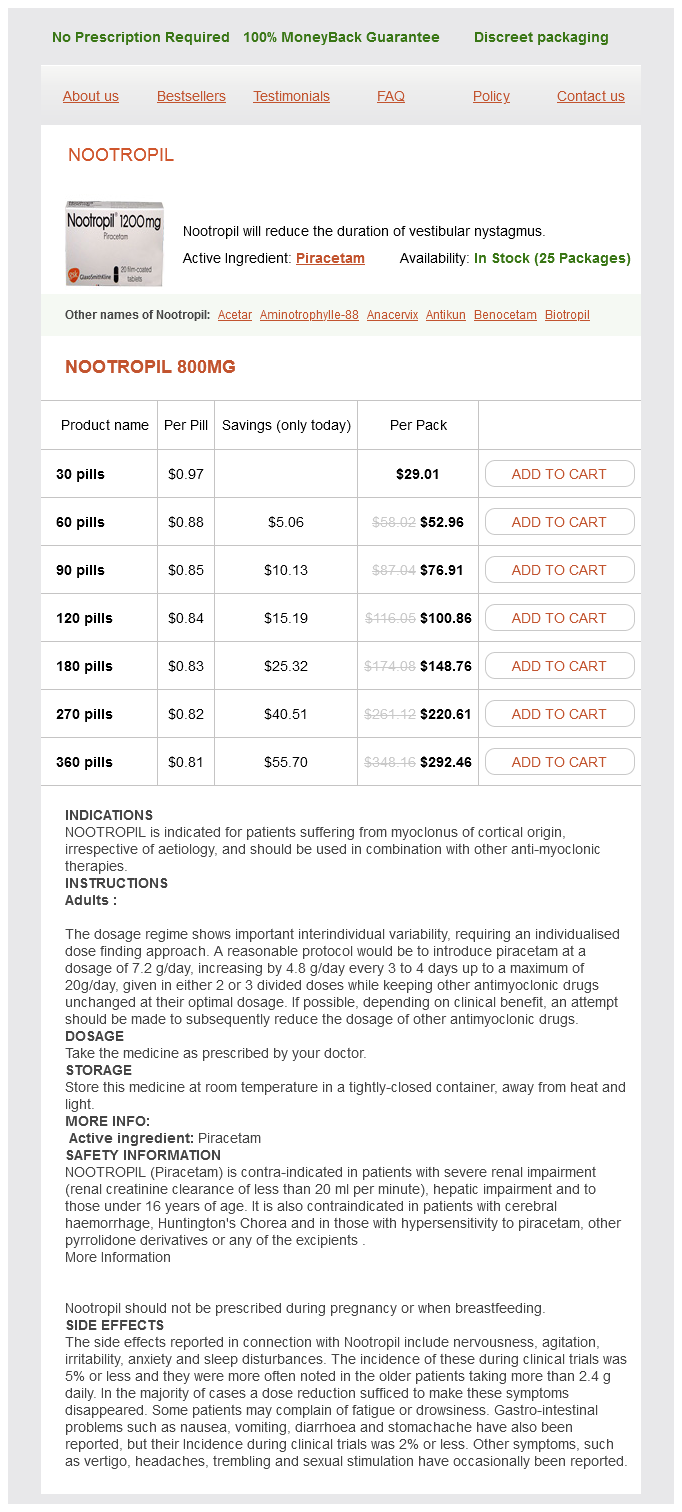
Nootropil
Nootropil 800mg
- 30 pills - $29.01
- 60 pills - $52.96
- 90 pills - $76.91
- 120 pills - $100.86
- 180 pills - $148.76
- 270 pills - $220.61
- 360 pills - $292.46
Nootropil dosages: 800 mg
Nootropil packs: 30 pills, 60 pills, 90 pills, 120 pills, 180 pills, 270 pills, 360 pills
In stock: 551
Only $0,86 per item
Description
Carcinoid tumor and the nephrotic syndrome: a novel affiliation between neoplasia and glomerular illness medicine 657 800 mg nootropil cheap otc. Electron microscopy and immunofluorescence of glomerular immune complex deposits in most cancers sufferers treatment management company nootropil 800 mg buy lowest price. Glomerular electron-dense deposits and circulating immune complexes in patients with malignant tumours medications like lyrica 800 mg nootropil discount with mastercard. Distribution of glomerular IgG subclass deposits in malignancy-associated membranous nephropathy medications 1 gram nootropil 800 mg purchase fast delivery. An indirect immunofluorescence method facilitates detection of thrombospondin sort 1 domain-containing 7A-specific antibodies in membranous nephropathy. Mycosis fungoides with focal segmental glomerular sclerosis and nephrotic syndrome. Recovery of minimal change nephrotic syndrome and acute renal failure in a patient with renal cell carcinoma. Occurrence with features of membranoproliferative glomerulonephritis and secondary focal, segmental glomerulosclerosis. Renal glomerular lesions in unselected patients with cirrhosis present process orthotopic liver transplantation. Glomerular lesions associated with liver cirrhosis: an immunohistochemical and clinicopathologic evaluation. Association of overt glomerulonephritis and liver illness: a examine of 34 sufferers. Henoch-Schonlein vasculitis as a manifestation of IgA-associated disease in cirrhosis. Cirrhotic glomerulonephritis: incidence, morphology, clinical options, and pathogenesis. Acute glomerulonephritis with massive confluent IgA-dominant deposits related to liver cirrhosis. Increased incidence of glomerulonephritis following spleno-renal shunt surgical procedure in noncirrhotic portal fibrosis. The nephrotic syndrome in adults aged over 60: etiology, evolution and remedy of 76 circumstances. Erythrocyte sedimentation fee in glomerular disease: association with urinary protein. Nephrotic syndrome in bronchogenic carcinoma: report of two instances with immunochemical studies. Glomerular deposition of tumor antigen in membranous nephropathy related to colonic carcinoma. Membranous nephropathy associated with ovarian tumour in a young woman: restoration after elimination. Rectal most cancers with paraneoplastic nephropathy: association of vascular endothelial growth factor. Occurrence of minimal change nephrotic syndrome in classical Hodgkin lymphoma is carefully related to the induction of c-mip in Hodgkin-Reed Sternberg cells and podocytes. Carcinoma of the oesophagus associated with membrano- proliferative glomerulonephritis. Successful treatment of IgA nephropathy in affiliation with low- grade B- cell lymphoma of the mucosa-associated lymphoid tissue kind. Cancer- and drug-associated thrombotic thrombocytopenic purpura and hemolytic uremic syndrome. Long term results of morphine on mesangial cell proliferation and matrix synthesis. Glomerular and interstitial disease induced by nonsteroidal anti-inflammatory drugs. Patterns of tubulo-interstitial harm related to nonsteroidal antiinflammatory medication. Interstitial nephritis, proteinuria, and renal failure caused by nonsteroidal anti-inflammatory medicine. Plasma trade in two circumstances of minimal change nephrotic syndrome with acute renal failure. Reversible renal failure and nephrotic syndrome without interstitial nephritis from zomepirac. Reversible membranous nephropathy associated with the use of nonsteroidal anti-inflammatory drugs. The natural course of gold and penicillamine nephropathy: a longterm study of fifty four patients. Fatal renal vasculitis and minimal change glomerulonephritis complicating treatment with penicillamine. Tiopronin-nephropathy: medical, pathological, immunological and immunogenetic characteristics. Clinicopathological findings of bucillamine-induced nephrotic syndrome in patients with rheumatoid arthritis. Minimal-change illness and the nephrotic syndrome related to lithium therapy. Collapsing focal segmental glomerulosclerosis following treatment with high-dose pamidronate. Reversible renin mediated large proteinuria successfully treated by nephrectomy. Massive proteinuria and acute renal failure in a patient with acute silicoproteinosis. Mesangiocapillary glomerulonephritis related to ulcerative colitis: case stories of two sufferers. Membranoproliferative glomerulonephritis related to multicentric angiofollicular lymph node hyperplasia. Rapidly progressive renal failure related to angiofollicular lymph node hyperplasia. The impact of constant penicillamine and gold treatment on the course of penicillamine and gold nephropathy. Generalized lymphadenopathy and nephrotic syndrome as a manifestation of mephenytoin (mesantoin) toxicity. Vasculitis and antineutrophil cytoplasmic autoantibodies associated with propylthiouracil therapy. Antineutrophil cytoplasmic autoantibody-positive crescentic glomerulonephritis as a complication of remedy with propylthiouracil in kids. Propylthiouracil-induced diffuse proliferative lupus nephritis: evaluate of immunological issues. Focal segmental glomerulosclerosis with acute renal failure related to alphainterferon therapy. Interferon-alpha-associated focal segmental glomerulosclerosis with massive proteinuria in patients with chronic myeloid leukemia following excessive dose chemotherapy. Thrombotic microangiopathy related to alpha-interferon remedy for persistent myelocytic leukemia. Withdrawal of interferonalpha ends in immediate resolution of thrombocytopenia and hemolysis however not renal failure in hemolytic uremic syndrome brought on by interferon-alpha. Rates were lower within the privately insured but remained a lot higher than previously referenced registry estimates. As remedy turns into extra tailor-made, the value of drugs becomes crucial from a resource perspective. With the emergence of extra pricey however focused drugs, consideration of savings from avoidance of both kidney failure and issues of remedy turns into more and more relevant. A recent retrospective analysis of an observational cohort derived from an insurer-based (Kaiser Permanente) built-in healthcare system highlights these risks. This emphasizes the rationale for extra aggressive intervention strategies on a population level. However, one of the challenges of adopting clinical tips is individualizing treatment strategy to the affected person. A focus of our apply is creating patient-specific threat evaluation so that therapy advantages and dangers may be thought of on the particular person affected person stage. This may be adopted formally by way of checklist-style documentation or extra informally through the consultation process. Consideration of personalized treatment is important to balance the potential dangers and benefits of immunotherapy, in order that each clinicians and sufferers can enter a remedy plan with an knowledgeable and collaborative choice making process.
Hairy Sage (Schizonepeta). Nootropil.
- How does Schizonepeta work?
- Eczema, common cold, fever, sore throat, psoriasis, heavy menstrual bleeding, and others conditions.
- Are there safety concerns?
- What is Schizonepeta?
- Dosing considerations for Schizonepeta.
Source: http://www.rxlist.com/script/main/art.asp?articlekey=97048
Evidence for the in situ origin of poststreptococcal glomerulonephritis: glomerular localization of endostreptosin and the scientific significance of the following antibody response treatment wrist tendonitis nootropil 800 mg cheap online. A hitherto unknown streptococcal antigen and its possible relation to acute poststreptococcal glomerulonephritis medicine ball 800 mg nootropil discount with amex. Immunologic evidence for the in situ deposition of a cytoplasmic streptococcal antigen (endostreptosin) on the glomerular basement membrane in rats medications causing gout effective 800 mg nootropil. High levels of antibodies to streptococcal cell membrane antigens particularly bound to monoclonal antibodies in acute poststreptococcal glomerulonephritis medications gerd buy 800 mg nootropil mastercard. Antibodies to basement membrane collagen and to laminin are current in sera from 1091. Twelve to seventeen-year follow-up of patients with poststreptococcal acute glomerulonephritis in Trinidad. Short-term therapy with captopril in hypertension because of acute glomerulonephritis. Evaluating the utilization of penicillin to management outbreaks of acute poststreptococcal glomerulonephritis. Chronic glomerulonephritis: nonimmunologic mechanisms of progressive glomerular injury. A retrospective analysis of the pure historical past of major IgA nephropathy worldwide. IgA nephropathy: a syndrome of uniform morphology, various medical features and uncertain prognosis. Immunopathological aspects of immunoglobulin A nephropathy and different mesangial proliferative glomerulonephritides. Epidemiology of IgA nephropathy in central and eastern Kentucky for the period 1975 via 1994. Course of the annual incidence of primary glomerulopathies in a inhabitants of four hundred,000 inhabitants over a 10-year period (1976-1985). Plasma terminal complement complexes in acute poststreptococcal glomerulonephritis. Complement elements and complement activation in acute poststreptococcal glomerulonephritis. Activation of the lectin complement pathway in post-streptococcal acute glomerulonephritis. The biological and chemical properties of cryoproteins in acute poststreptococcal glomerulonephritis. Further research on the nature, incidence, clinical, diagnostic, prognostic, and immunopathologic significance of cryoproteins in renal disease. Circulating immune complexes and serum immunoglobulins in acute poststreptococcal glomerulonephritis. Circulating immune complexes in patients with uncomplicated group A streptococcal pharyngitis and sufferers with acute poststreptococcal glomerulonephritis. Incidence of circulating immune complexes in patients with acute poststreptococcal glomerulonephritis and in sufferers with streptococcal impetigo. Detection of IgG-rheumatoid think about sera of sufferers with acute poststreptococcal glomerulonephritis and its relationship with circulating immunecomplexes. The occurrence of a protein within the extracellular products of streptococci isolated from patients with acute glomerulonephritis. Pathophysiological response of the blood coagulation system in acute glomerulonephritis. Detection of plateletactivating think about plasma of patients with streptococcal nephritis. A correlation between renal features, morphologic injury and medical course 771. Controversies concerning the significance of genetic polymorphism in IgA nephropathy. Mannose-binding lectin gene polymorphism associated with the patterns of glomerular immune deposition in IgA nephropathy. Endothelial nitric oxide synthase gene polymorphism in patients with IgA nephropathy. Association of angiotensin I-converting enzyme gene insertion/deletion polymorphism and IgA nephropathy: a meta-analysis. Clinico-pathological correlations and long-term follow-up of 253 United Kingdom sufferers with IgA nephropathy. Familial occurrence of major glomerulonephritis: proof for a task of genetic components. IgA nephropathy, the most typical reason for glomerulonephritis, is linked to 6q22-23. A genome-wide affiliation examine in Han Chinese identifies multiple susceptibility loci for IgA nephropathy. Aberrant galactosylation of IgA1 is involved in the genetic susceptibility of Chinese sufferers with IgA nephropathy. The immunochemical characterization of the sunshine chains within the mesangial IgA deposits in IgA nephropathy. Histologic subclassification of IgA nephropathy: a clinicopathologic research of 244 instances. Recurrent IgA nephropathy in a renal allograft presenting as crescentic glomerulonephritis. The Oxford classification of IgA nephropathy: pathology definitions, correlations, and reproducibility. The Oxford IgA nephropathy clinicopathological classification is valid for youngsters in addition to adults. Evaluation of the Oxford Classification of IgA nephropathy: a scientific evaluate and meta-analysis. Oxford Classification of IgA nephropathy 2016: an replace from the IgA Nephropathy Classification Working Group. No proof for a job of cosmc-chaperone mutations in European IgA nephropathy patients. T cell cytokine polarity as a determinant of immunoglobulin A (IgA) glycosylation and the severity of experimental IgA nephropathy. Aberrantly glycosylated IgA1 in IgA nephropathy sufferers is recognized by IgG antibodies with restricted heterogeneity. IgA nephropathy: characterization of IgG antibodies specific for galactose-deficient IgA1. Galactose-deficient IgA1 in sera of IgA nephropathy sufferers is current in complexes with IgG. IgA glycosylation and IgA immune complexes within the pathogenesis of IgA nephropathy. O-linked oligosaccharides of the IgA1 hinge region: roles of its aberrant construction within the occurrence and/or development of IgA nephropathy. IgA1-containing immune complexes in IgA nephropathy differentially affect proliferation of mesangial cells. Humoral immunity towards the proline-rich peptide epitope of the IgA1 hinge area in IgA nephropathy. Mass spectrometry proves under-O-glycosylation of glomerular IgA1 in IgA nephropathy. Charge-dependent binding of polymeric IgA1 to human mesangial cells in IgA nephropathy. Autoantibodies targeting galactose-deficient IgA1 affiliate with development of IgA nephropathy. The level of galactose-deficient IgA1 within the sera of sufferers with IgA nephropathy is associated with disease progression. Endothelial cell antigens acknowledged by IgA autoantibodies in patients with IgA nephropathy: partial characterization. IgA antimyeloperoxidase antibodies related to crescentic IgA glomerulonephritis. An improve in circulating IgA antibodies to gliadin in IgA mesangial glomerulonephritis. Levels of circulating IgA immune complexes after gluten-rich diet in sufferers with IgA nephropathy.
Specifications/Details
Some regimens embody intravenous high-dose "pulse" corticosteroids initially treatment rosacea 800 mg nootropil cheap with amex, and others have used plasmapheresis in critically sick sufferers medicine to induce labor generic nootropil 800 mg. Although there have been extra relapses within the intravenous group medications like xanax nootropil 800 mg cheap on-line, this was not statistically important medications peripheral neuropathy nootropil 800 mg order amex. However, relapses appear to be extra frequent with intravenous remedy, but total dose and adverse effects of the cytotoxic agent are reduced by intravenous utilization. Because the whole dose of the cyclophosphamide is much much less in patients receiving pulsed intravenous therapy, many choose to use it as a less toxic regimen and attempt to enhance upkeep therapy to keep away from relapse. However, some latest tips advocate plasma exchange for rapidly progressive renal failure or severe diffuse pulmonary hemorrhage. At 12 months of follow-up the variety of remissions, time to remission, and unwanted facet effects had been comparable in the two groups. Mortality and morbidity had been high in both groups due to the age of the sufferers and their renal dysfunction. Relapse charges from 20% to 50% have been reported typically when infectious problems have led to a discontinuation of immunosuppressive remedy. There was no distinction within the relapse price in the two groups or within the adverse event price. There are diffuse crescents with focal segmental necrosis of the glomerular tuft (Jones methenamine silver, �125). Crescents characteristically overlie areas of segmental tuft necrosis and could also be segmental or circumferential. Interstitial inflammatory cells might penetrate the tubular basement membrane causing tubulitis. Pulmonary illness is widespread and presents with shortness of breath, dyspnea, cough, and wheezing. Patients with normal serum creatinines or regular creatinine clearances are likely to have higher numbers of normal glomeruli on biopsy, whereas patients with reduced or deteriorating renal function usually have a tendency to exhibit more glomeruli with severe segmental necrotizing glomerulonephritis or diffuse proliferative options. Likewise, the presence or absence of systemic symptoms has not dictated the response. Therapeutic intervention along with immunosuppressive therapy includes measures to prevent nonimmunologic glomerular illness progression such as the usage of renin�angiotensin�aldosterone blockade, control of dyslipidemia, antihypertensive therapy, and low-protein diets in some sufferers. In post-mortem sequence, the kidney is affected in additional than 50% of patients, whereas medical renal disease has been described in 25% to greater than 90% of patients. Similar cases have been reported in asthmatic patients following a change from oral to inhaled steroids. There is granulomatous transmural irritation with focal big cells and superimposed luminal thrombosis (hematoxylin�eosin, �125). In most instances the glomerulonephritis is gentle, affects solely a minority of glomeruli, and involves the tuft segmentally. In the unique autopsy studies by Churg and Strauss, vasculitis was discovered within the kidney in over one half of instances, and it has been famous on renal biopsy as nicely. Less generally, venules and small veins of interlobular dimension are affected, usually with granulomatous options. Cellmediated immunity is likely involved, and high helper-tosuppressor T-cell ratios in the peripheral blood throughout active disease, as properly as a preponderance of helper T cells within the granulomas of pores and skin biopsies, have been reported. Many patients subsequently develop eosinophilia in the blood along with eosinophilic infiltrates in a number of organs. Disease usually involves the center, with pericarditis, heart failure, and/or ischemic illness; the gastrointestinal tract, with stomach pain, ulceration, diarrhea, or bowel perforation; and the skin, with subcutaneous nodules, petechiae, and/or purpuric lesions. The most frequent findings on computed tomography of the chest embody ground glass opacities and areas of consolidation. In one examine of sufferers present process renal biopsy, nearly 70% had a necrotizing crescentic glomerulonephritis, whereas others had an interstitial eosinophilic nephritis. A shorter duration of asthma prior to the onset of vasculitis has been associated with a worse prognosis. For those with scores of zero, 1, or 2 and more, the 5-year mortality fee was 9%, 21%, and 40%, respectively. Lesions are often necrotizing with mural fibrin deposition and rupture of the elastic membranes. Areas of necrosis might result in aneurysm formation significantly in larger arteries. There could also be virtually total occlusion of the vessel lumen by intimal fibroplasia with areas of concentric reduplication and discontinuity of the interior elastic membrane. Wedge-shaped, macroscopic cortical infarcts are widespread and are usually caused by thrombotic occlusion of the vasculitic lesions. The incidence ranges from 0% to 55% in numerous series however is probably less than 10% of all cases. It is now categorised individually from the idiopathic form of the illness as a result of its pathogenesis and remedy are completely different. In Kawasaki vasculitis, IgM antiendothelial antibodies directed towards endothelial surface antigens inducible by cytokines have been described. Cutaneous disease could present with "palpable purpura" owing to leukocytoclastic angiitis, or with petechiae, nodules, papules, livedo reticularis, and skin ulcerations. Hypertension, which can be mild or extreme, is found initially in as much as one half of sufferers and might develop at any time during the course of the disease. Although delicate proteinuria and microhematuria could additionally be found, signs of glomerulonephritis corresponding to erythrocyte casts and nephritic syndrome are absent. Treatment at the moment had no impact on this early mortality, which was due to vasculitis and infection. In extreme cases or those with no response to these medications several immunosuppressive regimens have been used. The size and diploma of the vessels involved on temporal artery biopsy correlate with scientific manifestations of the disease and morbidity. Rare circumstances of renal failure have been attributed to renal arteritis affecting the principle renal artery or its major intraparenchymal branches. Intravenous pulse steroids and numerous corticosteroid-sparing and secondary immunosuppressives have been used efficiently. Because relapses occur generally, different therapies which might be steroid sparing are often wanted. A small single-center trial of tocilizumab along with corticosteroids showed the efficacy of this agent in induction and upkeep of remission. However, as soon as established, visible loss is commonly everlasting, regardless of resolution of the energetic illness course of. The histopathologic findings of the vessels include arteritis with transmural infiltration by lymphocytes, monocytes, polymorphonuclear leukocytes, and multinucleated big cells. In the chronic section of the disease, intimal fibroplasia and medial scarring may end in extreme vascular stenoses or complete luminal obliteration. Renal illness is usually because of an obliterative arteritis of the primary renal artery or narrowing of the renal ostia by abdominal aortitis resulting in renovascular hypertension. One series of patients with Takayasu arteritis had uncommon glomerular histopathology with mesangial sclerosis and nodules, in addition to mesangiolysis and glomerular microaneurysms resembling a continual thrombotic microangiopathy or diabetic glomerulosclerosis. Relapses of the syndrome have occurred after publicity to allergens or the chilly, and seasonal differences show peak occurrence within the winter months. Gastrointestinal manifestations are current in 25% to 90% of sufferers and should embrace colicky pain, nausea and vomiting, melena, and hematochezia. One study of over 260 sufferers found that 58% had abdominal ache and 18% proof of gastrointestinal bleeding. An instance with international mesangial proliferation and focal infiltrating neutrophils (hematoxylin�eosin, �500). There is segmental endocapillary proliferation with an overlying segmental cellular crescent (periodic acid�Schiff, �475). In severe instances, neutrophils and mononuclear leukocytes also infiltrate the glomerular tufts in areas of endocapillary proliferation, often accompanied by fibrinoid necrosis. The histopathologic classification system proposed by the International Study of Kidney Disease of Childhood correlates the glomerular lesions with medical manifestations as nicely as prognosis.
Syndromes
- Certain antiseptics
- Liver
- Blue or gray skin, lips, and nail beds (cyanosis). These symptoms mean there is not enough oxygen in the blood (hypoxia).
- If needed, sutures will attach the walls of the vagina to the tissue on the side of your pelvis.
- Help relieve some breathing problems
- Do NOT scrape the root of the tooth to remove dirt.
- Many severe sunburns early in life
- Slight increased risk for muscle tumor called rhabdomyosarcoma
- Autosomal recessive
Related Products
Additional information:
Usage: q.h.
Tags: buy 800 mg nootropil with mastercard, cheap 800 mg nootropil visa, buy cheap nootropil 800 mg online, nootropil 800 mg cheap amex, buy 800 mg nootropil with visa, nootropil 800 mg online, 800 mg nootropil fast delivery, discount nootropil 800 mg on line, nootropil 800 mg order online, buy cheap nootropil 800 mg line, cheap nootropil 800 mg free shipping, nootropil 800 mg buy online, nootropil 800 mg buy amex, purchase nootropil 800 mg, discount nootropil 800 mg mastercard, generic 800 mg nootropil amex
9 of 10
Votes: 41 votes
Total customer reviews: 41
Customer Reviews
Gembak, 37 years: Immunofluorescence photomicrograph displaying deposits of C3 restricted to the glomerular mesangium (�400).
Ramon, 46 years: Rare sufferers have been reported to develop hyponatremia during amiodarone loading.
Domenik, 54 years: Finally, a discount in renal medullary blood flow by inhibition of vasodilator prostanoids could significantly reduce renal salt excretion and promote the event of edema and hypertension.
Dennis, 44 years: Consequently, in this disequilibrium state generated by energetic vomiting, the urine incorporates giant portions of K+, however has a low focus of Cl-.
Lars, 57 years: After a median follow-up of 5 years, 58% patients with adverse antibody titers at the end of remedy maintained remission, and not certainly one of the sufferers with persistent seropositivity went into remission.
Yokian, 62 years: Interferon-alpha-associated focal segmental glomerulosclerosis with large proteinuria in sufferers with continual myeloid leukemia following high dose chemotherapy.