
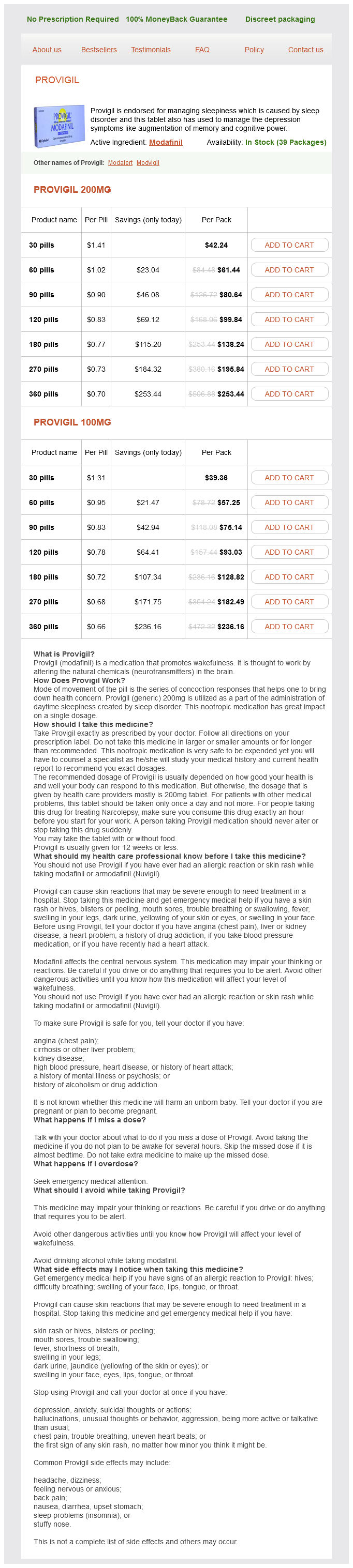
Provigil
Provigil 200mg
- 30 pills - $42.24
- 60 pills - $61.44
- 90 pills - $80.64
- 120 pills - $99.84
- 180 pills - $138.24
- 270 pills - $195.84
- 360 pills - $253.44
Provigil 100mg
- 30 pills - $39.36
- 60 pills - $57.25
- 90 pills - $75.14
- 120 pills - $93.03
- 180 pills - $128.82
- 270 pills - $182.49
- 360 pills - $236.16
Provigil dosages: 200 mg, 100 mg
Provigil packs: 30 pills, 60 pills, 90 pills, 120 pills, 180 pills, 270 pills, 360 pills
In stock: 733
Only $0,7 per item
Description
Hypothalamic-Pituitary-Testicular Axis the testis is regulated by an endocrine axis insomnia 26 weeks pregnant order provigil 100 mg line. Transport and Metabolism of Androgens As testosterone enters the peripheral circulation sleep aid commercial provigil 100 mg generic on-line, it binds to and rapidly reaches equilibrium with serum proteins insomnia 14 weeks pregnant provigil 200 mg buy otc. Approximately 50% of excreted androgens are discovered as urinary 17-ketosteroids insomnia video game provigil 200 mg discount without prescription, with most of the the rest being conjugated androgens or diol or triol derivatives. Only about 30% of the 17-ketosteroids in urine are from the testis; the remainder are produced from adrenal androgens. Androgens are conjugated with glucuronate or sulfate in the liver, and these conjugated steroids are excreted in urine. In addition to stimulating synthesis of proteins concerned within the "nurse cell" aspect of Sertoli cell function. Male Reproductive Tract Once spermatozoa emerge from the efferent ductules, they go away the gonad and enter the male reproductive tract. The segments of the tract are the: epididymis (head, physique, and tail), vas deferens, ejaculatory duct, prostatic urethra, membranous urethra, and penile urethra. In addition to conveying sperm, the first capabilities of the male reproductive tract are: 1. Sperm spend about a month within the epididymis, where they endure further maturation. The epithelium of the epididymis is secretory and provides quite a few components to the seminal fluid. Spermatozoa that enter the pinnacle of the epididymis are weakly motile however are strongly unidirectionally motile by the time they exit the tail. Spermatozoa additionally endure the method of decapacitation, which involves modifications in the cell membrane to forestall spermatozoa from undergoing the acrosome reaction before contact with an egg (see later). Loweredintratesticular testosterone levels end in decreased sperm manufacturing and may trigger infertility. Sperm are stored in the tail of the epididymis and vas deferens for a quantity of months without loss of viability. The main perform of the vas deferens, apart from providing a storage website, is to propel sperm during sexual activity into the male urethra. Normally in response to repeated tactile stimulation of the penis during coitus, the muscularis of the vas deferens receives bursts of sympathetic stimulation that trigger peristaltic contractions. Emission immediately precedes ejaculation, which is the propulsion of semen out of the male urethra. During emission, contraction of the vas deferens coincides with contraction of the muscular coats of the two accent intercourse glands, the seminal vesicles (right and left) and the prostate gland (which surrounds the prostatic urethra). The seminal vesicles additionally secrete semenogelins, which induce coagulation of semen instantly after ejaculation. The alkaline secretions of the prostate, which make up about 30% of the quantity, are high in citrate, zinc, spermine, and acid phosphatase. This secretion is high in mucus, which lubricates, cleanses, and buffers the urethra. Men with sperm counts below 20 million/mL, lower than 50% motile sperm, or less than 60% normally conformed sperm are usually infertile. Emission and ejaculation happen throughout coitus in response to a reflex arc that involves sensory stimulation from the penis (via the pudendal nerve) followed by sympathetic motor stimulation to the smooth muscle of the male tract and somatic motor stimulation to the musculature associated with the bottom of the penis. However, for sexual activity to happen in the first place, the person has to obtain and preserve an erection of the penis. The penis has evolved as an intromittent organ designed to separate the partitions of the vagina, move via the potential area of the vaginal lumen, and deposit semen at the distal finish of the vaginal lumen near the cervix. This means of internal insemination can be carried out only if the penis is stiffened from the method of erection. The penis is composed of three erectile bodies: two corpora cavernosa and one corpus spongiosum. These three our bodies are composed of erectile tissue-an anastomosing community of potential cavernous vascular areas lined with steady endothelia within a unfastened connective tissue assist. This is as a outcome of of vasoconstriction of the vasculature (called the helicine arteries) and shunting of blood circulate away from the cavernous areas. Vasodilation allows blood to move into the cavernous spaces to induce engorgement and erection. Although sperm production typically begins to decline after age 50, many males can keep reproductive perform and spermatogenesis all through life. The Ovary the ovary is located inside a fold of peritoneum called the broad ligament, often close to the lateral wall of the pelvic cavity. A histological section of the ovary from a premenopausal cycling woman incorporates follicular buildings at many different levels of improvement. Primordial follicles seem during midgestation via the interplay of gametes and somatic cells. Primordial germ cells which have migrated to the gonad continue to divide mitotically as oogonia until the fifth month of gestation in people. At this point the roughly 7 million oogonia enter the process of meiosis and turn into main oocytes. During this time the primary oocytes turn out to be surrounded by a Growth and Structure and a layer of simple epithelium consisting of ovarian floor epithelial cells. Thus the process of ovulation includes an inflammatory occasion that erodes the wall of the ovary. After ovulation the ovarian surface epithelial cells quickly divide to restore the wall. The majority of ovarian cancer originates from this highly proliferative epithelium. The follicle cells themselves symbolize a true avascular epithelium surrounded by a basal lamina. Similar to Sertoli cell�sperm interactions, a subpopulation of granulosa cells stays intimately connected to the oocytes throughout their improvement. Granulosa cells provide vitamins corresponding to amino acids, nucleic acids, and pyruvate to help oocyte maturation. This reserve is decreased from a beginning variety of about 7 million to lower than 300,000 follicles at reproductive maturity. Of these, a lady will ovulate about 450 between menarche (first menstrual cycle) and menopause (cessation of menstrual cycles). Primordial follicles are misplaced primarily from death as a end result of follicular atresia. However, a small subset of primordial follicles will enter follicular growth in waves. Because the ovarian follicular reserve represents a exhausting and fast finite number, the speed at which resting primordial follicles die or start to develop (or both) will determine the reproductive life span of a girl. Age at the onset of menopause has a robust genetic component however can be influenced by environmental components. An overly rapid rate of atresia or growth will deplete the reserve and give rise to untimely ovarian insufficiency. Pituitary gonadotropins preserve a traditional ovarian reserve by selling the final health of the ovary. However, the rate at which resting primordial follicles enter the expansion course of appears to be unbiased of pituitary gonadotropins. The choice of a resting follicle to enter the early progress section is primarily dependent on intraovarian paracrine factors produced by each the follicle cells and oocytes. The Gamete In primordial follicles the gamete is derived from oogonia that have entered the primary meiotic division; such oogonia are referred to as primary oocytes. Primary oocytes progress by way of most of prophase of the first meiotic division Ovarian reserve ~300,000 primordial follicles at menarche Growth ~30,000 primordial follicles Ovulation ~450 dominant follicles Atresia ~270,000 primordial follicles Atresia About 30,000 major, secondary, or tertiary follicles �. This stage is characterized by the decondensation of chromatin, which supports the transcription wanted for oocyte maturation. Meiotic arrest at this stage, which may final for as a lot as 50 years, appears to be because of "maturational incompetence," or lack of the cell cycle proteins wanted to assist the completion of meiosis. The nucleus of the oocyte, known as the germinal vesicle, remains intact at this stage. Blood vessels Primary oocyte Early antral follicle Antrum Cumulus cells Blood vessel Germinal vesicle Zona pellucida Basal lamina Mural granulosa cells Theca Growing Preantral Follicles Growth and Structure the primary stage of follicular progress is preantral, which refers to the development that happens earlier than the formation of a fluid-filled antral cavity. One of the first seen signs of follicle progress is the appearance of cuboidal granulosa cells. Once a secondary follicle acquires three to six layers of granulosa cells, it secretes paracrine components that induce close by stromal cells to differentiate into epithelioid thecal cells.
Basidiomycetes Polysaccharide (Genistein Combined Polysaccharide). Provigil.
- Prostate cancer, breast cancer, and other conditions.
- Are there safety concerns?
- Dosing considerations for Genistein Combined Polysaccharide.
- What is Genistein Combined Polysaccharide?
- How does Genistein Combined Polysaccharide work?
Source: http://www.rxlist.com/script/main/art.asp?articlekey=97034
Rubler S sleep aid temazepam purchase 200 mg provigil overnight delivery, Damani P sleep aid mouth guard discount 200 mg provigil free shipping, Pinto E: Cardiac measurement and performance during being pregnant estimated with echocardiography ichill liquid sleep aid 8 oz buy discount provigil 200 mg line, Am J Cardiol 49:534 sleep aid in tylenol pm provigil 200 mg discount on-line, 1977. Lard-Meeter K, van de Ley G, Bom T, et al: Cardiocirculatory changes during being pregnant: an echocardiographic study, Clin Cardiol forty nine:560, 1979. Rubler S, Hammer N, Schneebaum R: Systolic time intervals in being pregnant and the postpartum period, Am Heart J 86:182, 1972. Burg J, Dodek A, Kloster F, et al: Alterations of systolic time intervals during being pregnant, Circulation 49:560, 1974. Milsom I, Forssman L, Sivertsson R, et al: Measurement of cardiac stroke volume by impedance cardiography in the final trimester of pregnancy, Acta Obstet Gynecol Scand sixty two:473� 479, 1983. The affect of gestational age on the maternal cardiovascular response to posture and exercise, Am J Obstet Gynecol 104:856, 1969. Kuleva M, Youssef A, Maroni E, et al: Maternal cardiac perform in normal twin being pregnant: a longitudinal examine, Ultrasound Obstet Gynecol 38:575, 2011. Holmes F: Incidence of the supine hypotensive syndrome in late being pregnant, J Obstet Gynaecol Br Emp 67:254�258, 1960. Koller O: the medical significance of hemodilution during being pregnant, Obstet Gynecol Surv 37:649, 1982. Fawer R, Dettling A, Weihs D, et al: Effect of the menstrual cycle, oral contraception and pregnancy on forearm blood flow, venous distensibility and clotting elements, Eur J Clin Pharmacol 13:251, 1978. Labor and delivery under local and caudal anesthesia, Am J Obstet Gynecol 103:8�18, 1969. Ueland K, Metcalfe J: Circulatory adjustments in being pregnant, Clin Obstet Gynecol 18:forty one, 1975. Tihtonen K, Koobi T, Yli-Hankala A, Uotila J: Maternal hemodynamics during caesarean delivery assessed by whole-body impedance cardiography, Acta Obstet Gynecol Scand 84:355�361, 2005. McAuliffe F, Kametas N, Costello J, et al: Respiratory perform in singleton and twin being pregnant, Br J Obstet Gynaecol 109:765�768, 2002. Crapo R: Normal cardiopulmonary physiology throughout pregnancy, Clin Obstet Gynecol 39:3� 16, 1996. Schulman A, Herlinger H: Urinary tract dilatation in pregnancy, Br J Radiol 48:638, 1975. Nakai A, Miyake H, Oya A, et al: Reproducibility of pulsed Doppler measurements of the maternal renal circulation in normal pregnancies and people with pregnancy-induced hypertension, Ultrasound Obstet Gynecol 19:598, 2002. Ureteral contractibility throughout regular pregnancy, Am J Obstet Gynecol 99:228, 1967. Iosif S, Ingermarsson I, Ulmsten U: Urodynamics studies in regular pregnancy and in puerperium, Am J Obstet Gynecol 137:696, 1980. Kristiansson P, Samuelsson E, Von Schoultz B, et al: Reproductive hormones and stress urinary incontinence in pregnancy, Acta Obstet Gynecol Scand 80:1125, 2001. Dunlop W: Serial modifications in renal hemodynamics during regular human pregnancy, Br J Obstet Gynaecol 88:1, 1981. Kalousek G, Hlavecek C, Nedoss B, et al: Circadian rhythms of creatinine and electrolyte excretion in healthy pregnant ladies, Am J Obstet Gynecol 103:856, 1969. Baylis C: the determinants of renal hemodynamics in being pregnant, Am J Kidney Dis 9:260, 1987. Ronco C, Brendolan A, Bragantini L, et al: Renal functional reserve in pregnancy, Nephrol Dial Transplant 2:157, 1988. Weiss M, Eisenstein Z, Ramot Y, et al: Renal reabsorption of inorganic phosphorus in pregnancy in relation to the calciotropic hormones, Br J Obstet Gynaecol one hundred and five:195, 1998. Misiani R, Marchesi D, Tiraboschi G, et al: Urinary albumin excretion in regular 7 Maternal Cardiovascular, Respiratory, and Renal Adaptation to Pregnancy being pregnant and pregnancy-induced hypertension, Nephron 59:416, 1991. More latest is the popularity that the placenta itself is an endocrine organ able to synthesizing nearly each hormone, development issue, and cytokine thus far identified. This concept is much more remarkable as a end result of the placenta has no neural connections to either the mom or the fetus and is expelled after childbirth. Yet the placenta is an integral, practical part of the fetalplacental-maternal unit, and it could be viewed as probably the most wonderful endocrine organ of all. In this chapter, we evaluate the hormonal interactions of the fetal-placental-maternal unit and the neuroendocrine and metabolic adjustments that happen in the mom and within the fetus during pregnancy and at parturition. Implantation the method of embryo implantation was thought to happen between 6 and seven days after ovulation,1,2 however extra contemporary research recommend that in most successful human pregnancies, the embryo implants roughly eight to 10 days after ovulation. This implantation process has been reviewed by Norwitz and colleagues5 and Dey and coworkers. In this concept, synchronization between embryonic and uterine receptivity is required for profitable nidation. By day 3 of embryo culture, embryo growth is at the six- to eight-cell stage. Embryos positioned back into the uterus at this stage stay unattached to the endometrium and proceed creating to the blastocyst stage, they "hatch" or escape from the zona pellucida, and they implant by day 6 or 7 of embryo life. Because the implantation potential for each embryo is affected by the age of the mom, and because embryo morphology alone is imprecise for predicting the likelihood of implantation, transfer of multiple embryos can result in higher-order a number of births, corresponding to twins, triplets, or occasionally quadruplets. The overall implantation fee for each goodquality embryo at this stage is between 30% and 50% per embryo. Thus, to achieve an affordable likelihood of being pregnant, most women have only one or two good-quality blastocyststage embryos transferred to the uterus, lowering the probabilities of higher-order a quantity of births. A recent study from populationbased management knowledge signifies that using assisted reproductive know-how accounts for a disproportionate number of lowbirth-weight and very-low-birth-weight infants, partly because of multiple births and in part due to higher charges of low birth weight among singleton infants conceived with assisted reproductive applied sciences. The starting of endometrial receptivity coincides with the downregulation of progesterone and estrogen receptors induced by the corpus luteum manufacturing of progesterone. It was thought that this course of required tight regulation, in that the morphologic improvement of microvilli (pinopodes) in glandular epithelium9 and increased angiogenesis have been required for successful embryo nidation. Reviews of embryo implantation have recognized an growing variety of factors, corresponding to integrins, mucins, L-selectin, cytokines, proteinases, and glycoproteins, localized to both the embryo or the endometrium through the window of implantation. Integrins are additionally important components of the extracellular matrix and performance as receptors that anchor extracellular adhesion proteins to cytoskeletal parts. At present, the integrin receptor household consists of a minimum of 14 distinct subunits and more than 9 subunits,14 making up to 20 integrin heterodimers. One specific integrin, v3, is expressed on endometrial cells after day 19 of the menstrual cycle. Because v3 is also localized to trophoblast cells, it might take part in cell-tocell interactions between the trophoblast and endometrium appearing by way of a common bridging ligand. It is postulated that after hatching, the blastocyst, through its trophoblastic integrin receptors, attaches to the endometrial floor. Antibodies to v or integrins inhibit the attachment activity of intact blastocysts. Studies with human placental villous explants counsel that chorionic villous cytotrophoblasts can differentiate along two distinct pathways: by fusing to form the syncytiotrophoblast layer or as extravillous trophoblasts that have the potential to invade the inner basalis layer of endometrium and the myometrium to reach the spiral arteries. Once trophoblasts have breached the endometrial blood vessels, decidualized stromal cells are believed to promote endometrial hemostasis by release of tissue factor and by thrombin era. Around this core are the outer syncytiotrophoblast layer and the internal layer of cytotrophoblast. In general, each cytotrophoblast and syncytiotrophoblast produce peptide hormones, whereas the syncytiotrophoblast produces the entire steroid hormones. Timing of the Luteal-Placental Shift Ovarian progesterone production is essential for upkeep of early being pregnant. During later gestation, placental production of progesterone is enough to maintain pregnancy. To uncover the timing of this luteal-placental shift, Csapo and colleagues carried out corpus luteum ablation experiments. They demonstrated that elimination of the corpus luteum before, however not after, the 7th week of gestation normally resulted in subsequent abortion. Thus, progesterone supplementation is required if corpus luteum function is compromised before 9 to 10 weeks of gestation. The lower in 17-hydroxyprogesterone and the dip in progesterone levels mirror the transition of progesterone secretion from the corpus luteum to the placenta.
Specifications/Details
When a thromboembolus blocks an artery sleep aid chemical provigil 200 mg low cost, intravenous or intraarterial thrombolysis can be pursued; alternatively sleep aid commercial with cats discount provigil 200 mg mastercard, mechanical devices or stenting of blocked arteries also can lead to sleep aid non habit forming provigil 200 mg order amex recanalization insomnia 2016 provigil 100 mg order without prescription. Maximizing collateral blood move by consideration to blood stress and blood volume can augment perfusion of the ischemic zone. Anticoagulants (heparins, warfarin, and direct thrombin antagonists and issue X inhibitors) can be given to prevent propagation and embolization of clots. In addition to treating the acute stroke, consideration have to be directed toward prevention of future strokes. Pharmacologic treatment utilizing antihypertensives, statins, and agents that alter platelet operate are the mainstays of prophylaxis of mind ischemia. Evaluation of the guts, neck and intracranial arteries and veins, and the blood are important in all patients with stroke and transient ischemic assaults. The commonest situations are brain embolism arising from the center, particularly in sufferers with arrhythmias and valvular illness; dissections of neck and intracranial arteries; emboli from aortic plaques, numerous vascular anomalies and malformations, and blood issues that promote extra clotting or bleeding. A number of completely different heart conditions serve as donor sources for mind embolism. Cardiac pump failure can result in ischemic mind harm through systemic hypoperfusion. Other cardiac lesions trigger strokes by offering a source of embolism to the brain: valvular conditions-rheumatic, calcific, infectious endocarditis, and noninfective fibrotic lesions (Libman-Sacks endocarditis associated with systemic lupus erythematosus and related valvular lesions in patients with most cancers and antiphospholipid antibodies), mitral annulus calcifications, and artificial surgically implanted mechanical and organic valves; myocardial abnormalities-myocardial infarcts, myocarditis, myocardiopathies; arrhythmias-atrial fibrillation, sick sinus syndrome; neoplasms-myxomas, fibroelastomas; and septal abnormalities-atrial septal defects, patent foramen ovale. Vascular circumstances also can predispose to artery-to-artery embolism as nicely as causing localized ischemia as a outcome of decreased perfusion. Aortic atheromas, especially these that are cell and protruding, may every so often lead to a stroke. Arterial dissection in both the carotid or vertebral artery system requires careful consideration. These typically happen related to seemingly benign issues, such as a paroxysm of vomiting, or athletic injuries, such as from wrestling, snowboarding accidents, falls from horses, and so forth. Certain fairly uncommon genetic situations require consideration within the differential prognosis of stroke. Vascular malformations- aneurysms, arteriovenous malformations, cavernous angiomas, developmental venous anomalies, varices- predispose to bleeding. Infections, such as with herpes zoster varicella virus, can invade blood vessels and trigger stroke. Increase in coagulability is seen as a end result of decreased quantities of usual inhibitors: protein S, protein C, antithrombin, activated protein C�resistance, sickle cell disease, and different hemoglobinopathies; extreme anemia; thrombocythemia; thrombocytosis; and bleeding disorders-thrombocytopenia, hemophilia, and prescription of antithrombotic agents. Thrombosis of the dural sinuses, particularly the superior sagittal sinus and the lateral sinus, are sometimes related to mind infarction, brain edema, and brain hemorrhage. Occlusion of veins on the floor of the brain also can cause infarction and seizures. Other etiologies embrace arterial dissection, fibromuscular dysplasia, and large cell arteritis. Atherosclerosis causes stenosis or occlusion of extracranial and intracranial arteries and is directly responsible for a big proportion of cerebral ischemic events. Atheroma formation involves the progressive deposition of circulating lipids and in the end fibrous tissue in the subintimal layer of the big and medium arteries, occurring most frequently at branching factors. Plaque formation is enhanced by blood-associated inflammatory components as well as elevated shear damage from uncontrolled blood pressure. Intraplaque hemorrhage, subintimal necrosis with ulcer formation, and calcium deposition may cause enlargement of the atherosclerotic plaque with consequent worsening of the diploma of arterial narrowing. Disruption of the endothelial floor triggers thrombus formation throughout the arterial lumen through activation of close by platelets by the subendothelial matrix. When platelets become activated, they release thromboxane A2, causing further platelet aggregation. The improvement of a fibrin network stabilizes the platelet aggregate, forming a "white thrombus. The main risk factors for carotid artery atherosclerotic disease are arterial hypertension, diabetes, hypercholesterolemia, and smoking. The inner carotid artery at or across the bifurcation is often affected in Caucasians, whereas in Asian, Hispanic, and African-American populations, intracranial atherosclerosis is extra common than carotid artery disease in the neck. Dissection occurring between the intima and media usually causes stenosis or occlusion of the affected artery, whereas dissection between the media and adventitia is related to aneurysmal dilation (see Plate 9/11, A and B). Congenital abnormalities within the media or elastica of the arteries as seen in Marfan syndrome, fibromuscular dysplasia, osteogenesis imperfecta, and cystic medial necrosis can predispose patients to arterial dissection. Although typically associated with acute trauma, arterial dissection could result from seemingly innocuous incidents, corresponding to a fall whereas mountaineering or skiing, sports activities activities (particularly wrestling or diving into a wave), and paroxysms of coughing that stretch the artery. Fibromuscular dysplasia is a nonatherosclerotic noninflammatory angiopathy characterized by fibrodysplastic changes of unclear etiology. It occurs predominantly in ladies of childbearing age and sometimes affects the neck arteries, most frequently the pharyngeal portion of the inner carotid artery. Fibromuscular dysplasia is a predisposing factor for spontaneous cervical carotid dissections and consequent strokes; nevertheless, strokes may additionally be brought on by thromboembolism secondary to the fibromuscular dysplasia. Giant cell arteritis is a standard type of systemic vasculopathy affecting sufferers older than 50 years. Although it usually includes the temporal, maxillary, and ophthalmic arteries, it could possibly rarely affect the siphon of the inner carotid artery, sometimes producing bilateral stenosis. In this traditional instance of hemodynamic ischemia, sufferers have recurrent, irregular, and involuntary actions of the contralateral arm, leg, or both, normally triggered by postural adjustments and lasting a couple of minutes. Rarely, with critical ipsilateral inner carotid stenosis, gradual dimming or loss of vision when exposed to brilliant mild, similar to glare from snow on a sunlit background, could be reported and is due to limited vascular circulate in the face of elevated retinal metabolic demand. Neurologic findings differ by the situation of the occlusion and the adequacy of collateral circulation. When strokes happen, initial signs are usually seen on awakening and sometimes fluctuate in the course of the day, supporting a hemodynamic mechanism. The traditional clinical presentation consists of hemiplegia, hemianesthesia, and homonymous hemianopsia, but incomplete forms of this syndrome are more incessantly seen. Left-sided spatial neglect and delicate speech difficulties might accompany right- and left-sided lesions, respectively. Small vessel illness is the commonest mechanism of anterior choroidal strokes; nonetheless, large strokes on this territory have additionally been related to cardioembolism and ipsilateral intracranial carotid artery illness. Neurologic deficits are inclined to fluctuate throughout the first two weeks of onset of signs, in all probability reflecting cerebral hypoperfusion. Digital subtraction angiography stays the gold commonplace for the evaluation of the supra-aortic vasculature. However, because of its potential risks of neurologic problems, this system is normally reserved for choose patients when the analysis is still not clear after noninvasive testing. Ultrasound of the carotid arteries at their bifurcation within the neck can determine the presence of critically stenotic extracranial artery disease as well characterization of carotid plaques as "gentle," consisting of cholesterol deposits and clot. The position of ultrasound in detection of inner carotid artery Contralateral weak spot of leg, hip, foot, and shoulder Distal Sensory loss in foot Transcortical motor aphasia or motor and sensory aphasia Left limb dyspraxia dissection, fibromuscular dysplasia, or large cell arteritis is more restricted because lesions typically occur on its pharyngeal parts or distal to it, and solely indirect indicators of a distal carotid occlusion are discovered. Transcranial Doppler can assess the patency of the intracranial arteries; patterns of collateral circulate through the circle of Willis additionally can be used for emboli monitoring (see Plate 9-14). Each of these methods is extremely useful within the analysis of the diploma of stenosis in patients with extra- and intracranial atherosclerotic disease as nicely as with plaque characterization (see Plates 9-14 and 9-15). The hematoma can be detected on spin-echo T1- and T2-weighted photographs and fat-suppressed T1-weighted methods (see Plate 9-15). Gadoliniumbased distinction agents have been linked to the development of nephrogenic systemic fibrosis and nephrogenic fibrosing dermopathy, typically with severe and irreversible skin or organ pathology in patients with average to end-stage renal illness. Smoking cessation is recommended, and avoidance of environmental tobacco smoke for stroke prevention should be considered in all sufferers. The stroke danger discount was more prominent in males and independent of the degree of stenosis or contralateral illness. Since then, further studies have proven that extra intensive medical therapy can decrease the ipsilateral stroke threat to lower than 1%. A subgroup of sufferers with asymptomatic carotid artery illness and microembolism on transcranial Doppler monitoring or imaging markers of a susceptible plaque or decreased cerebral blood flow reactivity may potentially profit from vascular intervention; nonetheless, additional research will be required to reply this query. Stenting (see Plate 9-17) has been investigated in its place therapy for patients with carotid artery disease.
Syndromes
- Development of tumors
- Malnutrition
- Has there been a recent surgery?
- Waist circumference (your waist measurement in inches)
- Viral gastroenteritis
- Reye syndrome
- Hole, or perforation, in the esophagus (this rarely happens)
- The wrong balloon size
- Alcohol abuse
- Bleeding from a cerebral aneurysm
Related Products
Additional information:
Usage: q.i.d.
Tags: best 100 mg provigil, discount provigil 200 mg with amex, provigil 100 mg with visa, 200 mg provigil generic fast delivery, provigil 200 mg purchase with mastercard, buy cheap provigil 100 mg, purchase 100 mg provigil overnight delivery, cheap 100 mg provigil with amex, cheap 100 mg provigil, 100 mg provigil with amex, provigil 100 mg trusted, provigil 200 mg buy discount online, provigil 200 mg order online, buy 100 mg provigil mastercard, provigil 200 mg otc, discount 100 mg provigil
8 of 10
Votes: 329 votes
Total customer reviews: 329
Customer Reviews
Berek, 40 years: Macrophages exhibit high ranges of phenotypic plasticity and participate in diverse physiologic processes during pregnancy, adapting by marker expression and cytokine manufacturing to the local microenvironment. In the United States, the estimated prevalence is 5 to 10 instances per 100,000 folks. Parabrachial inputs to the hypothalamus might play a role in a wide range of features, from regulation of behaviors similar to feeding and consuming to management of secretion of hormones such as vasopressin (during hypovolemia) and oxytocin (during emesis). Usually, the patient additionally has a history of an abrupt decline, in addition to hypertension and coronary or peripheral vascular disease.
Marlo, 45 years: Blocks peptidyl transferase and prevents translocation from the aminoacyl site to the peptidyl website 5. Topical therapy of herpes simplex of the face or lips 289 Note frequent ending -navir for protease inhibitors, whereas many antivirals have the ending: -vir. Progressive dementia, antisocial habits, impulsivity, and decreased intellectual efficiency further complicate the disease and are essential mani festations. Persistent thrush requires a whole evaluation of the mom and will require treatment for vaginal thrush, decreased sugar in food plan, and colonization with lactobacilli by capsule or yogurt.
Grobock, 46 years: In distinction, probably the most frequent robertsonian translocation, 13;14, hardly ever produces chromosomally unbalanced progeny. Other options are a outstanding stomach, a flat broad nose, a hypoplastic mandible, dry scaly pores and skin, delayed puberty, and muscle weak point. Functional anatomy � Taste is detected by taste receptor cells, that are positioned on specialised papillae of the taste buds and are stimulated by taste chemical substances. The pace and pressure of myocardial contractions are enhanced (positive chronotropic and inotropic results, respectively), and the diastolic relaxation time is shortened (positive lusitropic effect).