
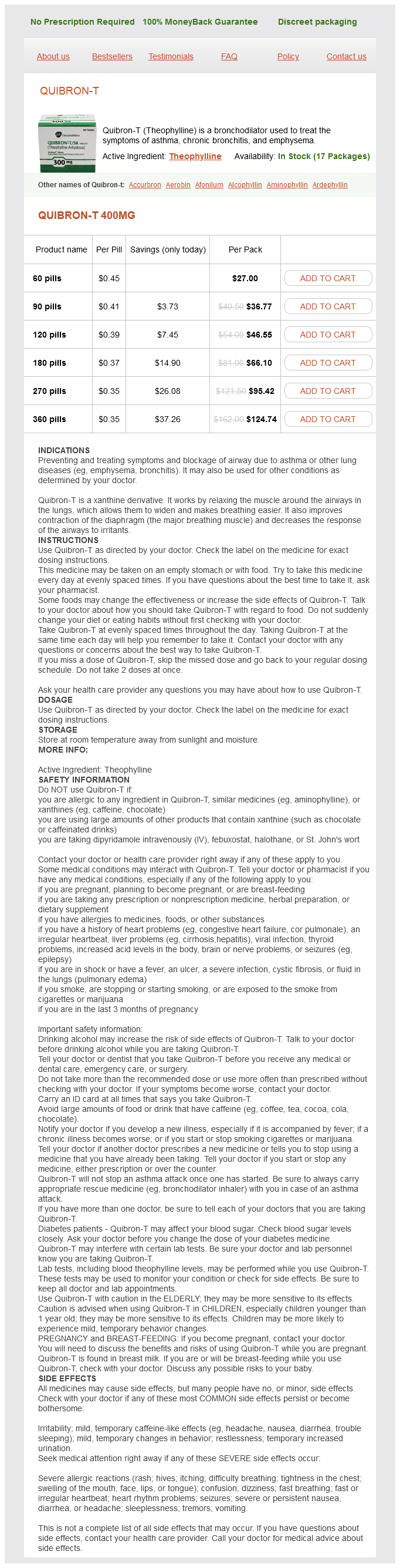
Quibron-t
Quibron-t 400mg
- 60 pills - $27.00
- 90 pills - $36.77
- 120 pills - $46.55
- 180 pills - $66.10
- 270 pills - $95.42
- 360 pills - $124.74
Quibron-t dosages: 400 mg
Quibron-t packs: 60 pills, 90 pills, 120 pills, 180 pills, 270 pills, 360 pills
In stock: 582
Only $0,37 per item
Description
Internal uterine manipulations carry the risks of uterine rupture and cervical damage in addition to that of colporrhexis allergy forecast oahu 400 mg quibron-t order visa. Therefore allergy medicine safe during pregnancy quibron-t 400 mg generic visa, exploration of the uterine cavity after the delivery of placenta and thorough inspection of the cervix and the vaginal vault are integral elements of the total operative procedure allergy symptoms hay fever symptoms order quibron-t 400 mg otc. Spontaneous vertex supply often follows artificial rupture of the membranes; if not allergy medicine cats 400 mg quibron-t generic, delivery can be completed with the vacuum extractor. Thus, transverse lie of the second twin might be the one good cause for inside model and extraction in trendy obstetrics. It consists of three steps: (1) introduction of the palms, (2) grasping the decrease extremity or extremities, and (3) model of the body. External version can lead to up to 70% reduction within the incidence of breech presentation at term. It was profitable in 68% of the instances, and all of those introduced in labor subsequently with vertex shows. Nulliparity, maternal weight problems, engagement of the breech, and uterine anomaly tended to scale back the success rate of external version. In the management group, only 18% of the presenting breeches transformed to vertex past week 37 of the pregnancy. Transient fetal heart fee decelerations had been famous during model in 36% of the makes an attempt (24% of successes and 63% of failures). External cephalic version is much less profitable in circumstances of frank breech, the place the splinting action of the extended fetal legs makes model troublesome to carry out. Other complications of external version include fetal misery; twisting, knotting, or laceration of the cord; placental separation; uterine rupture; untimely labor; premature rupture of the membranes; and spinal cord transection in utero. Parity, sufficient amniotic fluid, and unengaged presenting half are conducive to a successful model. It is really helpful that the external version procedure be carried out in accordance with a prearranged protocol. The availability of no much less than one assistant for the efficiency of the procedure is taken into account essential. For the efficiency of exterior version, the patient should take nothing by mouth for a minimum of 6 hours before the process. The placement of the patient right into a head-down Trendelenburg position (about 15�) is conducive to the disengagement of the presenting breech from the pelvis. It is considered advantageous by some to unfold fine talc powder over the stomach in order to facilitate the maneuver. As talked about earlier, the efficiency of a nonstress check at the end of the process is indicated in order to keep away from overlooking fetal distress resulting from the model. After the exact place of the fetus has been established by ultrasound, the physician performing the procedure positions himself/herself in such a fashion that he/she faces the fetus. The process itself begins with the operator lifting out the presenting breech from the pelvis and elevating it as high as possible with out the use of undue pressure. Thereafter, the breech is displaced toward the path of the fetal again, away from the pelvic inlet. At the identical time, the opposite hand of the operator makes an attempt to drive the top ahead and downward as if encouraging the fetus to do a somersault. A useful various strategy is to entrust the assistant with the elevation and displacement of the breech so as to allow the operator to use each palms for driving the head through 180� into the pelvic inlet while the breech is moved gently upward in the reverse direction. It is axiomatic in good obstetric follow to not force the version in the absence of success with one or two attempts or when, after what appears to have been an accomplished external version, the fetus repeatedly returns to its authentic position. It is to be remembered, furthermore, that a breech presentation carries less threat than a transverse lie. Accordingly, care have to be taken not to go away the fetus, initially presenting by the breech, mendacity in transverse or oblique position. Contrary to what one may anticipate, exterior version within the case of transverse lie is more difficult than when the presentation is breech. Particularly, when permitted to prevail until the late third trimester, the form of the uterus adjusts to the transverse lie of the fetus. Thus, when the axis of the physique adjustments from transverse to longitudinal, it hinders the maintenance of the desired presentation. Whereas after a successful external model from breech presentation the fetus often stays in vertex presentation, it tends to return to transverse hours or days after the process when model is attempted from a transverse lie. The fetus have to be judged normal, with no oligohydramnios or placenta previa demonstrated by commonplace sonography. That difficulties arising through the labor course of may be resolved by cesarean section is an old idea. On the opposite hand, it was accepted up to the final many years of the 20 th century that difficulties leading to the demise of the child may come up through the means of supply in a variety of medical conditions. The latter embrace shoulder dystocia within the process of delivering a fetus presenting by the vertex, interlocking of the heads of twins (thus stopping the delivery of the first one), arrest of supply of conjoined twins, and inability to ship the aftercoming head in breech presentation. Fetal death or catastrophic injury deriving from these problems has generally been considered inevitable by obstetricians till lately. The double-setup for supply of breech shows and twin deliveries along with the development of some contemporary techniques mentioned elsewhere in this quantity provides a chance for overcoming some difficulties through the vaginal delivery course of that had previously led to fetal demise or gross harm prior to now. Relevant to breech presentation, "stomach rescue" represents a determined, last-ditch effort to save fetal life in a situation when extraction of the aftercoming head or upper physique seems impossible with out probably catastrophic fetal damage. Under double setup, the same approach may be a sensible solution each time supply of the aftercoming head turns into inconceivable for some unforeseen reason, corresponding to deflexion of the fetal head during the means of supply, resistance supplied by an incompletely dilated cervix,52 or interlocking of the heads of twins. It is believed that the vaginal delivery of the premature breech fetus creates an increased danger of brain damage due to intracranial hemorrhage and birth trauma. This should embrace (1) frank breech position; (2) quick availability of cesarean part (including anesthesiologist and nursing staff); (3) estimated fetal weight 2000�3600 g; (4) sufficient medical pelvimetry, (5) absence of hyperextension of the fetal head; (6) absence of fetal misery; (7) absence of postmaturity; (8) regular progress of labor; (9), in case of second twin presenting by the breech, absence of a difference exceeding 3�4 mm between the biparietal diameters in favor of dual B. It is a crucial principle that the membranes in breech labor must be left intact so lengthy as possible. Since the small presenting parts permit the escape of a lot of the amniotic fluid after their rupture, breaking the membranes artificially is an invite for cord-related problems. Labor frequently is preceded by rupture of the membranes, an occasion that carries the risk of prolapse of the wire and its dire sequelae. Since no tangible improvement in prenatal mortality and morbidity rates derives from continued fetal maturation beyond completed week 38, the risk/benefit ratio of procrastination past this time, in cases the place vaginal supply in contraindicated, is certain to be unfavorable. Accordingly, the beneficial time for elective belly delivery is completed week 38 of gestation. With regard to the definition of the place of the fetus, it needs to be determined whether or not the fetus is in a dorsoanterior or dorsoposterior position. Those threat factors identified to be conducive to breech presentation are additionally conducive to this entity. The risks of early labor or rupture of membranes have to be dropped at the eye of the affected person. The precise presentation must be confirmed by ultrasound with the same concerns in mind which have been described for breech presentation. It is advisable to attempt the exterior model maneuver earlier with a transverse lie than in breech presentation because it becomes extremely troublesome, if not impossible, by the previous couple of weeks of gestation. By that time, the shape of the uterus has adjusted to the position of the fetus, and with the quantity of amniotic fluid lowered, it can no longer accommodate the kid in the longitudinal lie. For the identical purpose, variations that seem to be successful initially could often show to be a failure a couple of days later. Presumably on account of the lack of many of the amniotic fluid, fetuses in transverse lie fare poorly after the membranes have ruptured. Because of the high threat of prolapse of the wire (10%), elective supply at week 37 by cesarean part is beneficial. If the fetal back is turned downward, a decrease vertical or classical incision is needed. If the again is turned upward, the technique of stomach supply is essentially the same as in breech shows. Breech supply and intelligence: A population-based research of 8,738 breech infants. Risks and prevention of cervical twine harm within the administration of breech presentation with hyperextension of the fetal head. American Academy of Pediatrics and American College of Obstetricians and Gynecologists.
DESICCATED LIVER (Liver Extract). Quibron-t.
- Improving liver function, preventing liver damage, treating liver diseases, allergies, improving muscle development, improving strength and physical endurance, chronic fatigue syndrome (CFS), removing chemicals from the body (detoxification), chemical addiction recovery, or other uses.
- What is Liver Extract?
- Are there safety concerns?
- Dosing considerations for Liver Extract.
- How does Liver Extract work?
Source: http://www.rxlist.com/script/main/art.asp?articlekey=96971
In addition to attempting to improve the quality of life for the patients by way of manipulation of medicines and the environment allergy forecast okc purchase quibron-t 400 mg with mastercard, improvement in high quality of life for the caregiver is also crucial to success allergy forecast baltimore quibron-t 400 mg generic overnight delivery. In addition allergy forecast killeen 400 mg quibron-t mastercard, the identification of the different medical phenotypes might be needed to differentiate and individualize the treatment allergy medicine infant buy quibron-t 400 mg line. Diffuse intracytoplasmic ganglionic inclusions (Lewy type) associated with progressive dementia and quadriparesis in flexion. Diffuse type of Lewy body illness: progressive dementia with abundant cortical Lewy our bodies and senile adjustments of varying degree � a model new illness Prevalence of dementia in a semi-urban inhabitants in Sri Lanka: report from a regional survey. Dementia with Lewy bodies in accordance with the consensus standards in a basic population aged 75 years or older. Incidence and pathology of synucleinopathies and tauopathies associated to parkinsonism. Incidental Lewy physique illness: Do some circumstances symbolize a preclinical stage of dementia with Lewy bodies L-dopa responsiveness in dementia with Lewy bodies, Parkinson disease with and without dementia. Sensitivity and specificity of three clinical standards for dementia with Lewy our bodies in an autopsy-verified sample. Visual hallucinations in Lewy body disease relate to Lewy our bodies within the temporal lobe. Dopaminergic loss and inclusion body formation in alpha-synuclein mice: implications for neurodegenerative issues. Influence of Alzheimer pathology on clinical diagnostic accuracy in dementia with Lewy our bodies. Abundant neuritic inclusions and microvacuolar modifications in a case of diffuse Lewy body illness with the A53T mutation in the alpha-synuclein gene. Alpha- and gamma-synuclein proteins are current in cerebrospinal fluid and are elevated in aged subjects with neurodegenerative and vascular modifications. Gaucher illness with parkinsonian manifestations: does glucocerebrosidase deficiency contribute to a vulnerability to parkinsonism Mutations within the glucocerebrosidase gene and Parkinson disease: phenotype-genotype correlation. Cerebrospinal fluid beta-glucocerebrosidase activity is reduced in dementia with Lewy bodies. The development of cognition, psychiatric symptoms, and useful abilities in dementia with Lewy bodies and Alzheimer illness. Survival and mortality variations between dementia with Lewy our bodies vs Alzheimer disease. Better cognitive and psychopathologic response to donepezil in sufferers prospectively recognized as dementia with Lewy bodies: a preliminary study. Dementia with Lewy our bodies: choline acetyltransferase parallels nucleus basalis pathology. Cardiac (123)I-metaiodobenzylguanidine imaging allows early identification of dementia with Lewy bodies during life. The deposited tau shows attribute morphological appearances that aid with the analysis. All three patients had died and underwent pathological examination which revealed focal frontoparietal atrophy, the presence of achromatic swollen neurons, and neuronal loss and gliosis of the substantia nigra and cerebellar dentate nuclei. Given these particular findings the authors proposed the time period corticodentatonigral degeneration with neuronal achromasia. After the unique description, there were few reports of additional instances with comparable presenting features until Riley and colleagues printed a series of 15 patients in 1990 [2]. The onset of symptoms is typically around the fifth to seventh decade of life and disease period is roughly 7 years [9]. Cases with a fast development and much shorter illness length have additionally been described [10]. Rigidity, adopted by bradykinesia, postural instability, after which tremor, so as of reducing frequency, have been reported [20]. In addition, very early reviews have advised that the tremor tends to be seen with posture or motion, rather than at rest [2]. Postural instability might lead to falls and eventually the patient becomes wheelchair bound. In nearly all of instances dystonia affects the limbs, though there have been reports of patients having neck and trunk dystonia in addition to blepharospasm. Recently, larger case collection have been published that have confirmed earlier reports. Ideomotor limb apraxia tends to be bilateral but typically uneven, significantly early in the disease course. Corticobasal syndrome Alien limb phenomenon A subset of sufferers with limb apraxia will develop what is called an "alien limb phenomenon". In alien limb phenomenon, the affected person observes that the limb behaves as if it has a thoughts of its personal. Alien limb phenomenon sometimes is noticed in the higher extremities but can also affect the lower extremities [18]. Patients with an alien limb may personify the limb and refer to it as "my little good friend", or time period it "this thing". The corticobasal syndrome is characterised by the presence of uneven parkinsonism and cortical dysfunction [32]. This syndrome is characterised by symmetric parkinsonism, with postural instability and falls and vertical supranuclear gaze palsy. Neuropathological studies of such circumstances have revealed a shifting of the tau deposition with more tau deposited in limbic and hindbrain buildings in those presenting with a progressive supranuclear palsy syndrome [52, 53]. Sometimes there can be overlap between options of the corticobasal syndrome and features of the progressive supranuclear palsy syndrome, known as the hybrid syndrome [54]. Some sufferers had features of the progressive supranuclear palsy syndrome however many either offered with, or additionally had, comparatively severe behavioral changes and govt dysfunction [55]. These sufferers tended to be on average 5 years youthful than those with an asymmetric presentation. In such situations the speech output is characterised by the production of distorted sounds and sound substitutions. One such syndrome is posterior cortical atrophy by which sufferers have visual spatial and visuoperceptual deficits [9, 17]. Another syndrome is that of behavioral variant frontotemporal dementia by which sufferers current with behavioral dyscontrol and government dysfunction [9, 50, 57]. Neuronal inclusions tend to be found in small neurons in the higher lamina of the cortex, or they may be noticed in brainstem nuclei, for example within the substantia nigra or locus coeruleus. In unique descriptions, neuronal inclusions in the substantia nigra had been referred to as corticobasal our bodies [4]. Tau is a microtubule associated protein that capabilities to promote assembly and to stabilize microtubules. Tauopathies can subsequently be divided into those by which exon 10 is spliced in, and there are four conserved repeat sequences (4R tau), and people during which exon 10 is spliced out, and there are 3 conserved repeat sequences (3R tau). The superior frontal gyrus is usually more affected than center and inferior frontal gyri [3]. Unless the affected person had a posterior cortical atrophy presentation, the occipital lobe is usually spared. On sectioning the brain, cerebral white matter volume loss and thinning of the corpus callosum are observed [59]. Regions of the basal ganglia, including globus pallidus, striatum, and subthalamic nuclei, in addition to thalamic nuclei and brainstem regions, are variably affected. The chromosomal region containing the microtubule associated protein tau gene has been proven to contain two major haplotypes, H1 and H2, outlined by linkage disequilibrium between a number of polymorphisms over the whole gene. Other neocortical regions can be affected, as can basal ganglia, brainstem, and cerebellar regions, however to a lesser degree. Note focal superior frontal (premotor) atrophy (arrow) (A), and microscopic findings of balloon neurons on hematoxylin and eosin (B) and tau (C), cortical pre-tangles on tau (D), astrocytic plaque (asterisk) on tau (E), and white matter threads (arrow signifies a coiled body) on tau (F) staining. The 3D surface renders show cortical gray matter loss within the medial and lateral posterior frontal lobes, significantly premotor cortex, with relative sparing of the temporal, parietal, and occipital lobes and frontal pole.
Specifications/Details
An excitotoxin(s) current in the seeds of the cycad plant allergy symptoms 2013 quibron-t 400 mg purchase visa, a food staple of the natives allergy history order 400 mg quibron-t with visa, has been implicated however not proven to be the trigger [21] allergy testing babies 400 mg quibron-t buy otc. Some evidence means that some situations of common sporadic types of neurodegenerative problems are caused by an environmental excitotoxin or an agent that renders neurons susceptible to excitotoxicity allergy symptoms for penicillin 400 mg quibron-t purchase. Pathology/pathophysiology particular to the disease the morphological and biochemical features of excitotoxic degeneration of neurons have been extensively studied and reviewed [1, 29, 30]. Excitotoxic neuronal dying can manifest in two distinct forms, necrosis and apoptosis. Necrosis is characterised by fast swelling of the cell and intracellular organelles accompanied by disruption of membrane integrity and cell lysis. Because glutamate receptors are concentrated in postsynaptic areas of dendrites, the dendrites will usually swell and degenerate, followed by the cell body and the axon. The axon could stay intact for some time (many hours) after the relaxation of the neuron is "lifeless" because it lacks glutamate receptors [31]. Neurons present process glutamate receptor-mediated apoptosis exhibit a reduction within the size of the cell body and nuclear chromatic condensation and fragmentation, with retention of plasma membrane and organellar integrity. Cellular power levels are sometimes maintained, albeit at a decreased degree, till late within the cell death process. Two of the neurons were delicate to excitotoxic necrosis (S), whereas the other neuron was resistant (R). Typically, acute insults corresponding to an ischemic stroke or traumatic mind injury end in fast (minutes to hours) necrosis of neurons in the most severely affected brain region, and delayed (many hours to days or weeks) apoptotic dying of neurons within the surrounding less severely affected regions. Glutamate receptor activation is, by definition, the set off of excitotoxic harm to neurons. Both the intensity and duration of glutamate receptor activation can determine whether or not or not excitotoxicity occurs. Importantly, the brink level of glutamate receptor activation that may set off excitotoxic harm is influenced by many alternative components including the level of activation of different neurotransmitter receptors on the identical neuron, cellular power availability, the presence of neurotrophic factors, and oxidative stress. There are no much less than 4 various sorts of glutamate receptors, all of which are largely concentrated within the postsynaptic plasma membrane, though some glutamate receptors are positioned extrasynaptically. In addition, some of the glutamate receptors are expressed in astrocytes and oligodendrocytes. In distinction to the ionotropic receptors, if and to what extent metabotropic receptors (mGluRs) contribute to excitotoxic processes stays to be established [37]. In addition, mGluRs also activate protein kinase C which may up-regulate the expression of genes encoding proteins that promote neuronal survival. Moreover, there are five mGluRs, some of which have been reported to promote excitotoxicity whereas others defend neurons towards excitotoxicity. Sodium and calcium inflow are the immediate occasions resulting from glutamate receptor activation that, in flip, provoke excitotoxic neuronal injury. Ca2+ prompts, directly or not directly, a number of enzymes involved in excitotoxic cell dying together with calpains [43], caspases [44], and oxidases [45]. The ordinary focus of Ca2+ in neurons beneath resting conditions is approximately one hundred nM, and in response to normal synaptic activation of glutamate receptors the native dendritic Ca2+ focus can improve more than 10-fold, however then rapidly returns to the basal level inside seconds. However, excitotoxicity happens when the Ca2+ concentration is elevated for prolonged time intervals, even if the magnitude is significantly less than that which occurs regionally during synaptic activation. Dysfunction of one or more of these Ca2+-lowering techniques may render neurons weak to excitotoxicity. Oxidative stress is another contributory consider excitotoxicity, particularly the slower non-necrotic forms of glutamate receptormediated cell dying. Hydrogen peroxide, in turn, may be transformed to water through the activities of catalase and glutathione peroxidase. However, even very low quantities of Fe2+ or Cu+ can act upon hydrogen peroxide to trigger the manufacturing of hydroxyl radical which is very reactive and "attacks" double-bonds in membrane fatty acids to provoke a self-propagating process called lipid peroxidation [48]. Another major source of oxidative stress in the course of the excitotoxic process is the enzyme nitric oxide synthase, which is activated by Ca2+ resulting in the production of the free radical nitric oxide. Nitric oxide can harm mobile proteins by first interacting with superoxide ensuing within the era of peroxynitrite which, in turn, instantly reacts with tyrosine residues in proteins resulting in protein nitration [49]. In a process called the Michael addition, 4-hydroxynonenal covalently modifies proteins on cysteine, lysine, and histidine residues. Genetics Because excitotoxicity is a mechanism of neuronal degeneration and not a disease per se, the genetics of excitotoxicity may be outlined because the inheritance of genes that increase (or decrease) the vulnerability of neurons to excitotoxicity. At one end of the spectrum is epilepsy, which can be considered a (largely) excitotoxic dysfunction. Considerable progress has been made in figuring out genetic aberrancies that cause inherited types of epilepsy. Mutations in Cl- channels, K+ channels, and the K+/Cl- cotransporter also can cause syndromes that embrace seizures as a prominent symptom [56]. Other mutations have been identified in proteins not previously related to the regulation of neuronal excitability including leucine-rich glioma inactivated 1 which causes autosomal dominant partial epilepsy with auditory options [57]. Beyond epilepsy, the case might be made that mutations that trigger other neurological issues involving neuronal degeneration enhance the vulnerability of neurons to excitotoxicity. By mechanisms not but understood, mutant huntingtin renders medium spiny neurons in the striatum weak to excitotoxic degeneration [63]. Thus, there are many genetic factors that can promote excitotoxicity, particularly when neurons experience the adversities of growing older or a pro-excitotoxic environment (see Environment). Instead, two environmental elements that will influence neuronal vulnerability to excitotoxic degeneration are food plan (particularly energy intake) and exercise. Perhaps the primary evidence that food regimen can modify excitotoxicity was back in round 400 bc when Greek physicians similar to Erasistratus discovered that seizures could probably be reduced by fasting. Wilder at the Mayo Clinic found that seizures can in lots of cases be managed by a food plan high in fats and low in carbohydrates and protein [68]; this type of diet is believed effective as a result of it increases the extent of fatty acids (ketone bodies) out there to neurons. Fasting additionally elevates ranges of ketone bodies, suggesting that a ketogenic food regimen and fasting might share a typical excitoprotective mechanism of action [69]. Intermittent energy restriction also can enhance the result of traumatic spinal cord damage [77] and traumatic mind injury [78]. Recent findings have offered proof that dietary power restriction, particularly intermittent fasting, can shield neurons towards excitotoxicity by inducing a mild adaptive mobile stress response [79]. A set of adaptive stress response proteins that overlaps with these up-regulated by power restriction is also up-regulated in response to train and cognitive stimulation (Table four. Epidemiological research and interventional trials in humans have proven that common train throughout life is beneficial for brain well being generally and will defend against multiple neurodegenerative problems [80�82]. Exercise enhances synaptic plasticity and stimulates neurogenesis within the hippocampus, each of which have been associated with improved studying and memory, significantly spatial studying and pattern separation [87, 88]. Exercise can even induce the expression of vascular endothelial growth issue, which promotes the growth of cerebral blood vessels and enhances cerebral blood flow [89, 90]. Collectively, the available evidence means that lack of exercise, excessive energy consumption, and diets high in trans fatty acids 42 Neurodegeneration Table 4. Because all of these environmental elements are modifiable, main healthcare efforts should focus on mitigating these dangers. Medical school curricula ought to embody an emphasis on preventative drugs with new approaches for prescribing food regimen and life-style interventions, and follow-up to enhance compliance. Diagnostic issues in excitotoxicity There are at present no specific diagnostic checks for excitotoxicity per se. Instead, problems that contain excitotoxicity are recognized based mostly upon the established criteria for these issues. An various to medicine that block a particular early event within the excitotoxic cascade (glutamate release, glutamate receptor activation, or Ca2+ influx) is to interact adaptive cellular stress responses in order to assist neurons restore cellular ion and power homeostasis. Dietary interventions are a viable strategy for lowering neuronal harm and practical impairment in acute neurodegenerative conditions and for delaying or eliminating the onset of a quantity of age-related neurodegenerative problems. Pharmacological approaches for excitoprotection that target cellular vitality metabolism have proven effective in animal fashions and have, in some cases, moved to clinical trials in people. Treatment approaches Because epilepsy is the result of neuronal hyperexcitability and uncontrolled activation of glutamatergic synapses, the remedies for epilepsy can be considered anti-excitotoxic. While all antiepileptic drugs inhibit neuronal community activity, the molecular mechanisms of motion differ amongst the medicine [91]. There is also a potential for anti-excitotoxic brokers to retard the neurodegenerative process in age-related neurodegenerative disorders.
Syndromes
- Missing and rotted teeth (called "meth mouth")
- Blockage of a ureter due to scarring, tumor, urinary stones
- Rheumatoid arthritis
- Infection (a slight risk any time the skin is broken)
- Abdominal CT scan
- You experience persistent fungal nail infections
- Hematoma (blood accumulating under the skin)
Related Products
Additional information:
Usage: q.i.d.
Tags: quibron-t 400 mg discount without prescription, 400 mg quibron-t cheap overnight delivery, 400 mg quibron-t with visa, quibron-t 400 mg buy discount on line, 400 mg quibron-t with mastercard, quibron-t 400 mg discount with mastercard, quibron-t 400 mg cheap mastercard, generic quibron-t 400 mg overnight delivery, quibron-t 400 mg generic fast delivery, purchase quibron-t 400 mg line, quibron-t 400 mg buy generic line, safe quibron-t 400 mg, quibron-t 400 mg buy, quibron-t 400 mg buy cheap on line, quibron-t 400 mg discount without a prescription, 400 mg quibron-t
8 of 10
Votes: 46 votes
Total customer reviews: 46
Customer Reviews
Tom, 21 years: Remarks on the lymphatics of the reproductive tract of the female rhesus monkey (Macaca mulatta).
Lukjan, 37 years: After the delivery of the first infant, most practitioners keep the patient on bed relaxation till the being pregnant is completed, beneath shut observation for indicators of impending an infection.
Volkar, 24 years: Close to the lateral border of the rectus muscle, the inferior epigastric artery pierces the transversalis fascia and enters the rectus sheath by passing in entrance of the arcuate line.