
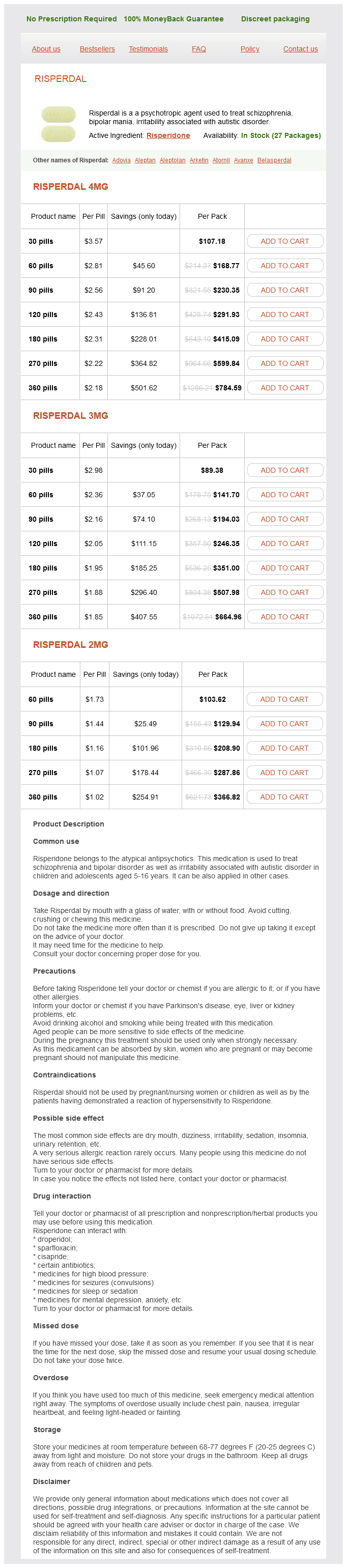
Risperdal
Risperdal 4mg
- 30 pills - $107.18
- 60 pills - $168.77
- 90 pills - $230.35
- 120 pills - $291.93
- 180 pills - $415.09
- 270 pills - $599.84
- 360 pills - $784.59
Risperdal 3mg
- 30 pills - $89.38
- 60 pills - $141.70
- 90 pills - $194.03
- 120 pills - $246.35
- 180 pills - $351.00
- 270 pills - $507.98
- 360 pills - $664.96
Risperdal 2mg
- 60 pills - $103.62
- 90 pills - $129.94
- 180 pills - $208.90
- 270 pills - $287.86
- 360 pills - $366.82
Risperdal dosages: 4 mg, 3 mg, 2 mg
Risperdal packs: 30 pills, 60 pills, 90 pills, 120 pills, 180 pills, 270 pills, 360 pills
In stock: 741
Only $1,08 per item
Description
Vasa recta provide substrate for medications quiz 2 mg risperdal discount fast delivery, and remove finish products of medicine tour discount 3 mg risperdal free shipping, metabolic reactions medicine gabapentin risperdal 4 mg generic with visa. Interested readers are referred to a current evaluation of the renal medullary microcirculation administering medications 8th edition 2 mg risperdal generic with mastercard. In the outer stripe, these vessels divide into descending vasa recta that kind vascular bundles within the inside stripe of the outer medulla. Peripherally positioned vessels can kind an interbundle capillary plexus in close proximity to metabolically energetic thick ascending limbs and amassing ducts. More centrally situated descending vasa recta penetrate to the deep portion of the inner renal medulla. In the inside stripe vascular bundles, descending and ascending vasa recta in addition to thin descending loops of Henle from shortlooped nephrons are in shut apposition. Descending vasa recta have continuous endothelial cells and pericytes (contractile clean muscle remnants). Descending vasa recta are nicely situated adjacently in vascular bundles and likewise in deeper parts of the medulla to obtain NaCl and urea from ascending vasa recta and to ship water toward the ascending vessels down concentration gradients. As a end result, fluid within the descending vessel penetrates deep within the medulla and carries a high solute concentration near that within the interstitium. The driving pressure for passive lack of this solute from interstitium to vessels is thereby minimized. This segment can take up solute from ascending vasa recta and recycle it to accumulating ducts traversing the deep medulla, the place solute and water are further reabsorbed. If the papilla is bathed with solutions of various osmolality and urea concentrations, the osmolality of urine from the papillary tip increases when the urea tub focus is elevated, but not essentially when the bathtub osmolality is altered. In addition, not all rodents present a relation between extensions of renal pelvis and fornices round their papillae and the ability to maximally focus urine. They characterize molecular water-transporting channels and are expressed in a broad variety of tissues. These tissues have high water permeability and facilitate the constitutive movement of water down an osmotic gradient. To determine whether this protein behaved as a water channel, investigators employed Xenopus oocytes, which might survive in fresh water owing to their very low water permeability. This remark was confirmed by reconstituting the purified protein into proteoliposomes and demonstrating a dramatic improve in osmotic water permeability. Aquaporin-1 is found in renal proximal tubules, long-loop thin descending limbs of Henle, and nonfenestrated endothelium of descending vasa recta. In nephron segments, this protein is recognized in both apical and basolateral membranes, together with both basal and lateral infoldings, but to not any substantial diploma in cytoplasmic vesicle and vacuole membranes. This is likely related to the need for speedy equilibration of water across the skinny descending limb of Henle in helping establish the countercurrent multiplication process. Medullary circulation consists of network of interconnecting vessels and major thoroughfares. During antidiuresis, individual cells are more distinct, and intercellular spaces are broadly dilated. If one excises the ureter to expose the renal papilla of a rat, urine osmolality on the papillary tip drops by almost 40%. Urea could then recycle from pelvic urine to the medullary interstitium and assist keep a high medullary urea concentration gradient, enhancing abstraction of water from skinny descending limbs of Henle. Alternatively, there may be solute switch across this section associated with aquaporin-independent water circulate. Furthermore, some staining for aquaporin-2 happens in basolateral plasma membranes of internal medullary collecting-duct principal cells. There can additionally be evidence that aquaporin-2 performs a serious role in the long-term adaptation to pathophysiologic stimuli known to alter urinary concentrating ability. In addition, the sluggish restoration is marked by persistence of decreased aquaporin-2 expression. When hypokalemia was induced by potassium deprivation for eleven days, polyuria correlated with downregulation of aquaporin-2 in each the cortex and internal medulla of rat kidneys. Polyuria expression of aquaporin-2 corrected within per week of potassium repletion. In a renal artery clamp model of ischemic acute renal failure, decreased accumulating duct aquaporin-2, 3, and four have been documented, in association with impaired elements of the countercurrent concentrating mechanism, which generates the hyperosmotic driving drive for water transport via the aquaporins water channels. Finally, within the hypothyroid rat a major diminution in renal concentrating capacity has been documented. This defect appeared multifactorial and partially as a end result of a lower in aquaporin-2 expression and trafficking to the apical membrane of the amassing duct. Staining of aquaporin-2 was not as intense as in cortical amassing ducts, however nonetheless was current in large quantities and was up-regulated in segments dissected from animals that had been thirsted. Water not reclaimed within the cortical vascular circulation but delivered to the deeper medulla might dilute the medullary interstitium and impair maximal concentrating ability. Distribution of aquaporin-2 in rat internal medulla is regulated by a stability between vasopressin and prostaglandin E2. Decreased prostaglandin E2 manufacturing, as induced by cyclooxygenase inhibition, leads to reduced endocitosis of aquaporin-2 and subsequently increased abundance of aquaporin-2 plasma membrane with associated water reabsorption. Labeling is just about absent from the apical plasma membrane and is modest for intracellular cytoplasmic vesicles. It is extra prominent within the inside medullary base than within the papillary tip and is present in basolateral (both basal and lateral domains) rather than apical membranes. The role of aquaporin-4 has been further assessed in transgenic knockout mice missing aquaporin-4. One study from Agre86 suggests that this aquaporin could presumably be implicated in the urine acidification course of. The protein appears to be current in intracellular vesicles, not plasma membranes, and may symbolize an intracellular water and ion channel. Chloride channels would be poised to facilitate transmembrane motion of solute and, in reality, such channels. The channel was localized to both apical and basolateral membranes in one study89 and primarily on the basolateral membrane in another. Although this channel can be present in other, more distal segments in each cortex and medulla, its location within the skinny ascending limb underscores its function in concentrating and diluting urine. In this regard, dehydration was shown to enhance expression of the ClC-K1 channel in cortical and medullary segments. Moreover, knockout mice deleted of ClC-K1 confirmed medical nephrogenic diabetes insipidus, a defect that was attributed to impaired generation of inside medullary hypertonicity somewhat than decreased accumulating duct water permeability. At all ranges of the medulla (outer and inside stripes of the outer medulla as nicely as the internal medulla), but particularly within the inside stripe, in which the vessels located inside the vascular bundle are separated only by a skinny layer of interstitium, solute has the potential to leave ascending vasa recta and enter descending vasa recta. Some of this solute can be taken up by descending loops of Henle from short-loop nephrons which might be additionally throughout the bundle. When deep within the medulla, the solute could be transferred to ascending vasa recta or to ascending loops of Henle and might then reenter the descending loop of Henle to recycle within the medulla. In the outer stripe of the outer medulla, fluid in the ascending loop, as well as the ascending vasa recta, may be able to enter the proximal straight tubules of short- and long-looped nephrons. Urine leaving the renal papillary collecting ducts enters the renal pelvis and might find a way to flow into in the pelvic areas to bathe parts of the outer medulla. There is the potential for urea to recycle again to the medulla and contribute additional to urinary focus. InSpitzerA,editor:The kidney throughout improvement: morphology and function, New York, 1982,Masson,pp223�231. Loops of Henle, vasa recta, and tubules should have established the mandatory anatomic relationship. Therefore free water clearance, defined as urine move rate minus osmolar clearance, is decreased, indicating that free water is extra effectively separated (reabsorbed) from solute in the older fetal kidney. Cells swelled with conspicuous dilation of intercellular spaces, indicating outward net move of water by way of intercellular areas and thru cell membranes. This response happens in nearly all (9 out of 10) near-term fetuses of more than a hundred thirty days and approximately half (5 out of 9) of younger fetuses of less than 120 days. There is a sharp improve after 20 days, reaching adult levels by the fifth week of life. Loops of Henle are short,135,136 and salt reabsorption in thick ascending limbs is restricted in youth.
Citrus (Grapefruit). Risperdal.
- How does Grapefruit work?
- What is Grapefruit?
- Are there safety concerns?
- Asthma, lowering cholesterol, hardening of the arteries (atherosclerosis), preventing cancer, weight loss, psoriasis, muscle fatigue, promoting hair growth, toning the skin, reducing acne and oily skin, treating headaches, stress, depression, infections, digestive complaints in people with eczema, yeast infections (as a vaginal douche), and other conditions.
- Are there any interactions with medications?
- Dosing considerations for Grapefruit.
Source: http://www.rxlist.com/script/main/art.asp?articlekey=96909
Carpenter G: Epidermal growth issue is a serious growth-promoting agent in human milk symptoms 6 days past ovulation 3 mg risperdal discount. Hara T medications a to z order risperdal 3 mg free shipping, Irie K 85 medications that interact with grapefruit risperdal 4 mg cheap otc, Saito S treatment for shingles order 2 mg risperdal with visa, et al: Identification of macrophage colony-stimulating think about human milk and mammary epithelial cells. Brantl V: Novel opioid peptides derived from human beta-casein: human -casomorphins. Jyonouchi H, Zhang-Shanbhag L, Georgieff M, et al: Immunomodulating actions of nucleotides: enhancement of immunoglobulin production by human cord blood lymphocytes. Eiwegger T, Stahl B, Schmitt J, et al: Human milk�derived oligosaccharides and plant-derived oligosaccharides stimulate cytokine production of wire blood T-cells in vitro. Schack L, Lange A, Kelsen J, et al: Considerable variation in the concentration of osteopontin in human milk, bovine milk, and toddler formulation. De Wit D, Olislagers V, Goriely S, et al: Blood plasmacytoid dendritic cell responses to CpG oligodeoxynucleotides are impaired in human newborns. Vigano A, Esposito S, Arienti D, et al: Differential development of type 1 and kind 2 cytokines and beta-chemokines within the ontogeny of wholesome newborns. Oei J, Lui K, Wang H, et al: Decreased interleukin-10 in tracheal aspirates from preterm infants growing persistent lung disease. Brandtzaeg P: Mucosal immunity: integration between mom and the breastfed toddler. Peltola H, Kaayhty H, Virtanen M, et al: Prevention of Haemophilus influenzae type b bacteremic infections with the capsular polysaccharide vaccine. Toivanen P, Rossi T, Hirvonen T: Immunoglobulins in human fetal sera at completely different levels of gestation. Winberg J, Wessner G: Does breast milk protect towards septicaemia within the new child Narayanan I, Prakash K, Bala S, et al: Partial supplementation with expressed breast-milk for prevention of an infection in low-birth-weight infants. American Academy of Pediatrics, Section on Breastfeeding: Breastfeeding and using human milk. K�hn R, L�hler J, Rennick D, et al: Interleukin-10-deficient mice develop persistent enterocolitis. Lindberg T, Ohlsson K, Westr�m B: Protease inhibitors and their relation to protease exercise in human milk. Bach J-F: the effect of infections on susceptibility to autoimmune and allergic illnesses. Wright S, Bolton C: Breast milk fatty acids in moms of children with atopic eczema. Duch�n K, Yu G, Bj�rksten B: Atopic sensitization in the course of the first yr of life in relation to lengthy chain polyunsaturated acid levels in human milk. Despite the decrease airway being sterile, the higher airway turns into quickly colonized with bacteria that could be aspirated into the decrease airway; thus the lung has advanced an array of host defense mechanisms to prevent development of an infection in the air house. This robust improvement of pulmonary host defense mechanisms was an essential step in the evolution of air-breathing animals. The main physiologic aspect of the lung is to perform gas exchange- particularly the trade of oxygen and carbon dioxide across the alveolar capillary membrane. To preserve this operate, the lungs will must have buffering capacity within the airway and alveolar space to neutralize probably injurious brokers together with pathogens. This is a problematic task in that the alveolar surface area requiring safety is 20 times the typical neonatal body floor area. Available pulmonary host defenses may be broadly categorized as both structural or immunologic. Examples of structural defenses embody the larynx and epiglottis (which are anatomically situated to decrease aspiration of oropharyngeal material), airway angulation, mucus secretion, and mucociliary clearance mechanisms together with the cough reflex. These mechanisms result in progressive filtering of about 99% of inhaled particles as they cross by way of the conducting airways so that overall degree of antigen exposure at a given website is inversely associated to its depth throughout the respiratory tree. Immunologic mechanisms may be divided into innate immune response and adaptive immune response. Innate immunity is rapid (within minutes to hours) and usually lacks specificity towards the pathogen. Adaptive immunity takes longer to develop (days as opposed to minutes to hours), is more pathogen specific, and is characterised by recombination of cell floor receptors to obtain pathogen specificity in each B-lymphocytes and T-lymphocytes. Although surfactant was initially described because the important phospholipid component of the alveolar lining fluid that reduces surface rigidity and permits successful transition from liquid respiratory in the fetus to air breathing in the neonate, surfactant additionally plays important roles in innate immunity. Macrophages categorical a wide selection of phagocytic receptors to ingest and kill pathogens together with Dectin-1, macrophage mannose receptors, and scavenger receptors. Thus these cells can secrete cytokines that control mucosal immunity, however endure restricted T cell receptor rearrangement compared with classic T cells, which orchestrate more specific adaptive immunity. The recruitment of T cells and B cells heralds the onset of the adaptive immune response. These cells express T cell and B cell receptors that bear genetic reengagement in order that the receptor has excessive affinity for peptides that are antigen specific. The latter population is able to responding far more quickly than naive cells if the antigen is reencountered by the host. Adaptive immunity thus initiates a focused response geared toward containment and clearance of a selected antigen, permitting titration of nonspecific-and potentially host-injurious-alveolar irritation. During air entry, the nostril performs humidification of entrained air and in addition serves as an essential filter. The turbulent airflow that exists within the upper airway facilitates particle deposition within the upper airway. The next barrier to shield the decrease airway is the larynx, which consists of the epiglottis, aryepiglottic folds, and glottis. Nervous innervation into these structures supplies a gag and cough reflux, which minimizes oropharyngeal aspiration. Particles smaller than 10 �m may be inhaled into the decrease respiratory tract, and particle deposition is greatest at areas of airway bifurcation. An essential clearance mechanism within the lower airways is cough and mucociliary clearance, which is coordinated by specialized epithelia cells. There is hierarchy of cell populations when touring from the massive airways to the alveolar ducts. In the trachea and enormous airways, ciliated columnar epithelium forms an basically continuous epithelium, with a ratio of ciliated cells to goblet cells of 5: 1. The glycocalyx has also been shown to be a critical barrier to forestall infection of the epithelium by various respiratory viruses. Repetition of this process in adjacent doublets, in a unidirectional front circumferentially, causes the sequential movement of fibers that affect cilia movement. As a cilium swings backward into its restoration stroke, it engages different resting cilia, stimulating them to begin a recovery stroke; this mechanical recruitment is pivotal for the coordinated beating of airway cilia. Endogenous mechanisms that enable such native ciliary beat modulation have been described. Local physiologic loads to airway epithelium, similar to elevated portions of mucus, can mechanically stimulate elevated ciliary beating in vivo; this impact seems to be mediated by elevated cytosolic calcium and could be reproduced pharmacologically by brokers that modulate intracellular calcium ranges. The cells in the massive airways exist as a pseudostratified epithelium with every cell having contact with the basement membrane. These cells specific apical-tight junctions that limit passive diffusion or pathogen movement throughout the lateral intracellular space, augmenting local mechanical limitations. Excluding areas of the larynx and pharynx the place squamous epithelium predominates, ciliated epithelium is present from the higher respiratory tract to the level of the respiratory bronchioles. In addition to the ciliated epithelium, there are a variety of various nonciliated cell sorts including mucus-producing goblet cells, serous cells, club cells, neuroendocrine cells, and basal cells. Ciliogenesis commences within the higher trachea early in gestation (week 7) and proceeds distally; by week 24 of gestation, the fetal airway epithelium resembles that of the mature trachea. Epithelial cell sorts answerable for mucus production embody the goblet cells, serous cells, and club cells. Goblet cells are found predominantly in massive airways and are the principal supply of mucus. Club cells are found only in small airways and produce watery secretions; serous cells have related location and performance, but have been recognized solely in fetal tissues. Club cells also serve as a likely stem cell for regeneration of ciliated epithelium.
Specifications/Details
Contents of the -granules treatment irritable bowel syndrome cheap 4 mg risperdal with amex, similar to fibrinogen symptoms depression 3 mg risperdal free shipping, thrombospondin symptoms 4 days before period purchase risperdal 4 mg online, and von Willebrand issue medications xl buy 2 mg risperdal, also correlate with megakaryocyte maturation. Of current interest is how such factors may be liable for stage-specific differences noted between neonatal and adult megakaryopoiesis. Some of the most effective understood transcription components that play a task in megakaryopoiesis are summarized here. The patterns of endomitosis are somewhat completely different between high-ploidy and low-ploidy megakaryocytes. For these causes, other criteria have been established for mega- Proliferation Progenitor Precursor Microtubulin formation is required for proplatelet formation and subsequent release of platelets from the megakaryocyte. Overexpression of Ets-1 in cultured megakaryocytes ends in a state of elevated proliferation with larger megakaryocytes which have an increased number of nuclear lobes. This medical phenotype can happen independently or as a part of Jacobsen syndrome (platelet defects with cardiac anomalies, facial anomalies, psychological retardation). In both situations, megakaryocytes are elevated in quantity however have a diminished number of -granules, as well as a disorganized internal membrane. However, all makes an attempt to isolate and purify Tpo from these sources failed, until the fortuitous discovery within the early 1990s of a viral myeloproliferative leukemia virus oncogene (v-mpl), whose construction advised that it was a member of the hematopoietic growth issue receptor superfamily. With use of fluorescence in situ hybridization, the gene that encodes Tpo was localized to 3q26-27. Early studies by several investigators demonstrated that, in steady-state and in noninflammatory situations. Recently, a mechanism through which platelets themselves regulate hepatic Tpo manufacturing was described. Specifically, c-mpl mutations causing frameshifts and early termination trigger congenital amegakaryocytic thrombocytopenia, a dysfunction sometimes characterised by extreme thrombocytopenia and absence of megakaryocytes starting in infancy. In the years after the isolation of Tpo, a number of in vitro and in vivo research were carried out to characterize the role of this cytokine. It quickly grew to become evident that Tpo acted each as a potent proliferative factor (megakaryocyte colony stimulating factor) and as a maturational factor on megakaryocytes. This suggests that Tpo is the first regulator of platelet manufacturing but that various pathways exist for megakaryocytopoiesis. Onbindingtoplatelet c-mpl receptors, the hormone is removed from the circulation and destroyed,whichreducesbloodlevels. As an alternate, much interest was directed to the development of Tpo-mimetic molecules. The lack of homology represents a significant advantage over recombinant types of Tpo as a outcome of it should preclude the development of crossreactive neutralizing antibodies in opposition to endogenous Tpo. At least 5 different Tpo receptor agonists have been described,95-97 and three have been studied in humans. Romiplostim is an engineered peptibody composed of a recombinant protein service Fc area linked to multiple c-mpl binding domains, and eltrombopag is an oral, nonpeptide Tpo receptor agonist. Both have shown great efficacy and an appropriate security profile in medical research in adults and kids, although no studies in neonates have been printed. Because of that, most research have been carried out with umbilical wire blood, from which large quantities of megakaryocyte progenitors could be readily obtained. Zauli and colleagues140 in contrast megakaryocyte colonies derived from fetal blood and megakaryocyte colonies derived from grownup bone marrow. Other investigators also reported the existence of a megakaryocyte progenitor with an unusually excessive proliferative potential in human fetal bone marrow. This cell, not noticed in adult bone marrow cultures, could characterize a extra primitive megakaryocyte progenitor. The development of miniaturized assay systems to study megakaryocyte progenitors made it possible to research these cells within the peripheral blood of neonates. This discovering was in concordance with the beforehand described gestational age�related lower within the focus of other dedicated hematopoietic progenitors. On the basis of the premise that circulating megakaryocyte progenitors are a reflection of bone marrow megakaryocytopoiesis, investigators utilized these assays to the evaluation of thrombocytopenic neonates. Murray and Roberts146 quantified circulating megakaryocyte progenitors in preterm neonates with early thrombocytopenia secondary to maternal preeclampsia or intrauterine progress restriction. They observed that the concentration of circulating progenitors in those neonates was considerably decrease than in nonthrombocytopenic preterm neonates and elevated because the thrombocytopenia resolved, suggesting that decreased platelet manufacturing underlies this number of thrombocytopenia. Every stage of megakaryocyte development might be discovered within the liver section, although megakaryocytes at every stage had been smaller than their grownup counterparts. They reported that, at all phases of maturation, fetal megakaryocytes have been substantially smaller than adult megakaryocytes (Table 117-3). Allen Graeve and de Alarcon161 also reported decrease megakaryocyte ploidy levels in fetal bone marrow biopsy specimens in contrast with grownup bone marrow biopsy specimens. Hegyi and colleagues162 cultured megakaryocytes from livers obtained from 8- to 20-week fetuses and from umbilical twine blood and in contrast their dimension, maturity, and ploidy with those of cultured adult bone marrow megakaryocytes. They discovered a progressive shift to larger ploidy lessons and to bigger megakaryocytes during improvement. These findings supported earlier observations by Kelemen and colleagues,163 who stated that "megakaryocytes with only one to four nuclei produce the platelets of the fetus. Results just like those obtained in the analysis of cultured megakaryocytes or fetal necropsy specimens (which can be related to artifacts) have been additionally obtained when megakaryocytes elutriated from term umbilical wire blood had been examined. Levine and colleagues165 reported that umbilical twine blood contained significantly bigger numbers of circulating megakaryocytes than adult blood. As within the fetus, umbilical twine blood megakaryocytes had been significantly smaller and had less nuclear lobulation than grownup megakaryocytes however had been in any other case mature cells. Levine and colleagues165 instructed that these small however mature cells have been the results of a left shift in the megakaryocyte ploidy. In 2002, Mattia and colleagues15 demonstrated that decreased ploidy levels are related to decreased ranges of platelet production. To decide whether or not (and how) these developmental variations have an result on the ability of neonates to enhance platelet manufacturing in response to thrombocytopenia, our group examined the megakaryocyte focus and size in the bone marrow of thirteen thrombocytopenic and thirteen nonthrombocytopenic neonates using a mixture of immunohistochemistry and image analysis. To set up the timing of the transition from a neonatal to an grownup phenotype, Fuchs and colleagues170 measured megakaryocyte diameters (using a combination of immunohistochemistry and image analysis) in 72 bone marrow samples from sufferers aged three days to eighty years. This examine showed that neonates have megakaryocytes of uniform small sizes, which diverge into separate clusters of smaller and bigger cells beginning at 2 years, and finally transition to larger (adult-like) megakaryocytes by 4 years. With the exception of the examine by Albert and colleagues,176 who reported larger Tpo focus in preterm neonates than in time period neonates, these studies found no obvious gestational age�related modifications in plasma or serum Tpo concentrations and no correlation with platelet counts. However, all research reported Tpo concentrations in neonates that have been three-fold to four-fold greater than in healthy adults. The reasons underlying this discovering are unclear and would possibly contain an increased price of Tpo production, decreased Tpo clearance, different mechanisms of Tpo regulation, or a reduced number of c-mpl receptors. In that research, Tpo concentrations increased shortly after birth, reached a peak on the second day of life, and returned to umbilical cord blood ranges by the top of the primary month. Several investigators also evaluated Tpo concentrations in neonates with different varieties of thrombocytopenia,147,148,176,180-182 and a few correlated those with other measures of thrombopoiesis, similar to marrow megakaryocytes147,148,174 or circulating megakaryocyte progenitors. This was demonstrated by Slayton and colleagues,167 who transplanted neonatal liver cells or grownup bone marrow cells from green fluorescent protein transgenic mice into wild-type adult recipients and evaluated the size and ploidy of the donor-derived (green fluorescent protein positive) megakaryocytes. Megakaryocytes derived from neonatal stem and progenitor cells, placed in an grownup setting, had been considerably larger and of higher ploidy than neonatal megakaryocytes of their unique setting (fetal liver). However, they have been still smaller than posttransplantation megakaryocytes derived from adult bone marrow cells. First, research by several investigators demonstrated that neonatal megakaryocyte progenitors generated considerably larger colonies with extra megakaryocytes than adult bone marrow cells. Compared with megakaryocytes derived from adult peripheral blood derived, megakaryocytes derived from umbilical cord blood also had greater c-mpl ranges and exhibited significantly up-regulated signaling via Janus kinase 2 and mammalian goal of rapamycin in response to Tpo, thus offering a mechanism for the elevated sensitivity to this cytokine. This study disclosed reverse effects of Tpo on the ploidy of neonatal megakaryocytes compared with grownup megakaryocytes. Although adult megakaryocytes reached the best ploidy ranges when cultured in serum-free medium with maximal concentrations of rTpo, neonatal megakaryocytes reached their highest ploidy when cultured in medium conditioned with bone marrow stromal cells in the absence of rTpo; the addition of supraphysiologic concentrations of rTpo (0. This study provided the first proof that human neonatal and adult megakaryocytes have different biologic responses to Tpo, and potentially to other cytokines. These differences must be taken into account when one is considering using thrombopoietic development components within the scientific setting of neonatal thrombocytopenia.
Syndromes
- Meningitis
- You notice deformity of the affected areas
- Defects in which only one ventricle is present
- Tertiary syphilis (the late phase of the illness)
- You have recently traveled to a foreign country and developed diarrhea
- Fluid or salt restriction
- A gritty, scratchy sensation as if there is a foreign body
- Barium enema
- Follow any instructions you are given about how to care for your shoulder at home. This includes activities that you should not do.
Related Products
Additional information:
Usage: a.c.
Tags: risperdal 4 mg buy cheap, 4 mg risperdal discount overnight delivery, discount risperdal 4 mg otc, risperdal 3 mg discount without a prescription, risperdal 4 mg buy online, cheap 2 mg risperdal with amex, risperdal 2 mg overnight delivery, generic risperdal 3 mg with visa, buy discount risperdal 2 mg online, 3 mg risperdal generic with amex, risperdal 4 mg buy discount, buy 2 mg risperdal, generic 4 mg risperdal with amex, cheap risperdal 2 mg mastercard, 4 mg risperdal buy otc, 3 mg risperdal order
8 of 10
Votes: 59 votes
Total customer reviews: 59
Customer Reviews
Ugrasal, 37 years: Hartley C, Slater R: Neurophysiological measures of nociceptive brain activity within the new child infant - the following steps.
Daryl, 22 years: Silverman M, Prendiville A, Green S: Partial expiratory flow-volume curves in infancy: technical features.