
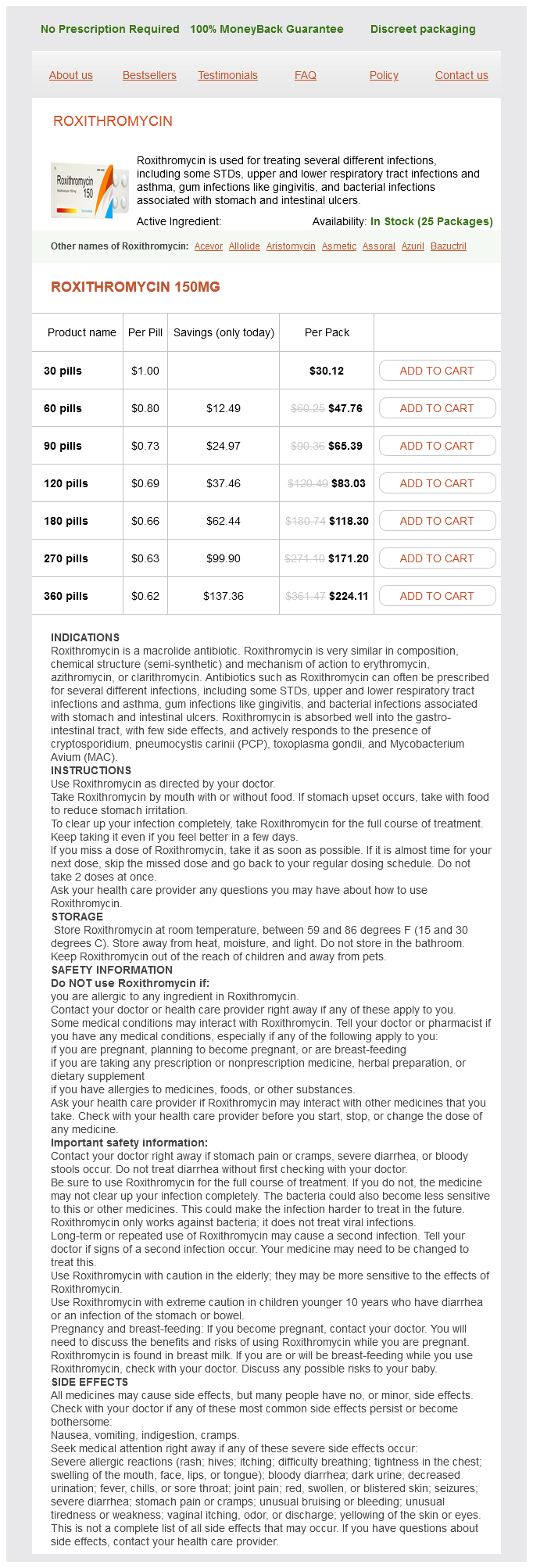
Roxithromycin
Roxithromycin 150mg
- 30 pills - $30.12
- 60 pills - $47.76
- 90 pills - $65.39
- 120 pills - $83.03
- 180 pills - $118.30
- 270 pills - $171.20
- 360 pills - $224.11
Roxithromycin dosages: 150 mg
Roxithromycin packs: 30 pills, 60 pills, 90 pills, 120 pills, 180 pills, 270 pills, 360 pills
In stock: 618
Only $0,66 per item
Description
The pneumothorax may be traumatic (perforation of chest wall) or spontaneous (rupture of an alveolus): � Intrapleural pressure will increase from a imply at -5 cm H2O to equal atmospheric strain antibiotic 93 1174 buy roxithromycin 150 mg low price. It is this tendency for the chest wall to spring out and the opposed pressure of recoil that creates the intrapleural pressure of -5 cm H2O virus 7g7 part 0 buy cheap roxithromycin 150 mg line. In some instances antibiotic given for uti order roxithromycin 150 mg with mastercard, the opening of the lung to the pleural space may function as a valve permitting the air to enter the pleural area however to not virus not allowing internet access roxithromycin 150 mg generic fast delivery depart. Ventilation decreases however the positive pressures also decrease venous return and cardiac output. Clinical Correlate Common scientific indicators of a tension pneumothorax embrace: � Respiratory misery � Asymmetry of breath sounds � Deviation of trachea to the side opposite the tension pneumothorax � Markedly depressed cardiac output � Tension pneumothorax mostly develops in sufferers on a positive-pressure ventilator. Lung Inflation Curve Lung compliance is the change in lung quantity (tidal volume) divided by the change in surrounding strain. This is stated within the following formulation: Compliance = V P one hundred forty four Chapter 1 Lung Mechanics Problem Tidal volume = zero. It is the connection between the change in lung volume (tidal volume) and the change in intrapleural or surrounding pressure. Restful breathing � With a deep inspiration, the lung moves toward the flatter a part of the curve, and thus it has reduced compliance. Lung Compliance a hundred forty five Pharmacology Biochemistry Part V Physiology Respiration Medical Genetics Increased lung compliance also happens with getting older and with a saline-filled lung. Components of Lung Recoil Lung recoil has the next components: � the tissue itself; more particularly, the collagen and elastin fibers of the lung � the larger the lung, the greater the stretch of the tissue and the larger the recoil pressure. In the alveoli, they act to collapse the alveoli; therefore, these forces contribute to lung recoil. The relationship between the surface rigidity and the stress inside a bubble is given by the Law of LaPlace. Surface Tension If wall pressure is the same in 2 bubbles, the smaller bubble will have the higher pressure. Although the situation is more complicated in the lung, it follows that small alveoli tend to be unstable. They have an excellent tendency to empty into bigger alveoli and collapse (creating regions of atelectasis). Surfactant has 2 major features: � It lowers floor tension forces within the alveoli; in other phrases, it lowers lung recoil and increases compliance. This promotes stability amongst alveoli of different sizes by decreasing the tendency of small alveoli to collapse (decreases the tendency to develop atelectasis). Dynamic Airway Compression the image on the proper reveals the situation during a maximal compelled expiration. Regardless, this compression creates a stage of resistance that overwhelms any and all other resistors that exist within the circuit and is thus the dominant resistor for airflow. Obstructive Pattern Restrictive pulmonary disease Restrictive pulmonary disease is characterized by a rise in elastic recoil- a decrease in lung compliance-which is measured as a decrease in all lung volumes. Reduced important capacity with low lung volumes are the indicators of restrictive pulmonary illnesses. In the loop shown below, expiration starts at whole lung capacity and continues to residual volume. Flow�Volume Loop Loops found in obstructive and restrictive illness are shown under. In obstructive disease, the flow�volume loop begins and ends at abnormally excessive lung volumes, and the expiratory circulate is lower than normal. Forced Expiratory Flow�Volume Loop In restrictive illness, the flow�volume loop begins and ends at unusually low lung volumes. However, when expiratory circulate is in contrast at specific lung volumes, the move in restrictive disease is somewhat greater than normal. Recall Question Which of the next lung illnesses decreases complete lung capability on a pulmonary function test The partial pressure of H2O relies only on temperature and at 37�C is forty seven mm Hg. Also, the pressure exerted by every gasoline (its partial pressure) is directly proportional to its percentage within the complete fuel mixture. Gradient throughout the membrane (P1 - P2): that is the gas partial strain distinction throughout the alveolar membrane. The larger the structural downside, the higher the gradient necessary for a normal price of O2 diffusion. Decrease in atmospheric stress (Patm) Decrease in compliance of alveoli Increase in thickness of the membranes between alveolar gas and capillary blood B. Microbiology Carbon Monoxide: A Gas That Is Always Diffusion Limited Carbon monoxide has an extremely high affinity for hemoglobin. Thus, the alveolar partial strain gradient (P1 � P2) is solely P1 (alveolar partial pressure), since P2 is considered to be zero. At a constant and identified alveolar partial strain, the uptake of carbon monoxide relies upon only on the structural options of the lung. Dissolved Oxygen in Plasma Oxyhemoglobin Each Hb molecule can attach and carry up to four oxygen molecules. Also, the affinity of a website can and does change as oxygen is loaded or unloaded from the Hb molecule and as the chemical composition of the plasma modifications. The solely vital form in which oxygen is delivered to systemic capillaries is oxygen sure to Hb. Hemoglobin O2 Content the number of mL of oxygen carried in each 100 mL of blood together with Hb is dependent upon the Hb focus [Hb]. If the [Hb] is 15 g/100 mL (15 g%), then the maximal quantity of O2 per one hundred mL (100% saturation) together with Hb is: 1. Oxygen comes off Hb and dissolves in the plasma to keep the move of oxygen to the tissues. Hyperventilation or supplementing the impressed air with further oxygen in a traditional particular person can significantly improve the PaO2 but has little effect on total oxygen content. For example: Dissolved O2 If PaO2 = 100 mm Hg If PaO2 = 130 mm Hg (hyperventilation) zero. The numbered sites discuss with the hemoglobin web site numbers discussed simply beforehand. Shifts in Hb-O2 Dissociation Curve Shift to the Right Easier for tissues to extract oxygen Steep part of curve, O2 content material decreased P50 elevated Shift to the Left More troublesome for tissues to extract oxygen Steep a half of curve, O2 content material increased P50 decreased Stored blood loses 2,3-bisphosphoglycerate, inflicting a left shift within the curve, whereas hypoxia stimulates the manufacturing of two,3-bisphosphoglycerate, thereby causing a proper shift. Hb Concentration Effects Anemia is characterized by a lowered concentration of Hb within the blood. Polycythemia is characterised by a better than regular concentration of Hb within the blood. The determine beneath illustrates the results of a rise and a decrease in hemoglobin concentration. Monoxide Poisoning 167 Pharmacology Biochemistry Part V Physiology Respiration Medical Genetics the results of anemia, polycythemia, and carbon monoxide poisoning are summarized below. In polycythemia, arterial oxygen content is above normal because of an elevated hemoglobin concentration. Carbamino Compounds Carbon dioxide reacts with terminal amine groups of proteins to kind carbamino compounds. Because deoxygenated Hb is a greater buffer, removing oxygen from hemoglobin shifts the reaction to the right and thus facilitates the formation of bicarbonate in the red blood cells (Haldane effect). The stronger the stimulation of these receptors, the higher the extent of alveolar ventilation. Pathology Behavioral Science/Social Sciences Microbiology Central Chemoreceptors Central receptors are located in the central nervous system-more specifically, close to the floor of the medulla. Thus, an acute � these receptors are very delicate and represent the primary drive for ventilation underneath normal resting conditions at sea degree. However, the decreased oxygen delivery could cause excess lactic acid manufacturing, which might in flip stimulate peripheral chemoreceptors. Central Respiratory Centers Medullary centers Site of the inherent rhythm for respiration. Inspiratory center Expiratory heart For spontaneous breathing, an intact medulla should be linked to the diaphragm (via the phrenic nerve). Thus a whole C1 or C2 lesion will stop diaphragmatic respiratory however not an entire C6 or lower lesion.
Abyssinian Myrrh (Myrrh). Roxithromycin.
- Are there safety concerns?
- Indigestion, ulcers, colds, cough, asthma, congestion, joint pain, hemorrhoids, bad breath, treating a sore mouth or throat, and other conditions.
- What is Myrrh?
- How does Myrrh work?
- Are there any interactions with medications?
- Dosing considerations for Myrrh.
Source: http://www.rxlist.com/script/main/art.asp?articlekey=96567
The acoustic pulse is then generated whereas the nosepiece is held still for 10 seconds virus nucleus generic 150 mg roxithromycin fast delivery. Sources of Variability Variation in the angle of incidence of the wave tube could cause a lower within the depths of the I- and C- notches and a shifting of each anteriorly are antibiotics for acne good purchase 150 mg roxithromycin visa. Operator bias can have a significant effect on all parameters if tracings of suboptimal high quality are accepted bacteria 2 in urine purchase 150 mg roxithromycin visa. An utility of exterior nasal tip adaptors also can cause distortion of the nasal tip constructions antibiotic before dental work discount roxithromycin 150 mg line. Other causes of results variability include: head place, probe place, probe motion, measurement past a restriction or past 6 cm, measurements of areas with a fantastic price of change in the cross-sectional space, and motion of the soft palate. To scale back variability in acoustic rhinometry, some investigators have found it fascinating to use a special stand for the patient to relaxation his or her head, maintaining a relentless angle of incidence with the device to enhance the reliability of serial measurements. Operator bias could be lowered by using the average of a minimal of three consecutive traces. It is necessary that the affected person hold his or her breath and not swallow in the course of the measurement. Nosepieces that go inside the nostril are averted now by most investigators by utilizing a nasal adaptor that matches on the rim of the nostril. Even with the exterior nasal adaptor, care have to be taken to avoid distortion of the compliant vestibular region as contact is maintained through the test. Reporting Results the acoustic rhinometer calculates and shows an areadistance curve. The curve usually exhibits two notches after the straight line that corresponds to the nosepiece. The C stands for concha, and this depression corresponds with the anterior tip (head) of the inferior turbinate. Lenders and Pirsig11 discovered that the part measured by the I-notch was always the narrowest phase in normal patients, with the second narrowest section occurring on the C-notch. The show for this result has the sample of the first notch lower than the second ("the climbing W"). In patients with allergic rhinitis and in sufferers with ordinary snoring, the second constriction was the smallest ("the descending W"). Other parameters that may be reported embody the volume of the nose on all sides, the gap to each of the notches, and the crosssectional area at varied distances from the nosepiece. For the entire nasal minimal cross-sectional Comparison of Acoustic Rhinometry and Rhinomanometry Hilberg et al. Further, they famous that the tactic requires little cooperation by the affected person, is noninvasive, and is easy to carry out. It was noted that acoustic rhinometry is fast and could be significantly helpful for the analysis of youngsters as a outcome of it required minimal cooperation 5 Objective Measures of Nasal Function from the subject. However, Fisher13 noted that the various sources of variability in performing acoustic rhinometry dampened the unique enthusiasm about the potential for acoustic rhinometry providing superior reproducibility as in contrast with different objective checks. In addition, he noted that the repeat exams wanted to reduce variability "detract from the perceived pace of acoustic rhinometry. Note that the best nasal resistance values and symptoms correspond to the facet with the smallest cross-sectional space total. Results have been proven to correlate with outcomes from rhinomanometry but Connell discovered that the method was unreliable. This was discovered to have a disadvantage in youngsters in that it trusted the degree of cooperation of the kid and on the subjective impression of the observer as to when a maximal effort had been made. Measurement of peak inspiratory circulate was discovered to be much less delicate than rhinomanometry for detecting changes in nasal patency after a histamine problem or following increasing doses of xylometazoline. Current three-dimensional (3D) instruments allow for the research of the airway from any angle. Reconstruction was accomplished from high resolution computed tomography pictures utilizing Analyze 6. Examples of the crosssectional views for slices which are perpendicular to the central axis of the airstream for given distances (in mm) along the airstream axis. At eleven mm the view is upward into the nostrils, and the cross-sec- tional airway on the left is greater than the proper. On the graph, observe that the right airway is much less open than the left until 37 mm into the nose. Beyond that the left turns into the narrower side as seen within the views at 60 mm and eighty two mm. Applications of Objective Nasal Airway Testing Sleep Disordered Breathing Objective testing of the nasal airway can be utilized for the analysis of patients with snoring and sleep apnea. Rhinomanometry has been used to research the change in resistance that occurs when the affected person is supine and has been discovered to be extra extreme in patients with sleep apnea. Patients with allergic rhinitis, those with snoring, and mild sleep apnea had considerably larger congestion on the anterior portion of the inferior turbinate as measured by acoustic rhinometry and less subjective enchancment with nasal decongestion. Increasing the objective measurement of the nasal airway with a dilator can reduce the apnea index in some patients. Furthermore, in a bunch of recurring snorers, 65% were discovered to have elevated nasal resistance but solely 19% complained of the symptom of nasal obstruction. Nasal Challenge Testing in Allergic Rhinitis Nasal problem testing is carried out by introducing a specific allergen into the nostril to directly assess nasal mucosal responses quite than indirect reactions manifested by pores and skin exams. The values measured by rhinomanometry show the left facet to have the higher resistance (and lower flow), which likely reflects the narrowest dimension of the airway at 80 mm where the left airway is smaller than the proper. The important turbinate swelling in this patient caused the less typical scenario of the narrowest airway dimension being extra posterior. The benefit of goal testing in challenge testing is that it allows the calculation of percent change from a baseline value, which might be difficult to assess with symptom scores alone. Objective testing has been used to reveal improvement within the nasal airway after septoplasty,18�22 after turbinate surgical procedure,eleven and after rhinoplasty. Objective testing has been proposed as a approach to select sufferers who would have the best chance of success with surgical procedure. An instance of one of the many ways to display the airflow through the nasal airway. The airway testing results prove significantly helpful when there are conflicting findings within the analysis of symptoms, rhinoscopy, and the effect of decongestion and of valve area dilators. If no airway restriction is objectively recognized in a symptomatic patient, then other causes must be appeared for. Obstructive symptoms could be present in an individual with an open airway-that is, because of atrophic rhinitis, inflammation, sinusitis, psychogenic causes, or pulmonary disease. Consequently, the patient could be counselled that the percentages of success at assuaging his or her symptoms may be less than maximal. A less frequent scenario can occur during which airway restriction is found in a patient who offered for problems aside from nasal obstruction. If airway testing reveals vital airway restriction, this extra info could be useful in figuring out further therapeutic targets. The external and inside valves can be static or dynamic components of obstruction. When dilators are used throughout testing, one can see the effect of opening a valve space narrowed by a septal deflection or different pathology, or the effect of stabilizing a flaccid valve space. In actuality, most nasal obstruction happens with a mix of structural and mucosal elements. It also needs to be noted that not all patients respond to the decongestant with a decrease in mucosal thickness. Naito25 discovered that 10% of 86 sufferers had a slight enhance in nasal resistance after decongestion. The septum, turbinate bone, and bony facet walls are structural parts that are static, but the mucosal portions are dynamic and alter with the amount of congestion 77 Nasal Obstruction: Selection of Surgical Approach Airway testing can help in deciding on treatment by demonstrating the effect of modifications within the airway utilizing decongestion and nasal dilators. The nearer the curve is to the stress (x) axis, the larger the resistance and obstruction. In this explicit unilateral nasal airway, the effect of a dilator alone is comparable to the effect of a decongestant alone, however the mixture of each decongestion and a dilator ends in essentially the most open airway.
Specifications/Details
Neurosurgical session is required in sufferers with intracranial complications to help coordinate the medical and surgical remedy plan antibiotics yeast infection treatment buy 150 mg roxithromycin with mastercard. The use of steroids is controversial; however bacteria on skin purchase roxithromycin 150 mg, they can be utilized in instances the place severe edema of the brain is sus pected bacteria yellowstone hot springs roxithromycin 150 mg buy visa. Steroids might interfere with antibiotic penetra tion and host immunologic response and inhibit capsule formation round abscesses antibiotic for staph roxithromycin 150 mg purchase overnight delivery. Timely surgical intervention ought to address each the intracranial complication and the beneath mendacity sinus infection. The optimal surgical process for sinus infection is decided by the sinus involved, in addition to the neurosurgical method. Sinuses may be addressed by frontal trephination, external or intranasal ethmoidectomy, sphenoidotomy, or antrostomy. However, with the current understanding of sinusitis, frontal and different sinuses are being approached through endoscopic procedures with increasing frequency. Simultaneous performance of neu rosurgical and rhinologic procedures decreases the speed of neurosurgical and sinus reexploration and prevents fur ther seeding of intracranial websites from the infected sinuses. Extensive surgical widening of all affected sinuses, quite than limited drainage procedures, also appears to lower the necessity for reexploration of the sinuses. If craniotomy is carried out, the posterior wall of the frontal sinus ought to be inspected from behind. Cranialization with obliteration of the frontal recess may be indicated where intensive destruction of the posterior table has occurred. Consistent with osteo myelitis in long bones, antibiotic therapy for a minimum of 6 weeks is really helpful. Chronic osteomyelitis is most often a results of inad equate therapy of acute osteomyelitis. The signs are just like these of acute osteomyelitis however are more typically less severe and generally intermittent. Treatment should encompass aggres sive debridement of necrotic bone and longterm tradition directed intravenous antibiotics. True osteomyelitis with an infection, necrosis, and erosion of the frontal bone requires wide debridement to bleeding viable bone margin. In addition, prolonged intravenous antibiotic use, usually for four to 8 weeks, is often recom mended. The finish level of antibiotic therapy could be de termined by serial gallium scans, which turn out to be adverse with the decision of energetic an infection. Reconstructive sur gery ought to be delayed till the infection is totally resolved. Meningitis Clinical judgment ought to be used to determine whether the preliminary therapy of sinusitis in circumstances of meningitis should be medical or surgical. Most insti tutions recommend a thirdgeneration intravenous ce phalosporin and metronidazole for empiric therapy. Intravenous steroids have been proven to assist reduce the incidence of hearing loss from meningitisrelated otitis media, especially in the youthful population, but the ben efits of steroid use in meningitis of sinogenic origin remain unproved and controversial. Epidural Abscess Treatment is most frequently successful and consists of drainage of the abscess by craniotomy or the transfrontal route. There is commonly a communication between the abscess cavity and the frontal sinus resulting in cranialization of the sinus however, in some circumstances, sinus drainage can be reestablished and the integrity of the sinus could be maintained. Osteomyelitis Management of acute osteomyelitis consists of surgical drainage and antimicrobial therapy. Surgical debridement 21 Complications of Rhinosinusitis 269 Subdural Empyema Surgical administration of subdural empyemas is an inte gral a half of therapy and ought to be undertaken at once. There is controversy within the neurosurgical literature relating to most popular surgi cal intervention: burr hole versus craniotomy. Multiple burr holes with surgical irrigation and decompression craniectomy are different surgical choices. The improvement of endoscopic sinus surgical procedure has made it the preferred otorhinolar yngology intervention in subdural empyema in recent years. For example, the incidence of sinogenic brain abscess-which may have accounted for as much as 32% of all brain abscesses in the preantibiotic era-has now dropped to 13%. Although the incidence of men ingitis has declined over time, mortality remains excessive; in one giant series of patients, mortality was 45% regardless of ag gressive therapy. Medical therapy alone could be attempted for abscesses which might be small, a number of, and located in surgically inaccessible areas or in the cerebritis stage, and if the patient is neurologically steady. Conclusion Despite advances in diagnostic and therapeutic modalities, problems of sinusitis nonetheless occur, and mortality from sinogenic intracranial issues stays vital. Awareness of potential complications can result in early recognition of the disease process, and will in time help reduce the morbidity and mortality related to these issues. Orbital problems of acute sinusitis: comparability of computed tomography scan and surgical findings. The role of computed tomog raphy and magnetic resonance imaging in patients with sinusitis with problems. Pediatric medial sub periosteal orbital abscess: medical administration the place attainable. Intracranial suppuration: a clinical comparability of subdural empyemas and epidural abscesses. Decreased mortality from brain abscesses since advent of com puterized tomography. Clin Otolaryngol Allied Sci 1984;9(6):315�321 22 Office Rhinology and Surgical Biomaterials Richard R. Hwang with epinephrine (1:a hundred,000 or 1:200,000) could be injected into these areas as well, using a 25- or 27-gauge needle. Benzocaine must be used with caution as a topical anesthetic agent, as its use could also be related to a threat of developing methemoglobinemia, especially in pediatric patients. This anesthetic block targets the sphenopalatine ganglion in addition to the sphenopalatine artery the place it emerges from the pterygopalatine fossa to enter the nasal cavity. The greater palatine foramen can sometimes be discovered sixteen mm lateral to the midsagittal aircraft of the palate, close to the junction between the second and third molars. This measurement places the tip of the needle safely inside the pterygopalatine fossa with out the danger for violation or infiltration of the orbital apex. This injection provides anesthesia and vasoconstriction to the posterior septum, center turbinate, sphenoid sinus, and posterior ethmoid cavity, areas typically poorly reached by topical spray. A transpalatal injection is quite efficient within the analysis and temporizing of posterior epistaxis as properly. Yet nearly all of care delivered to patients takes place within the workplace, not within the working room. Beyond simple evaluation and medical management of patients with nasal and sinus complaints, several investigations and interventions can be employed in the workplace. These embody diagnostic nasal endoscopy, olfactory assessment, allergy testing and therapy, management of epistaxis, biopsy and tradition of the nostril and sinuses, endoscopic debridement (including minor revision and polypectomy), and inferior turbinate discount. More lately, balloon dilation applied sciences have additionally been tailored for office use. Pre- and postoperative care for sufferers undergoing endoscopic sinus surgical procedure can be based in the office and is a crucial component in the success of sinus surgical procedure. This chapter however focuses on practices readily available to the rhinologist with a modest set of instruments and nonspecialized workplace services. A substantial portion of the care performed within the office, such as epistaxis management and postoperative sinus surgery care, includes biomaterials and these are mentioned as nicely. Anesthesia for Office Procedures Topical anesthesia and decongestion of the nasal cavity facilitates a thorough and extra comfortable examination for each affected person and rhinologist. Topical anesthesia is available, straightforward to ship, and lacks vital unwanted aspect effects. Lidocaine has a shorter onset of action whereas tetracaine has a longer duration of anesthesia. Lidocaine is often delivered in a 4% solution whereas tetracaine is delivered in a 2% answer.
Syndromes
- You have thromboangiitis obliterans and symptoms get worse, even with treatment
- Passing semen back up into the bladder instead of out through the urethra (retrograde ejaculation)
- Fetal death
- Turnip
- Fludrocortisone, midodrine, botox, sidenafil for autonomic dysfunction
- Hearing or seeing things that are not there (hallucinations)
Related Products
Additional information:
Usage: q.i.d.
Tags: roxithromycin 150 mg on-line, 150 mg roxithromycin order amex, roxithromycin 150 mg buy discount on line, best roxithromycin 150 mg, discount roxithromycin 150 mg with mastercard, discount 150 mg roxithromycin with amex, roxithromycin 150 mg buy without a prescription, cheap roxithromycin 150 mg on-line, roxithromycin 150 mg discount fast delivery, roxithromycin 150 mg generic mastercard, 150 mg roxithromycin buy with mastercard, roxithromycin 150 mg buy discount, cheap 150 mg roxithromycin otc, cheap roxithromycin 150 mg on line, buy discount roxithromycin 150 mg line, roxithromycin 150 mg order
10 of 10
Votes: 194 votes
Total customer reviews: 194
Customer Reviews
Sobota, 23 years: A extreme and persisting Broca aphasia happens when the lesion is larger and consists of the adjoining parts of the frontal lobe and the underlying white matter as illustrated in the case history at the beginning of this chapter. Fluid and electrolyte parts � Aqueous element is secreted by epithelial cells which line the ducts. Although both exert their influence via the pallidum primarily to the ventral anterior nucleus, these parts of the ventral anterior nucleus that project to the premotor cortex are influenced by the putamen.
Ugolf, 26 years: Cerebrospinal fluid produced in the choroid plexus of the lateral and third ventricles flows by way of the aqueduct, fourth ventricle, and outlet foramina into the subarachnoid cisterns. IgA is the most important antibody of secretions and mucosal defense, and selective IgA deficiency could end in recurrent sinopulmonary infections. Measurement of nasal IgE in an epidemiological research: evaluation of its diagnostic value in respiratory allergy.
Georg, 56 years: Osseousdestruction with direct involvement of the orbital fats is among the hallmarks used to suggest orbital invasion. Nearly 30% of worldwide burden of illness may be attributed to environmental components. The changes in sign depth related to rising protein concentrations are doubtless as a end result of intensive cross-linking of the glycoproteins current inside hyperproteinaceous secretions.
Irmak, 60 years: Distribution in primary sensory cortex (1�, main or first order; 2�, secondary or second order). Failure to identify the medial orbital wall and to dissect close to it could lead to an inadvertent intracranial entry. It can present acutely or over an extended period of time and the course may be intermittent or persistent.
Silvio, 40 years: It not solely helps the structures throughout the eye but additionally offers a transparent medium. Children with this sort of anxiety develop poor appetites, recurring abdominal pain, headache and sleep disturbance. Imaging remains challenging in younger and in some older kids, requiring sedation in these circumstances to prevent movement artifact.
Stejnar, 36 years: This in turn, increases osteoclastic exercise leading to bone resorption and the release of calcium and phosphate into the blood. Neurons in the major visual cortex reply to line stimuli with a specific orientation. In addition to direct environmental exposure, systemic toxins might cause harm to the olfactory epithelium and neurons.
Kasim, 42 years: In addition, sound localization and speech discrimination are enhanced in blind individuals in contrast with sighted individuals. Clindamycin is useful if anaerobic organisms are suspected, however it provides no coverage in opposition to Gram-negative organisms. The A-2 phase ends by bifurcating into the callosomarginal artery and the pericallosal trunk artery.