
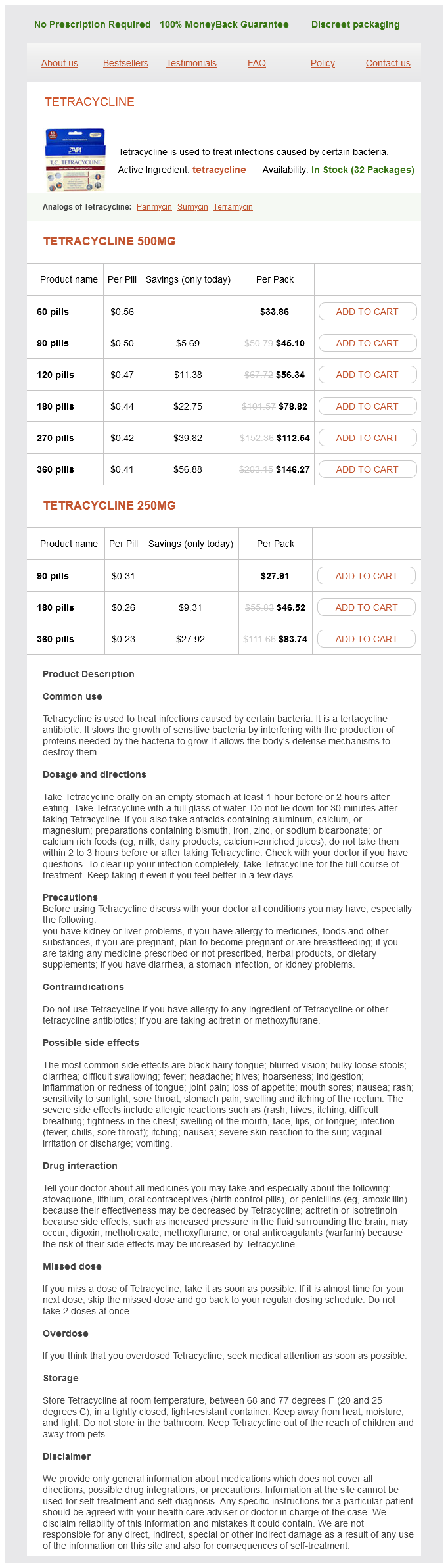
Tetracycline
Tetracycline 500mg
- 60 pills - $33.86
- 90 pills - $45.10
- 120 pills - $56.34
- 180 pills - $78.82
- 270 pills - $112.54
- 360 pills - $146.27
Tetracycline 250mg
- 90 pills - $27.91
- 180 pills - $46.52
- 360 pills - $83.74
Tetracycline dosages: 500 mg, 250 mg
Tetracycline packs: 60 pills, 90 pills, 120 pills, 180 pills, 270 pills, 360 pills
In stock: 848
Only $0,25 per item
Description
Surgery of the Septum the essential rules of septoplasty had been described by a number of authors in the early 20th century and have advanced over time antibiotics listed by strength tetracycline 250 mg cheap without prescription. In recent years antibiotics for acne yahoo buy generic tetracycline 500 mg on-line, using endoscopic methods has allowed for additional refinement of septoplasty surgical strategies infection behind eye generic tetracycline 500 mg without a prescription. Modern septoplasty techniques enable for definitive correction of septal deviations whereas minimizing problems treatment for uti emedicine tetracycline 250 mg generic fast delivery. Patient Selection/Indications Septal surgical procedure could additionally be indicated for correcting septal deflections which would possibly be causing nasal airway obstruction, limiting entry during endoscopic sinus surgery, or leading to contact point complications. Surgery may be indicated when the nasal septum is to be used as a supply for cartilage, bone, or mucosal grafts in patients present process endoscopic skull base surgical procedures. Septoplasty may also be indicated at the facet of endoscopic sinus surgery when septal deflections limit entry to the center meatus. Preoperative endoscopy will allow the surgeon to determine when septoplasty could also be essential in these situations. Correction of these deflections improves access in the course of the course of surgery, and likewise helps to enhance entry for postoperative debridement and surveillance. Contact level headaches might end result from septal deflections and spurs that result in areas of contact between the septum and turbinates. These areas are best identified at the time of office endoscopy, and the analysis may be supported by selectively anesthetizing the contact points using topical anesthetic brokers on cotton-tipped applicators. Rhinomanometry and acoustic rhinometry provide objective measures of nasal resistance and cross-sectional space. Anterior rhinoscopy utilizing a nasal speculum allows for sufficient visualization of the anteriormost aspect of the nasal septum and nasal cavities. This analysis should be carried out before and after decongestion to evaluate the contribution of vasoactive tissue alongside the turbinates and nasal septum to nasal airway obstruction. This is as a end result of anterior rhinoscopy alone might not provide an enough evaluation of the posterior aspects of the nasal cavity. Additionally, use of a nasal speculum during anterior rhinoscopy can distort the nasal valve. For patients with nasal obstruction, rigid nasal endoscopy is routinely performed in the workplace as a outcome of it provides a wonderful visualization of the nasal valve, nasal septum, turbinates, and another sinonasal pathology which will contribute to nasal airway obstruction. This provides the Surgical Anatomy the nasal septum has cartilaginous and bony components. A thorough understanding of the construction and performance of these components is important. The bony parts are shaped by the maxillary crest, the perpendicular plate of the ethmoid bone, the vomer, and the perpendicular plate of the palatine bone. The area alongside the junction of the upper lateral cartilages and the nasal septum has been termed the inner nasal valve, which provides vital nasal resistance. The anteroinferior side of the quadrangular cartilage articulates with the maxillary crest. Posteriorly, the cartilaginous component of the septum articulates with the ethmoid bone and the vomer. At the junction of the 34 Surgery of the Septum and Turbinates For patients with broad septal deflections, the process starts with a hemitransfixion incision at the caudal side of the nasal septum. This incision is made using a nasal speculum and an overhead gentle for illumination. Optimal positioning of the nasal speculum permits the mucosa over the caudal fringe of the septum to be positioned on stretch, facilitating visualization of the layers of soppy tissue as the dissection is carried right down to the cartilage. A scalpel is used to incise by way of the soft tissue layers down to the level of the cartilage. Initial identification of the subperichondrial plane may be tough due to the tight adherence of the perichondrium to the cartilage. However, it is necessary to take time to determine the correct dissection aircraft as a outcome of this decreases bleeding and preserves maximal flap vascularity and power. Once a small pocket has been elevated, the endoscope can be utilized to proceed the dissection. The magnified view out there with the endoscope allows the surgeon to confirm that all of the perichondrial layers have been elevated. In the subperichondrial plane, the cartilage has a characteristic bright white appearance. Our most well-liked approach is to incise and elevate on the facet of the higher septal deviation. As the dissection continues posteriorly, the bony-cartilaginous junction is identified, and elevation continues along the bony septum to the extent essential to adequately expose the deviated portions of the septum. The preliminary flap elevation is alongside the quadrangular cartilage and ethmoid bone, above the extent of the decussating fibers. Once an adequate ipsilateral dissection has been carried out, an incision is made just anterior to the areas of greatest deflection. This incision is most regularly made simply anterior to the bony-cartilaginous 445. The decussating fibers are proven on the confluence of the perichondrium and periosteum. Instead, there are dense decussating fibers on the junction of those elements as a outcome of the perichondrium and periosteum pass round their respective bony or cartilaginous element to the other aspect. These fibers have to be sharply divided through the course of surgical procedure to keep a subperichondrial/subperiosteal plane of dissection. Surgical Technique Septoplasty has historically been carried out utilizing a headlight and nasal speculum. Whether the procedure is carried out with a headlight or an endoscope, the general methods and ideas remain the identical. The approach described in this part is an endoscopic one; the identical sequence of steps can be utilized for traditional nonendoscopic septoplasty. Components proven include the quadrangular cartilage, maxillary crest, perpendicular portion of the ethmoid bone, and vomer. Initial flap elevation is alongside the quadrangular cartilage and ethmoid bone, above the decussating fibers. After the incision is made, a contralateral subperichondrial/subperiosteal dissection is performed through the septotomy. The deviated parts of the septum are isolated after flaps have been elevated bilaterally, and these parts can then be removed. Through-cutting instruments are used to make a minimize superiorly along the portion of the cartilage and bone that might be resected. Once the superior reduce is full, the cartilage and bone inferior to this minimize could be eliminated using noncutting forceps. Spurs regularly happen at the junction of the quadrangular cartilage and maxillary crest or vomer. Dissection in these areas may be difficult, and flap tears are generally unavoidable at these sites. The height of the strip is determined by the deflection point of the cartilaginous portion of the spur. Once the strip of cartilage is removed, the maxillary crest is more simply seen and dissected. A scalpel or very sharp Freer elevator is normally sufficient to reduce by way of the decussating fibers to allow flap elevation from the maxillary crest and vomer down to the extent of the nasal flooring. In some cases, a more conventional "two-tunnel" method is useful to full the dissection and decrease the risk of enormous flap perforations. The "two-tunnel" technique involves the dissection of a "superior tunnel" over the cartilaginous septum and an "inferior tunnel" over the maxillary crest firstly of the dissection, extending to the nasal floor. The maxillary crest bone is type of thick and is often eliminated using closed Jansen Middleton forceps as a rongeur. Alternatively, an osteotome or a drill can be utilized to address thickened and deviated parts of the crest. Relatively giant portions of the bony septum may be removed without compromising the help of the nasal tip and dorsum. However, when resecting the cartilaginous parts of the nasal septum, it is very important be conservative. Adequate amounts of the dorsal and caudal septum must be preserved to avoid disrupting the help of the tip and dorsum.
Pegu Catechu (Catechu). Tetracycline.
- What is Catechu?
- How does Catechu work?
- Dosing considerations for Catechu.
- Diarrhea, swelling of the nose and throat, swelling in the colon, bleeding, cancer, skin diseases, hemorrhoids, osteoarthritis, and injuries.
- Are there safety concerns?
- Are there any interactions with medications?
Source: http://www.rxlist.com/script/main/art.asp?articlekey=96408
The triplets of the genetic code antimicrobial zinc gel 250 mg tetracycline discount with mastercard, nonetheless antimicrobial quiz safe 500 mg tetracycline, present up to antibiotics for acne cons order tetracycline 500 mg without a prescription 64 attainable different codons (Appendix 1) virus check tetracycline 500 mg cheap on line. Shown are the results of a degree mutation on, and the insertion of a single nucleotide into, the coding area of a gene. The overwhelming majority of genes from all organisms obey the identical code; nonetheless, some mitochondrial encoded genes deviate from the code. The insertion, or deletion, of nucleotides has an even more dramatic impact on the encoded protein. The codon�anticodon pairing due to this fact directs the addition of the right amino acid to the rising polypeptide chain. Under optimum conditions about 15�20 amino acids can be polymerized per second (Crowlesmith and Gamon, 1982). Translation has confirmed to be notably essential to the genetic engineer since many antibiotics target translation as their mechanism of inhibiting bacterial progress. The following antibiotics function by the inhibition of translation: � � � chloramphenicol � inhibits peptidyl transferase on the 50S ribosomal subunit. The protein chain incorporates information that directs post-translational processes and cellular compartmentalization in eukaryotes. Many proteins, in both prokaryotes and eukaryotes, have this residue removed by an enzyme known as methionine aminopeptidase such that the final protein sequence begins with the amino acid encoded by the second codon (Bradshaw, Briday and Walter, 1998). The 30S ribosomal subunit binds on to this sequence and then recruits the 50S subunit. Many eukaryotic proteins are, nonetheless, destined for a specific compartment of the cell. The polypeptide itself encodes the data required for its final vacation spot. As far back as the Fifties, it was noted that if a bacteriophage was ready from a selected strain of E. The enzyme displayed a quantity of complicated activities that made it tough to research (Table 2. More than 900 restriction enzymes have now been isolated from over 230 species of micro organism. Restriction enzymes have names that mirror their origin � the primary letter of the name comes from the genus and the second and third letters from the species of bacteria from which they have been isolated. The numbers following the nuclease name point out the order by which the enzyme was isolated from the bacterial strain. Like many restriction enzymes, the genes encoding each the nuclease and the modifying enzymes are adjacent to one another within the genome. The methylated base presumably flips again into the helix when the enzyme dissociates. Reproduced from Blumenthal and Cheng (2001) by permission of Xiaodong Cheng (Emory University) can then be a substrate for the enzyme-catalysed chemical reaction (Cheng and Roberts, 2001). The numerous methylase, restriction and specificity subunits are color coded as indicated 2. The sluggish remethylation of oriC after one spherical of replication delays one other round till the primary is complete (von Freiesleben et al. The Dam- and Dcm-dependent methylation may interfere with cleavage by restriction endonucleases with recognition websites partially or utterly overlapping such methylation sites. Once it encounters its explicit recognition sequence, the restriction enzyme undergoes a big conformational change, which prompts the catalytic sites. The positions of those two cuts, each in relation to each other, and to the recognition web site itself, are decided by the person restriction enzyme. The recognition website of every enzyme is shown, along with the cleavage web site, indicated by the blue line. When the enzyme encounters this sequence, it cleaves each backbone between the G and the closest A base residues (Mertz and Davis, 1972). Once the cuts have been made, the resulting fragments are held collectively only by the comparatively weak hydrogen bonds that hold the four complementary bases to one another. Any specific 6 bp goal could be expected to occur once each 46 (4096) bp, and an 8 bp target each forty eight (65 536) bp. As we noticed in Chapter 1, Chargaff famous that the amount of C + G residues in different organisms was completely different to the quantity of A + T. The ultimate step is a nucleophilic attack by the three -hydroxyl group on this activated phosphorus atom. This sequence of reactions is driven by the hydrolysis of the pyrophosphate that was released within the formation of the enzyme�adenylate complicated. The temperature optimum for such reactions has been found to be in the range of 4�20 C (Sgaramella and Ehrlich, 1978). In the vector the recognition sites for the restriction enzymes are located near each other. Treating the vector with a phosphatase enzyme after it has been cut with the restriction enzymes, nevertheless, can forestall this. Phosphatases catalyse the elimination of 5 phosphate groups from nucleic acids and nucleotide triphosphates. The basics of cloning into a plasmid vector containing a single distinctive restriction enzyme recognition site. The ligation of a compatible insert into this vector will outcome within the ligation of solely the 5 -ends of the insert with the vector. The three -end of the insert (a hydroxyl group) and the 5 -end of the vector (also a hydroxyl group) will be unable to ligate. Other websites may be made blunt by both cleaving off the overhanging ends with a nuclease. The different plasmids and bacteriophages that are used as vectors are described element in Chapter three. These markers, usually antibiotic resistance genes, shall be mentioned in more element in Chapter 3. This chemical transformation treatment was also subsequently shown to permit plasmids to enter bacterial cells, at various ranges of efficiency. Increased transformation efficiencies have been noticed utilizing high voltage electrical pulses in a process known as electroporation, and using a gene gun. This single molecule may be amplified many occasions within the host, however all of the resulting molecules are equivalent. Essentially, the cells are grown to mid-log phase, harvested by centrifugation and resuspended in an answer of calcium chloride. Cells are handled with an electrical pulse, which mediates the formation of pores. If an appropriate electrical subject pulse is applied, then the electroporated cells can recuperate, with the electropores resealing spontaneously, and the cells can proceed to grow. Pore formation is extraordinarily speedy (approximately 1 �s), whereas pore resealing is way slower, and is measured in the order of minutes. The use of electroporation to rework each bacterial and better cells grew to become very fashionable throughout the 1980s. The pulse amplitude and duration are crucial if electropores are to be induced in a particular cell. The product of the coronary heart beat amplitude and duration has to be above a lower limit threshold earlier than pores will form, beyond which the variety of pores and the pore diameter improve with the product of amplitude and period. An higher restrict threshold is finally reached, at high amplitudes and durations, when the pore diameter and whole pore space are too giant for the cell to restore. During the electroporation pulse, the electrical subject causes electrical present to move by way of the cells which would possibly be to be transformed. These currents can lead to dramatic heating of the cells that can result in cell dying. Heating effects are consequently minimized through the use of a relatively high-amplitude, short-duration pulse or through the use of two very short-duration pulses (Sukharev et al. The coated beads are then hooked up to the top of a plastic bullet and loaded into the firing chamber of the gene gun. An explosive pressure fires the bullet down the barrel of the gun in course of the goal cells that lie simply beyond the tip of the barrel.
Specifications/Details
Angiographic balloon check occlusion and therapeutic sacrifice of major arteries to the mind virus 000 order tetracycline 500 mg mastercard. Endoscopic endonasal strategy for the treatment of benign schwannoma of the sinonasal tract and pterygopalatine fossa virus zapadnog nila buy tetracycline 500 mg on line. Sellar restore in endoscopic endonasal transsphenoidal surgical procedure: outcomes of 170 instances 0157 infection tetracycline 500 mg cheap visa. Diagnostic values of beta-2 transferrin and beta-trace protein as markers for cerebrospinal fluid fistula virus contagious tetracycline 500 mg discount visa. Surgical occlusion of cerebrospinal fistulas of the anterior skull base using intrathecal sodium fluorescein. Graded repair of cranial base defects and cerebrospinal fluid leaks in transsphenoidal surgery. Subdural and intraventricular pressure pneumocephalus after transsphenoidal operation. It emphasizes the worth of multidisciplinary cooperation in selecting among administration choices, procedures, and affected person follow-up. This consists of: (1) utilizing high-resolution skull base imaging to assess the extent of disease; (2) appreciating the efficacy of alternatives or adjuncts of surgical procedure such as chemotherapy and conformal radiotherapy. Surgical approaches to the anterior cranium base have evolved since an initial paper in 1954 by Smith1 described resection of a frontal sinus tumor. Between 1963 and 1973, Ketcham4,5 demonstrated clearly that surgical procedure in this area, though related to important morbidity, improved the likelihood of remedy of malignant tumors. Since that point, numerous surgical strategies have been introduced to extend or enhance anatomic entry for resection or reconstruction, and/or to cut back practical or aesthetic morbidity. Small transfacial incisions that supplement a bicoronal craniotomy incision are widely used6 and, more and more, endoscopic and endoscopic-assisted approaches are being perfected for selected instances, as reviewed by Har-El. Compared with a generation in the past, improved local management and survival charges have been documented, and the incidence of severe morbidity and mortality has been reduced to much decrease than 5%. Thus, a purely rhinal and infrequently endoscopic approach is most well-liked until this would significantly restrict the extent of tumor resection or preclude sufficient repair of the anterior skull base. Identification of such limitations of a rhinal approach requires familiarity with surgical anatomy, the pure history of neoplastic illnesses of the realm, and the efficacy of adjuvant therapies. Indications Although extensive bacterial or fungal infections of the anterior or lateral cranium base occasionally require combined transcranial and rhinal approaches, tumors far more regularly require these mixed approaches and are the primary focus of this review. Tumors that may require anterior cranium base resection embrace selected malignant tumors of the paranasal sinuses that stretch superiorly by way of the cribriform plate, ethmoid roof, and planum sphenoidale or posteriorly via the posterior wall of the frontal sinus; benign and malignant meningiomas that involve the identical areas; and chosen benign tumors or tumorlike lesions corresponding to orbital apex schwannomas, giant nasal tumors corresponding to juvenile angiofibromas and inverted papillomas, and occasional encephaloceles and mucoceles. The targets of anterior skull base surgical procedure for tumors have remained fixed throughout the continuing evolution of surgical and radiation oncology techniques. Segregation of intracranial contents from the contaminated paranasal sinuses, reducing the incidence of meningitis four. Improved aesthetic end result Contraindications to aggressive surgical resection embody tumor extension that precludes resection of tumor with negative margins. Additional contraindications embody distant metastatic illness unlikely to reply to chemotherapy and affected person medical fragility. Specific indications for craniotomy or a combined procedure over a rhinal method alone embody the following: 1. Tumor involvement superior to the orbit (and lateral to the ethmoid roof) in circumstances by which preservation of the orbit is anticipated. Dural enhancement extends laterally (small white arrows), beyond the attain of an endoscopic strategy. Inaddition, bilateral left-greater-than-right extension of tumor into the orbit is seen (white arrows). Resectable tumor hooked up to the dorsal or lateral features of the optic nerve, optic chiasm, or the intracranial internal carotid artery and its branches three. Tumor widely involving subfrontal dura, particularly over the orbital roofs, such that watertight closure is precluded. In our expertise, when the affected person has full extraocular motility on preoperative scientific examination, one can usually protect the orbit. Extension of tumor superiorly by way of the orbital roof limits tumor resection from under, mandating craniotomy. The skinny fascial layer that surrounds the orbital fat simply inside the orbital periosteum9 A. Tumor was eliminated D largely through the orbital exenteration cavity, including resection of the anterior cranial fossa and nasopharynx, maxillectomy, ethmoidectomy, sphenoidectomy, and a craniectomyfor tumor within thefrontalbone(notshown). Tumor and tumor-infiltrated bone may be eliminated transsphenoidally from these structures until tumor invades the optic nerve sheath or the arterial adventitia, in which case tumor must be left behind lest the artery or nerve be injured. It typically runs on the lateral surface of the nerve in the anterior optic canal. Thus, dissection of the anterior optic chiasm and the medial optic canal is mostly secure. The orbits have been preserved, and the affected person maintained regular extraocular motility postoperatively. Recurrence is noted in the best lateral maxilla, nevertheless (straight E black arrows). In ddition, the left extraocular muscular tissues are swollen a duetoanorbitalapexmetastasis(notshown). In the absence of viable nasal septum, an endoscopically harvested and rotated pericranial flap presents a reconstructive various, however with very massive defects, a craniotomy may be warranted. This is particularly true when the dura involved extends lateral to the cribriform plate and planum sphenoidale and dorsal to the orbital roofs. The olfactory rootlets penetrate the cribriform plate, which lies simply medial and usually slightly inferior to the ethmoid roof. Dura is far more tightly adherent to bone at the cribriform plate than at the ethmoid roof. Thin-section coronal fast-spin echo T2-weighted photographs are sometimes most useful for assessing the presence or absence of refined anterior skull base penetration. If the olfactory apparatus is concerned solely minimally and unilaterally by, for instance, a small esthesioneuroblastoma, then preservation of the contralateral olfactory apparatus by a unilateral approach may be attainable. Such a patient could be first evaluated for the feasibility of an endoscopic conservational approach. The publicity from a limited craniotomy could be augmented as essential by endoscopic or external ethmoidectomy to allow full tumor resection. Cerebrospinal Fluid Fistula Anticipation of creating a big fistula by removing a tumor with substantial transcranial and transdural extension warrants robust consideration of a cranial strategy. It additionally permits direct suture repair of dural rents and circumferential suturing of dural grafts, both of which are harder to accomplish utilizing a transnasal endoscope. Paramedian or lateral fistulas are additionally extra readily repaired from above 54CranialandCombinedApproaches dependent largely on the underlying histology. Malignant tumors that envelop the cavernous or petrous inside carotid artery, nevertheless, are normally thought to be unresectable. Although tumor abutting the anterior or inferior optic chiasm may be efficiently resected, most surgeons feel that extra intensive involvement of the optic chiasm by a malignancy is an absolute contraindication for surgery due to the doubtless resultant complete bilateral blindness. Nasal endoscopy should establish the inferior boundaries and attachments of the mass. It is often sensible to have obtained a biopsy of accessible tumor, however in a quantity of cases, notably juvenile angiofibroma, the history, clinical findings, and radiologic findings are essentially pathognomonic. In different instances the place surgical procedure is indicated regardless of the histology, then histologic affirmation could additionally be deferred to an early frozen part at the time of surgery. Prior to planning a surgical approach to a tumor of the anterior cranium base, it may be very important have thought-about these histologies for which surgical resection will not be indicated. Primary lymphomas of the skull base and paranasal sinuses comprise one necessary category of nonoperative cranium base lesions. Because lymphomas are frequent sufficient to be thought-about in the differential prognosis of many aggressive lesions of the anterior skull base, biopsy could additionally be indicated to exclude lymphoma. Establishing that a mass is a metastasis from a previous malignancy should lead to additional metastatic analysis. If additional metastases are discovered, then a palliative approach with chemotherapy may be preferable to skull base surgical procedure. On the opposite hand, there are times that surgical resection might be indicated even for a metastasis to the skull base or for an anterior cranium base primary tumor with distant metastases. Radiologic imaging facilitates both preoperative planning and subsequent scientific follow-up. Thenormalrightcribriformplate(concave white arrow)andrightolfactorybulb(concave black arrowhead) are proven.
Syndromes
- What other symptoms do you have?
- Range of motion exercises for flexibility
- Dry the body and wrap with soft, clean blanket.
- Premature abdominal fullness after meals
- Surgical excision (cutting them out)
- Chest x-ray
Related Products
Additional information:
Usage: a.c.
Tags: buy generic tetracycline 250 mg on line, tetracycline 500 mg buy cheap on line, discount 250 mg tetracycline amex, tetracycline 250 mg trusted, order tetracycline 500 mg without a prescription, proven 500 mg tetracycline, 250 mg tetracycline overnight delivery, tetracycline 250 mg buy amex, tetracycline 250 mg purchase with mastercard, buy discount tetracycline 250 mg on line, 250 mg tetracycline buy with visa, 500 mg tetracycline order amex, 250 mg tetracycline buy overnight delivery, tetracycline 500 mg discount amex, tetracycline 250 mg order visa, discount 500 mg tetracycline fast delivery
9 of 10
Votes: 213 votes
Total customer reviews: 213
Customer Reviews
Marlo, 31 years: The aerodynamics of the airflow adjustments significantly from a relatively laminar profile at the vestibule to having high turbulent kinetic energy anterior to the pinnacle of the inferior turbinate. Tendinopathies and enthesopathies (where the tendon attaches to the bone) are often attributable to overuse or by repetitive minor trauma. Pat ents who remain systemically well and whose ache appears to be settling can often be discharged safely, with outpatient evaluation.
Mitch, 52 years: This might alter the nucleus and its threshold for spontaneous activity for as a lot as several months, as has been discovered when patients with midfacial segment ache undergo surgery. An preliminary helpful step is to set up a careful subdural aircraft using a blunt hook or a small curette. Completeness of resection is definitely of greater importance than postoperative rhinologic perform.
Chris, 50 years: Selective breeding programmes have been used to generate varieties yielding higher dietary qualities, higher yields, or improvements that may help cultivation and harvesting of the crop. Another essential issue is the united airway idea: higher respiratory tract issues are an independent risk issue for creating lower respiratory tract disorders. Suspect oesophageal perforation if acute extreme chest pain arises after vomiting/retching or oesophageal instrumentation.