
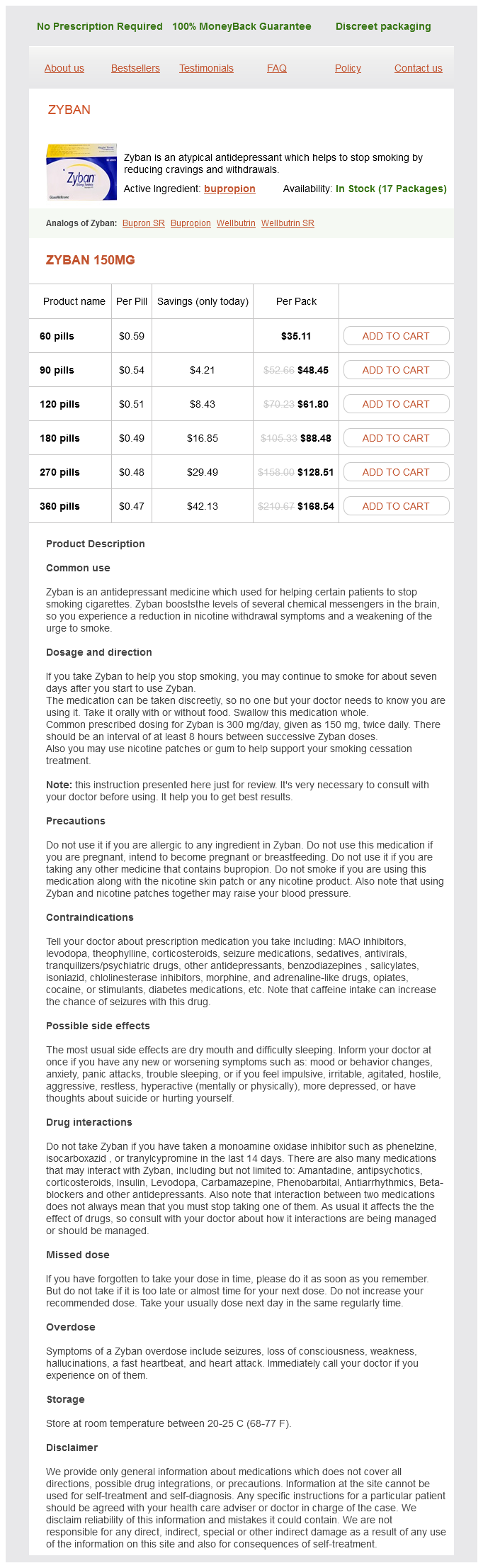
Zyban
Zyban 150mg
- 60 pills - $35.11
- 90 pills - $48.45
- 120 pills - $61.80
- 180 pills - $88.48
- 270 pills - $128.51
- 360 pills - $168.54
Zyban dosages: 150 mg
Zyban packs: 60 pills, 90 pills, 120 pills, 180 pills, 270 pills, 360 pills
In stock: 535
Only $0,5 per item
Description
Although that is usually insignificant in patients with regular baseline potassium levels mood disorder online test zyban 150 mg buy otc, it can be lifethreatening in sufferers with preexisting hyperkalemia depression test during pregnancy buy zyban 150 mg without a prescription. The improve in potassium in patients with burn injury depression testimony discount zyban 150 mg line, large trauma depression symptoms dogs 150 mg zyban buy amex, neurological problems, and various other different conditions (Table 11�5) can be large and catastrophic. Hyperkalemic cardiac arrest can show to be fairly refractory to routine cardiopulmonary resuscitation, requiring calcium, insulin, glucose, bicarbonate, and even cardiopulmonary bypass to help the circulation while lowering serum potassium ranges. Intragastric Pressure Elevation Abdominal wall muscle fasciculations improve intragastric pressure, which is offset by a rise in decrease esophageal sphincter tone. Intraocular Pressure Elevation Extraocular muscle differs from different striated muscle in that it has multiple motor end-plates on each cell. Prolonged membrane depolarization and contraction of extraocular muscular tissues following administration of succinylcholine transiently increase intraocular strain and theoretically could compromise an injured eye. Masseter Muscle Rigidity Succinylcholine transiently will increase muscle tone in the masseter muscular tissues. Some problem could initially be encountered in opening the mouth due to incomplete leisure of the jaw. A marked improve in tone stopping laryngoscopy is irregular and can be a premonitory signal of malignant hyperthermia. Malignant Hyperthermia Succinylcholine is a potent triggering agent in patients vulnerable to malignant hyperthermia, a hypermetabolic disorder of skeletal muscle (see Chapter 52). Generalized Contractions Patients afflicted with myotonia may develop myoclonus after administration of succinylcholine. These extrajunctional receptors enable succinylcholine to effect widespread depolarization and in depth potassium launch. The threat of hyperkalemia often seems to peak in 7�10 days following the injury, but the precise time of onset and the duration of the risk period range. The danger of hyperkalemia from succinylcholine is minimal within the first 2 days after spinal cord or burn harm. The relationship between fasciculations and postoperative myalgias is also inconsistent. The myalgias are theorized to be due to the initial unsynchronized contraction of muscle teams; myoglobinemia and increases in serum creatine kinase can be detected following administration of succinylcholine. Prolonged Paralysis As discussed above, sufferers with reduced levels of normal pseudocholinesterase may have a longer than regular period of action, whereas patients with atypical pseudocholinesterase will expertise markedly prolonged paralysis. Intracranial Pressure Succinylcholine could result in an activation of the electroencephalogram and slight will increase in cerebral blood move and intracranial pressure in some patients. Muscle fasciculations stimulate muscle stretch receptors, which subsequently improve cerebral activity. The increase in intracranial pressure can be attenuated by maintaining good airway control and instituting hyperventilation. It may also be prevented by pretreating with a nondepolarizing muscle relaxant and administering intravenous lidocaine (1. Histamine Release Slight histamine launch could additionally be noticed following succinylcholine in some patients. Based on their chemical structure, they are often categorized as benzylisoquinolinium, steroidal, or different compounds. It is often mentioned that alternative of a selected drug depends on its unique traits, which are often associated to its structure; nonetheless, for many patients, the variations among the intermediate-acting neuromuscular blockers are inconsequential. In common, steroidal compounds could be vagolytic, however this property is most notable with pancuronium and clinically unimportant with vecuronium or rocuronium. Because of structural similarities, an allergic history to one muscle relaxant strongly suggests the potential for allergic reactions to other muscle relaxants, particularly these in the same chemical class. For neuromuscular blockers, one typically specifies the dose that produces 95% twitch despair in 50% of people. Although a larger intubating dose speeds onset, it exacerbates side effects and prolongs the period of blockade. The consequence of a long length of action is the ensuing issue in completely reversing the blockade and a subsequent elevated incidence of postoperative pulmonary problems. As a common rule, the stronger the nondepolarizing muscle relaxant, the slower its pace of onset; the "explanatory dogma" is that higher efficiency necessitates a smaller dose, with fewer whole drug molecules, which in flip, decreases the rate of drug binding alternatives at the neuromuscular junction. The introduction of short- and intermediateacting brokers has resulted in the greater use of priming doses. Theoretically, giving 10% to 15% of the standard intubating dose 5 min earlier than induction will occupy sufficient receptors in order that paralysis will rapidly follow when the stability of relaxant is run. Use of a priming dose can produce circumstances suitable for intubation as soon as 60 sec following administration of rocuronium or ninety sec following administration of different intermediate-acting nondepolarizers. In some patients, nonetheless, the priming dose produces distressing dyspnea, diplopia, or dysphagia; in such situations, the affected person ought to be reassured, and induction of anesthesia should proceed without delay. Priming can moreover trigger measureable deterioration in respiratory operate (eg, decreased pressured important capacity) and should result in oxygen desaturation in patients with marginal pulmonary reserve. Suitability for Preventing Fasciculations To stop fasciculations and myalgias, 10% to 15% of a nondepolarizer intubating dose may be administered 5 min earlier than succinylcholine. When administered solely shortly earlier than succinylcholine, myalgias, but not fasciculations, might be inhibited. Although most nondepolarizers have been efficiently used for this function, tubocurarine and rocuronium have been most popular (precurarization); tubocurarine is now not out there within the United States. Maintenance Relaxation Following intubation, muscle paralysis might have to be maintained to facilitate surgery, (eg, abdominal operations), to allow a lowered depth of anesthesia, or to management ventilation. Monitoring neuromuscular operate with a nerve stimulator helps to forestall over- and underdosing and to cut back the probability of significant residual muscle paralysis within the recovery room. Maintenance doses, whether by intermittent boluses or steady infusion (Table 11�7), ought to be guided by the nerve stimulator and scientific signs (eg, spontaneous respiratory efforts or movement). In some situations, medical indicators may precede twitch recovery due to differing sensitivities to muscle relaxants between muscle teams or technical issues with the nerve stimulator. Some return of neuromuscular transmission ought to be evident prior to administering each upkeep dose, if the patient needs to resume spontaneous air flow on the end of the anesthetic. When an infusion is used for upkeep, the speed ought to be adjusted at or simply above the speed that enables some return of neuromuscular transmission so that drug effects may be monitored. Potentiation by Inhalational Anesthetics Volatile agents lower nondepolarizer dosage necessities by a minimal of 15%. Potentiation by Other Nondepolarizers Some combos of nondepolarizers produce a larger than additive (synergistic) neuromuscular blockade. The lack of synergism (ie, the medication are only additive) by intently associated compounds (eg, vecuronium and pancuronium) lends credence to the speculation that synergism results from barely differing mechanisms of motion. Autonomic Side Effects In scientific doses, the nondepolarizers differ in their relative effects on nicotinic and muscarinic cholinergic receptors. Some older brokers (tubocurarine and, to a lesser extent, metocurine) blocked autonomic ganglia, decreasing the power of the sympathetic nervous system to enhance heart contractility and fee in response to hypotension and different intraoperative stresses. In distinction, pancuronium (and gallamine) block vagal muscarinic receptors in the sinoatrial node, resulting in tachycardia. All newer nondepolarizing relaxants, together with atracurium, cisatracurium, vecuronium, and rocuronium, are devoid of significant autonomic effects in their really helpful dosage ranges. Histamine Release Histamine release from mast cells can lead to bronchospasm, skin flushing, and hypotension from peripheral vasodilation. Both atracurium and mivacurium are capable of triggering histamine launch, notably at greater doses. Slow injection charges and H1 and H2 antihistamine pretreatment ameliorate these side effects. Hepatic Clearance Only pancuronium and vecuronium are metabolized to any significant degree by the liver. Clinically, liver failure prolongs pancuronium and rocuronium blockade, with much less effect on vecuronium, and no effect on pipecuronium. Renal Excretion 9 Doxacurium, pancuronium, vecuronium, and pipecuronium are partially excreted by the kidneys, and their motion is extended in patients with renal failure. The elimination of atracurium, cisatracurium, mivacurium, and rocuronium is impartial of kidney function. Obese Hepatic illness General Pharmacological Characteristics Some variables affect all nondepolarizing muscle relaxants. Temperature Hypothermia prolongs blockade by decreasing metabolism (eg, mivacurium, atracurium, and cisatracurium) and delaying excretion (eg, pancuronium and vecuronium).
Tofu (Soy). Zyban.
- Treating diabetes type 2.
- Reducing muscle soreness caused by exercise.
- Heart disease.
- What is Soy?
- Are there any interactions with medications?
- High cholesterol.
- Are there safety concerns?
- Reducing protein in the urine of people with kidney disease.
- Preventing thyroid cancer, endometrial cancer, lung cancer, prostate cancer, improving memory, reducing breast pain, weight loss, asthma, high blood pressure, premenstrual syndrome (PMS), and other conditions.
- Is Soy effective?
Source: http://www.rxlist.com/script/main/art.asp?articlekey=96936
Congenital hypothyroidism depression definition and description buy discount zyban 150 mg online, spiky hair anxiety in teens 150 mg zyban trusted, choanal atresia anxiety treatment center discount zyban 150 mg line, cleft palate mood disorder in children symptoms effective 150 mg zyban, bifid epiglottis. Ichthyosis vulgaris, distinctive facial look (sparse lateral eyebrows, prominent/full cheeks), high-arched palate, scoliosis, pectus anomalies, pes planus. Autosomal dominant with imprinting (phenotype is expressed when mutation is maternally inherited). Spondyloepiphyseal dysplasia, multiple lentigines, progressive immunodeficiency, immune-complex nephritis. Over half of individuals have findings including microcephaly, eye anomalies (microphthalmia, optic atrophy, cataracts, nystagmus, strabismus), dental anomalies, spasticity, seizures, mental incapacity. Craniosynostosis, prognathia, broad, medially deviated first toes with brief first metatarsal, calcaneocuboid fusion, abnormally formed tarsals. Short limb skeletal dysplasia (undermineralized bones, metaphyseal enlargement, quick bowed lengthy bones, sclerosis of base of skull and irregular ossification of calvaria), midface prominence, micrognathia, enlarged joints, ligamentous laxity. Distinctive craniofacial appearance (abnormal hair whorl/frontal upsweep or scalp defects, upslanting palpebral fissures, nasal alae aplasia/hypoplasia, nasolacrimal duct fistulae, oligodontia), development restriction, mental disability, exocrine pancreatic insufficiency, hypothyroidism, hearing loss, imperforate anus, genitourinary/renal anomalies. Neurologic dysfunction, including intellectual disability, respiratory dysregulation, and seizures, cerebellar hypoplasia resulting in neuroradiologic "molar tooth sign. Hyalinized fibrous tissue growth, especially subcutaneous areas of scalp, face, ears, neck, hands, toes, variable systemic/visceral involvement, gingival hypertrophy, joint contractures, osteopenia, osteoporosis. Intellectual incapacity, growth deficiency, distinctive facial look (arched/broad eyebrows, long palpebral fissures, decrease lateral eyelid eversion, short columella with depressed nasal tip, distinguished earlobes), persistent fetal fingertip pads. Can also embody cardiovascular, genitourinary, and gastrointestinal anomalies, cleft lip/palate. Distinctive craniofacial appearance (brachycephaly, extensive eyebrows, telecanthus), higher central incisor macrodontia, quick stature, skeletal anomalies, cryptorchidism, mental incapacity. Hypoparathyroidism, progress failure, distinctive facial appearance (deep-set eyes, massive earlobes, depressed nasal bridge, beaked nose, lengthy philtrum, thin vermilion border, micrognathia), osteosclerosis, recurrent bacterial infections, mental incapacity. Sanjad-Sakati syndrome is allelic (but has not been reported as together with osteosclerosis or recurrent infections). Abnormal cartilage calcification, peripheral pulmonary stenosis, midface hypoplasia. Brachycephaly, distinctive facial look (coarse features, midface hypoplasia, hypertelorism, synophrys, upslanting palpebral fissures, tented lip, prognathia, ear dysplasia), natal enamel, brachydactyly, hypopigmentation, mental disability and behavioral disturbances. Tall stature with long limbs and low upper-to-lower section ratio, gynecoid habitus, gynecomastia, hypogonadism, reduced fertility, learning disabilities. Cervical vertebral segmentation anomaly with fused vertebrae; scientific triad includes short neck, low posterior hairline, restricted neck movement. Short stature, brief limbs, enlarged and stiff joints, finger contractures, skeletal anomalies (kyphoscoliosis, platyspondyly, bell-shaped chest, lengthy bone dysplasia), talipes equinovarus, distinctive facial look (round face, midface hypoplasia, hypertelorism, outstanding eyes, cleft palate), myopia. Absence or irregular lacrimal puncta, duct, or glands; cup-shaped ears; mixed listening to loss; absent, abnormally-shaped, late erupting, and enamel-deficient tooth; absent or short radius; absent, hypoplastic, triphalangeal, or duplicated thumbs. Distinctive facial appearance (prominent brow, hypertelorism, flat midface, cleft palate), brief stature, scoliosis/kyphosis, joint dislocations, spatula-shaped digits, hearing impairment. Laryngeal atresia, anterior encephalocele, limb anomalies (flexion deformities, syndactyly, camptodactyly, radial, tibial, and different skeletal aplasia/hypoplasia), variable further anomalies. Lateral meningocele, distinctive facial appearance (high arched eyebrows, hypertelorism, telecanthus, downslanting palpebral fissures, ptosis, midface hypoplasia, lowset, posteriorly-angulated ears, high-arched palate, micrognathia), dental crowding, cryptorchidism, skeletal anomalies (including scoliosis, Wormian bones, pectus excavatum, vertebral scalloping), brief stature, joint hypermobility, hernias, conductive hearing loss, Chiari I malformation, hypotonia, variable developmental delay. Intellectual incapacity, short stature, brachydactyly, outstanding forehead, hyperostosis, elbow and knee contractures, cutis laxa, progressive osteosclerosis. Short stature, microcephaly, microphthalmia, malformed ears, cleft lip/ palate, dental anomalies, slim shoulders, urogenital anomalies, scoliosis, duplication of thumbs or different digital anomalies, mental disability. Spasticity, choreoathetosis, seizures, self-mutilation, uric acid stones, mental disability. Severe, neonatally deadly arthrogryposis, with congenital nonprogressive joint contractures involving upper and/or lower limbs and vertebral column; some varieties may embody further findings. Females might have faulty follicular development and ovulation, amenorrhea, infertility. Exencephaly/encephalocele, anterior body wall defects, limb anomalies, variable facial clefts. Microcephaly, neuronal migration defect (frontal pachygyria in males, subcortical band heterotopia in females), hypoplastic genitalia, hypotonia, seizures, spasticity, intellectual incapacity. Microcephaly, lissencephaly, agenesis of corpus callosum, skinny cerebral cortex, abnormal genitalia, chronic diarrhea, intractable seizures, mental incapacity. Lissencephaly, involving a quantity of subtypes as nicely as a spread of severity, from full agyria to subcortical band heterotopia; may co-occur with different neuroanatomic anomalies and contains intellectual disability. Arterial tortuosity and aneurysms, hypertelorism, bifid uvula or cleft palate; may embody craniosynostosis, further cardiac anomalies, arachnodactyly, scoliosis, talipes equinovarus, thin pores and skin with simple bruising/striae. Short stature, cataracts, renal tubular dysfunction, hypotonia, areflexia, intellectual incapacity. Growth in higher centiles, Marfanoid skeletal habitus, distinctive facial appearance (including long face, distinguished forehead, excessive nasal bridge, high-arched palate, low-set, posteriorly angulated ears), pectus excavatum, long arms and ft, thin digits, behavioral abnormalities, mental disability. Lymphedema of limbs, double rows of eyelashes; may embody ptosis, cleft palate, cardiac anomalies, spinal extradural cysts. Chronic lymphedema, typically with congenital or early pediatric onset, due to underlying lymphatic anomalies, variable dermatologic involvement (nail dysplasia, papillomatosis). Features indicated by the acronym: Macrocephaly, Alopecia, Cutis laxa, Scoliosis; also entails distinctive facial appearance (progressively coarsening of options, gingival hypertrophy), variable extra options. Growth restriction, distinctive facial appearance (mandibular hypoplasia), dental anomalies, extensive cranial sutures, progressive osteolysis of distal phalanges and clavicles, pigmentary skin modifications, lipodystrophy (variable according to subtype), variable progeroid options, insulin resistance, diabetes mellitus. Ocular anomalies (eyelid colobomas, cryptophthalmos, anophthalmia/microphthalmia), hairline anomalies, bifid or broad nasal tip, gastrointestinal anomalies (omphalocele, anal stenosis). Joint contractures, camptodactyly, distinctive facial look (including "immobile facies," blepharophimosis, cleft palate), low muscle bulk, hindbrain malformations (Dandy-Walker malformation), mental disability. Tall stature, gaunt face, ectopia lentis, pectus abnormality, aortic root dilation or dissection, scoliosis, hypermobile joints, lengthy limbs, arachnodactyly. Distinctive facial appearance (prominent brow, shallow orbits, blue sclerae, flat nasal bridge, micrognathia), accelerated osseous maturation, mental disability. Pancreatic hypoplasia, intestinal atresia, gallbladder aplasia/hypoplasia, variable tracheoesophageal fistula. Features indicated by the acronym: Mental retardation, Aphasia, Shuffling gait, Adducted thumbs. Prenatal and postnatal development restriction, microcephaly, cardiac defects, mental incapacity. Anophthalmia or extreme microphthalmia, distinctive facial look described in some patients, multiple congenital anomalies together with pulmonary agenesis, diaphragmatic hernia, cardiac, and genitourinary anomalies. Polyostotic fibrous dysplasia, cafe-au-lait hyperpigmentation, peripheral precocious puberty, variable further endocrinologic anomalies (Cushing syndrome, pituitary gigantism, thyrotoxicosis). Polydactyly, genitourinary malformations (hydrometrocolpos in females, hypospadias, cryptorchidism, chordee in males), congenital cardiac anomalies. Ciliopathy, with broad clinical range of manifestations, together with cystic renal disease, central nervous system malformations (especially occipital encephalocele), hepatic anomalies (portal fibrosis, ductal proliferation), polydactyly (typically postaxial), variable additional anomalies. Severe intrauterine and postnatal growth restriction, microcephaly, microtia, patellar aplasia/ hypoplasia. Prenatal or early lethality in males; growth restriction, distinctive facial look (asymmetry, proptosis, full cheeks, micrognathia), thorax hypoplasia, scoliosis, long digits with gentle distal phalangeal hypoplasia, limb bowing, joint subluxation, sensorineural and conductive hearing loss, hydronephrosis. Growth deficiency, full cheeks, sparse hair and eyebrows, twisted or damaged hair shafts, lax and hypopigmented pores and skin, seborrheic dermatitis, tortuous arteries, metaphyseal abnormalities, hypothermia, hypertonicity, seizures, lethargy, extreme mental disability. Symmetric shortening of upper and lower limbs, with brief ulnae, bowed radii, dumbbell-shaped distal humerus, progressive interphalangeal flexion contractures, carpal and tarsal synostoses, feet fixed in plantar flexion, outstanding ventral facet of distal fibula, aplasia or hypoplasia of calcaneus, small fibula and talus, fibulocalcaneal synostosis. Short limbs, narrow chest, prominent joints with limited mobility, kyphoscoliosis, sacral appendage, skeletal adjustments (small epiphyses and extensive metaphyses of long bones, small diamond formed vertebral bodies, platyspondyly). Microcephaly, intrauterine development restriction, severe proportionate short stature, skeletal anomalies (brachymesophalangy, brachymetacarpy, high and narrow pelvis, V-shaped flare of distal femoral metaphyses, triangular form of distal femoral epiphyses, proximal femoral epiphysiolysis, coxa vara) variable mental incapacity. Microphthalmia can happen as an isolated discovering or co-occur with different ophthalmologic anomalies, (such as coloboma, cataract); may also occur in the context of many syndromes with multiorgan manifestations. Females with quick stature, eye anomalies (microphthalmia, corneal opacification, glaucoma, cataracts, orbital cysts, retinal dysplasia or detachment), mind malformations (corpus callosum, dysgenesis, absent septum pellucidum, cystic cerebellar lesions, ventriculomegaly), linear areas of dermal aplasia of the face, neck and higher torso. Short stature, microcephaly, distinctive facial look (facial asymmetry, medial flare to eyebrows, exotropia, ptosis, small palpebral fissures, thick alae nasi, midface hypoplasia, open mouth, thick alveolar ridges, high-arched palate, malocclusion), pectus excavatum, scoliosis, lengthy hands, arch fingerprints, rocker-bottom toes with vertical talus, spasticity, mental disability. Distinctive facial look (eyelid coloboma, cleft lip/palate, extreme micrognathia), posterior limb aplasia/hypoplasia, supernumerary nipples.
Specifications/Details
Some melanocytes are seen in the superficial epithelium mood disorder dsm v code cheap zyban 150 mg on line, singly and in nests (arrows) depression quotes pinterest zyban 150 mg buy cheap line. The minimally pigmented melanocytic proliferation (arrows) entails a lot of the epithelial thickness bipolar depression nac cheap zyban 150 mg free shipping. Higher magnification reveals epithelioid melanocytes (arrows) throughout the epithelium anxiety 1st trimester zyban 150 mg purchase online. Melanomas are often nodular growths with vascularity which will contain any portion of the conjunctiva. Conjunctival melanomas metastasize to regional lymph nodes in 25% of sufferers, in addition to to the lungs, liver, brain, bone, and skin. Histologic features related to a worse prognosis embrace nonbulbar conjunctival location (ie, plica semilunaris/caruncle, forniceal or palpebral conjunctiva, palpebral conjunctiva) and greater tumor thickness. Occasionally, extrascleral extension of an anterior uveal melanoma presents as an episcleral/conjunctival mass. A complete eye examination, including gonioscopy and dilated ophthalmoscopy, ought to all the time be carried out in any affected person with a conjunctival mass. Conjunctival melanoma and melanosis: a reappraisal of terminology, classification and staging. Primary acquired melanosis of the conjunctiva: dangers for development to melanoma in 311 eyes. This indicates that the characteristically localized to the forniceal and the lesion is deep to the conjunctiva. Evaluation of conjunctival lymphoid lesions is restricted by the size of the biopsy specimen. Thus, communication with the pathologist concerning suggestions for optimal specimen submission is crucial. When the submitted tissue is sufficient for additional research, flow cytometry and molecular genetic research can be carried out (see Chapters three and 4). Of all ocular adnexal lymphomas, conjunctival lymphoma has one of the best prognosis, as approximately 80% of conjunctival lymphomas are localized to the conjunctiva and not associated with systemic illness. Conjunctival lymphoid tumors: scientific analysis of 117 instances and relationship to systemic lymphoma. Clinical appearance ("salmon patch") in the inferior fornix (A) and in the bulbar conjunctiva (B). C, Histologic examination of benign lymphoid hyperplasia, showing regular follicular architecture, with a well-defined germinal center (G) and corona (C). D, Histologic examination of lymphoma reveals a sheet of lymphocytes infiltrating the stroma, with out well-defined follicles. It typically arises within the caruncle, but it might often be located elsewhere on the conjunctiva. Histologically, the lesion is composed of a cystadenomatous proliferation of columnar epithelium with plentiful, intensely eosinophilic cytoplasm (reflecting the presence of numer ous mitochondria) and granular eosinophilic material in the lumen. Other Neoplasms Virtually any neoplasm that may happen in the orbit and eyelid skin can happen, though much less frequently, within the conjunctiva, including sebaceous, neural, muscular, vascular, and fibrocytic tumors. H&E-stained preparation demonstrates a diffuse proliferation of small lymphocytes with mildly irregular nuclear contours, inconspicuous nucleoli, and scant cytoplasm. B, Histology exhibits cystadenomatous proliferation of columnar epithelial cells, with deeply eosinophilic cytoplasm. The corneal epithelium is nonkeratinized stratified squamous epithelium with out goblet cells; it ranges from 5 to 7 cell layers in thickness. It consists of collagen-producing keratocytes (corneal stromal fibrocytes), collagenous lamellae, and proteoglycan ground substance. The composed of epithelium (Ep), Bowman layer (B), stroma (S), Descemet membrane (D), and posteriormost stroma forms a skinny, acellular layer that endothelium (En). The cells appear mostly hexagonal en clefts are absent, corneal edema or fibrosis is face, corresponding to on confocal microscopy. In a histologic suspected (the former if the cornea is thick, cross part of the cornea, the endothelial cells have a and the latter if thin). The keratocyte dialogue of the embryology, construction, and physiology nuclei (arrow) are obvious. This condition is often bilateral and sporadic, however autosomal dominant and recessive modes of inheritance have additionally been reported. In this anomaly, a localized defect, often recognized as inside ulcer of von Hippel, seems within the central or paracentral portion of Descemet membrane; at the edges of the defect, iris strands are sometimes adherent to the posterior corneal floor. In the most severe type of Peters anomaly, the lens also adheres to the posterior corneal floor. The anterior chamber angle may be malformed, predisposing patients to congenital glaucoma. Inflammations Infectious Keratitis Infectious processes brought on by a selection of microbial brokers could have an effect on the cornea. Bacterial infections Corneal infections attributable to bacterial agents usually comply with a disruption in the corneal epithelial integrity resulting from contact lens put on, trauma, alteration in immunologic defenses (eg, use of topical or systemic immunosuppressive agents), antecedent corneal disease (eg, dry eye disease, publicity keratopathy), ocular medi cati on toxicity, or contamination of ocular medicines. Bacterial organisms commonly involved in corneal infections embrace Pseudomonas aeruginosa, Staphylococcus aureus, Streptococcus pneumoniae, and Enterobacteriaceae. B, Gross photograph of a more severe type of Peters anomaly demonstrates attachment of a cataractous lens to the opacified cornea (adherent leukoma). Note the accompanying peripheral flattening of the corneal curvature and opacification (cornea plana and sclerocornea, respectively). The iris and anterior chamber angle constructions are Scrapings from infected corneas show collections of neutrophils admixed with necrotic particles. A culture is useful for correct identification of particular organisms and for evaluation of antibiotic sensitivities. Corneal scrapings obtained from a dendrite and ready using Giemsa or hematoxylin-eosin stain reveal intranuclear viral inclusions. C, Low-magnification photomicrograph demonstrates inner ulcer of von Hippel (arrow) with attached iris strands (double arrowhead). Incomplete cleavage of the anterior chamber angle structures (fetal angle deformity) can be present (single arrowhead). The central cornea is fibrotic and demonstrates absence of posterior stroma and Descemet membrane (arrow). A fibrotic iris strand (double arrowhead) is attached to the edge of the corneal defect. Unlike most bacteria, fungi are in a place to penetrate the cornea and lengthen via Descemet membrane into the anterior chamber. The commonest organisms are the septated, filamentous fungi Aspergillus and Fusarium and the yeast Candida; Mucor (nonseptated, filamentous) is much less common. Cultures, particularly on Sabouraud agar, are helpful for accurate identification of specific organisms and for assessment of antifungal sensitivities. B, H&E stain demonstrates acute necrotizing ulcerative keratitis, with numerous neutrophils infiltrating corneal stromal lamellae and necrotic cellular debris. D, Keratoplasty specimen (different patient) exhibiting a scar from healed keratitis. Note lack of Bowman layer (between arrowheads) and stromal thinning with fibrosis (arrow) and compensatory epithelial thickening. Patients presenting with Acanthamoeba keratitis normally have extreme eye pain attributable to radial keratoneuritis. Special tradition strategies and media, together with nonnutrient blood agar layered with Escherichia coli, are required to grow Acanthamoeba. In later phases of illness, the organisms penetrate into deeper layers of the stroma and may be difficult to isolate from a superficial scraping. The commonest etiologic microorganism is viridans (-hemolytic) streptococci, however different organisms have been reported, together with micro organism, mycobacteria, and fungi. In many circumstances, the prognosis is missed clinically and is made histologically after failure of a corneal graft. Histologically, colonies of organisms are current within the interlamellar areas of the stroma. Clinical images depicting dendritic (A) and stromal (disciform) (B) keratitis. C, Histology of corneal button exhibits stromal keratitis with lack of Bowman layer (asterisk), stromal scarring and vascularization (arrowhead), and scattered chronic inflammatory cells (arrows).
Syndromes
- Urinary tract infections
- Special needs your child may have after birth
- Electrocardiogram (ECG)
- Illness
- Changes in menstrual bleeding
- Congestive heart failure
- How many times each day are you urinating?
Related Products
Additional information:
Usage: gtt.
Tags: generic zyban 150 mg on line, zyban 150 mg quality, zyban 150 mg order, zyban 150 mg with visa, discount zyban 150 mg on line, order zyban 150 mg amex, 150 mg zyban proven, zyban 150 mg safe, buy zyban 150 mg overnight delivery, generic zyban 150 mg mastercard, 150 mg zyban cheap free shipping, order 150 mg zyban overnight delivery, 150 mg zyban cheap with visa, 150 mg zyban cheap amex, 150 mg zyban discount mastercard, zyban 150 mg cheap with mastercard
8 of 10
Votes: 264 votes
Total customer reviews: 264
Customer Reviews
Tjalf, 22 years: Compare the thickness of the anterior capsule (left) with that of the posterior capsule (right). Hepatic uptake of bilirubin from the circulation is passive, but binding to intracellular proteins traps the bilirubin inside hepatocytes. Strickberger S, Conti J, Daoud E, et al: Patient selection for cardiac resynchronization therapy: from the Council of Clinical Cardiology Subcommittee on Electrocardiography and Arrhythmias and the Quality of Care and Outcomes Research Interdisciplinary Working Group in Collaboration with the Heart Rhythm Society.
Yorik, 24 years: For instance, the onset of action of subcutaneous common insulin is lower than 1 h, however in rare sufferers its period of action could proceed for 6 h. The probe may be turned in the esophagus from left to right to look at each left and right sided constructions (A). In some facilities, a superior vena cava to the primary pulmonary artery (bidirectional Glenn) shunt may be employed before or as an alternative of a Fontan procedure.