
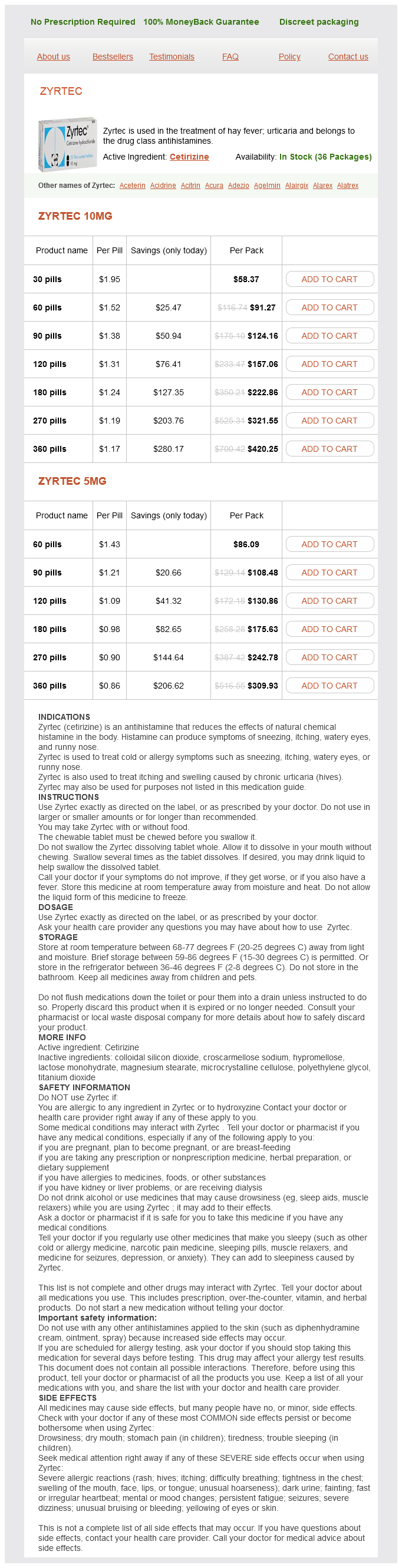
Zyrtec
Zyrtec 10mg
- 30 pills - $58.37
- 60 pills - $91.27
- 90 pills - $124.16
- 120 pills - $157.06
- 180 pills - $222.86
- 270 pills - $321.55
- 360 pills - $420.25
Zyrtec 5mg
- 60 pills - $86.09
- 90 pills - $108.48
- 120 pills - $130.86
- 180 pills - $175.63
- 270 pills - $242.78
- 360 pills - $309.93
Zyrtec dosages: 10 mg, 5 mg
Zyrtec packs: 30 pills, 60 pills, 90 pills, 120 pills, 180 pills, 270 pills, 360 pills
In stock: 964
Only $0,91 per item
Description
An strategy that directly enters the tumor largely defeats the purpose of utilizing the endoscope allergy shots when sick buy zyrtec 5 mg overnight delivery. In addition to clear visualization of the lesion allergy forecast euless tx zyrtec 10 mg discount without a prescription, the pathway made should permit for treatment of secondary hydrocephalus allergy medicine over the counter non drowsy buy 5 mg zyrtec with mastercard. The optimum trajectory allows attainment of those goals whereas avoiding eloquent buildings allergy symptoms 10 discount zyrtec 10 mg overnight delivery. Neuronavigation is useful for planning the course and confirming right location of the entry into the ventricle. For resection of tumors in the lateral ventricle, correct orientation ought to first be attained after the ventricle is entered. An ideal trajectory into the ventricle entails leaving space between the entry level and the lesion (approach trajectory A) quite than entry directly into the lesion (approach trajectory B). In the event of hemorrhage, hemostasis is first attempted with irrigation immediately concentrating on the bleeding vessel, which, with persistence, is profitable within the majority of cases. Once resection is full and hemostasis achieved, the endoscope is eliminated, throughout which period the tract created is inspected for intraparenchymal bleeding. For resection of colloid cysts, which usually originate from the roof of the third ventricle, the surgeon first identifies the foramen of Monro and surrounding buildings, together with the fornix, choroid plexus, thalamostriate veins, and anterior nucleus of the thalamus. If extra working room is important to entry the lesion, the choroid plexus can be coagulated. This maneuver normally provides enough further working room, but if needed, the thalamostriate vein could be sacrificed as properly. Once the lesion can be accessed, its floor is coagulated, and resection proceeds as described previously for lateral ventricular tumors. However, when the cyst wall is removed from the roof of the third ventricle, excessive pressure must be prevented: excess traction on the roof of the third ventricle may cause daunting hemorrhage from the internal cerebral veins. Therefore, a flexible neuroendoscope could additionally be preferable as a result of each procedures can be carried out from a single bur gap. As famous beforehand, in transcranial approaches to the pineal area, together with supracerebellar infratentorial and occipital transtentorial approaches, the endoscope is advantageous for inspecting the third ventricle and the vein of Galen for residual tumor. A ultimate use of the endoscope in intraventricular cases is in treating underlying hydrocephalus, which can be conveniently carried out at the same time as other endoscopic interventions. This can be completed by endoscopic third ventriculostomy, septum pellucidotomy, or different procedures. For many intraventricular lesions, the endoscope is the only device wanted in management, undertaking inspection, remedy of hydrocephalus, and either biopsy or resection of the lesion. Further advances will increase the effectiveness and safety of neuroendoscopy, and its indications will proceed to expand. For example, with improved instrumentation, complete resection of extra complex intraventricular tumors might be potential. Similarly, indications for endonasal approaches will increase with more versatile devices and improved strategies in repairing the skull base. As neurosurgery continues to evolve in such a way to improve patient outcomes and cut back morbidity, neurosurgeons probably will discover more uses for this device. Two bur holes are generally needed to attain the pineal area tumor (A) and perform third ventriculostomy (B) with a inflexible endoscope. Keyhole Concept in Neurosurgery with Endoscope-Assisted Microsurgery: 25 Case Studies. Endoscopic and minimally invasive microsurgical approaches for treating mind tumor sufferers. Endoscope-assisted microsurgical resection of epidermoid tumors of the cerebellopontine angle. Subtemporal keyhole strategy to the suprasellar and petroclival region: microanatomic considerations and clinical application. Endoscopic endonasal transsphenoidal surgical procedure: surgical results of 228 pituitary adenomas handled in a pituitary center. Endoscopic, endonasal prolonged transsphenoidal, transplanum transtuberculum strategy for resection of suprasellar lesions. The endoscopic endonasal approach for the administration of craniopharyngiomas: a sequence of 103 patients. Endonasal versus supraorbital keyhole elimination of craniopharyngiomas and tuberculum sellae meningiomas. Postoperative improvement in visible function in sufferers with tuberculum sellae meningiomas: outcomes of the prolonged transsphenoidal and transcranial approaches. Beyond the nasoseptal flap: outcomes and pearls with secondary flaps in endoscopic endonasal cranium base reconstruction. The posterior pedicle inferior turbinate flap: a model new vascularized flap for skull base reconstruction. Endoscopic cranium base reconstruction of huge dural defects: a systematic evaluate of published evidence. Early diffuse leptomeningeal primitive neuroectodermal tumors can escape detection by magnetic resonance imaging. Tate and Hugues Duffau Recent information from multiple series have clearly demonstrated the importance of extent of resection for improved outcomes in each low- and high-grade gliomas. In this mild, a meta-analysis analyzing outcomes in more than 8000 sufferers undergoing surgical procedure for glioma with or without intraoperative stimulation-based mapping demonstrated that direct electrical mapping not only decreased late severe neurological deficits, even in so-called functional areas, but also elevated extent of resection. Among the totally different intraoperative mapping strategies obtainable, direct cortical and subcortical mapping under awake condition offers a quantity of advantages over asleep mapping: (1) for many of the more commonly tested neural capabilities, similar to visuospatial awareness, language, and sensation, mapping by definition must be performed within the awake state; (2) stimulation underneath awake situations requires a decrease present amplitude relative to asleep mapping, which decreases the risk for intraoperative seizures and improves spatial constancy; (3) for mapping of motor function, along with the aforementioned improved spatial localization, awake mapping permits testing of volitional features of movement. Cortical and subcortical awake mapping strategies are then detailed, with an emphasis on current advances in white matter connectivity and its significance in intrinsic tumor surgical procedure. Next, the emergence of the concept of neural plasticity within the grownup human brain, significantly on the cortical level, is mentioned in the context of resection of traditionally designated eloquent brain regions in addition to the elevated extent of resection afforded at repeat surgical procedure. Finally, we talk about the useful outcomes afforded by awake intraoperative mapping in glioma surgical procedure. Such a philosophy allows the neurosurgical oncology staff to optimize the quality of life for a person patient whereas advancing our understanding of the fundamental properties governing organization and function of the human mind. Thus a affected person with profound cognitive deficits and diffuse illness burden could additionally be greatest served by administration of chemotherapy before surgery to both enhance neurological efficiency and to higher outline a surgical goal before resection. Also, a detailed information of preoperative dysfunction permits the neurosurgeon to properly counsel patients as to anticipated short-term deficits after surgery and to plan an efficient postoperative rehabilitation strategy. Also, the time lag between neuronal firing and diverted blood circulate may forestall decision of transiently activated but functionally necessary mind regions. During a selected task, adjustments within the magnitude of alpha, beta, and gamma band cerebral oscillations can be detected, with larger and decrease frequencies representing synchronization and resynchronization, respectively. In addition, a 30-gauge needle is used to administer native anesthetic to the dura along the middle meningeal artery. Stimulation is performed by applying a bipolar electrode to the cortical surface for 2 seconds. A starting present of 1 mA (peak to peak) is applied to the first motor cortex (typically face motor cortex or hand knob), and the present elevated in intervals of 0. Following mapping of the first motor space, sensory mapping could additionally be performed inside the postcentral gyrus at the similar present depth, with patients typically reporting dysesthesias. Respecting the positive motor and sensory websites, cortical home windows are opened to present adequate entry to the intrinsic tumor beneath the floor. Similarly, throughout resection of retrocentral gliomas, subcortical stimulation permits identification of the thalamocortical somatosensory pathways, which elicits dysesthesias in awake patients. Before dural closure, a ultimate stimulation at the cortical floor with preserved muscle exercise distally confirms for the neurosurgeon that the complete motor circuit is undamaged. Thus, even within the presence of a model new postoperative motor deficit, the patient could be reassured that operate will return. Compilation of cortical stimulation knowledge (n = 771 stimulation sites) in the proper and left hemisphere of low-grade glioma sufferers undergoing surgical procedure with awake cortical mapping demonstrating the distribution of cortical representation for critical features of the human mind: motor (green), sensory (yellow), anarthria/arrest (red), anomia (blue), dysarthria (orange), phonologic (pink), semantic (black). For these scenarios, the approach could be to carry out both asleep mapping (to delineate cortical and subcortical motor regions) or a more conservative resection based mostly on anatomic imaging and available preoperative practical data. Finally, for the subset of patients with preoperative breakthrough seizures despite sufficient anticonvulsant trials, electrocorticography can be utilized to information resection of seizure foci in addition to the deliberate tumor resection. Such electrocorticography-guided glioma resections are notably effective in decreasing long-term seizure profiles in kids.
Canadian Horseweed (Canadian Fleabane). Zyrtec.
- Are there safety concerns?
- How does Canadian Fleabane work?
- Dosing considerations for Canadian Fleabane.
- Bronchitis, diarrhea, dysentery, worms, fever, inflammation, swelling, bleeding from the uterus, sore throat, urinary tract infections (UTIs), and tumors.
- What is Canadian Fleabane?
Source: http://www.rxlist.com/script/main/art.asp?articlekey=96267
Cancer surveillance series [corrected]: brain and different central nervous system cancers: current tendencies in incidence and mortality allergy testing renton wa order zyrtec 5 mg. Increased mortality from brain tumors: a mixed end result of diagnostic know-how and change of perspective towards the elderly lidocaine allergy zyrtec 10 mg purchase overnight delivery. The incidence price and mortality of malignant mind tumors after 10 years of intensive cellular phone use in Taiwan allergy x amarillo zyrtec 5 mg purchase without prescription. Temporal trends in incidence of major mind tumors within the United States quinoa allergy treatment zyrtec 5 mg discount free shipping, 1985-1999. Prognostic implications of p53 protein, epidermal development issue receptor, and Ki-67 labelling in mind tumours. The glial and mesenchymal elements of gliosarcomas share comparable genetic alterations. Gliosarcoma metastatic to the cervical spinal cord: case report and evaluation of the literature. Prognostic implications of the extent of surgical resection in sufferers with intracranial malignant gliomas. Cerebral gliosarcomas: correlation of computed tomographic findings, surgical facet, pathological options, and prognosis. Extraneural metastases in gliosarcoma: a case report and evaluation of the literature. Cerebral gliosarcoma, pulmonary adenoidcystic carcinoma, and pulmonary metastatic gliosarcoma: report of an untreated case. October 1998-61 year old male with mind tumor and oral, lung, and palpebral masses. Gliosarcoma with a quantity of extracranial metastases: case report and evaluate of the literature. Gliosarcoma with intramedullary spinal metastases: a case report and review of the literature. Multiple spinal metastases of cranial gliosarcoma: a case report and review of the literature. Gliosarcoma with areas of primitive neuroepithelial differentiation and extracranial metastasis. The endothelial hyperplasia of the cerebral blood vessels with brain tumors, and its sarcomatous transformation. Gliosarcoma with osteosarcomatous differentiation: review of radiological and pathological options. Rapid migration of grafted cortical astrocytes from suspension grafts positioned in host thoracic spinal cord. C6 glioma cell invasion and migration of rat brain after neural homografting: ultrastructure. C6 glioma-astrocytoma cell and fetal astrocyte migration into artificial basement membrane: a permissive substrate for neural tumors but not fetal astrocytes. Human malignant astrocytoma xenografts migrate in rat mind: a model for central nervous system most cancers research. The in vitro motility of human gliomas will increase with rising grade of malignancy. Effect of epidermal progress factor on membrane motility and cell locomotion in cultures of human clonal glioma cells. Effect of epidermal progress issue on glioma cell growth, migration, and invasion in vitro. The spread of glioblastoma multiforme as a figuring out issue within the radiation handled volume. Isolation and characterization of human malignant glioma cells from histologically regular brain. Recurrence and malignant degeneration after resection of grownup hemispheric low-grade gliomas. Prognostic significance of contrast-enhancing low-grade gliomas in adults and a review of the literature. Extent of surgical resection is independently related to survival in sufferers with hemispheric infiltrating low-grade gliomas. Regional heterogeneity in the proliferative exercise of human gliomas as measured by the Ki-67 labeling index. Cell proliferation patterns in the analysis of astrocytomas, anaplastic astrocytomas and glioblastoma multiforme: a Ki-67 examine. The use of the monoclonal antibody Ki-67 in the identification of proliferating cells: utility to surgical neuropathology. Determination of the proliferative potential of human mind tumors using the monoclonal antibody Ki-67. Human cerebrospinal fluid regulates proliferation and migration of stem cells by way of insulinlike growth factor�1. Transcriptional differences between regular and glioma-derived glial progenitor cells establish a core set of dysregulated genes. Marked genomic differences characterize primary and secondary glioblastoma subtypes and establish two distinct molecular and scientific secondary glioblastoma entities. Incidence and timing of p53 mutations during astrocytoma progression in sufferers with a number of biopsies. Epidermal progress factor receptor activation in glioblastoma through novel missense mutations within the extracellular domain. Platelet-derived development factor�B enhances glioma angiogenesis by stimulating vascular endothelial development issue expression in tumor endothelia and by selling pericyte recruitment. Generation of neurons and astrocytes from isolated cells of the adult mammalian central nervous system. Glial progenitors in grownup white matter are driven to form malignant gliomas by plateletderived progress factor-expressing retroviruses. Stem cell-like glioma cells promote tumor angiogenesis by way of vascular endothelial progress factor. The development of contiguous sarcomatous and gliomatous tissue in intracranial tumours. Prognostic value positron emission tomography with [18F]fluoro-2-deoxy-d-glucose within the low-grade glioma. Practice parameter: Anticonvulsant prophylaxis in sufferers with newly recognized brain tumors. Long-term seizure outcomes in adult sufferers present process main resection of malignant mind astrocytomas. Persistent outpatient hyperglycemia is independently associated with survival, recurrence and malignant degeneration following surgery for hemispheric low grade gliomas. Persistent outpatient hyperglycemia is independently related to decreased survival after primary resection of malignant brain astrocytomas. Management of venous thromboembolism in patients with major and metastatic brain tumors. Efficacy of mechanical prophylaxis for venous thromboembolism in patients with mind tumors. Complications of therapy for venous thromboembolic disease in patients with brain tumors. Methylphenidate therapy improves cognition, temper, and performance of mind tumor patients. Depression in patients with high-grade glioma: results of the Glioma Outcomes Project. An extent of resection threshold for recurrent glioblastoma and its danger for neurological morbidity. Extent of resection in patients with glioblastoma: limiting factors, notion of resectability, and effect on survival. Patterns of recurrence of glioblastoma multiforme after external irradiation followed by implant boost. Volumetric extent of resection and residual contrast enhancement on preliminary surgery as predictors of consequence in grownup sufferers with hemispheric anaplastic astrocytoma. The relationship between survival and the extent of the resection in patients with supratentorial malignant gliomas. A prospective study of quality of life in adults with newly diagnosed high-grade gliomas: the impact of the extent of resection on high quality of life and survival. Phase I trial of carmustine plus O6-benzylguanine for sufferers with recurrent or progressive malignant glioma.
Specifications/Details
Practice patterns of in-hospital surgical therapy of trigeminal neuralgia from 1980 to 2010 allergy forecast fort worth texas 5 mg zyrtec cheap with mastercard. The long-term outcome predictors of pure microvascular decompression for main trigeminal neuralgia allergy testing gainesville fl cheap zyrtec 5 mg fast delivery. Recovery of nerve conduction following microvascular decompression for trigeminal neuralgia allergy medicine while pregnant second trimester zyrtec 10 mg generic amex. Operative findings and outcomes of microvascular decompression for trigeminal neuralgia in 35 patients affected by a quantity of sclerosis allergy medicine expired buy 10 mg zyrtec free shipping. Predictors of end result in surgically managed patients with typical and atypical trigeminal neuralgia: comparison of results following microvascular decompression. Clinical features and surgical remedy of trigeminal neuralgia caused solely by venous compression. Micro-vascular decompression for main trigeminal neuralgia (typical or atypical). Long time period effectiveness on ache: prospective examine with survival evaluation in a consecutive sequence of 362 patients. Repeat posterior fossa exploration for sufferers with persistent or recurrent idiopathic trigeminal neuralgia. Comparison of surgical therapies for trigeminal neuralgia: re-evaluation of radiofrequency rhizotomy. Percutaneous stereotactic radiofrequency lesioning for trigeminal neuralgia: dedication of minimum clinically necessary distinction in ache enchancment for patient-reported outcomes. Microvascular decompression for classic trigeminal neuralgia: willpower of minimum clinically important difference in pain improvement for patientreported outcomes. Microvascular decompression versus percutaneous procedures for typical trigeminal neuralgia: private expertise. Patient reports of satisfaction after microvascular decompression and partial sensory rhizotomy for trigeminal neuralgia. Results from the usage of glycerol injection, microvascular decompression, and rhizotomia. Comparison of percutaneous trigeminal ganglion compression and microvascular decompression for the administration of trigeminal neuralgia. Fifteen years of Gamma Knife surgery for trigeminal neuralgia within the Journal of Neurosurgery: history of a revolution in useful neurosurgery. Microvascular decompression for trigeminal neuralgia in sufferers with a number of sclerosis. Percutaneous retrogasserian glycerol rhizotomy for patients with idiopathic trigeminal neuralgia: a potential evaluation of factors associated to ache reduction. Arthroscopic partial meniscectomy versus sham surgery for a degenerative meniscal tear. Safety and efficacy in deep brain stimulation for refractory cluster headache: a randomized, placebo-controlled, double-blind trial followed by an open extension. Gamma Knife surgical procedure for recurrent or residual trigeminal neuralgia after a failed initial process. Effectiveness of repeat glycerol rhizotomy in treating recurrent trigeminal neuralgia. The plaques of demyelination that occur lead to hyperexcitability of uncovered and probably injured afferents, which ends up in afterdischarges large enough to cause a nonnociceptive sign being perceived as pain. There can also be genetic and/or myelin biologic predispositions, provided that rare reviews of genetic and familial associations do exist. Hemminki and colleagues constructed a nationwide neurological database from the Swedish multigenerational register on 0- to 69-year-old siblings that was linked to the hospital discharge register for the 15-year period 1987 to 2001. In nearly all of circumstances the pain begins in the second or third divisions of the trigeminal nerve (V2 and V3, respectively). Typically, the ache could be triggered by light touch on any space innervated by the trigeminal nerve, together with such things as wind, chewing, talking, washing the face, applying or removing makeup, shaving, or cleaning the enamel. The frequency of paroxysms is very variable, starting from hundreds of assaults a day to lengthy intervals of remission that may final years. Pictogram describing the standard time onset, decision, and severity early in the center of the syndrome (A) and later within the course as the pain frequency and severity improve (B). The pain is characteristically sudden in onset and resolution without pain between episodes and lasts only seconds to a couple of minutes. With chronicity, a continuing persisting background uninteresting, aching, or burning pain might develop (C), but this component is usually minor in comparability to the attribute episodes from the patient perspective. These bursts may cluster with either complete (A) or partial (B) resolution between spikes. If current, it overwhelmingly manifests as first unilateral involvement, to be later adopted by contralateral involvement. Simultaneous onset of bilateral involvement ought to trigger work-up for a broader orofacial ache differential prognosis. There is growing proof that typical trigeminal neuralgia by which sufferers are ache free between episodes can evolve into atypical trigeminal neuralgia with chronicity of the syndrome. Typical trigeminal neuralgia sufferers who develop trigeminal numbness from surgical interventions can develop fixed background neuropathic pain as a end result of deafferentation. May result from prior maxillofacial trauma, particularly if it includes facial fractures. Anesthesia dolorosa (pain in an area of complete sensory anesthesia) is its most severe type, which is usually refractory to successful remedy. Trigeminal sensory examination is often regular or demonstrates hyperpathia to stimulation. Consider postherpetic neuralgia in patients with pores and skin, lip, or oral mucosa vesicles or ulcers, or a history of prior skin, lip, or oral mucosa vesicles or ulcers in the region of the pain. Consider temporal arteritis in anyone with isolated V1 division ache, especially if pain and tenderness over the ipsilateral superficial temporal artery and/or ipsilateral visual complaints are current. Consider trigeminal perineural spread of malignancy in sufferers with: � parotid, submandibular, or lacrimal gland asymmetry or masses � painless oral mucosal ulcers or plenty � skin lesions suspicious for malignancy in the trigeminal dermatome � head and neck adenopathy � a historical past of cutaneous facial, oral, nasopharyngeal, salivary, or lacrimal gland most cancers surgical procedure or removal � a history of a mole or other benign pores and skin lesion elimination within the dermatomal distribution of the trigeminal pain Consider trigeminal nerve tumor or other brainstem lesion involving the trigeminal system. Consider an orbital apex or parasellar lesion in sufferers with ipsilateral visible acuity reduction, relative afferent papillary defect, fundus abnormality, and/or visible subject defect together with their trigeminal ache. The frequency of this allele varies worldwide and is highest in some Asian populations. A full blood rely; measurements of electrolytes, liver enzymes, and vitamin D ranges; and other tests of bone metabolism. May be useful in patients with multiple sclerosis, in whom its antispasticity results can be harnessed. Evidence weak; structurally much like carbamazepine, although probably higher tolerated. These patients are sometimes taking baclofen already, and may obtain control of symptoms with out having to add carbamazepine. For carbamazepine, maximum tolerable doses are often 800 to 1200 mg/day, however aged sufferers might attain tolerance limits at even lower doses. This ought to ideally be carried out well before the nonsurgical members of the team feel that a patient really wants surgery. It is neither fair to the patient nor probably greatest apply to have the patient be seen by the surgeon solely when medical therapy has failed. Under these circumstances, the patient is usually in very severe pain to the purpose of desperation and will likely conform to something offered to help. The time to learn about surgical choices, their relative professionals and cons, and the providers available to deliver these options is within the "cool of the second" when patients are neither desperate from pain nor relatively incapacitated by excessive doses of medicines. Patients can also have their very own ideas about optimal timing for their lives for transferring on to a surgical therapy as quickly as they understand the prognosis, the procedures, and their relative success rates. Contingency plans for surgical procedure are finest made properly upfront, just as one would do for a trust fund or a will. These plans can then be applied with confidence once the suitable agreed-on trigger point is reached. If the median life expectancy for a given patient is longer than 20 years (currently age <63. Surgical intervention should in all probability be thought of earlier than situations develop with age which may make common anesthesia or surgical intervention excessively risky. In kids the brain continues to be developing, and the consequences of these drugs at these doses are potentially rather more severe than in adults. Getting them off these drugs and ache free, permitting them to study, compete, develop professionally, socialize, and gain personal self-confidence is crucial. Differential analysis of trigeminal neuralgia: look-a-like ailments and atypical trigeminal neuralgia.
Syndromes
- Physical assault
- Comprehensive metabolic panel
- The medicine should not be used for longer than 5 years.
- Sclera
- Examine the arteries of the heart
- Rheumatic fever
- Relationship problems due to impotence
Related Products
Additional information:
Usage: t.i.d.
Tags: order zyrtec 5 mg on line, order zyrtec 5 mg mastercard, zyrtec 5 mg cheap with amex, zyrtec 5 mg fast delivery, 10 mg zyrtec discount amex, zyrtec 5 mg order free shipping, buy cheap zyrtec 10 mg online, zyrtec 10 mg buy discount online, generic 5 mg zyrtec free shipping, zyrtec 10 mg discount online, zyrtec 5 mg purchase with amex, purchase zyrtec 5 mg without prescription, zyrtec 10 mg buy generic on-line, zyrtec 5 mg without a prescription, purchase zyrtec 5 mg with visa, discount 10 mg zyrtec with amex
9 of 10
Votes: 145 votes
Total customer reviews: 145
Customer Reviews
Sanuyem, 35 years: If after the resection bleeding is insignificant, we use the Avitene-thrombin mixture immediately after cotton ball removal. Cancer cells frequently activate telomerase to preserve telomere length and escape apoptosis.
Konrad, 23 years: Spinal ependymomas in neurofibromatosis type 2: a retrospective analysis of fifty five patients. Incision of the tentorium just lateral to the straight sinus could be accomplished extra safely with exact information of the infratentorial venous sample.
Oelk, 26 years: E, A right-sided combined pterional-orbitozygomatic craniotomy was used to expose the tumor. Interest has now begun to shift to less invasive, endoscopically assisted surgical intervention with adjuvant radiosurgery or stereotactic radiotherapy.
Milok, 60 years: Human trigeminal root evoked potentials during differential retrogasserian thermal and chemical rhizotomy. The in vitro motility of human gliomas will increase with rising grade of malignancy.
Gnar, 62 years: Magnification (2�) of the fluoroscopic image may be required to visualize the foramen clearly. Leptomeningeal carcinomatosis in non-small-cell lung cancer sufferers: influence on survival and correlated prognostic components.
Grimboll, 24 years: A, Patients with bigger preoperative tumor volumes have significantly shorter progression-free survival instances (Cox proportional hazards model based on log transformation of preoperative tumor quantity, P <. Gonadotroph adenoma of the pituitary gland: a clinicopathologic analysis of a hundred instances.